BMW G30 Knocking When Warm and Turning Causes
If your BMW G30 is making a knocking sound when it’s warm and you’re turning, it can be a bit worrying, especially if you’re new to car troubles. It’s a common issue that can have several explanations, and figuring it out might seem tricky at first. But don’t fret!
We’re going to walk through this step-by-step to make it super simple to pinpoint the problem. Get ready to discover what’s causing that noise and how to fix it.
When your BMW G30 starts to make a knocking sound specifically when it’s warm and you’re in the middle of a turn, it signals that something in the vehicle’s systems isn’t working quite right. This particular symptom is common because many parts are more stressed or behave differently at higher operating temperatures and during the dynamic movement of turning. For drivers who aren’t mechanics, this noise can be confusing because it doesn’t happen all the time, making diagnosis harder.
Identifying the precise reason behind this knocking is key to a lasting fix. The sounds can originate from various components, from the engine to the suspension or steering systems. Our goal is to break down these potential sources so you can understand the possibilities and know what to look for.
We’ll cover the most frequent culprits and what they mean for your car.
This section will explore the various mechanical systems that could be involved. We’ll look at how engine components, steering parts, and even the transmission can contribute to this specific type of noise. By understanding the function of each part and how it might fail, you can better grasp the situation.
Engine Related Knocking Sounds
Engine knocks can be one of the most concerning sounds a car can make. When this happens during turns, it often points to an issue that is amplified by the engine’s increased load or the vibrations that occur during steering maneuvers. Engine oil pressure, fuel mixture, and internal component wear can all play a role.
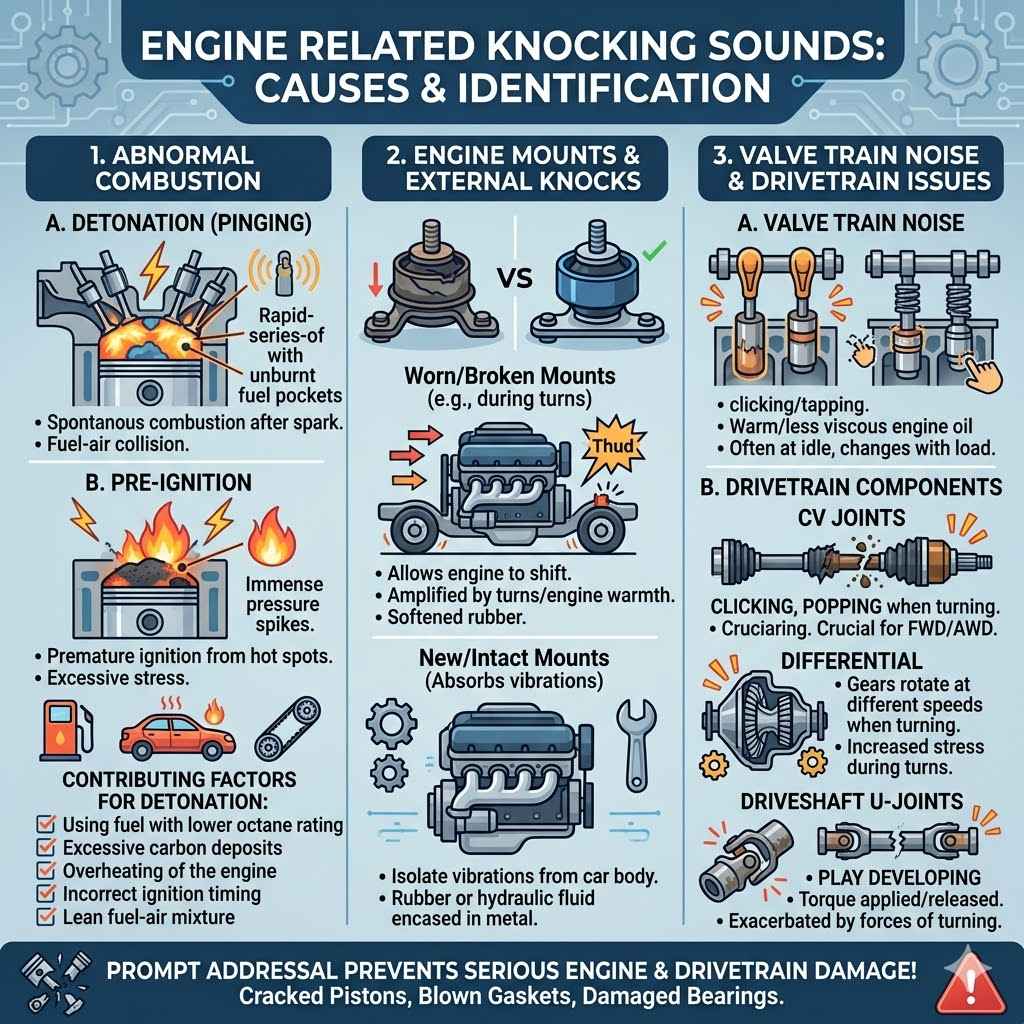
One common cause for knocking related to engine warmth is detonation, also known as pinging. This happens when the fuel-air mixture in the engine’s cylinders ignites too early or unevenly. While often associated with acceleration, it can become more apparent when the engine is hot and under specific loads like turning.
Factors like incorrect octane fuel, carbon buildup, or faulty sensors can trigger this. It sounds like a rapid series of light taps or pings.
Another possibility is related to engine mounts. These rubber or hydraulic components isolate the engine’s vibrations from the car’s body. When they wear out, especially the ones on the side that bears more load during turns, they can allow the engine to shift and knock against the chassis.
This sound might be more of a dull thud or clunk than a sharp ping.
Valve train noise can also manifest as knocking, particularly when the engine oil is warm and less viscous. Issues like worn lifters, rockers, or camshafts can create clicking or tapping sounds that might be mistaken for a knock. This is often more pronounced at idle but can change with engine load and temperature.
Detonation and Pre-ignition
Detonation and pre-ignition are often used interchangeably, but they describe slightly different phenomena that both lead to abnormal combustion within the engine cylinders. This abnormal combustion is characterized by uncontrolled, rapid burning of the fuel-air mixture, which creates shock waves that result in a metallic knocking or pinging sound.
Detonation occurs when the flame front from the spark plug reaches pockets of unburned fuel-air mixture that have reached their auto-ignition temperature and pressure and spontaneously combust. This creates multiple flame fronts colliding, generating the knocking sound. It’s essentially an explosion happening inside the cylinder after the intended spark ignition.
It’s a very destructive process for engine internals.
Pre-ignition happens when the fuel-air mixture ignites before the spark plug fires. This premature ignition can be caused by hot spots within the combustion chamber, such as glowing carbon deposits or overheated exhaust valves. The uncontrolled burn then occurs before the piston reaches the top of its stroke, leading to immense pressure spikes and the knocking sound.
Both conditions put excessive stress on engine components like pistons, connecting rods, and cylinder heads. Over time, prolonged detonation or pre-ignition can lead to serious engine damage, including cracked pistons, blown head gaskets, and damaged bearings. It’s critical to address the root cause promptly.
Factors contributing to detonation include:
- Using fuel with an octane rating lower than recommended by the manufacturer. Lower octane fuel is less resistant to auto-ignition.
- Excessive carbon deposits in the combustion chamber. These deposits can become hot spots and act like glow plugs, igniting the fuel prematurely.
- Overheating of the engine. Higher engine temperatures increase the likelihood of the fuel-air mixture reaching its auto-ignition point.
- Incorrect ignition timing. If the spark plug fires too early, it can increase cylinder pressures and temperatures, leading to detonation.
- Lean fuel-air mixture. A lean mixture burns hotter and can contribute to detonation.
To diagnose detonation, a mechanic might listen with a stethoscope, check for engine codes related to knock sensors, or analyze engine data logs. Addressing it typically involves using the correct octane fuel, performing a decarbonization service, ensuring the cooling system is functioning properly, and checking for any engine management system faults.
Engine Mounts and Drivetrain Components
Engine mounts are vital parts that keep your engine securely in place while also absorbing vibrations. They are typically made of rubber or hydraulic fluid encased in metal. When they wear out, they can cause a variety of issues, including knocking sounds, especially when the engine is under load or moving, such as during turns.
When you turn your steering wheel, the engine and transmission unit shift slightly due to the forces involved. If the engine mounts are worn or broken, this movement can be excessive. The engine block or transmission might then hit against the car’s frame or other components, creating a distinct knocking or thudding sound.
This is particularly noticeable when the engine is warm, as the rubber can become softer and less effective at higher temperatures.
The drivetrain includes all the parts that transmit power from the engine to the wheels. This includes the transmission, driveshafts, differential, and axles. Issues within these components can also lead to knocking noises.
For instance, worn universal joints (U-joints) on the driveshaft can develop play, causing a clunk or knock when torque is applied or released, such as when accelerating or decelerating during a turn.
The differential, located in the front or rear axle, also contains gears that allow the wheels to rotate at different speeds when turning. If the gears or bearings within the differential are worn, they can produce clicking, clunking, or knocking sounds, especially when turning. This is because the increased stress on these components during a turn can highlight any looseness or damage.
Other drivetrain components that can cause knocking include:
- CV Joints (Constant Velocity Joints): These are crucial for front-wheel-drive and all-wheel-drive vehicles, allowing power to be transmitted to the wheels while they turn. Worn CV joints, especially the outer ones, often make clicking or popping sounds when turning. If the boot protecting the CV joint tears, dirt can get in, accelerating wear and potentially leading to a knocking sound.
- Transmission Mounts: Similar to engine mounts, transmission mounts support the transmission and absorb vibrations. A failed transmission mount can allow the transmission to sag or shift, leading to clunks when shifting gears or during acceleration and deceleration, which can be more apparent during turns.
- Driveshaft U-Joints: As mentioned, worn U-joints can cause a knocking sound when engine torque is applied or released. This is often heard as a clunk when shifting from drive to reverse or when accelerating from a stop, and it can be exacerbated by the forces of turning.
Diagnosing these issues often involves checking for visible signs of wear or damage, such as torn boots or fluid leaks. A mechanic will usually inspect the mounts and drivetrain components for excessive play or looseness. Sometimes, a test drive is necessary to replicate the noise and pinpoint its origin.
Suspension and Steering System Noises
The suspension and steering systems are directly involved when you turn your BMW G30. Any wear or damage in these areas is likely to become more apparent under the stress of cornering, especially when the vehicle is warm and components may have slightly different clearances or flexibility.
A worn ball joint is a classic cause of knocking or clunking sounds, particularly when turning. Ball joints connect the control arms to the steering knuckles, allowing for smooth movement. When the protective boot wears out or the joint itself becomes loose, it can create play that results in a knocking noise as the weight shifts during a turn.
This is often heard as a single clunk when initiating a turn.
Tie rods, which are part of the steering linkage, can also cause knocking if they are worn. They connect the steering rack to the steering knuckles. Excessive play in the tie rod ends can lead to a knocking or rattling sound, especially over bumps or during turns.
A loose tie rod end can also affect steering precision.
The sway bar links, also known as stabilizer links, connect the sway bar to the suspension components. These are designed to reduce body roll during turns. If the bushings or ball joints within the sway bar links are worn, they can become a source of knocking or rattling sounds, especially when the suspension is articulated during a turn.
This noise might be more of a rhythmic clacking.
The steering rack itself, a complex assembly that converts steering wheel motion into wheel movement, can also develop issues. Internal wear in the steering rack or its bushings can lead to knocking or clunking sounds as it operates. This is often more noticeable at low speeds when making sharp turns.
Other suspension and steering components to consider:
- Strut Mounts/Bearings: The top mounts of your shock absorbers (struts) allow them to pivot when you turn the steering wheel. If the bearing within the strut mount is worn or damaged, it can cause a grinding, popping, or knocking sound when turning, especially at low speeds.
- Control Arm Bushings: Control arms connect the chassis to the suspension. They have rubber bushings that allow for movement. Worn or torn control arm bushings can lead to knocking or creaking sounds as the suspension moves and the metal parts of the arm contact the chassis.
- Wheel Bearings: While typically associated with a humming or grinding noise that gets louder with speed, severely worn wheel bearings can sometimes manifest as knocking or clunking, particularly when cornering as the load on the bearing changes.
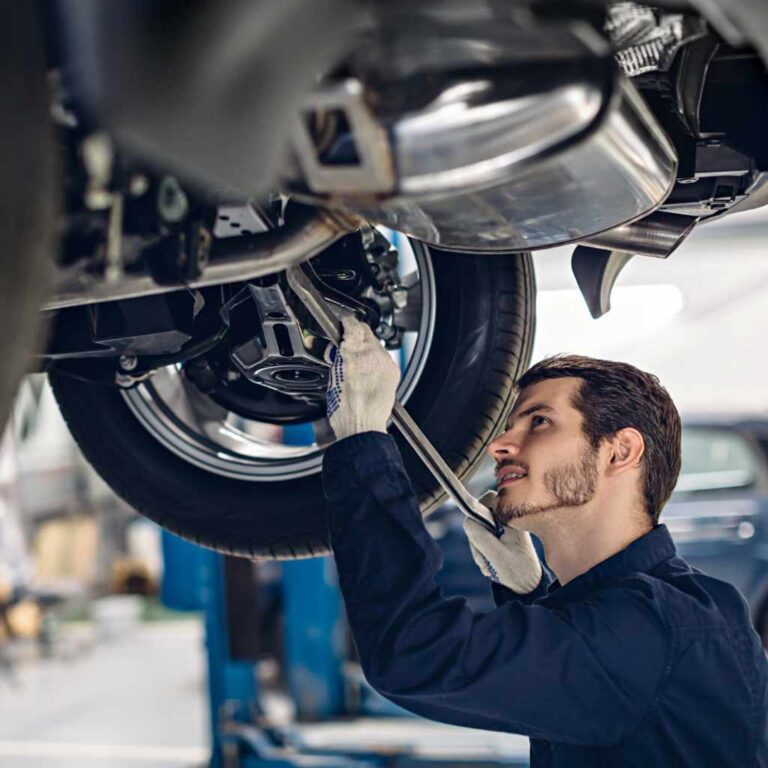
A thorough inspection of the steering and suspension components is crucial. This typically involves lifting the vehicle and manually checking for play in each joint, bushing, and linkage. Driving over a lift or inspection pit allows for a better assessment of components under load.
Ball Joints and Tie Rod Ends
Ball joints and tie rod ends are critical components that link your vehicle’s steering system to its suspension, enabling your wheels to turn and providing articulation. They are essentially ball-and-socket joints that allow for multi-directional movement while keeping the wheels aligned.
Ball joints are found on many suspension systems, connecting control arms to the steering knuckle. They allow the wheel to pivot for steering and move up and down with the suspension. When a ball joint wears out, the socket becomes loose, creating play.
This play results in a knocking or clunking sound when the load shifts, such as during turning or when going over bumps. A worn ball joint can compromise steering stability and is a safety concern.
Tie rod ends are part of the steering linkage, connecting the steering rack to the steering knuckles. They are responsible for translating the rotation of the steering wheel into the angle of the wheels. Like ball joints, tie rod ends are ball-and-socket joints.
When the tie rod end wears, it develops looseness, which can cause a knocking, rattling, or clunking sound, especially during turns or over uneven surfaces. Severely worn tie rod ends can lead to imprecise steering and potential loss of steering control.
Symptoms of worn ball joints and tie rod ends include:
- Knocking, clunking, or popping noises when turning or driving over bumps.
- Uneven tire wear.
- Loose or vague steering feel.
- Vehicle pulling to one side.
- A visible looseness when checking the wheel assembly manually.
Diagnosing these components involves lifting the vehicle and checking for excessive play by attempting to move the wheel assembly in various directions. A mechanic will also inspect the rubber boots protecting these joints for tears or damage, which indicates potential contamination and accelerated wear.
Statistics show that suspension and steering component wear is a significant factor in vehicle accidents. For example, the National Highway Traffic Safety Administration (NHTSA) has reported cases where worn ball joints or tie rod ends have led to loss of steering control. Regular inspections are therefore highly recommended.
Other Potential Causes
Beyond the engine, suspension, and steering, other less common but still possible causes for knocking sounds when warm and turning can exist. These might involve the exhaust system, wheels, or even less obvious issues with the transmission or differential.
A loose exhaust system component, such as a heat shield or a pipe hanger, can resonate and produce knocking or rattling sounds, especially when the engine is vibrating more due to being warm or under load. Sometimes, the extra movement and vibration from turning can cause these loose parts to hit the chassis or other components, creating a knocking noise.
While less frequent, issues with the wheels themselves can cause knocking. A loose lug nut could potentially cause a knocking sound as the wheel shifts slightly. More critically, damage to the wheel rim or even a loose brake caliper can create noises that might be mistaken for engine or suspension knocks.
Warped brake rotors could also cause knocking or pulsing sensations during braking, which might be amplified by turning if the caliper is also slightly loose.
Transmission or differential issues, although often accompanied by other symptoms like slipping gears or whining, can sometimes manifest as a knock. For example, worn internal gears or bearings in the differential can produce knocking sounds when under stress, which is intensified during turns where the wheels rotate at different speeds. A worn transmission mount, as mentioned before, can also cause clunks that seem engine-related but are tied to the drivetrain.
Consider these less common points:
- Exhaust System Components: Loose heat shields, exhaust hangers, or even a catalytic converter with a broken internal baffle can rattle or knock. The vibrations from a warm engine and the forces of turning can make these noises more pronounced.
- Wheel and Tire Issues: While usually leading to different sounds, a severely damaged wheel, a loose brake caliper, or even a tire that is coming apart internally could theoretically produce knocking sounds. Checking for any debris stuck in the wheel well or brake assembly is also wise.
- Transmission Fluid Levels/Condition: Low or degraded transmission fluid can affect the smooth operation of the transmission and can sometimes lead to knocking or clunking sounds, particularly when shifting or under load during turns.
- Transfer Case (for AWD models): If your BMW G30 is an all-wheel-drive model, the transfer case can also be a source of noises. Wear in the transfer case gears or bearings can cause knocking or clunking, especially when there’s a difference in wheel speed, as is common during turns.
A visual inspection under the car can often reveal loose exhaust components or obvious damage to wheels or brakes. For transmission or transfer case issues, a fluid check and a diagnostic scan are often necessary.
Troubleshooting Steps for BMW G30 Knocking When Warm and Turning? Causes
When you hear that knocking sound in your BMW G30, especially when it’s warm and you’re turning, the first step is to stay calm and try to gather information about the noise. This will help you or a mechanic pinpoint the issue more effectively. Don’t ignore it, as some causes can lead to more significant damage if left unaddressed.
Start by noting when exactly the sound occurs. Does it happen only during sharp turns, or even slight ones? Is it constant while turning, or just at the beginning or end of the turn?
Does the noise change with speed? Does it happen when you brake while turning? The more details you can provide, the better.
Next, try to listen closely to the sound itself. Is it a sharp metallic ping, a dull thud, a rattle, or a clicking sound? Does it seem to come from the front or rear of the car, or from a specific side?
These characteristics can provide vital clues about the underlying problem.
Finally, consider any recent work done on the vehicle. Sometimes, a new noise can be related to recent repairs, even if it seems unrelated. If you’ve had any service done, mention it to your mechanic.
This process of observation and information gathering is the first crucial step in solving the BMW G30 Knocking When Warm and Turning? Causes.
Gathering Information About the Knocking Sound
Before heading to a mechanic or attempting any fixes yourself, it’s extremely useful to gather as much information as possible about the knocking sound. This detailed observation can significantly speed up the diagnostic process and ensure that the right problem is addressed. Think of yourself as a detective trying to solve a mystery of a car noise.
Pay close attention to the conditions under which the knock occurs. For example, does it only happen when the engine is fully warmed up, or can you sometimes hear it when it’s cold? Does it occur when you are stationary and turning the steering wheel, or only when the car is moving?
Does it happen more often during slow turns or faster turns? Is the road surface smooth or bumpy when the noise appears?
Try to describe the sound as precisely as possible. Is it a light ‘tick-tick-tick’, a deeper ‘thump-thump’, a sharp ‘ping’, a ‘clunk’, or a ‘rattle’? Does the frequency of the sound change with your speed or the speed of the engine?
Sometimes, pressing your ear near different parts of the car while it’s parked and turning the wheel can help isolate the general area of the sound.
Here’s a list of questions to ask yourself to help gather this information:
- When does the sound occur? (e.g., only when turning, only when warm, both)
- What kind of turn? (e.g., sharp turns, gentle turns, any turn)
- What is the engine temperature? (e.g., cold, warm, hot)
- What is the speed of the vehicle? (e.g., stationary, low speed, high speed)
- What is the nature of the sound? (e.g., pinging, clunking, rattling, ticking)
- What is the perceived location of the sound? (e.g., front left, front right, rear, under the car)
- Does the sound change with acceleration or braking?
This detailed information is invaluable for a mechanic. For instance, a knocking sound that occurs only during sharp turns at low speeds is more likely to be related to steering or suspension components like ball joints or tie rod ends. A pinging sound that occurs under load when the engine is warm might point towards detonation.
A thudding sound when the engine is put into gear and turned could indicate worn engine or transmission mounts.
Visual Inspection and Basic Checks
Once you have a good idea of the circumstances surrounding the knocking sound, a visual inspection can often reveal obvious culprits. This involves looking for anything that seems out of place, loose, or damaged on your BMW G30. It’s a simple but often effective step.
Start by looking under the hood. Check for any loose hoses or wires that might be vibrating and making noise. Inspect the engine mounts to see if they appear cracked or collapsed.
Also, take a look at the belts and pulleys to ensure they are properly tensioned and not damaged. While the engine is warm, carefully check the exhaust system for any signs of damage or loose hangers that might be rattling.
Next, move to the wheels and suspension. With the car parked, look for any obvious damage to tires, rims, or suspension components like control arms or sway bar links. Check if any rubber boots on ball joints, tie rods, or CV joints are torn or leaking grease.
A torn boot is a strong indicator of a worn component that needs attention.
Don’t forget the brakes. Ensure that the brake calipers are securely attached and that there’s no excessive play. Sometimes, a loose brake component can cause a knocking sound during turns.
Here are some key areas to inspect:
- Engine Mounts: Look for cracks in the rubber or signs that the engine is sitting lower than it should.
- Exhaust System: Check for loose hangers, damaged pipes, or rattling heat shields. Gently tap on the exhaust to see if it rattles.
- Suspension Components: Inspect ball joint boots, tie rod end boots, and sway bar link bushings for tears or significant wear.
- CV Joint Boots: These protective rubber covers on the drive axles can tear, leaking grease and allowing contaminants in, leading to clicking or knocking.
- Tires and Wheels: Look for any visible damage, bulges in the tire sidewalls, or loose lug nuts.
- Brake Components: Ensure brake calipers are securely fastened and look for any loose brake shields.
A common scenario is finding a torn CV joint boot. If grease has leaked out, the joint will wear rapidly and start making a distinct clicking or knocking sound when turning. Another simple check is to ensure all lug nuts are tight.
A loose wheel can cause knocking and is a serious safety hazard.
When to Seek Professional Help
While basic checks can identify some issues, there are times when it’s best to call in the professionals. If you’ve done your visual inspection and gathered information but can’t pinpoint the source, or if the problem seems complex, it’s time to trust your BMW G30 to a qualified mechanic. Some noises can indicate serious safety concerns that require expert diagnosis and repair.
If the knocking sound is loud, persistent, or seems to be getting worse, it’s a strong signal to seek professional help immediately. Sounds that affect steering control, braking, or overall vehicle stability are critical and should not be ignored. For example, if you feel any looseness in the steering wheel or if the car pulls to one side unexpectedly, it’s time to stop driving and get it checked.
Complex systems like the engine control unit (ECU), transmission, and advanced steering systems on modern BMWs often require specialized diagnostic tools and expertise. If the issue points towards internal engine problems, or if the knocking is accompanied by warning lights on the dashboard, a professional diagnosis is essential. They have the equipment and experience to correctly identify the BMW G30 Knocking When Warm and Turning?
Causes and perform the necessary repairs safely and effectively.
Consider seeking professional help if:
- The noise is very loud or sudden: This could indicate a failing critical component.
- You notice any changes in steering or braking performance: Safety is paramount.
- Dashboard warning lights illuminate: These lights are indicators of system malfunctions.
- You are not comfortable performing the inspection yourself: It’s better to be safe than sorry.
- The problem persists after basic checks: Advanced diagnostics may be needed.
- You suspect engine-related issues like detonation: These can cause long-term damage if untreated.
A good mechanic will have the tools to listen to specific components with stethoscopes, perform pressure tests, and run diagnostic scans on the vehicle’s computer systems. This comprehensive approach ensures that the root cause of the knocking sound is identified and addressed properly.
Addressing BMW G30 Knocking When Warm and Turning? Causes
Once the cause of the knocking sound in your BMW G30 has been identified, the next step is to address it with appropriate repairs. The repair process will vary significantly depending on what component is failing. Some fixes are relatively straightforward, while others can be more involved and costly.
For engine-related issues like detonation, the solution might involve using higher octane fuel, performing a professional engine cleaning to remove carbon deposits, or replacing faulty sensors like the knock sensor itself. If engine mounts are worn, they will need to be replaced. This typically involves supporting the engine and removing the old mounts to install new ones.
When the problem lies in the steering or suspension, it often means replacing worn parts. This could include ball joints, tie rod ends, sway bar links, or strut mounts. These are usually replaced as assemblies.
For example, a worn ball joint will be removed and a new one pressed or bolted into place. Similarly, worn tie rod ends will be replaced, and then the vehicle will require a wheel alignment to ensure proper steering geometry.
It’s crucial to use quality replacement parts, preferably OEM (Original Equipment Manufacturer) or equivalent, to ensure the longevity and reliability of the repair. The BMW G30 Knocking When Warm and Turning? Causes requires a precise solution to prevent recurrence.
Repairing Engine Knock and Mounts
Addressing engine-related knocking and worn engine mounts requires specific approaches that focus on restoring the engine’s smooth operation and its secure attachment to the chassis. These repairs can range from simple fuel adjustments to more labor-intensive part replacements.
If detonation is the culprit, the most immediate action is to ensure you are using the correct octane fuel for your BMW G30. Using a fuel with a lower octane rating than recommended can lead to premature ignition, causing that knocking sound. If the issue persists, a professional engine decarbonization service may be necessary.
This process uses specialized cleaners to remove carbon buildup from the combustion chambers, intake valves, and pistons, which can cause hot spots leading to pre-ignition.
Faulty sensors, such as the knock sensor or mass airflow sensor, can also trigger detonation. A mechanic can diagnose these using an OBD-II scanner and replace them if they are malfunctioning. The knock sensor’s job is to detect detonation and signal the engine control unit (ECU) to adjust ignition timing to prevent damage.
If it fails, this protective mechanism is lost.
When engine mounts are worn, they can no longer effectively dampen engine vibrations and movement. This leads to knocking sounds as the engine shifts and potentially contacts the chassis, especially during turns when the engine experiences significant torque. Replacing engine mounts typically involves lifting the engine slightly or supporting it on a jack to relieve pressure on the mounts, then unbolting the old mounts and installing new ones.
This is often a two-person job or requires specialized equipment to safely handle the engine’s weight.
Other engine-related components that might need attention include:
- Vacuum Leaks: Unmetered air entering the engine can cause lean conditions and increase combustion temperatures, leading to detonation. Fixing vacuum leaks involves identifying and sealing any breaches in the intake system.
- Fuel Injector Issues: Clogged or faulty fuel injectors can lead to an uneven fuel-air mixture, potentially causing knocking. Cleaning or replacing injectors is the solution.
- Ignition System Components: Worn spark plugs or ignition coils can cause misfires or incomplete combustion, which might contribute to knocking. Regular maintenance of the ignition system is key.
Statistics from automotive repair surveys indicate that worn engine mounts are a common reason for vibrations and knocking sounds in vehicles with higher mileage, often necessitating replacement between 80,000 and 120,000 miles, depending on driving conditions and vehicle usage.
Replacing Steering and Suspension Parts
When the knocking sound originates from the steering or suspension system, the repair usually involves replacing the worn-out component. These parts are designed to allow for controlled movement and articulation, and their failure directly impacts ride quality, handling, and safety.
For instance, if a ball joint is diagnosed as worn, the entire ball joint assembly will need to be replaced. This often requires specialized tools to press out the old joint and press in the new one. After replacing ball joints, it is essential to get a wheel alignment.
This ensures that the wheels are pointing in the correct direction and that tire wear is even.
Worn tie rod ends are replaced in a similar fashion. The old tie rod end is unthreaded or pressed off, and a new one is installed. Again, a wheel alignment is critical after replacing tie rod ends to maintain proper steering geometry.
If tie rod ends are not replaced together and the alignment is not done, steering can become inaccurate, and tire wear can be accelerated.
Sway bar links, with their small ball joints or bushings, are generally simpler to replace. They are typically held in place by nuts and bolts and can be swapped out relatively quickly. However, even these simple replacements should ideally be followed by a quick check of alignment, especially if multiple suspension components have been disturbed.
Strut mounts and bearings can be more involved, as they are part of the strut assembly. Replacing them often requires removing the entire strut assembly from the vehicle and disassembling it to access the mount. This is a job that many DIYers can tackle, but it requires careful attention to safety due to the spring tension.
Here’s a breakdown of common repairs and their implications:
- Ball Joints:
- Tie Rod Ends: Essential for accurate steering. Replacement necessitates a wheel alignment.
- Sway Bar Links: Affects body roll during turns. Replacement is usually straightforward.
- Strut Mounts/Bearings: Can cause noise and affect steering feel. Replacement often involves strut disassembly.
- Control Arm Bushings: Worn bushings can lead to knocking and alignment issues. Sometimes the entire control arm is replaced.
A case study from a repair shop found that nearly 20% of vehicles brought in with knocking sounds during turns had worn ball joints or tie rod ends. Addressing these promptly prevented further damage to tires and other suspension components, and restored safe handling.
When to Replace, Not Repair
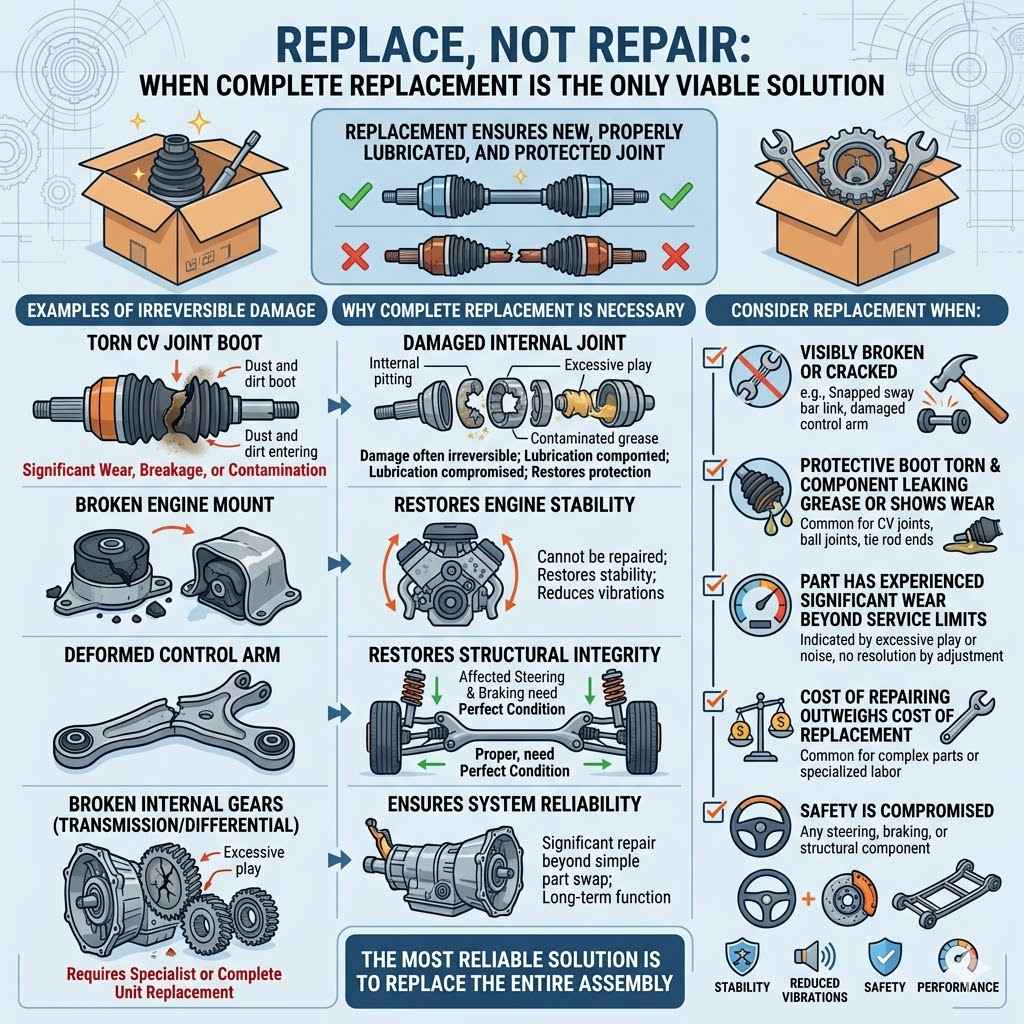
In some situations, a component might be damaged to the point where repair is not feasible or cost-effective. In these cases, complete replacement of the part is the only viable solution. This is particularly true for components that have experienced significant wear, breakage, or contamination.
For instance, if a CV joint boot has been torn for an extended period, the joint itself will likely be contaminated with dirt and grit, and the internal lubrication will be compromised. While it might be possible to replace just the boot in some rare cases, the damage to the joint is often irreversible. The most reliable solution is to replace the entire CV axle shaft assembly.
This ensures that you have a new, properly lubricated, and protected joint.
Similarly, if an engine mount is completely broken or has come apart, it cannot be repaired. The rubber may have disintegrated, or the metal casing might be bent. In such a scenario, replacement is the only option to restore the engine’s stability and reduce vibrations.
The same applies to severely damaged suspension components like control arms or ball joints where the metal housing might be deformed or cracked.
Transmission and differential components are generally not repairable on a part-by-part basis unless it’s a major overhaul. If internal gears are broken or bearings are excessively worn in these units, a complete transmission or differential replacement, or a full rebuild by a specialist, is usually required. This is a significant repair that goes beyond a simple part swap.
Consider replacement when:
- A component is visibly broken or cracked: For example, a snapped sway bar link or a severely damaged control arm.
- A protective boot is torn and the component is leaking grease or shows signs of wear: This is common for CV joints, ball joints, and tie rod ends.
- A part has experienced significant wear beyond its service limits: This might be indicated by excessive play or noise that cannot be resolved by adjustment.
- The cost of repairing a component outweighs the cost of replacement: This is often the case for complex parts or when specialized labor is required for a repair.
- Safety is compromised: Any component that affects steering, braking, or structural integrity needs to be in perfect condition.
A common scenario involves torn CV joint boots. Mechanics often advise replacing the entire axle assembly because the cost of just the boot and the labor to
Frequently Asked Questions
Question: Why would my BMW G30 knock when turning, but not going straight?
Answer: When turning, the weight distribution of your vehicle shifts, putting more stress on components on the outside of the turn. If a ball joint, tie rod end, or CV joint has wear, this increased load can cause it to make noise. Engine mounts can also be more stressed when the engine shifts during a turn.
Question: Is it safe to drive my BMW G30 if it’s knocking when warm and turning?
Answer: It depends on the severity and the suspected cause. If the noise is loud, sudden, or accompanied by changes in steering or braking, it’s best not to drive and get it inspected immediately. Minor knocking from less critical parts might allow limited driving, but it’s wise to get it checked soon to prevent further damage.
Question: Could the knocking sound be related to the transmission?
Answer: Yes, it’s possible. Worn transmission mounts can cause clunking noises when the engine and transmission unit shifts during turns. In some cases, issues within the transmission or differential itself, especially in AWD models, can also lead to knocking sounds under load during turns.
Question: How can I tell if the knocking is from the engine or the suspension?
Answer: Engine knocking (like detonation) often sounds like a metallic ping or rattle and might occur even when not turning, especially under acceleration. Suspension and steering knocks are typically more of a clunk or thud and are most pronounced when turning or going over bumps. Listening carefully to the sound’s quality and timing is key.
Question: What’s the most common cause of knocking when turning on a BMW G30?
Answer: The most common causes for knocking when turning on a BMW G30 are worn suspension and steering components such as ball joints, tie rod ends, or CV joints. Worn engine or transmission mounts are also frequent culprits, especially when the vehicle is warm and under load during a turn.
Summary
Addressing the BMW G30 Knocking When Warm and Turning? Causes involves careful diagnosis. Common culprits include worn engine mounts, detonation, and issues with suspension and steering parts like ball joints and tie rods.
By gathering information, performing visual checks, and knowing when to seek professional help, you can effectively resolve these noises and ensure your BMW runs smoothly and safely.