Can a 65-Inch TV Fit in a Car? Only in an SUV or Minivan
A 65-inch TV can fit in some vehicles, but the safe answer depends on the box, the hatch or trunk opening, and whether the set can stay upright. A sedan is usually the hardest case. SUVs and minivans are more likely to work, but only if the opening and cargo floor dimensions clear the actual box.
65-inch TV dimensions
Do not treat “65-inch” as a transport measurement. It is the diagonal screen size, while the real fit check depends on the TV’s width, height, depth, and weight. A standard 65-inch TV is typically about 57.5 inches wide and 33 inches tall, with a panel depth of 2-4 inches and a stand depth of 12-16 inches.
Boxed versus unboxed fit
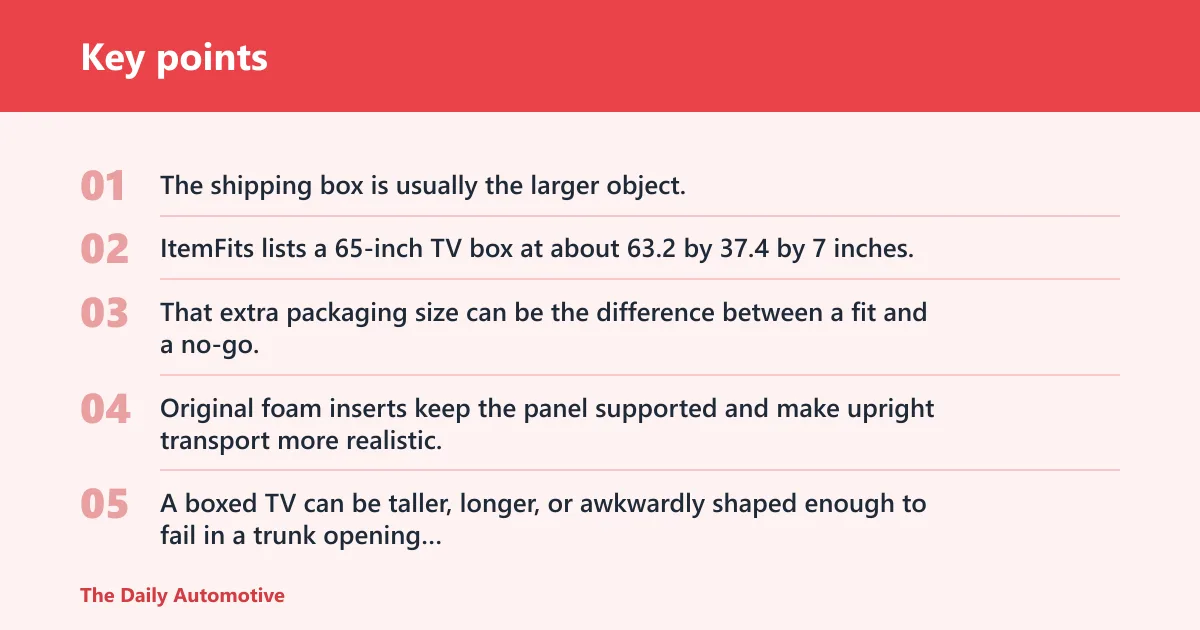
The shipping box is usually the larger object. ItemFits lists a 65-inch TV box at about 63.2 by 37.4 by 7 inches, while Will It Trunk says a recent LG 65-inch OLED box measures around 62.8 by 37.1 by 7.6 inches. That extra packaging size can be the difference between a fit and a no-go.
Packaging also changes the handling risk. Original foam inserts keep the panel supported and make upright transport more realistic, which matters more than a bare screen alone. A boxed TV can be taller, longer, or awkwardly shaped enough to fail in a trunk opening even if the panel itself would have slid in.
Why brand and model details matter
Two 65-inch TVs do not have to share the same transport size. Bezels, stand shape, carton thickness, and foam inserts vary by brand and model. Some boxes are close to 7 inches deep, while others are a little larger. That is why a spec sheet and the carton dimensions matter more than the label on the display.
How to measure your vehicle
Measure the opening first, not the cargo volume alone. A box has to pass through the hatch, trunk, or door opening before it reaches the rear load floor, so that mouth size is the first gate. Measure the smallest clear opening, then compare it with the carton.
What to measure
Use a tape measure and check three things: opening width, opening height, and usable cargo floor length with the seats folded or stowed. Also look for obstacles such as wheel wells, seatbacks that do not fold flat, sloping rooflines, and rear-seat pass-throughs that are too narrow for the box corners.
- Check the TV carton dimensions from the retailer or manufacturer before pickup.
- Measure the narrowest point of the hatch, trunk, or rear door opening.
- Measure cargo floor length with seats folded, not cargo volume alone.
- Confirm whether the TV must stay upright according to the manufacturer.
- Compare the box shape to the opening shape, not just the total space.
Picture a compact SUV with generous cargo volume but a sloped hatch opening. The box may appear to “fit” on paper, yet the top corners hit the hatch frame before the load is fully inside. That is why the smallest opening dimension often matters more than the published cargo cubic feet.
Can you fit a 65-inch TV in a sedan?
Usually not in the box, and often not safely even if the panel itself seems close. Sedans are limited by trunk opening shape, rear-seat pass-through size, and the way the seatbacks and rear shelf block long, flat cartons. The same source says a compact sedan does not fit a 65-inch TV in its box, and it gives the same verdict for a midsize sedan.
Trunk opening limits
A sedan trunk can be wide enough in the interior but still fail at the mouth. The opening may be too short, too narrow, or too low for the box to angle through without binding. Even when rear seats fold, the pass-through may still be too small for a 65-inch carton.
When a sedan can still work
A sedan can sometimes handle an unboxed panel if the rear seat folds and the panel can be loaded through the cabin opening, but that depends on the exact vehicle and the exact TV. The safer rule is simple: if the box cannot pass through the opening without force, do not try to “make it fit.”
Will a 65-inch TV fit in an SUV or minivan?
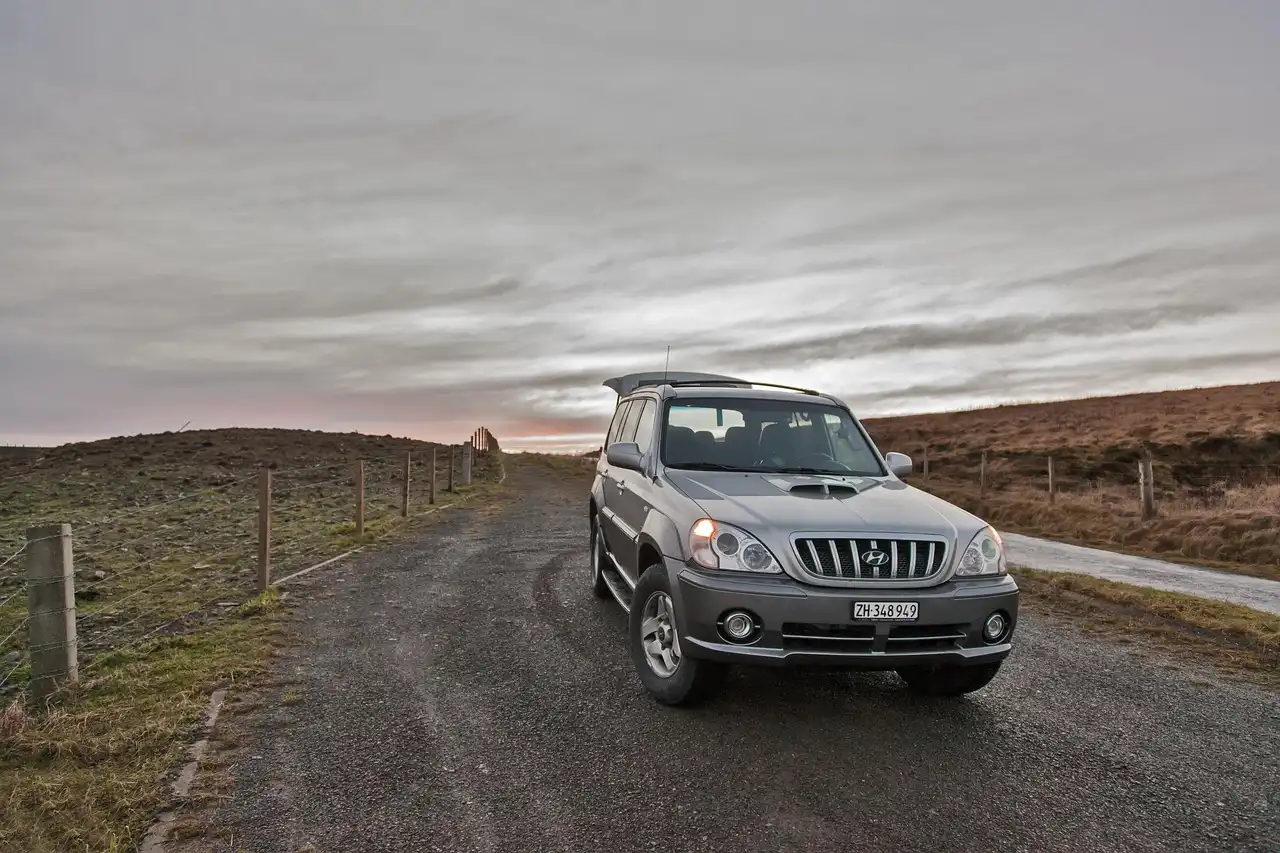
Often yes, but not automatically. SUVs and minivans usually make the fit easier because the rear opening is larger and the cargo floor is more usable, yet the hatch shape still has to clear the box. The same source says a minivan can fit a 65-inch TV in its box with the third row folded, and it says a compact SUV does not fit a boxed 65-inch TV lying flat.
SUV checks that matter
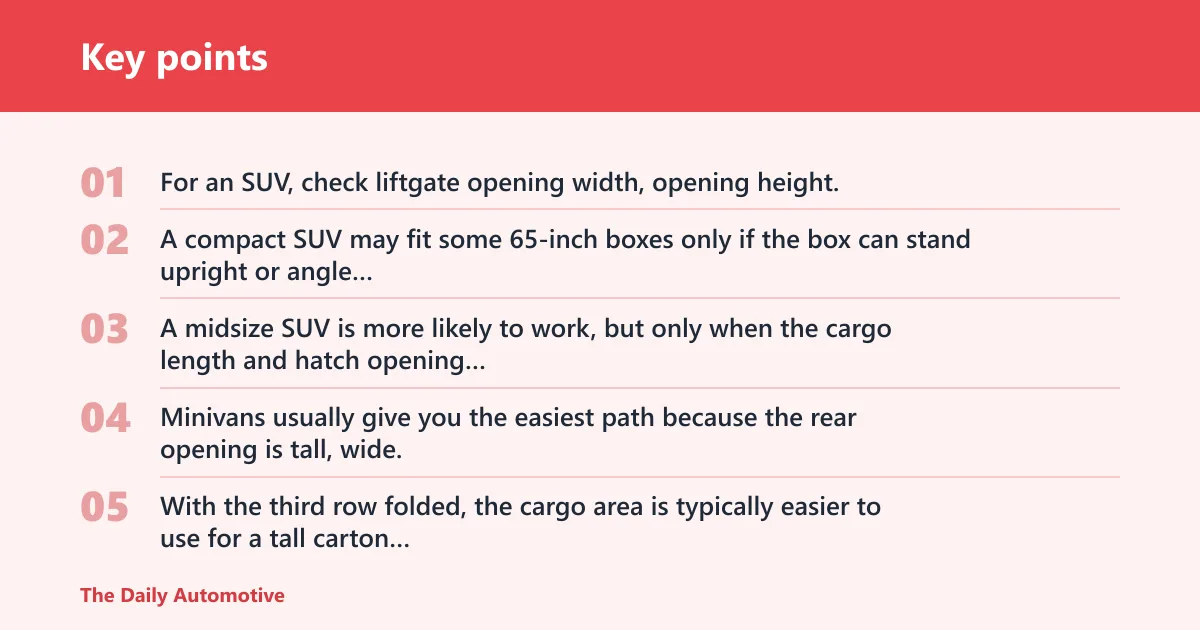
For an SUV, check liftgate opening width, opening height, and cargo floor length with the rear seats folded. A compact SUV may fit some 65-inch boxes only if the box can stand upright or angle through the opening. A midsize SUV is more likely to work, but only when the cargo length and hatch opening both clear the carton.
Why minivans usually load easier
Minivans usually give you the easiest path because the rear opening is tall, wide, and close to the load floor. With the third row folded, the cargo area is typically easier to use for a tall carton or an upright panel. The same source says a minivan can fit a 65-inch TV out of the box with the third row folded.
Suppose a shopper has a midsize SUV with a deep cargo area but a liftgate opening that narrows near the top. The carton might still fail because the upper edge of the box hits the hatch frame before the base is fully inside. A minivan with the third row folded can avoid that problem if the box height clears the opening.
Do I need to keep a TV upright during transport?
Yes, upright is the safer default for a flat-screen TV unless the manufacturer says otherwise. Will It Trunk says manufacturers advise transporting flat-screen TVs upright, not laid flat. Laying a TV flat increases the chance of flexing the panel, stressing the frame, or shifting the box in a stop.
How to secure it
If the TV is upright, brace it so it cannot tip, slide, or bounce. Use blankets to protect the carton from scuffs, then use straps or other tie-downs to stop the box from moving. An angled load can work only if the box stays supported along its length and the opening closes without pinching the carton.
Do not assume “it fit in the cargo area” means it was safe. A box that shifts one hard brake away from the side panel or rear gate can damage the screen or the packaging. The goal is a stable load, not a forced one.
65-inch TV fit matrix
This matrix separates physical fit from safe transport. The opening has to clear the carton or panel first, and the load still has to ride upright or in the orientation allowed by the manufacturer. Use the exact carton dimensions and the narrowest opening measurement for your vehicle.
| Vehicle type | Minimum opening and cargo dimensions to check | Verdict conditions for boxed vs unboxed 65-inch TVs |
|---|---|---|
| Sedan | Trunk opening width, trunk opening height, rear-seat pass-through width, and folded-seat clearance through the cabin | Boxed: Usually no. A compact sedan does not fit a boxed 65-inch TV, and a midsize sedan also does not fit the box in ItemFits’ guidance. Unboxed: Possible only if the panel clears the cabin opening and can stay protected and upright. |
| Compact SUV | Liftgate opening width and height, cargo floor length with rear seats folded, and room to keep the box upright | Boxed: Sometimes yes, sometimes no. ItemFits says a compact SUV does not fit a boxed 65-inch TV lying flat, while Will It Trunk says compact SUVs and wagons usually fit with rear seats folded. Unboxed: More likely than boxed, if upright loading is possible. |
| Midsize SUV | Liftgate opening width and height, usable load-floor length, and hatch clearance for the carton corners | Boxed: Often yes if the box clears the opening and can stay upright or angle in without force. Unboxed: Usually easier than boxed, but still needs stable support and enough height for the panel. |
| Minivan | Rear opening width and height, cargo floor length with the third row folded, and tie-down points for bracing | Boxed: Usually the easiest fit path. ItemFits says a minivan can fit a 65-inch TV in its box with the third row folded. Unboxed: Also likely, with upright support and the load secured. |
| Pickup | Bed length, tailgate position, bed width between wheel wells, and tie-down points | Boxed: Possible in some bed and cab setups, but not guaranteed. Unboxed: Possible if the panel can be protected, upright, and tied down. Bed length and tailgate position vary widely by model. |
Final yes/no decision tree
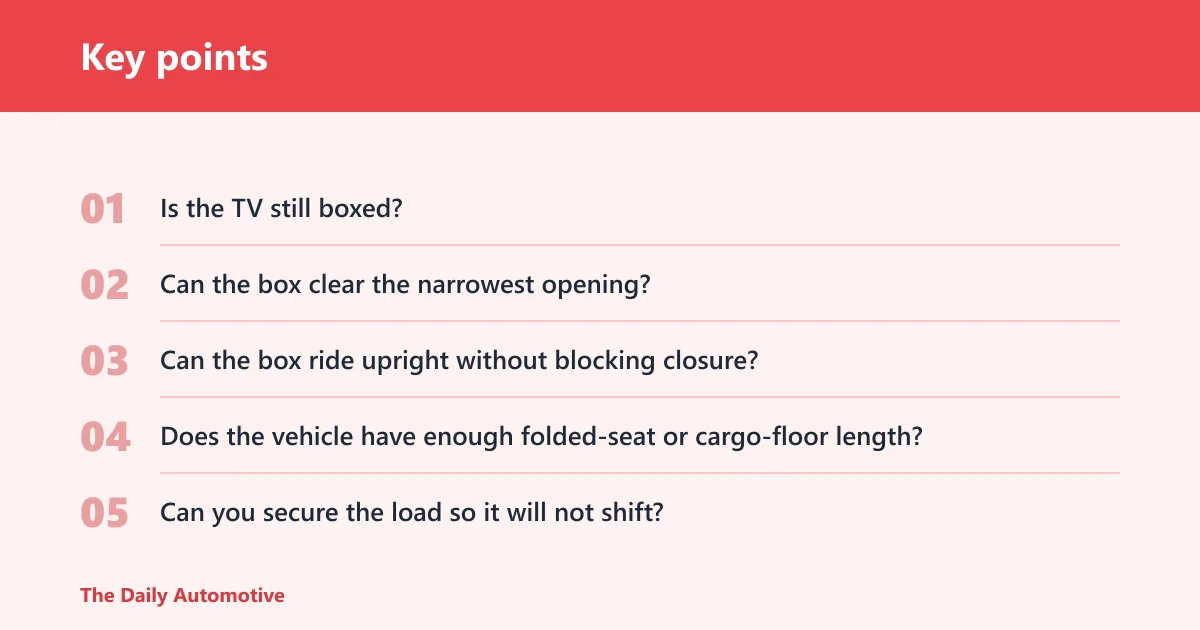
- Is the TV still boxed? If yes, use the carton dimensions, not the screen size.
- Can the box clear the narrowest opening? If no, stop and arrange delivery or a rental van.
- Can the box ride upright without blocking closure? If no, do not force it flat.
- Does the vehicle have enough folded-seat or cargo-floor length? If no, the fit fails even if the opening seems wide.
- Can you secure the load so it will not shift? If no, use another vehicle or have it delivered.
What size is a 65-inch TV box?
A 65-inch TV box is commonly around the size of a large, flat carton rather than a small appliance box. The figures available here vary by source and model: ItemFits lists about 63.2 by 37.4 by 7 inches, Will It Trunk gives roughly 65 by 38 by 8 inches, and a recent LG 65-inch OLED box is listed at around 62.8 by 37.1 by 7.6 inches.
Why the box changes the answer
The box can be wider or taller than the bare panel because of foam end caps, corner protection, and the stand carton. That is why the box often decides the fit, not the screen itself. If the carton will not pass through the opening, the vehicle fails before cargo length even matters.
Should I use the original box to move a TV?
Yes, if you still have it in good condition. The original box and foam inserts give the panel the best support and make the load easier to brace upright. Without that packaging, the screen is more exposed to edge pressure, vibration, and flexing during transport.
A common first-timer mistake is tossing the box after installation and then trying to move the TV in blankets alone. Blankets help with scuffs, but they do not replace the molded supports that keep the panel from bending or shifting inside the carton.
What vehicle type is best for transporting a 65-inch TV?
A minivan is usually the easiest choice, followed by a midsize SUV with a wide liftgate opening and flat folded cargo space. A pickup can work if the bed is long enough and the load can be secured, but it depends on the exact cab and bed setup. Sedans are the least forgiving.
If you are choosing between vehicles before buying the TV, look for the widest rear opening and the straightest loading path. That is more useful than a large cargo-volume number with a narrow hatch or a shallow trunk mouth.
How do I measure my car to see if the TV will fit?
Measure the carton first, then measure the vehicle’s narrowest opening and its usable floor length. Compare the three numbers directly. If the box does not clear the hatch, trunk, or door opening without force, the vehicle does not pass the test, even if the cabin volume sounds large enough.
Use the manufacturer’s specifications for the TV and the vehicle’s cargo dimensions for the exact model, then confirm with a tape measure in the parking lot before loading. That simple check avoids the common mistake of trusting only cargo volume, which says little about a box moving through a narrow opening.
Frequently asked questions
Will a 65-inch TV fit in my car?
Maybe, but only after you check the actual box dimensions and the narrowest opening in your vehicle. A 65-inch screen is a diagonal measurement, so the carton can be much larger than you expect. In practice, SUVs and minivans are the safer starting point, while sedans are usually a poor fit.
Products related to this article
Sponsored / affiliate links. As an Amazon Associate I earn from qualifying purchases. I may earn additional commission from eligible campaigns.