Personal Branding Through the Automotive Lifestyle Tips
Build a personal brand by choosing one vehicle category, a few repeatable visual cues, and a steady posting rhythm. Break that system, and your account looks random instead of recognizable. This guide shows how to align vehicle choice, styling, posting habits, and community activity into one clear brand.
What personal branding means in the automotive lifestyle


In this setting, personal branding means making your public automotive presence read as one person with a clear point of view. Dictionary.com defines personal as relating to or coming from a particular person. That matters here because the car, the content, and the way you show up should all point back to the same identity.
How clarity narrows your niche
Clarity means people can quickly answer a few basic questions, such as what you drive, what you care about, and why they should follow. If the answer is vague, the account becomes a mixed feed of clean shots, random events, and unrelated trends. A narrow niche is not a limitation. It is a signal.
A luxury sedan creator, a JDM track-day account, and an off-road build page can all be strong brands, but they need different cues. A clear niche cuts mixed messaging and makes audience selection easier. It also tells you what to ignore.
How consistency shapes public perception
Consistency means the visual language, posting behavior, and real-world behavior match across platforms. People notice when a polished feed is paired with a neglected car, erratic posting, or captions that change tone every week. Repetition builds recognition. Recognition builds trust.
Think of consistency as a checklist, not a feeling. If the same color accents, car angle, and caption style appear again and again, your audience knows what to expect. That is how an automotive profile becomes memorable instead of merely active.
How content and communication support trust
Content should prove you know your lane. Communication should make that proof easy to read. Useful posts, clear captions, and direct replies tell people that the brand is intentional, not accidental. In automotive spaces, trust often grows from precision: details, dates, specs, and a stable point of view.
Suppose a daily-driver creator posts a short cold-start clip, a maintenance note, and a brief commute review each week. That pattern tells a stronger story than a feed full of unrelated reels. The content says what the car is for, and the communication explains why it matters.
How do you choose a car that supports your brand?
Choose a car that sends the same message you want your audience to read. The model, trim, condition, and modification path should fit your intended image. If the car signal and the brand story conflict, the account feels uncertain even when the visuals are polished.
Using car model as a visible signal
A car model is an immediate brand cue. A classic coupe suggests one kind of identity, a lifted truck another, and an EV hatchback another still. People decode the vehicle before they read the caption, so the model should match the position you want to own.
If you want to be read as practical and detail-oriented, a clean daily driver can be stronger than an overbuilt show car. If you want performance credibility, the platform, chassis reputation, and mod path need to support that claim. The visible signal should match the narrative.
Matching modifications to the image you want
Mods should sharpen the identity, not scatter it. A subtle wheel setup, factory-plus suspension, and restrained exterior changes communicate differently than widebody panels, stickers, and aggressive aero. Neither is better by default. The question is whether the parts fit the brand position.
A common first-timer mistake is building for internet attention and then trying to explain the brand later. That usually creates visual noise. Start with the signal you want: refined, technical, rugged, street-focused, or commuter-first. Then choose mods that support that message.
How maintenance affects credibility
Vehicle maintenance affects brand image because neglect is visible. Dirty paint, worn tires, mismatched panels, and overdue service make a creator look careless, even if the content is polished. A well-kept car signals attention to detail and supports credibility.
That does not require a flawless build. It does require steady upkeep, accurate mechanical documentation, and honest presentation of the car’s condition. A clean, maintained daily driver can read as more credible than a half-finished project that is always “almost done.”
What should you post to build an automotive brand?
Post material that proves the car, the use case, and the point of view line up. The best automotive brand content is repeatable. It can come from commutes, meets, road trips, detailing, charging stops, track days, or repairs, as long as the format and message stay consistent.
Platform-specific formats that fit car content
Short video works well for starts, walkarounds, quick changes, and before-and-after edits. Photo carousels fit build summaries, detail shots, and event recaps. Stories suit behind-the-scenes updates, while live coverage is useful for meets, launches, and track sessions. Longer posts work when a change needs context.
- Short video: startup clip, exhaust note, modification reveal, commute snapshot
- Photo carousel: exterior detail, interior detail, mod sequence, event recap
- Stories: fuel fill-up, weather check, parts arrival, route preview
- Live coverage: meet walk-through, track paddock updates, off-road trip checkpoints
- Long-form post: build rationale, ownership lessons, cost breakdown, maintenance summary
Content pillars built from ownership and use
Build your pillars from how you actually use the car. A luxury creator may focus on refinement, detailing, and design. A JDM page may center on tuning, parts sourcing, and event culture. An off-road account may prioritize terrain, recovery gear, and durability. A daily-driver account can lean into reliability, commute comfort, and care.
That structure keeps content from drifting. If every post can be sorted into one of three or four pillars, the audience learns your pattern fast. It also makes planning easier because each drive, repair, or meet becomes usable material.
What makes a post feel on-brand
A post feels on-brand when the visual style, caption tone, and subject matter all point in the same direction. Clean, minimal photos with technical captions read differently from gritty action shots with informal language. The content should match the car and the audience signal.
Use the same decision filter each time: does this post support the niche, the look, and the behavior people associate with the account? If not, it may still be interesting, but it is probably not brand-building content.
How can social media amplify your automotive identity?
Social media is the main distribution channel for most automotive personal brands, but it works best when it distributes an identity that already exists. The platform can amplify recognition, audience engagement, and reputation, yet it cannot fix a weak vehicle signal or inconsistent behavior.
Choosing the right platforms for your audience
Choose platforms based on the type of proof you can repeat. Short-form video rewards motion and quick edits. Photo-driven platforms reward styling and composition. Long-form channels reward explanation and credibility. If your brand depends on technical depth, do not force it into a format that strips out the detail.
A luxury-focused account may do well with polished stills and concise captions. A performance build may need video, data, and repair notes. An EV creator might benefit from charging updates, range notes, and clean comparison shots that explain daily use.
Using captions, stories, and video to reinforce positioning
Captions should explain the choice, not repeat the obvious. Stories can document the maintenance rhythm, the commute, or the trip between events. Video should show motion, sound, or process. Together, these formats create a steady identity instead of a one-off post.
Use communication that matches the audience you want. Technical audiences need specifics. Lifestyle audiences need a clear visual mood. Community audiences need interaction, direct replies, and acknowledgment of shared spaces. The message should feel intentional every time.
Community touchpoints that build recognition
Your brand is also built at meets, in comments, during group drives, and at local events. People remember how you park, how you speak about the car, how you credit others, and how you respond when someone asks a question. Those moments create reputation.
Automotive lifestyle extends beyond ownership. It includes attendance, participation, and conduct. The public reads not only what you drive, but how you behave around other enthusiasts, vendors, and builders.
A brand-alignment worksheet for your car and content
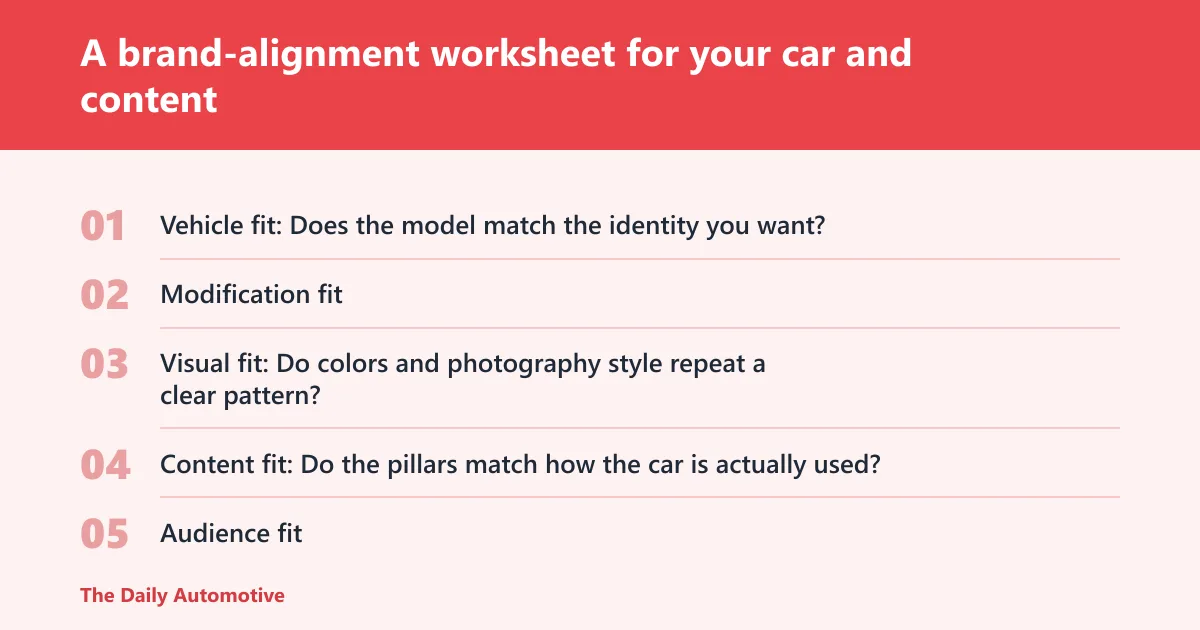
Use this worksheet to test whether your vehicle, modifications, visual style, and posting behavior all support the same identity. It turns personal branding from a vague idea into a repeatable system. If the columns do not agree, the account will feel generic or split.
| Vehicle | Mods | Color palette | Content pillars | Audience signal | Consistency risks |
|---|---|---|---|---|---|
| BMW M340i daily driver | OEM-plus wheels, mild suspension drop, intake, clean ceramic coat | Black, gray, silver, one accent color | Commute, detailing, maintenance, highway pulls | Refined performance, practical taste | Too many stickers, harsh edits, neglecting service |
| Toyota GR86 track build | Brake pads, coilovers, wheels, harness bar | White, red, matte black | Track days, tire wear, setup changes, lap prep | Driver-focused, technical, active | Showing only static photos, vague captions |
| Ford Bronco off-road rig | All-terrain tires, skid plates, recovery kit | Earth tones, sand, dark green | Trail use, recovery, camping, washdowns | Durability, utility, outdoor use | Urban-only content, overstyled garage shots |
Scoring rubric for one real example
Score each category on a 1-to-5 scale. A 1 means the element fights the brand. A 5 means it reinforces the brand clearly. Add the six scores to get a total score out of 30. Scores below roughly 18 may mean the identity is unclear. Scores above roughly 24 may suggest strong alignment.
- Vehicle fit: Does the model match the identity you want?
- Modification fit: Do the parts support that identity without distraction?
- Visual fit: Do colors and photography style repeat a clear pattern?
- Content fit: Do the pillars match how the car is actually used?
- Audience fit: Are you attracting the people you want to reach?
- Behavior fit: Do your comments, meet presence, and maintenance habits match the image?
How to spot mismatches before they weaken the brand
If the car says luxury but the content is mostly messy project clips, the brand signal is split. If the account says off-road but never leaves pavement, the audience will notice. If wardrobe, captions, and photography all point in different directions, recognition drops.
Picture a lifted truck account that posts polished city portraits in tailored streetwear one day, then muddy trail clips with no context the next. The account may still gain views, but it will struggle to become memorable because the audience cannot pin down the identity.
Why do automotive creator accounts stall?
Automotive creator accounts stall when the car, visuals, posting rhythm, and audience expectations do not line up. The page may get initial attention, but without a stable identity, it becomes hard to retain viewers or build a clear reputation. Stalls usually come from confusion, not lack of effort.
Generic visuals and mixed messaging
When every post looks like every other car page, nothing separates the account. Generic angles, copied captions, and trend-chasing edits can flatten the identity. The feed may look active, but it does not communicate a point of view.
Mixed messaging creates the same problem. If the account says it is about premium driving but posts budget parts, aggressive memes, and unrelated lifestyle content, the audience receives conflicting signals. That weakens clarity and makes the niche harder to read.
Inconsistent posting and weak audience signals
Consistency requires regular posting and stable messaging. Without a rhythm, the audience cannot learn what to expect. A burst of activity followed by long silence tells people the account is unreliable, even if the content itself is solid.
Weak audience signals show up in the wrong topics, the wrong tone, or the wrong visual language. A performance build that speaks like a fashion page may confuse viewers. A daily-driver account that acts like a track team page may miss the people it should attract.
When the car, wardrobe, and captions do not line up
The strongest automotive identities are coordinated. The vehicle condition, wardrobe, camera style, and captions should all support the same message. If one element drifts, the whole brand looks less intentional. Alignment makes the identity easier to remember and easier to trust.
A practical fix is to audit every post for fit. Ask whether the car, the edit, the words, and the setting all send the same signal. If one of them does not, adjust before posting. That habit prevents a lot of avoidable brand noise.
Frequently asked questions
How do I build a personal brand through cars and the automotive lifestyle?
Start with a defined vehicle category, then build repeatable cues around it. Your car, modification style, color choices, content format, and community behavior should all support one identity. The goal is not to be everywhere. The goal is to be easy to recognize in the spaces that matter.
What should I post to create an automotive personal brand?
Post what proves your niche: build updates, maintenance notes, commute clips, event recaps, detailed photos, and short videos that fit the platform. Use content pillars so each post supports the same positioning. If the material does not reinforce the car’s role or your point of view, save it for later.
How do I make my car fit my personal brand?
Choose a model and modification path that match the image you want people to read. Then keep the color palette, cleanliness, and repair standard consistent with that image. A car fits a brand when it sends the same message as the account does online and in person.
What are the four pillars of automotive personal branding?
The four pillars are clarity, consistency, content, and communication. Clarity defines the niche. Consistency keeps the visuals and messaging aligned. Content provides useful proof of your automotive focus. Communication builds trust by making the account understandable, responsive, and easy to follow.
How can social media help with automotive personal branding?
Social media distributes your identity at scale, but only if the identity is already coherent. Use platform-specific formats to repeat your niche, your visual code, and your point of view. Captions, stories, and video should all reinforce the same signal rather than competing for attention.
Products related to this article
Sponsored / affiliate links. As an Amazon Associate I earn from qualifying purchases. I may earn additional commission from eligible campaigns.