Can You Write Off a Leased Car for Business? (2026 IRS Rules)
Yes — you can write off a leased car for business, but only the business-use share of your lease payments, and only if you qualify to claim it in the first place. Self-employed owners, freelancers, and partners in a business can generally claim it. Most W-2 employees can no longer deduct a leased vehicle at all, even if they drive it entirely for work, because of a 2025 change in federal tax law that most guides on this topic have not caught up with yet.
This guide walks through who actually qualifies in 2026, the two IRS-approved ways to calculate the deduction, a common myth about Section 179 that trips up a lot of business owners, and the recordkeeping the IRS expects if you’re ever asked to prove it.
This is general tax information, not personalized advice. Tax rules change and your situation may have details a blog post can’t account for — always confirm specifics with a CPA or enrolled agent before you file.
Who Can Actually Deduct a Leased Business Car in 2026
GLOVE-BOX MILEAGE & EXPENSE LOG
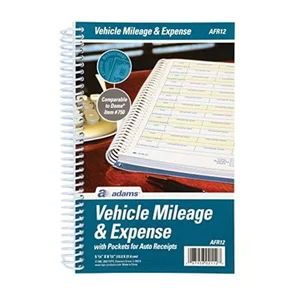 |
Adams Vehicle Mileage & Expense Journal – $14.99 Every method of deducting a leased car depends on a contemporaneous mileage log — this spiral-bound journal keeps that log and your receipts in the glove box together.
|
To write off a leased car, the car has to be used for business — meeting clients, delivering goods, traveling between job sites, and similar work tasks. That part hasn’t changed. What has changed is who is allowed to claim it:
- Self-employed / Schedule C filers, sole proprietors, and single-member LLCs can deduct the business-use share of a leased car directly on Schedule C.
- Partners and S-corp shareholders can generally deduct it through the partnership or corporation, or get reimbursed under an accountable plan.
- W-2 employees can no longer claim it as a personal itemized deduction. The 2017 Tax Cuts and Jobs Act suspended unreimbursed employee business expenses (Form 2106) from 2018 through 2025, and the 2025 One Big Beautiful Bill Act made that suspension permanent for most employees — Armed Forces reservists, qualified performing artists, and fee-basis government officials are the narrow exceptions.
In practice, this means if you’re a W-2 employee who leases a car and uses it for work, your best path to any tax benefit is getting your employer to reimburse you under an accountable plan (which isn’t taxable income to you), not trying to deduct it yourself.

The Business-Use Rule: Only the Business Percentage Counts
You can never write off 100% of a lease payment just because the car is registered to your business — unless you can prove 100% business use, which is rare. Instead, the IRS wants your business-use percentage: business miles divided by total miles driven for the year.
For example, if you drove 12,000 miles total and 8,400 of those were for business, your business-use percentage is 70%. That 70% is what gets applied to your lease payments and other car costs — not the full amount. Commuting from home to a regular office is treated as personal mileage, not business mileage, even if you’re self-employed and driving to a co-working space or a regular client site.
Keeping the two separate matters more than people expect. If you can’t produce a mileage log that supports your business-use percentage, the IRS can disallow the deduction entirely — not just reduce it.
Two Ways to Calculate Your Deduction: Standard Mileage Rate vs. Actual Expenses
The IRS gives you two methods, and for a leased vehicle the choice matters more than it does for an owned one:
| Method | How it works | Key limitation for a leased car |
|---|---|---|
| Standard mileage rate | Multiply business miles by the IRS rate for the year (72.5 cents per mile for miles driven January 1–June 30, 2026, rising to 76 cents per mile for July 1–December 31, 2026, per the IRS). | If you use this method in the first year you lease the car, you must keep using it for the entire lease term, including any renewals — you can’t switch to actual expenses partway through. |
| Actual expense method | Add up your real costs — lease payments, gas, insurance, repairs, registration — then multiply the total by your business-use percentage. | If the leased car’s value is high enough, you must subtract a small “lease inclusion amount” from your deduction, based on IRS tables for the year you started the lease. |
The IRS mileage rate changes every year (and sometimes mid-year, as it did for 2026), so always confirm the current rate on the IRS’s Business Use of Car page before you file rather than relying on last year’s number.
Most people leasing a modestly priced car with low running costs come out ahead using the standard mileage rate, simply because it’s less paperwork. Actual expenses tend to win out for expensive-to-run vehicles with high insurance, maintenance, or fuel costs — but you have to do the math both ways to know for sure. If you want a full step-by-step example of calculating the actual expense method, including how the business-use percentage gets applied to a real lease payment, see our companion guide on how to deduct car lease payments for a business.

Common Myth: Does Section 179 Cover a Leased Car?
No — and this is one of the most repeated mistakes in articles about this topic. Section 179 lets a business deduct the cost of qualifying equipment it owns, including some purchased vehicles, in the year it’s placed in service. Because a true lease means you never own the car, Section 179 generally does not apply to it. The one exception is a capital lease or “$1 buyout” lease structured so you effectively own the car at the end of the term — the IRS treats that arrangement as a purchase, not a lease, for tax purposes.
What actually limits a high-value leased car’s deduction is the lease inclusion amount mentioned above — a small amount you add back to your income each year if you’re using the actual expense method and the car’s value exceeds an IRS threshold that’s updated annually in a Revenue Procedure. It reduces your deduction slightly for pricier vehicles; it does not cap your entire lease deduction at a flat dollar figure the way Section 179 does for a purchase. If you’re leasing anything close to luxury pricing, ask a tax professional to check the current year’s inclusion table before you sign.
What You Can Deduct Under the Actual Expense Method
If you go with actual expenses, the business-use percentage applies to each of these, not just the lease payment itself:
- Monthly lease payments
- Fuel and oil
- Insurance premiums
- Routine maintenance and repairs
- Registration and license fees
- Parking fees and tolls incurred for business trips (these are generally 100% deductible even under the standard mileage rate, since they’re not baked into the per-mile rate)
If you choose the standard mileage rate instead, all of the above (except parking and tolls) is already baked into that per-mile rate — you don’t deduct them separately on top of it.
Recordkeeping the IRS Expects
A mileage log is the single most important piece of documentation for this deduction. For every business trip, the IRS wants:
- The date of the trip
- Starting and ending odometer readings (or total miles driven)
- Where you drove
- The specific business purpose — “client meeting” is fine; “business” alone is not
A paper logbook, a spreadsheet, or a mileage-tracking app all satisfy the requirement — the IRS doesn’t mandate a specific format, only that the log is contemporaneous (kept close to when the trip happened, not reconstructed months later from memory) and detailed enough to support your business-use percentage. Keep your lease agreement, monthly payment statements, and receipts for fuel, insurance, and repairs alongside the mileage log, since self-employed filers typically report this deduction on Schedule C.

Common Mistakes That Get This Deduction Rejected
Trying to claim it as a W-2 employee. This is now the single most common mistake, since it was legal before 2018 and many people (and older articles) haven’t caught up with the current rule.
Reconstructing a mileage log after the fact. A log filled in at tax time from memory is exactly what an audit is designed to catch. Update it as you drive, or at least weekly.
Counting commuting miles as business miles. Driving from home to your regular workplace is personal mileage under IRS rules, even for a self-employed business owner, unless your home is your principal place of business.
Switching methods mid-lease. If you started with the standard mileage rate on a leased car, you’re locked into it for the rest of that lease term.
Assuming Section 179 applies. As covered above, it generally doesn’t for a true lease — don’t build your tax plan around a deduction that doesn’t exist for your situation.
Should You Talk to a Tax Professional?
For a straightforward, mostly-business-use lease with clean records, many self-employed filers handle this deduction themselves using tax software. It’s worth paying for an hour with a CPA or enrolled agent if your business-use percentage is close to the line, you’re leasing something expensive enough that the lease inclusion amount might apply, or your business structure (partnership, S-corp) changes how the deduction gets reported. A professional can also confirm the current year’s mileage rate and inclusion tables, both of which change annually.
Frequently Asked Questions
How Do You Write Off a Car Lease With an LLC?
A single-member LLC reports the business-use share of the lease on Schedule C, the same as a sole proprietor. A multi-member LLC taxed as a partnership generally deducts it at the partnership level or reimburses the member under an accountable plan. Either way, you still need a mileage log showing the car is used for business more than incidentally, and you’ll pick either the standard mileage rate or the actual expense method for the life of the lease.
What Are the Tax Benefits of Leasing a Car for a Business?
The main benefit is that the business-use share of your monthly lease payment, along with related costs like fuel, insurance, and maintenance, can be deducted as a business expense, lowering your taxable income. Leasing also typically means lower upfront costs than buying, which can help cash flow, though buying comes with its own tax benefits like depreciation that leasing doesn’t offer.
How Much of a Car Lease Can You Write Off?
Only the percentage that matches your business use — for example, 70% business use means you can deduct roughly 70% of your lease payments and other qualifying car costs. There’s no fixed dollar cap for the business-use share itself, though the lease inclusion amount can slightly reduce the deduction for higher-value vehicles under the actual expense method.
What Is the Maximum Write-Off for a Car Lease?
There’s no single flat maximum. Section 179 does not apply to a true lease, so it doesn’t set a cap here. Instead, your deduction is capped by (1) your actual business-use percentage and (2) the IRS’s annual lease inclusion amount if your car’s value is high enough to trigger one. Both figures are published or updated annually, so check the current year’s numbers rather than relying on an older figure you may have seen elsewhere.
Can a W-2 Employee Write Off a Leased Car for Business?
Generally, no. Unreimbursed employee business expenses, including a leased car used for work, were suspended by the 2017 Tax Cuts and Jobs Act from 2018 through 2025, and the 2025 One Big Beautiful Bill Act made that suspension permanent for most W-2 employees. Armed Forces reservists, qualified performing artists, and fee-basis government officials remain narrow exceptions. Most employees’ best option is asking their employer for mileage reimbursement under an accountable plan instead.
Is It Better to Lease or Buy a Car for Business Taxes?
It depends on the vehicle and how you use it. Leasing generally means a more predictable, fully deductible-by-percentage monthly payment with less paperwork. Buying opens up depreciation and, for qualifying vehicles, Section 179, which can front-load a larger deduction in the year of purchase but adds more complexity and ties up more capital upfront. Run the numbers both ways, or ask a tax professional, before committing to either one for tax reasons alone.
Conclusion
Leasing a car for business can still lower your tax bill, but the details matter more than they used to. Confirm you’re eligible to claim it in the first place (most W-2 employees no longer are), pick one deduction method and stick with it for the life of the lease, keep a real mileage log as you go, and don’t count on Section 179 to bail out a lease the way it can for a purchase. When in doubt, a short conversation with a CPA before you sign the lease is far cheaper than an amended return after the fact.
Products related to this article
Sponsored / affiliate links. As an Amazon Associate I earn from qualifying purchases. I may earn additional commission from eligible campaigns.
![TAPMEI Car Phone Holder [2026 Updated] Fit for iPhone 17 Pro Max, Black](https://m.media-amazon.com/images/I/41Jo3OxikiL._SL500_.jpg)