Nationwide Auto Insurance Review
Nationwide auto insurance fits safe, low-mileage drivers who can use SmartRide and bundle policies. It is a weaker pick if you want the cheapest bare-bones rate or have a riskier record. Picking the wrong policy can mean paying more than needed for coverage you will not use. This review covers pricing, coverage, discounts, claims support, and which driver profiles are most likely to get value.
Who Nationwide auto insurance suits and why
Nationwide is a large insurer with personal auto coverage, online service, and local-agent help. The best value usually shows up for drivers who can pair a standard policy with SmartRide, SmartMiles, roadside help, or an auto and home bundle. Drivers who rack up a lot of miles, drive late at night, or dislike data tracking may find a poorer fit.
Main reasons shoppers choose Nationwide: the usage-based discount options, the ability to combine auto and home insurance, roadside help that includes towing and jump-starts, and claim access from the site. Main reasons shoppers skip it: premiums that may not be the lowest in every profile, telematics privacy concerns, and a setup that only pays off if your driving pattern matches the program.
Who it’s for
Nationwide fits commuters with predictable driving, low-mileage households, bundlers, and people who want both digital tools and a local agent option. It is less attractive for high-mileage drivers, night-driving-heavy commuters, shoppers focused only on the lowest upfront premium, and anyone who wants to avoid usage tracking.
Pros and cons
Pros
- Usage-based savings through SmartRide and SmartMiles.
- Auto and home bundling can reduce total cost.
- Roadside help includes towing and jump-starts.
- Online account access covers bills, ID cards, and claims.
- Local agent support is available for shoppers who want help choosing coverage.
Cons
- SmartRide and SmartMiles can disappoint drivers whose habits do not fit the program.
- Telematics may feel intrusive if you prefer not to share driving data.
- Bundling is not always the cheapest option versus separate policies.
- High-mileage drivers may find pay-as-you-drive pricing less attractive.
- Service tools help with claims, but they do not mean claims finish instantly.
What coverage and discounts does Nationwide offer?
Nationwide offers personal auto insurance, savings-oriented discounts, usage-based programs, roadside help, and the ability to combine auto and home insurance. The basic value proposition is flexible enough for shoppers who want standard coverage plus add-ons, but the savings story depends heavily on your profile and how you drive.
Personal auto policy basics
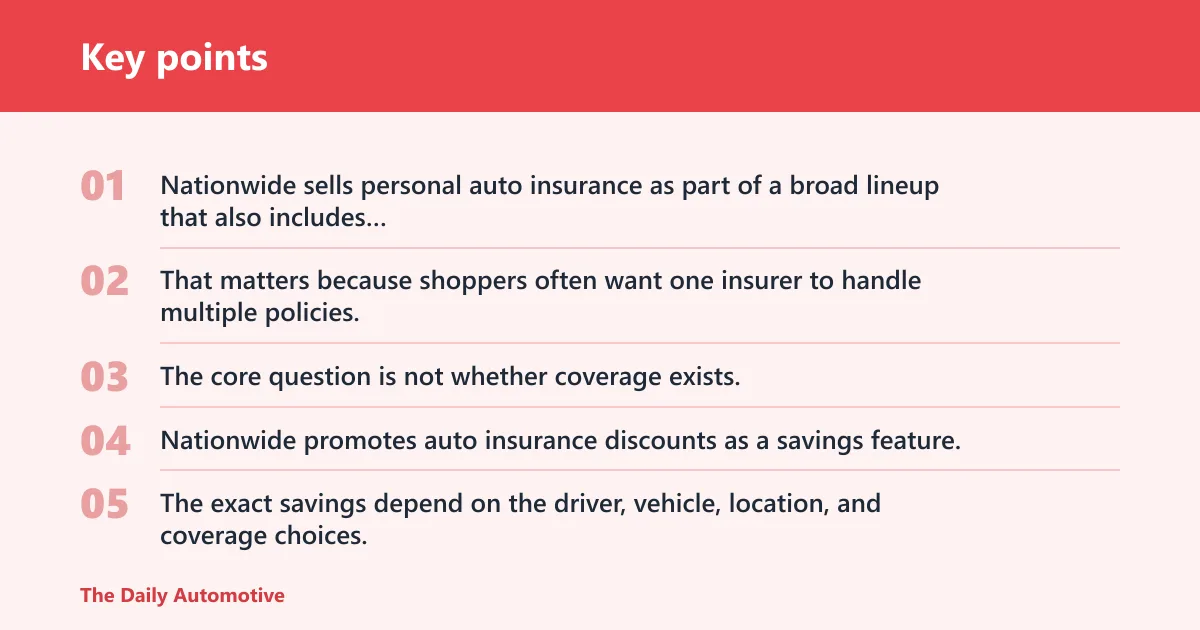
Nationwide sells personal auto insurance as part of a broad lineup that also includes property and other coverage types. That matters because shoppers often want one insurer to handle multiple policies, billing, and service tasks. The core question is not whether coverage exists; it is whether the price and service fit your household.
Auto insurance discounts
Nationwide promotes auto insurance discounts as a savings feature, with offers tied to driver profile and policy setup. The exact savings depend on the driver, vehicle, location, and coverage choices, so discount availability should be checked during quote comparison rather than assumed upfront.
SmartRide and SmartMiles
SmartRide is Nationwide’s usage-based program that rewards driving behavior and may help some drivers save. It is best for careful drivers who are comfortable with telematics in exchange for a discount opportunity. SmartMiles is the pay-as-you-drive option, which ties value more directly to mileage than to broad household shopping habits.
A common first-timer mistake is assuming both programs help the same driver. They do not. A 25-mile weekday commuter with late-night shifts may do better with a standard policy than with SmartMiles, while a retiree who drives only short daytime trips may find SmartMiles more appealing than a mileage-blind discount.
Roadside assistance
Nationwide advertises roadside help that includes towing and jump-start support for when you are stranded. That can matter if you commute in older vehicles, park far from help, or simply want a faster path to basic help without arranging service on your own.
Auto and home bundle
Nationwide lets customers combine auto and home insurance, and it says bundling home and car can save an average of $1,032. That figure is a marketing average, not a promise for every household. Bundling is worth pricing when your home and auto policies are both competitive, but it should not be treated as automatic best price.
Who Nationwide fits best
| Driver type | Likely best-fit product | Likely value signal | Caution flag |
|---|---|---|---|
| Low-mileage retiree | SmartMiles | Fewer miles can make pay-as-you-drive pricing more attractive. | Extra cost if mileage rises seasonally. |
| Safe weekday commuter with stable habits | SmartRide | Driving behavior may support a discount. | Night driving and harsh braking can weaken the result. |
| High-mileage commuter | Standard policy | Simple pricing may beat telematics-based pricing. | SmartMiles can punish heavy annual mileage. |
| Homeowner with multiple policies | Bundle | Combining auto and home may cut total household cost. | Bundle savings can disappear if either policy is overpriced. |
| Privacy-sensitive driver | Standard policy | No need to trade data for a possible discount. | SmartRide may feel too intrusive. |
| Hands-off digital user | Bundle or standard policy | Online account tools reduce routine admin work. | Needs comfort with self-service claims and billing. |
Bottom-line fit: commuters with steady habits should price SmartRide; low-mileage drivers should check SmartMiles; bundlers should compare the full household total; hands-off digital users will like the online tools if they are fine with self-service steps.
Is Nationwide expensive?
Nationwide is not automatically expensive, but it is not safe to call it the lowest-cost option either. The final price depends on driving history, mileage, vehicle, location, coverage limits, and whether you qualify for usage-based or bundle savings. For the right profile, the premium can make sense. For the wrong one, it can feel high fast.
When usage-based pricing can lower cost
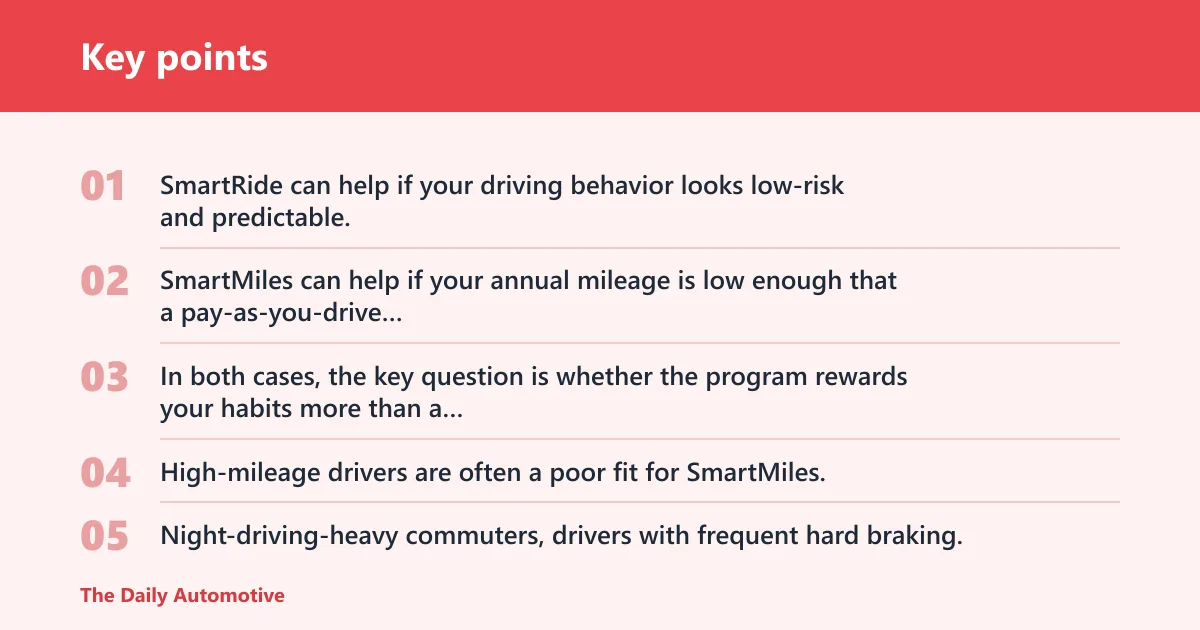
SmartRide can help if your driving behavior looks low-risk and predictable. SmartMiles can help if your annual mileage is low enough that a pay-as-you-drive structure works in your favor. In both cases, the key question is whether the program rewards your habits more than a standard policy would.
When mileage or driving patterns can push price higher
High-mileage drivers are often a poor fit for SmartMiles. Night-driving-heavy commuters, drivers with frequent hard braking, and households with stop-and-go urban traffic may also get less from SmartRide than they expect. The savings opportunity can shrink quickly if the pattern is not clean.
Say your work commute is about 42 miles each way, five days a week, plus weekend driving. That mileage profile makes pay-as-you-drive pricing harder to justify, even if the driving is careful, because distance alone can work against you.
Why bundling may or may not change the total
Bundling can lower the overall household bill, and Nationwide says home-and-car bundling can save an average of $1,032. The caution is simple: a bundle only helps if both parts are priced well. If the auto policy is cheap but the home policy is not, the package may look better than it is.
How do claims and account tools work?
Nationwide offers claims access through its site, along with around-the-clock claims-related access. That helps with convenience, but it does not guarantee a fast resolution. The practical value is that you can start a claim, track it, and handle common policy tasks without needing a long call chain.
Start a claim
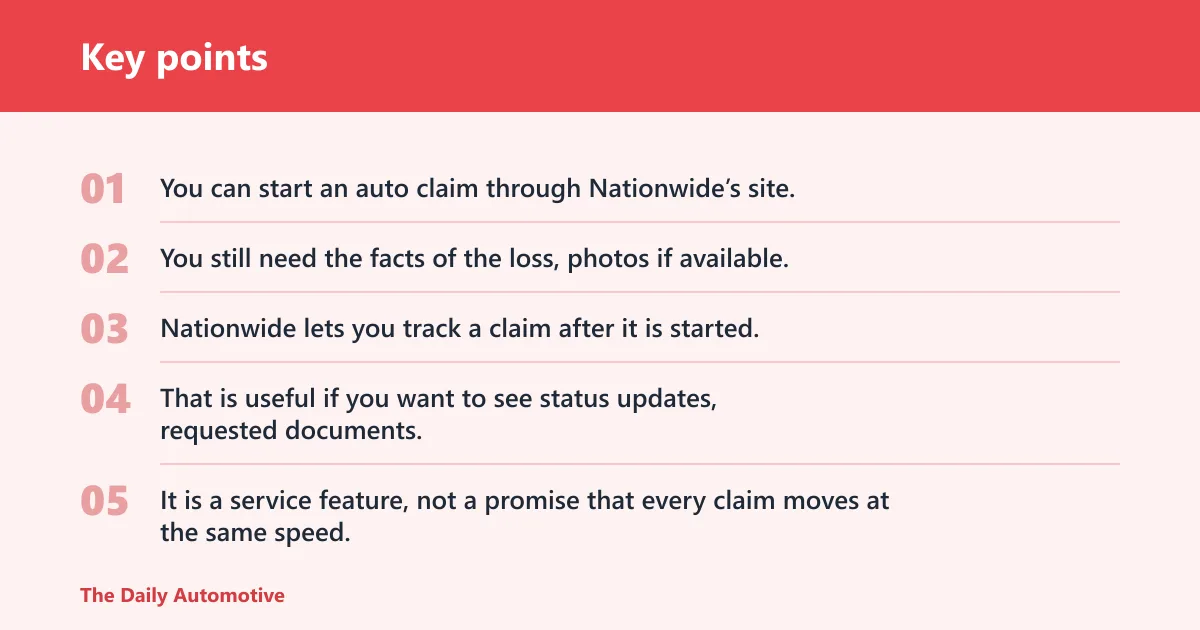
You can start an auto claim through Nationwide’s site. That is the first step, not the finish line. You still need the facts of the loss, photos if available, and any needed contact details for other parties, police, or repair shops.
Track a claim
Nationwide lets you track a claim after it is started. That is useful if you want to see status updates, requested documents, or next steps without calling repeatedly. It is a service feature, not a promise that every claim moves at the same speed.
Pay a bill
Nationwide says customers can pay a personal bill online. That is a routine convenience, but it matters because it reduces friction for policy management. Paying online is one of the easiest tasks to complete without an agent.
Get an auto ID card
Nationwide supports getting an insurance card online. That is especially useful if you need proof of insurance after hours or during travel. It is one of the clearest examples of a task that can be handled through account access without waiting for office hours.
24/7 access and support paths
Nationwide’s claims and service navigation includes a Vehicle insurance FAQ, and it also provides an option to find a local agent. Some policy tasks are available from the homepage without login, while others, such as billing, ID cards, and claim tracking, are handled after sign-in. That split matters if you want quick self-service.
Picture a driver who gets a windshield claim at 9 p.m. A site that lets them start the claim immediately, then track it later after signing in, is more useful than a phone number alone. The advantage is convenience; the limit is that repair timing still depends on the claim itself.
Should you bundle home and auto with Nationwide?
Bundling usually makes sense when both the home and auto quotes are competitive and you value simpler billing, one account, and one claims relationship. It is weaker when the home quote is inflated enough to erase auto savings or when another insurer offers a better combined total.
When a bundle usually makes sense
If you already want Nationwide for auto insurance and the home quote is close to market, bundling can be a smart move. The savings pitch is real, and the administrative convenience is real too. That combination is most attractive for homeowners who prefer one insurer and fewer moving parts.
When a separate policy may price better
If your home insurer already has a strong rate and your auto quote is the only Nationwide offer you like, a bundle may not be the cheapest path. The same is true if you only want SmartMiles or SmartRide for auto but do not need home coverage. A bundle should be compared, not assumed.
How to compare bundle savings against total cost
- Get separate home and auto quotes first before considering a bundle.
- Ask for the bundled version of the same coverage limits.
- Compare the total annual cost, not just one policy.
- Check deductibles, limits, and endorsements on both quotes.
- Keep the bundle only if the combined price and service still win.
Frequently asked questions
Is nationwide a good insurance company?
Nationwide is a good insurance company for shoppers who want a carrier with usage-based discounts, bundling options, roadside help, and digital account tools. It is less compelling if your main goal is the lowest bare-bones premium or if you prefer to avoid telematics and self-service claims steps.
Is nationwide a good car insurance?
Nationwide can be good car insurance for safe drivers, low-mileage drivers, and households that want to bundle auto with home insurance. It is weaker for people who drive a lot, drive late often, or want a policy that ignores behavior and mileage entirely.
Is nationwide insurance expensive?
Nationwide can be expensive for some profiles and competitive for others. The price depends on driving history, mileage, vehicle, and whether you qualify for SmartRide, SmartMiles, or a bundle. If your profile fits those savings paths, the quote can look much better than the sticker price suggests.
Why is nationwide insurance so expensive?
When a Nationwide quote looks high, the usual reasons are risk profile, vehicle cost, mileage, coverage limits, or the fact that a usage-based program is not a good fit. High-mileage drivers and people with more nighttime driving may see less value from the programs that are meant to save money.
What coverage and discount options does Nationwide auto insurance offer?
Nationwide offers personal auto coverage, auto insurance discounts, SmartRide, SmartMiles, roadside assistance, and the option to combine auto and home insurance. It also provides local-agent access and online service tools. The actual value depends on whether your household fits the discount structure.
How does Nationwide compare on claims support and account tools?
The same source gives you online claim access, claim tracking, bill payment, and an auto ID card through your account. It also offers 24/7 claims-related access and a Vehicle insurance FAQ. That is solid for self-service shoppers, though it does not replace the need to verify how a claim is handled once it starts.
Is Nationwide a better fit for bundling home and auto insurance?
Nationwide is often a better fit for bundling if both policies are priced well and you want simpler account management. It may not be the best choice if the bundled home quote outweighs any auto savings. Compare the total annual cost before you lock it in.
Which drivers benefit most from Nationwide usage-based programs?
SmartRide best fits drivers with steady, safe habits who are comfortable sharing driving data for a discount opportunity. SmartMiles fits low-mileage drivers who want pay-as-you-drive pricing. High-mileage commuters, night drivers, and privacy-sensitive shoppers are the least likely to get enough value from these programs.
Products related to this article
Sponsored / affiliate links. As an Amazon Associate I earn from qualifying purchases. I may earn additional commission from eligible campaigns.