Car Crushed Between Two Trucks: A Technical Survival Analysis
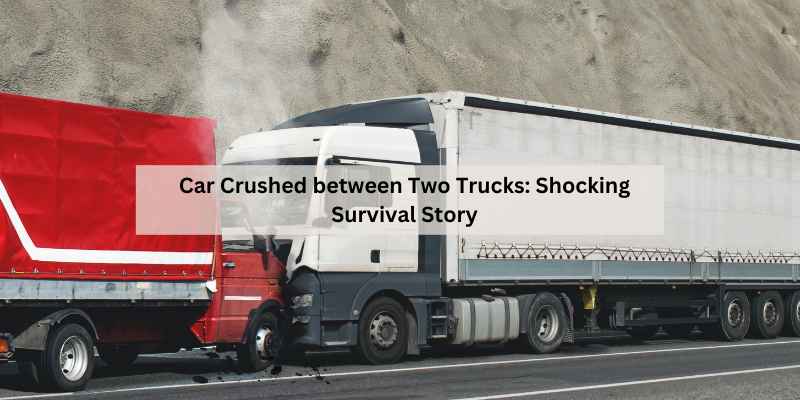
You have seen the photos. A compact sedan folded like an accordion, wedged between the front of one semi-truck and the rear of another. The cabin looks like it should be gone. Then you read the caption: the driver walked away with minor injuries. It sounds like a miracle, but it is not. It is physics, engineering, and a whole lot of luck working together in a specific sequence.
This article breaks down exactly what happens when a car is crushed between two trucks. We will look at how modern car safety engineering keeps the passenger compartment intact, what crash reports reveal about liability, and what you can do if you ever find yourself in a multi-vehicle pileup. This is not a horror story; it is a survival guide based on how these crashes actually play out.

McKay
McKay Metal Can Crusher, Wall-Mounted 12/16 Oz.…
- GREAT FOR THE ENVIRONMENT: Easily crushes cans to save room in the garbage or recycling bin by compressing to approx. 20% of its o…
- THE CAN CRUSHER / SMASHER makes recycling a breeze: Recycle aluminum soda, pop, and beer cans. For use with standard 16oz. aluminu…
- SAFE AND RELIABLE: mounts to any solid surface, wall, table, countertop, etc. Hardware included.
Before we get into the technical details, it helps to understand the forces at play. A loaded semi-truck can weigh 80,000 pounds. A typical sedan weighs around 3,500 pounds. When those two meet, the truck barely slows down. The car absorbs nearly all the kinetic energy. The only reason anyone survives is that the car is designed to sacrifice itself to save the occupants.
If you deal with cans at home the way these crashes deal with cars, you know the principle: compress something until it takes up less space. A McKay Metal Can Crusher does that to aluminum, flattening a 16 oz can down to about 20% of its original size. It is a handy tool for recycling, but the structural engineering in a car is the opposite: it is designed to keep its shape, not crush flat.
The Incident: A Chain-Reaction Pileup
Most of these severe cases start the same way. A highway accident occurs ahead, usually in low visibility or wet conditions. Traffic stops suddenly. A truck driver, who needs ten times the stopping distance of a car, cannot brake in time. The truck hits the car in front, pushing it into the next vehicle. That is the chain reaction.
In one documented case on a major interstate, a multi-vehicle pileup involved over 20 cars and several semi-trucks. The car in the middle was a small hatchback. It was hit from behind by one truck, which pushed it into the trailer of another truck stopped ahead. The car was compressed from roughly 14 feet in length to under 9 feet. The driver survived with a broken leg and a concussion.
Highway patrol reports often cite the same causes: following too closely, speed too fast for conditions, and driver fatigue. In many pileups, the initial crash is minor. The damage comes from the secondary impacts, as vehicles behind fail to stop. This is why emergency response teams talk about the “safe zone” — you want to be far away from the rear of a stopped truck.
The Vehicle: How Modern Car Safety Engineering Saved Lives
The passenger compartment of a modern car is a survival cell. It is built from high-strength steel, often boron steel, in the A-pillars, B-pillars, and rocker panels. These components are designed to resist deformation at forces that would have collapsed a car from the 1990s. The roof, floor, and side rails form a rigid cage.
When a car is crushed between two trucks, the cage is the last line of defense. The front and rear of the car are designed to crumple. They absorb the kinetic energy of the impact by folding in a controlled manner. This is why you see a car that looks completely destroyed from the outside, yet the doors can still open. The crumple zones did their job.
Crumple Zones vs. Truck Mass
Crumple zones work by converting kinetic energy into heat and deformation. They extend the duration of the impact. A longer impact time means a lower peak force on the occupants. It is simple physics: force equals mass times acceleration. If you slow down over 0.2 seconds instead of 0.05 seconds, the force on your body drops by 75%.
But there is a limit. A truck’s bumper sits high, often above a car’s rear crumple zone. This means the truck’s frame can override the car’s bumper and push directly into the trunk or cabin. This is called “underride.” It is why rear underride guards exist on trailers. When they fail, the results are catastrophic. In a crush scenario, the car’s roof and A-pillars take the brunt of the vertical and longitudinal forces.
Trucks also have a massive amount of stored energy. At 60 mph, a loaded truck has roughly 30 times the kinetic energy of a car. The car’s crumple zones absorb some of that, but the truck’s structure is essentially rigid. The car does all the deforming. This is why small cars fare worse than large sedans in truck collisions, but modern design has narrowed the gap.
The Role of Seatbelts and Airbags
A seatbelt is the single most important piece of safety equipment in a crash. It keeps you in your seat, so the airbag can do its job. In a crush scenario, the seatbelt prevents you from being thrown forward into the dashboard or steering wheel. It also distributes the deceleration forces across your pelvis and chest, rather than concentrating them on your head.
Airbags deploy based on crash severity sensors. In a high-speed impact, they inflate in about 30 milliseconds. They are designed to catch your head and torso as you move forward. However, airbags are only effective if you are belted. An unbelted occupant can hit the airbag at full speed and suffer severe head and neck injuries. The combination of a modern seatbelt pretensioner and a multi-stage airbag is what turns a fatal crash into a survivable one.
It is worth noting that side curtain airbags also play a role. In a sideways impact, they protect your head from hitting the window or the B-pillar. In a crush scenario, the cabin can deform inward. Curtain airbags provide a cushion between you and the collapsing structure. They are not a structural component, but they buy you precious milliseconds of protection.
The Survivor’s Story: From Impact to Escape
Survivors of these crashes describe the sound first. A deafening metallic screech, then a deep thud. The car shakes violently. Glass shatters. The airbags deploy with a loud pop and a cloud of dust. Then, silence. The engine is dead. The car is pinned.
The first thing to do is assess your own body. Move your fingers and toes. Check for blood. If you can move without sharp pain, try to turn off the ignition to prevent a fire. Do not try to open the doors if they are jammed. Wait for first responders. They have hydraulic rescue tools, often called the “Jaws of Life,” to cut the roof and pillars to free you.
One survivor recounted how she unbuckled her seatbelt and climbed out through the shattered rear window because the doors were crushed shut. She walked away with cuts and bruises. Another survivor, trapped for 45 minutes, said the hardest part was the waiting. He could hear the rescue crews working, but he could not see them. He focused on his breathing to stay calm.
Escape is not always immediate. In a severe crush, the cabin may be too small to move. The rescue team will stabilize the vehicle, then use spreaders and cutters to create an opening. They will likely remove the roof completely to access the patient. If you are conscious, talk to the rescuers. Tell them where you feel pain. Do not try to help them by moving the car yourself.
What the Crash Reports Reveal (Cause and Liability)
Official highway patrol reports are the ground truth. They document the sequence of events, the road conditions, and the contributing factors. In most truck-involved pileups, the primary cause is driver error. For trucks, that often means following too closely, distracted driving, or fatigue. Commercial drivers are regulated by hours-of-service rules, but violations happen.
Liability in a chain-reaction crash is rarely simple. The driver who rear-ends the car in front is usually presumed at fault. But in a multi-vehicle pileup, fault can be shared. The truck that started the chain reaction might be liable for all subsequent damage. The car that stopped abruptly might bear some responsibility if it stopped illegally. Insurance companies and lawyers will reconstruct the crash using black box data from the trucks and cars.
Road conditions matter. If the crash happened in fog or rain, the highway patrol will note visibility and pavement conditions. If the road was poorly maintained or lacked proper signage, the state or municipality could share liability. In one case, a pileup was attributed to a truck driver who was texting. The crash report noted the driver’s phone records showed active use at the time of impact. That evidence settled the liability question quickly.
For victims, the legal process is a marathon. You will deal with the trucking company’s insurance, which has high policy limits. You will need to prove damages: medical bills, lost wages, pain and suffering. A personal injury attorney who specializes in trucking accidents is essential. They know how to subpoena driver logs, maintenance records, and black box data. Do not accept a quick settlement offer without legal advice.
Survival Guide: What to Do When Trapped Between Trucks
If you see a truck behind you in your rearview mirror and it is not slowing down, you have seconds to act. Your goal is to avoid being the middle of the sandwich. Here is what to do.
- Brake hard and steer. Do not just stop. If there is a gap in the lane next to you, take it. Even moving half a car length forward can change the impact dynamics. Aim for the shoulder or the median if it is clear.
- If you must stop, leave space. Stop far enough behind the vehicle ahead so you can pull forward if needed. A truck needs a huge gap to stop. You need enough room to maneuver.
- Watch your mirrors. The moment you stop, check your rearview mirror. If a truck is barreling down, flash your brake lights and honk your horn. It might not hear you, but it is worth trying.
- Brace for impact. If impact is unavoidable, put your back against the seat, grip the wheel, and press your head against the headrest. This prevents whiplash and keeps your spine aligned. Do not put your arms out to brace against the dash.
- After the first hit, be ready for the second. If you are hit from behind, you will be pushed forward. You might hit the car ahead. Keep your foot on the brake to prevent rolling. Then, if you can, move your car to the side of the road immediately. Do not sit in the travel lane.
Remember that your car’s safety systems are designed for a single impact. A second impact from another truck can overwhelm them. Your best chance is to be out of the lane and on the shoulder. Even then, stay buckled up. The shoulder is not a safe zone if the pileup continues.
The Aftermath: Trauma, Recovery, and Legal Steps
The physical injuries from a crush can range from cuts and bruises to spinal fractures and internal bleeding. The hospital timeline is often days, not hours. You will likely have CT scans, X-rays, and possibly surgery. Even if you feel fine, internal injuries can be delayed. Go to the emergency room immediately after any significant crash.
The psychological aftermath is real. Post-traumatic stress disorder (PTSD) is common after a near-fatal crash. Survivors report flashbacks, anxiety while driving, and difficulty sleeping. This is not weakness; it is a normal response to an abnormal event. Therapy, particularly cognitive behavioral therapy, is effective. Support groups for crash survivors exist online and in person. Do not try to tough it out alone.
On the legal side, you have the right to compensation. This covers medical expenses, lost income, and pain and suffering. In many states, you have a limited window, often two years, to file a lawsuit. The clock starts on the date of the crash. You need to document everything: medical records, repair estimates, photos of the scene, and a diary of your recovery.
Insurance companies will try to minimize your payout. They will argue that your injuries were pre-existing or that you were partially at fault. This is why you need an attorney. A good lawyer will negotiate with the trucking company’s insurer and, if necessary, take the case to trial. The average settlement for a serious truck accident injury is significantly higher when a lawyer is involved.
For your own peace of mind, consider a dash cam. It provides an unbiased record of the events leading up to a crash. It can be the difference between a fair settlement and a lengthy legal battle. It is a small investment that pays for itself in stress reduction alone.
Expert Insights on Truck vs. Car Collisions
Let us look at the real-world data. Crash tests like the IIHS small overlap front test simulate a car hitting a fixed barrier at 40 mph. That is a severe test, but it does not replicate the mass of a truck. A truck crash is more like hitting a wall that does not move. The car absorbs all the energy.
Small cars, like the Suzuki Swift or Tata Nexon, have improved their safety ratings dramatically in recent years. They now feature six airbags and high-strength steel cages as standard. However, in a real-world truck collision, physics still matters. A heavier car has more momentum and will be pushed less. A lighter car will be crushed more. The safety cage can only do so much.
Compared to a US sedan like a Toyota Camry, a small hatchback is at a disadvantage. The Camry has a longer crumple zone and more mass. It will absorb more energy before the cabin is affected. In a crush scenario, every inch of crumple zone counts. This is not a criticism of small cars; it is a reason to understand their limits.
Structural integrity is not just about steel strength. It is about how the frame is designed to deform. A good design directs the crush forces away from the cabin, along the floor rails and side sills. A poor design lets the forces push the firewall into the driver’s legs. This is why some cars earn top marks in crash tests while others do not.
The bottom line is that you can survive a car crushed between two trucks, but it requires a modern car, a seatbelt, and a bit of luck. The engineering has come a long way, but the best strategy is still to avoid the situation entirely. Keep your distance from trucks, stay alert, and know what to do when the world goes wrong around you.
For more on handling tight spaces and avoiding collisions, check out this guide on parking between cars. And if you are reviewing your insurance coverage after a close call, this article on car insurance coverage is worth a read. Finally, equipping your vehicle properly starts with the basics, like a reliable jump starter for trucks in your emergency kit.
What You Should Remember
- Your car’s crumple zones are designed to sacrifice the hood and trunk to save the cabin. Trust them, but do not test them.
- Always wear a seatbelt. It is the difference between walking away and being carried out.
- In a pileup, your goal is to avoid being the middle vehicle. Steer for the shoulder if you have any room.
- After a crash, get medical attention even if you feel fine. Internal injuries can be silent.
- PTSD is a real injury. Seek therapy if you are struggling after a crash.
- Get a lawyer before you talk to any insurance adjuster after a truck accident.
- A dash cam is your best witness. Install one before you need it.
Products related to this article
Sponsored / affiliate links. As an Amazon Associate I earn from qualifying purchases. I may earn additional commission from eligible campaigns.