ACDelco Knock Sensor Review for GM Owners
ACDelco is the safest first pick for GM knock-sensor repairs, but buy the wiring and seals too if your 5.3L or 6.0L truck shows corrosion, oil, or coolant in the valley. Ignoring a bad sensor circuit can leave you with persistent knock-retard, poor drivability, and repeated code returns. This guide compares ACDelco fitment, common kit contents, and the signs that the fault is really a sensor, wiring, connector, or diagnosis problem.
Verdict

For GM owners, the main value is fitment confidence. GM OE-style parts are the better bet when you want the connector shape, sealing, and application match to track the original design instead of chasing a bargain part that fits loosely or needs trimming. That said, a new sensor alone will not cure broken wiring, a corroded connector, or a valley leak that keeps soaking the circuit.
Pros
- GM OE-style replacement with application coverage that matters for truck fitment.
- Better starting point when you want connector and sealing confidence.
- Lower risk of chasing a false code with the wrong part family.
Cons
- Single-sensor replacement may not solve a wiring or connector fault.
- Fitment still has to be checked by year, engine, and bank layout.
- Access can turn into intake work, so labor cost may exceed the part price.
Specs at a glance
| Item | What the listing says | Buyer takeaway |
|---|---|---|
| Part type | GM OE knock sensor, single sensor, OE update | Best when you need an OE-style sensor, not a universal substitute. |
| Brand | GM GENUINE PARTS | Good fitment confidence for GM applications. |
| Coverage | Chevrolet, Buick, GMC, and Cadillac applications | Match the exact model year, engine code, and bank before ordering. |
| Design note | Updated OE design with newer materials and technologies | Useful if you want a current OE-style revision. |
| Install planning | Sensor only | You may still need a wiring pigtail, connector, or intake gasket set. |
Who it
This fits GM owners who want an OE-style fix for a Silverado, Sierra, Tahoe, Yukon, Avalanche, Hummer, or similar truck or SUV with a confirmed knock-sensor fault. It also suits anyone replacing a sensor on a 5.3L or 6.0L engine and wanting the shortest path back to factory-style fitment.
It is less attractive if you already see coolant in the valley, oil contamination in the connector, or brittle wiring near the sensor. In those cases, the sensor may be only one piece of the repair, and a kit or wiring-first plan can make more sense.
Best fit for Silverado and Sierra repairs
For Silverado and Sierra trucks, the appeal is straightforward: GM trucks often reward parts that match the original connector, sealing, and engine-family layout. ACDelco-style OE parts are the safer buy when your goal is to avoid adapter trouble or a part that “fits” but leaves the code active.
Say your 5.3L Silverado flashes a knock-sensor code after a wet-season wash and the connector shows green corrosion. In that case, the sensor itself may be fine, but the OE-style replacement path still makes sense because the wiring and seal quality matter as much as the sensor body.
When a kit makes more sense than a sensor alone
A kit makes more sense when the wiring is heat-brittle, the connector seal is damaged, or the engine valley has signs of moisture or coolant intrusion. Knock sensors live in a harsh spot on many GM engines, so replacing only the sensor can leave the original wiring fault untouched.
A common first-timer mistake is buying a single sensor for a truck that really needs two sensors, a valley loom, and intake gaskets. On many GM V8 applications, the labor to reopen the intake again is the expensive part, so check the full circuit before you order.
What works
OE-style fitment confidence
GM OE-style parts are the short list for a reason. The sensor family, connector shape, and sealing approach are more likely to line up with the original GM calibration and wiring design than a generic low-cost replacement. That matters because a knock sensor is part of the engine’s detonation strategy, not just a plug-in switch.
Connector and wiring compatibility checks
Before buying, verify the connector shape, seal condition, and engine-family compatibility. The knock sensor connector is a corrosion-prone electrical interface, and a wiring loom can fail from heat, oil, or coolant exposure even when the sensor itself still reads normally. Match the OE-style plug and the engine layout, not just the code.
- Confirm the exact year, make, model, and engine.
- Check whether your engine uses one sensor, two sensors, or a full kit.
- Inspect the connector for corrosion, broken locks, and hardened seals.
- Check the wiring for chafing, oil soak, and brittle insulation.
- Scan for the code and note freeze-frame data before replacing parts.
Why GM owners keep this on the short list
GM owners keep ACDelco-style parts on the shortlist because they reduce guesswork in a repair where guesswork is expensive. The wrong sensor can waste time, but the wrong wiring loom or connector can leave you with the same code and an unnecessary second teardown.
GM knock sensor testing should always come before the parts order if the fault is unclear. A scan tool, continuity checks, and a quick look at engine-family fitment tell you more than the code alone.
What does not?
The main drawback is that fitment can vary by year and engine. A 5.3L and a 6.0L may both need knock-sensor service, but their access, connector routing, and related hardware can differ by platform and model year. A part that fits one truck may not be the right answer for another.
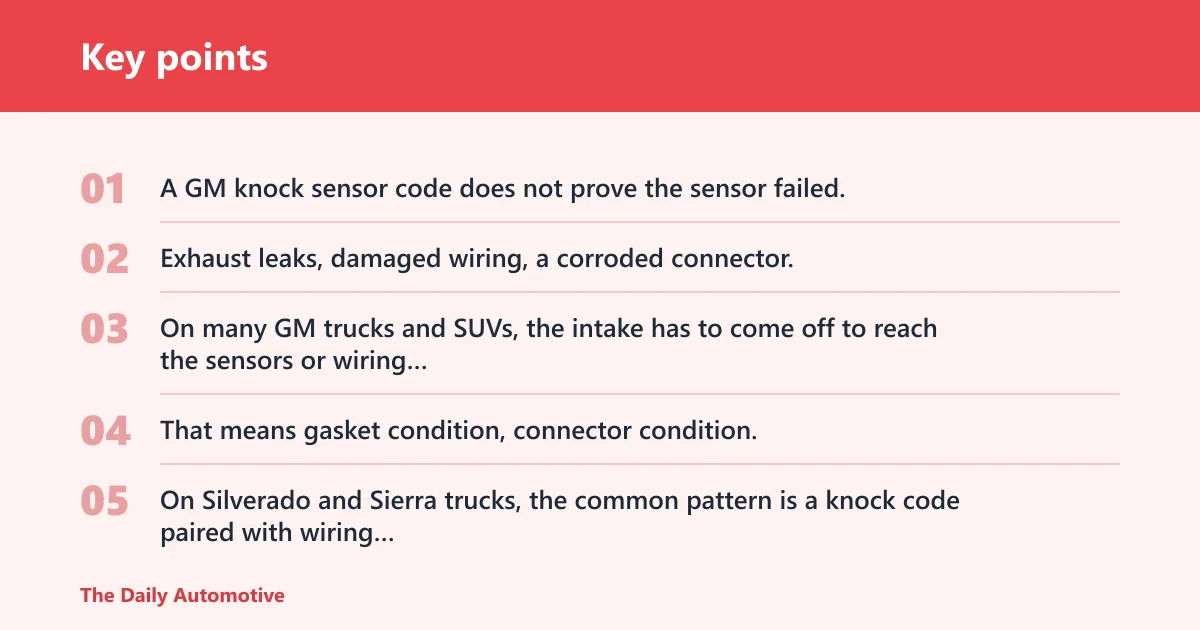
The second drawback is diagnostic ambiguity. A GM knock sensor code does not prove the sensor failed. Exhaust leaks, damaged wiring, a corroded connector, or valley moisture can all distort the signal the engine computer sees.
There is also the access issue. On many GM trucks and SUVs, the intake has to come off to reach the sensors or wiring properly. That means gasket condition, connector condition, and surrounding leaks all deserve a look before you buy only the sensor.
GM knock sensor decision table
| Symptom | Likely cause | Required part or parts | Replace now or inspect first |
|---|---|---|---|
| Persistent knock-retard under light throttle on a 5.3L | Sensor signal issue, loose connector, or wiring damage | Sensor, wiring, and connector inspection | Inspect first unless the circuit is already visibly damaged |
| Check-engine light with a knock sensor code after intake work | Connector not seated, pin damage, or wiring misroute | Connector check, continuity test, possible wiring | Inspect first |
| Intermittent code return on a 6.0L with oil in the valley | Moisture, seal failure, or sensor contamination | Knock sensor kit, wiring, intake gaskets | Replace now if contamination is confirmed |
| Rough running plus knock code after heavy rain or wash | Water intrusion at connector or wiring | Wiring and connector repair, then sensor if needed | Inspect first |
| Code with no obvious wiring damage but audible pinging under load | Possible real sensor fault or unrelated engine issue | Scan-tool data, wiring checks, sensor replacement only if confirmed | Inspect first |
| Multiple codes plus vacuum or exhaust leak symptoms | Signal distortion from another engine problem | Leak repair, then retest the circuit | Inspect first |
Typical Silverado and Sierra trouble patterns
On Silverado and Sierra trucks, the common pattern is a knock code paired with wiring age, valley moisture, or intake-related work history. That is why sensor-only replacement sometimes disappoints. The sensor may be new, but the circuit still has a bad ground path or a damaged seal.
Suppose a Sierra 6.0L shows a knock code, but the wiring plug has crusty terminals and the intake valley shows traces of coolant. In that case, replacing only the sensor is a half-fix. The smarter move is to inspect the wiring, connector, and gasket stack at the same time.
What causes a GM knock sensor code?
A GM knock sensor code can come from the sensor itself, but that is only one possible cause. More often, the problem is wiring damage, a corroded connector, a seal issue, or another engine problem that makes the signal look wrong to the control module. Scan-tool confirmation matters here.
GM knock sensor testing should include continuity checks on the wiring, a visual check for corrosion or pin fit, and plausibility checks under engine load. A code without those checks is only a clue, not proof.
Sensor failure
The sensor can fail internally or drift out of range. When that happens, the engine computer may lose accurate detonation feedback and set a code. A direct replacement is reasonable only after the connector and wiring have been ruled out.
Wiring or connector damage
Heat, oil, coolant, and vibration attack the wiring and connector first. A damaged seal or loose terminal can create a false fault even when the sensor body is fine. That is why kit contents matter so much on GM V8 repairs.
Signal problems from other engine issues
Exhaust leaks, vacuum leaks, or other combustion issues can create noise or signal behavior that looks like knock. In those cases, the sensor is reporting a real abnormal condition or a distorted one, and replacement alone will not fix the root cause.
Should you buy it?
Buy the ACDelco sensor if you want the safest OE-style starting point and your fitment check lines up with the exact GM engine and year. Buy a kit instead if the job involves both sensors, a tired wiring loom, or a valley opening that should not be repeated twice.
For a clean, confirmed sensor fault, the ACDelco part makes sense. For a code with corrosion, oil, or connector damage, it is better to plan the repair around the full circuit, not the sensor alone.
Sensor-only versus kit
Sensor-only is the leaner choice when the wiring tests good and the connector is clean. A kit is the better choice when the truck has the common GM valley issues that make the original wiring and seals suspect. Match the repair to the condition you can verify.
When to replace the wiring too
Replace the wiring when the insulation is brittle, the pins are loose, or the connector has green corrosion. On many GM applications, the wiring is a known weak link because it lives near heat and contamination sources. Leaving it in place can bring the code back.
Cost stack to plan
The real cost is usually parts plus access. A single sensor may be inexpensive, but intake gaskets, a wiring loom, connector work, and labor time can raise the total quickly. If the intake has to come off, plan for the gasket stack and any related seals before you start.
Alternatives
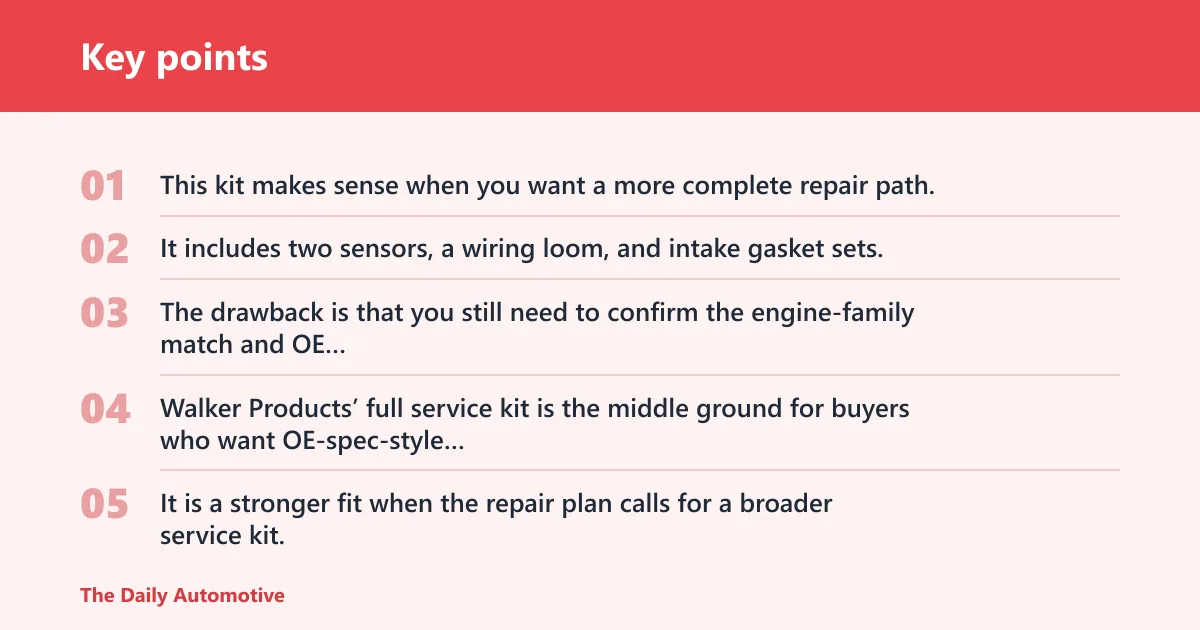

This kit makes sense when you want a more complete repair path. It includes two sensors, a wiring loom, and intake gasket sets, which is the right shape for many 4.8L, 5.3L, and 6.0L GM jobs where the problem may be bigger than the sensor alone. The drawback is that you still need to confirm the engine-family match and OE replacement numbers before ordering.

Walker Products’ full service kit is the middle ground for buyers who want OE-spec-style fitment and electronic sensor output without sticking to a single-sensor OE part. It is a stronger fit when the repair plan calls for a broader service kit, but the drawback is the same one that applies to any non-OE kit: check the exact application, connector style, and included hardware for your truck.
Frequently asked questions
Is an ACDelco knock sensor worth it for a GM truck?
Yes, if you want the safest OE-style starting point for a GM truck and you have confirmed the exact year, engine, and connector style. It is a smart buy when the problem is likely the sensor itself, but it is less useful if the wiring or connector is the real fault.
What ACDelco knock sensor kit do I need for a 5.3?
Pick the kit that matches your exact 5.3L year break and cylinder-bank layout. Some trucks need a sensor-only replacement, while others need two sensors, a wiring loom, and intake gaskets. Confirm the vehicle details first, then verify the OE-style connector and included parts.
How do I test a GM knock sensor before replacing it?
Start with a scan tool to confirm the code and check live data or knock-retard behavior. Then inspect the connector for corrosion and test wiring continuity with a multimeter. If the wiring checks out and the signal still looks wrong under load, the sensor becomes the stronger suspect.
Where is the knock sensor located on a GM 6.0?
On many GM 6.0L setups, the knock sensors sit in the engine valley under the intake manifold, but the exact access and layout vary by platform and model year. Before you buy parts, confirm the bank layout and whether the job needs one sensor, two sensors, or a wiring loom.
How much does a knock sensor replacement cost?
The total usually includes the sensor or kit, gaskets, and labor for access. A low-cost sensor can become a much larger bill if the intake has to come off and the wiring or connector also needs attention. Plan for parts plus related sealing hardware, not just the sensor price.
Products related to this article
Sponsored / affiliate links. As an Amazon Associate I earn from qualifying purchases. I may earn additional commission from eligible campaigns.