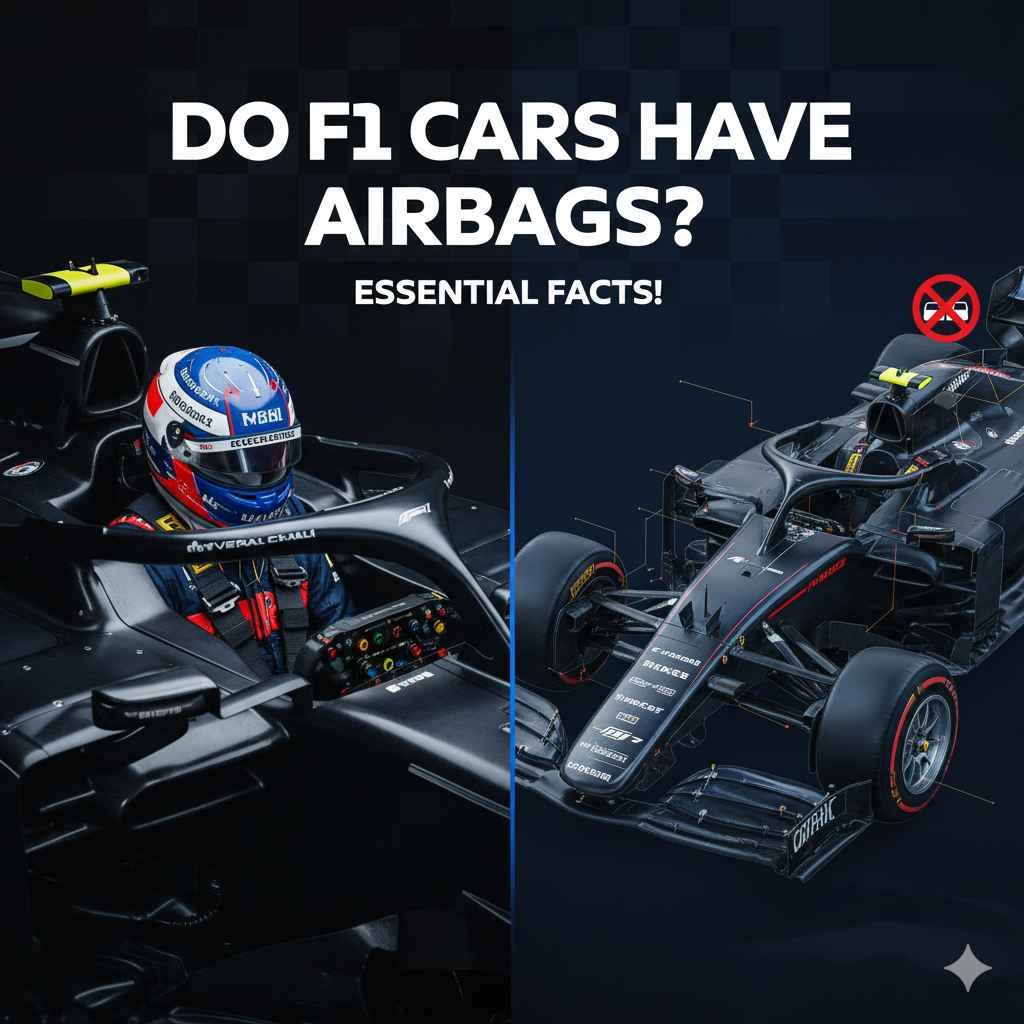
Do F1 Cars Have Airbags? Essential Facts!
No, Formula 1 cars do not have airbags as we know them in road cars. Instead, they rely on a comprehensive suite of advanced safety features, including a robust survival cell, advanced head and neck support (HANS) device, and extensive driver protective gear, to ensure driver safety in high-speed racing environments. These specialized systems are designed specifically for the unique demands of F1 racing.
Ever watched a Formula 1 race and seen those incredible speeds and daring maneuvers? It makes you wonder about the protective gear inside those sleek machines, right? One common question that pops up is: do F1 cars have airbags? It’s a totally fair question, especially when we see airbags protecting us in our everyday vehicles. But the world of F1 is a bit different, and their approach to driver safety is incredibly specialized. Don’t worry, we’re going to break down exactly how F1 drivers stay safe, even without those familiar inflated cushions. You’ll learn about the ingenious safety systems that have been developed over decades, making F1 one of the safest motorsports today. Let’s dive in and uncover the essential facts!
The Truth About Airbags in Formula 1
When you think about safety in cars, airbags are usually one of the first things that come to mind. They’ve become a standard feature in almost every car on the road, designed to deploy instantly in a crash and cushion the driver and passengers. However, in the high-octane world of Formula 1, the concept of an airbag is very different, and generally, they are not used. This might be surprising, given the extreme speeds and forces involved in F1 racing.
The reason behind this decision is rooted in the unique nature of F1 cars and the specific risks drivers face on the track. We need to understand that F1 engineers and safety experts have developed an entirely different, but equally effective, set of protective measures tailored to their sport. These measures focus on structural integrity, driver restraint, and impact absorption in ways that differ significantly from road car safety systems.
Why F1 Cars Don’t Have Traditional Airbags
So, why are F1 cars missing the airbags we see in regular cars? It all comes down to a few key factors that are unique to racing. Firstly, F1 drivers are strapped into their seats with incredibly strong six-point harnesses. These harnesses are designed to keep the driver firmly in place, preventing them from moving forward into the steering wheel or dashboard during a significant impact. In a road car, airbags work in conjunction with seatbelts to provide that extra layer of protection and prevent harmful contact with the car’s interior.
In an F1 car, the harness system is so effective that a traditional airbag might actually interfere with the driver’s ability to control the car or even cause injury if it deployed inappropriately during a violent maneuver or a minor incident that doesn’t warrant full deployment.
Secondly, F1 cars have a very compact and purpose-built cockpit. There simply isn’t much space for the kind of large airbag systems found in road cars. The space is optimized for the driver’s position, steering, and controls. Introducing a bulky airbag system would compromise this crucial design element. Instead, the focus has been on making the cockpit itself an incredibly strong safety cell, designed to withstand massive impacts. The materials and construction of the survival cell are paramount, offering a protective shell around the driver. This structural integrity is the primary line of defense, and it’s been continuously improved over the years through rigorous testing and technological advancements.
Finally, the types of impacts F1 cars experience are different. While collisions can be severe, they often involve high-speed sliding, impacts with other cars or barriers, and sometimes rollovers. Airbags are primarily designed for frontal or side impacts where the occupant might move forward or sideways. In F1, the protective measures are designed to handle a broader range of extreme events. This includes ensuring the driver’s head and neck are protected, which leads us to other vital safety innovations. The entire ecosystem of F1 safety is a holistic approach rather than relying on a single component like an airbag.
The Specialized Safety Features of F1 Cars
While F1 cars skip the traditional airbags, safety is their absolute top priority. The engineers and the governing body, the Fédération Internationale de l’Automobile (FIA), have developed a sophisticated array of safety features that work together to protect the driver. These systems have evolved significantly over the decades, driven by some terrible accidents that have sadly punctuated the sport’s history. The goal is to create a protective bubble around the driver that can withstand immense forces.
The Survival Cell: F1’s Strongest Defense
The heart of F1 driver safety lies in the monocoque, often referred to as the survival cell. Think of this as the driver’s personal safety capsule. It’s a highly engineered, incredibly strong structure made from layers of carbon fiber composites. The monocoque is designed to be extremely rigid and impact-resistant, capable of absorbing and dissipating enormous amounts of energy during a crash. It surrounds the driver, shielding them from direct impact with foreign objects and absorbing the shock of collisions.
The construction of the survival cell is a marvel of engineering. Carbon fiber is chosen for its exceptional strength-to-weight ratio, meaning it’s incredibly strong but also very light. This is crucial in racing, where every kilogram counts. The layers of carbon fiber are laid up by hand in a precise manner, then cured under heat and pressure in an autoclave. This process creates a seamless, incredibly robust shell. The cell is designed to protect the driver from impacts from the front, side, rear, and even from impacts with the wheels (which can detach during a crash).
According to the FIA’s technical regulations, the survival cell must meet extremely stringent performance standards. For instance, it must be able to withstand significant frontal and side impacts, as well as resist penetration from sharp objects. The FIA mandates rigorous crash testing to ensure each car’s survival cell can perform under extreme conditions before it’s allowed to compete. Organizations like NHTSA and other automotive safety bodies also research and develop standards that influence global automotive safety, though F1’s requirements are specific to its unique context.
The Halo Device: A Revolution in Cockpit Protection
One of the most visually striking safety innovations in recent F1 history is the Halo device. Introduced universally in 2018, the Halo is a T-shaped carbon fiber structure that sits above and around the driver’s head. Its primary purpose is to protect the driver from large debris striking the cockpit and to prevent the car from bottoming out on the driver’s head in the event of a rollover. Before the Halo, drivers were vulnerable to impacts from flying tires or wreckage, which could have devastating consequences.
The Halo is incredibly strong. It’s designed to support a load of up to five tons, meaning it can withstand immense downward forces. It’s attached to the car’s survival cell at three points, ensuring its stability even in severe accidents. Since its introduction, the Halo is credited with saving several drivers from serious injury by deflecting debris and preventing direct cranial impact. It has fundamentally changed the safety landscape of Formula 1 and is a prime example of how the sport continues to innovate in driver protection.
The development and testing of the Halo involved extensive simulations and physical tests. The FIA, the international motorsport governing body, meticulously researched its effectiveness and integration into car design. Its adoption was a significant step forward, demonstrating a commitment to driver well-being above all else.
Head and Neck Support (HANS) Device
The Head and Neck Support (HANS) device is another crucial piece of equipment that drivers wear. It’s a Y-shaped collar worn over the shoulders and around the neck, which is then tethered to the driver’s helmet. Its main function is to prevent the head from whipping forward excessively during a sudden deceleration, such as in a crash or even during hard braking. Without the HANS device, the inertia of the driver’s head could cause severe whiplash injuries, damage to the spinal cord, or other critical neck trauma.
The HANS device works by distributing the forces experienced by the neck and head across the chest and shoulders. This significantly reduces the strain on the cervical vertebrae. Like the Halo and survival cell, the HANS device is made from lightweight, high-strength materials, typically carbon fiber. It has been mandatory in Formula 1 since 2003 and is considered a vital component of the driver’s personal safety gear. Its widespread adoption has dramatically reduced the incidence of severe neck injuries in motorsport.
Fire Safety Systems
Fire is a significant risk in motorsport, and F1 cars are equipped with advanced fire suppression systems. These systems are designed to extinguish flames rapidly in the cockpit and engine bay. Typically, they consist of one or more fire extinguishers controlled by the driver and often by remote activation from race control. These systems use specialized extinguishing agents that can quickly suppress fuel and oil fires common in racing incidents.
Modern F1 cars also feature fire-retardant materials throughout the cockpit and in the driver’s race suit. The driver’s overalls are made from multiple layers of Nomex or similar fire-resistant fabrics. This provides crucial minutes of protection in the event of a fire, allowing the driver to escape the vehicle or for marshals to intervene. The effectiveness of these fire safety measures is regularly reviewed and updated by the FIA to meet the highest standards.
Other Key Safety Components
Beyond the major systems, F1 cars incorporate numerous other safety features:
- Seatbelts: As mentioned, F1 cars use a six-point harness system. This intricate arrangement secures the driver firmly in their seat, distributing forces across their pelvis and shoulders and preventing ejection from the cockpit.
- Driver Extraction System: In the event of an accident, marshals and medical crews can quickly and safely extract the driver. This involves specific protocols and often the use of specialized tools to deal with damaged car structures.
- Wheel Tethers: To prevent detached wheels from becoming dangerous projectiles, F1 cars are fitted with strong tethers that attach the wheels to the chassis. These are made of incredibly strong materials like Kevlar and are designed to withstand immense forces.
- Improved Track Safety: While not part of the car itself, track safety has also evolved dramatically. This includes advanced barrier systems (like SAFER barriers), larger run-off areas, and highly trained medical and rescue crews. The Formula 1 regulations governing track design and operation are constantly updated to enhance overall race safety.
A Comparative Look: F1 vs. Road Cars Safety
It’s fascinating to compare the safety philosophies behind F1 cars and everyday road vehicles. While both aim to protect occupants, they do so under vastly different circumstances and with different priorities.
F1 Cars:
- Focus: Preventing severe injury or fatality for a single, highly trained occupant in extreme, controlled environments.
- Key Technologies: Survival cell, Halo, HANS device, advanced fire suppression, six-point harnesses, driver-integrated suits.
- Design Philosophy: Robust, purpose-built cockpit that is the primary safety structure. Driver is integrated into the car’s safety system.
- Crash Types: High-speed impacts, rollovers, debris.
Road Cars:
- Focus: Protecting a potentially varied number of occupants (adults, children) of all ages and physical conditions in unpredictable, real-world crash scenarios.
- Key Technologies: Airbags (frontal, side, curtain), seatbelts, crumple zones, anti-lock braking systems (ABS), electronic stability control (ESC).
- Design Philosophy: Energy-absorbing chassis (crumple zones) and passive restraint systems (airbags, seatbelts) that react to impact.
- Crash Types: Frontal, side, rear impacts, rollovers, often at lower speeds than F1.
The table below highlights some key differences:
| Feature | Formula 1 Car | Typical Road Car |
|---|---|---|
| Primary Head Protection | Halo device, advanced helmet, HANS device | Airbags (front, side, curtain), seatbelts |
| Cockpit Structure | Extremely rigid monocoque (survival cell) | Energy-absorbing crumple zones |
| Occupant Restraint | Six-point harness | Three-point seatbelts |
| Impact Energy Management | Structural integrity of survival cell, driver integration | Deformation of car body, airbag deployment |
| Fire Safety | Advanced suppression systems, multi-layer fireproof suits | Standard fire suppression basics, fire-retardant materials |
The key takeaway is that F1 safety is about active prevention and extreme structural integrity, designed for a specific, highly controlled environment with a single, trained occupant. Road car safety, on the other hand, is about reactive protection for a diverse range of occupants in unpredictable situations, utilizing systems like airbags which are designed to deploy in specific scenarios and cushion occupants as they move within the cabin.
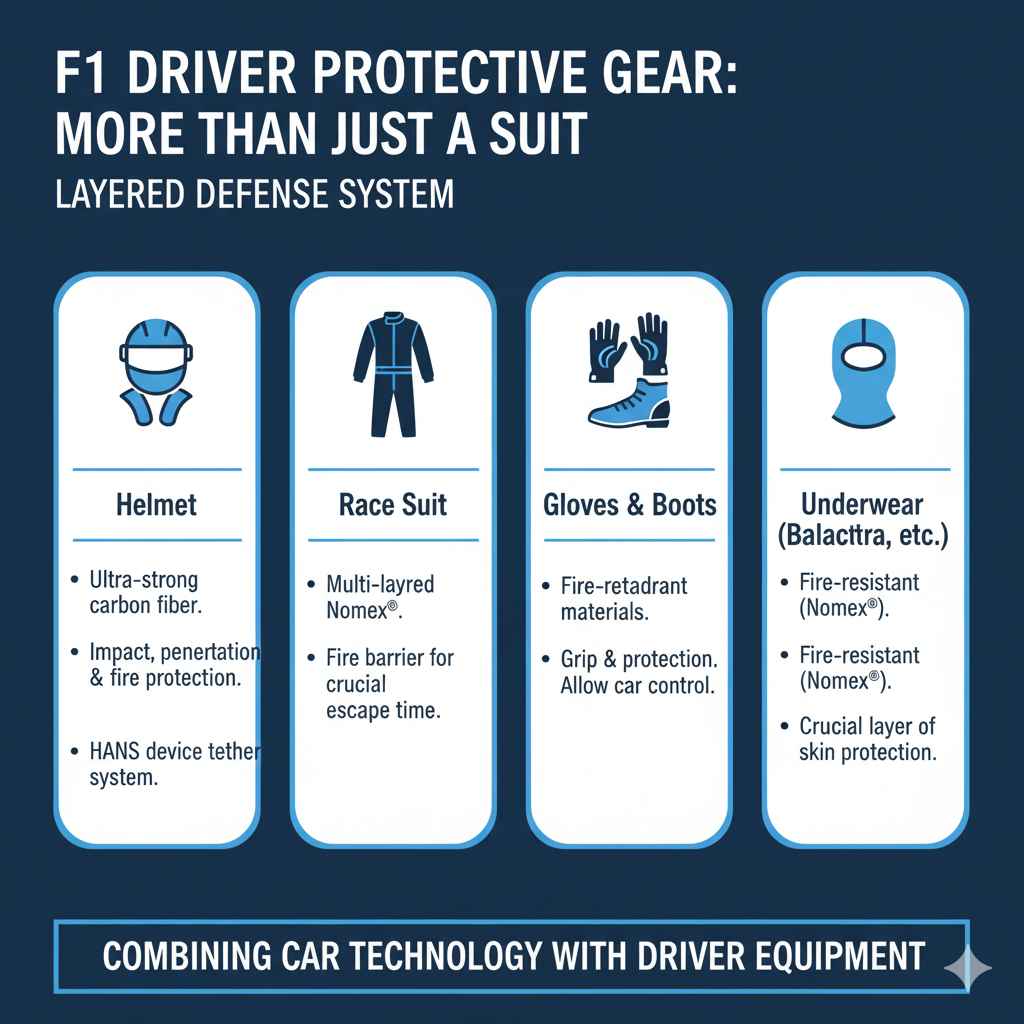
F1 Driver Protective Gear: More Than Just a Suit
The driver’s personal gear is an extension of the car’s safety systems. Every item is rigorously tested and certified by the FIA to ensure it provides the highest level of protection.
- Helmet: F1 helmets are incredibly advanced. They are made from ultra-strong carbon fiber composites, designed to protect against impacts, penetration, and fire. They feature advanced visors, communication systems, and are tested to withstand extreme forces. They also include a safety tether system that connects to the HANS device.
- Race Suit: The multi-layered suit, typically made from Nomex or similar aramid fibers, acts as a fire barrier. It’s designed to withstand direct flame contact for a significant period, giving the driver crucial time to escape.
- Gloves and Boots: These are also made from fire-retardant materials and are designed to provide grip and protection while allowing the driver to operate the car’s controls effectively.
- Underwear (Balaclava, etc.): Even the underwear worn by the driver is fire-resistant and made from materials like Nomex.
This comprehensive approach – combining car technology with driver equipment – creates a layered defense system that has continuously improved the safety of Formula 1 racing.
Frequently Asked Questions About F1 Safety
Q1: If F1 cars don’t have airbags, how are drivers protected in frontal impacts?
F1 cars rely on their incredibly strong survival cell (monocoque) to absorb and dissipate impact energy in frontal collisions. This reinforced cockpit structure is designed to remain intact and protect the driver from severe forces and debris.
Q2: Are there any situations where an F1 car might deploy something like an airbag?
No, traditional airbags that inflate rapidly are not used. The safety systems are entirely different, focusing on structural integrity and restraint systems rather than inflatable cushions.
Q3: What is the main purpose of the Halo device?
The Halo’s primary purpose is to protect the driver’s head from large pieces of debris striking the cockpit and to prevent the car from crushing the driver’s head in the event of a rollover.
Q4: How does the HANS device work?
The HANS device is a collar worn around the neck and shoulders, tethered to the helmet, which limits the forward and backward movement of the driver’s head. This reduces the risk of severe neck and spinal injuries during sudden decelerations.
Q5: Are F1 drivers protected from fire in the car?
Yes, F1 drivers are protected by a multi-layered fire suppression system within the car and by their own fire-resistant race suits and underwear, which are designed to withstand extreme heat for a substantial period.
Q6: Who is responsible for enforcing safety standards in F1?
The Fédération Internationale de l’Automobile (FIA) is the world governing body for motorsport and is responsible for setting and enforcing all safety regulations for Formula 1, including car design, track safety, and driver equipment.
Conclusion: A Legacy of Continuous Safety Improvement
So, while the familiar puff of an airbag might be absent from the cockpit of a modern Formula 1 car, it’s crucial to understand that this doesn’t mean less safety. Quite the opposite. F1 has pioneered some of the most advanced safety technologies in any field, and the absence of airbags is a conscious decision based on the unique requirements of the sport. The focus has shifted to creating an impenetrable survival cell, providing overhead protection with the Halo, supporting the driver’s head and neck with the HANS device, and ensuring robust fire safety measures.