How Fast Do NASCAR Drivers Actually Go? Track Speeds
NASCAR Cup cars can reach high speeds at superspeedways and usually run much slower in corners, with race speed varying by track. Mix those figures up, and you get bad comparisons and false claims about which tracks are fastest. This guide separates top speed, average race speed, and corner speed, then compares them by track type.
How fast do NASCAR drivers actually go?


The short answer: it depends on which speed you mean
A single NASCAR speed number rarely tells the full story. Top speed is the peak a car reaches on a straightaway, average race speed blends the whole event, and corner speed is what matters when the driver is steering hard and giving up speed for grip. Those numbers can be far apart.
That is why a car can flash over 200 mph on a drafting track and still post a much lower race average. Cautions, pit stops, and traffic all drag the average down. Corner speed is lower still, because the car cannot stay flat-out through every turn.
📊 Modern NASCAR engines are described as producing approximately 510 horsepower. Source: How Fast Do Nascar Cars Run on Ovals?.
What is the difference between top speed, average speed, and corner speed?

Top speed is the fastest instant a car reaches, usually on a straightaway or in a draft. Average speed is the whole lap or race distance divided by elapsed time. Corner speed is the speed a driver carries through a turn, where braking, grip, and steering angle matter most.
How NASCAR timing loops turn lap time into speed
NASCAR uses timing loops in the track surface to measure speed. Those loops register the exact moment each car crosses designated points. From there, speed is calculated from lap distance and elapsed time, so the reported figure is a calculated result rather than a direct radar reading.
That matters because a fast lap can hide what happened in the corners. If a car brakes hard before a turn, then accelerates on exit, the lap average may look ordinary even though the straightaway speed was very high. Lap time smooths out those peaks and dips.
Why a fast lap is not the same as a fast race
A qualifying lap is usually run under cleaner conditions than a race lap. No long caution periods. Fewer cars in the way. Less fuel burn and less tire falloff. A race average includes every green-flag mile, plus slow laps behind pace cars and laps lost to pit cycles.
Suppose a 400-mile race includes several caution periods and a handful of pit stops. The car may spend long stretches well below green-flag pace, so the official average speed can look much lower than the speed fans saw on the fastest laps. That is normal, not a contradiction.
How fast do NASCAR drivers go at Daytona and Talladega?
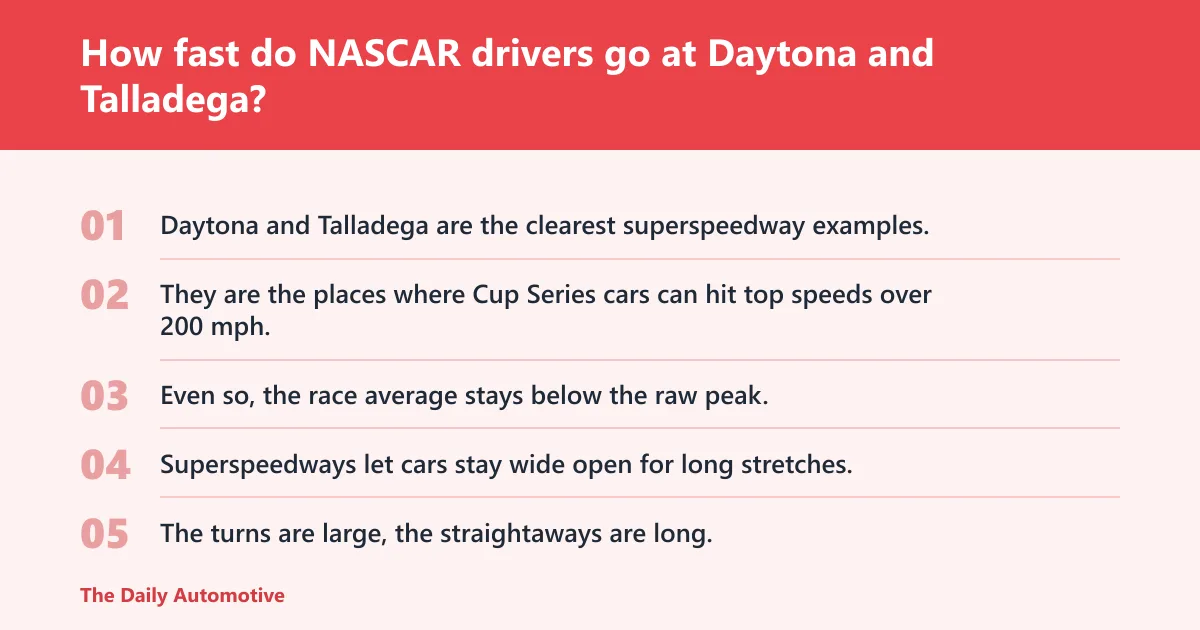
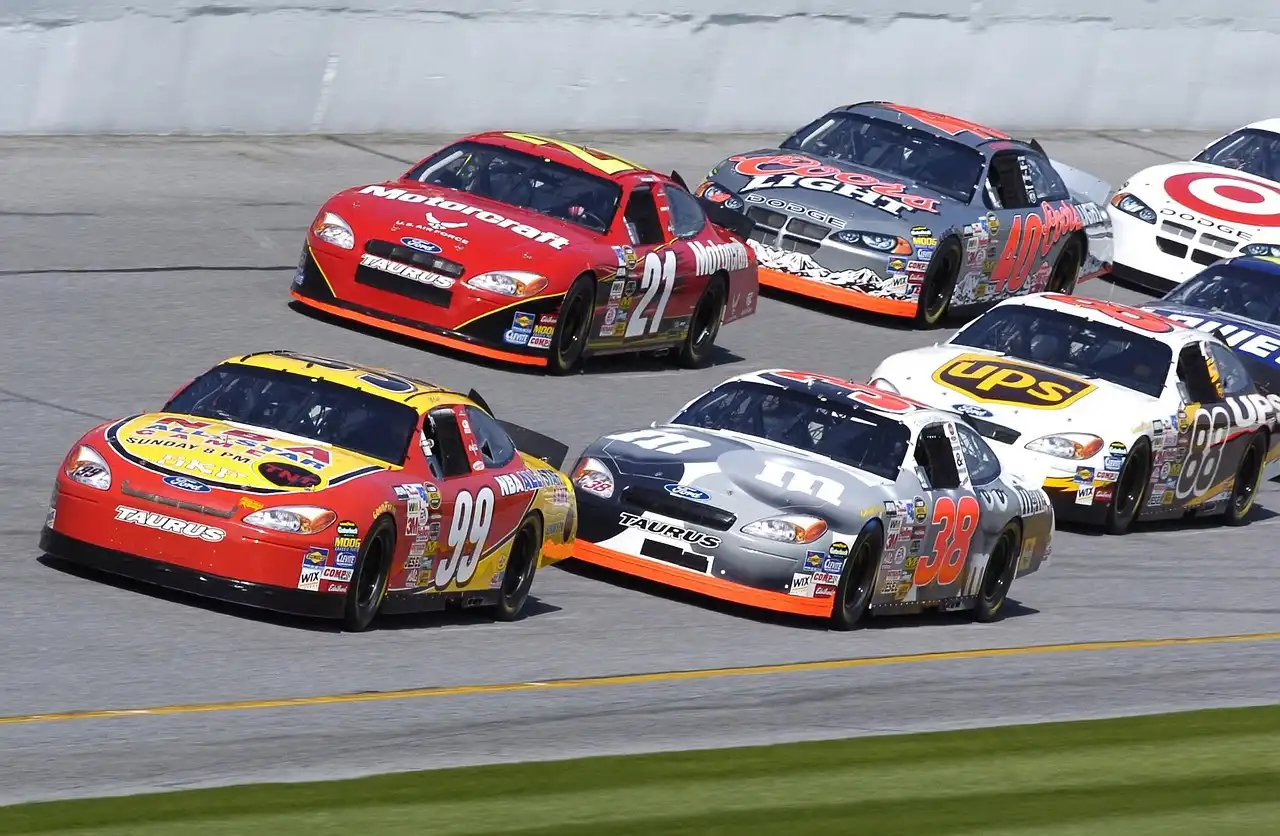
Daytona and Talladega are the clearest superspeedway examples. They are the places where Cup Series cars can hit top speeds over 200 mph, and where drafting can make the whole field run much faster than on most ovals. Even so, the race average stays below the raw peak.
Why superspeedways are the fastest tracks
Superspeedways let cars stay wide open for long stretches. The turns are large, the straightaways are long, and the airflow from surrounding cars matters more than at shorter tracks. That setup is why NASCAR cars on major superspeedways can reach average race speeds around 188 mph.
Drafting reduces aerodynamic drag. On Daytona and Talladega, a car tucked into the slipstream of another car can lose less air resistance and carry more speed with the same engine output. Modern NASCAR engines are described as producing approximately 510 horsepower, but the aerodynamic package is what turns that power into speed.
How drafting pushes Cup Series cars toward 200 mph and beyond
Top speed on these tracks often comes from a draft, not from one car running alone. The fastest laps on superspeedways are tied to aerodynamic design and powerful engines, which is why the same car may look quicker in a pack than in clean air. That is also why speed is harder to judge by eye than on a short track.
Bill Elliott set a NASCAR speed record at Talladega in 1987 at 212.809 mph. That record is historical context, not a normal race benchmark, but it shows how high superspeedway speed can climb when conditions, rules, and drafting line up. Modern safety and rule packages keep racing much closer to controlled limits.
Why race averages stay lower than raw top speed
Race average at Daytona and Talladega includes starts, restarts, fuel saving, pit windows, and caution periods. Those slower segments pull the final number down, even if the fastest green-flag laps are near or above 200 mph. Fans who only hear the average often miss the peak speed entirely.
How fast do NASCAR drivers go on different tracks?
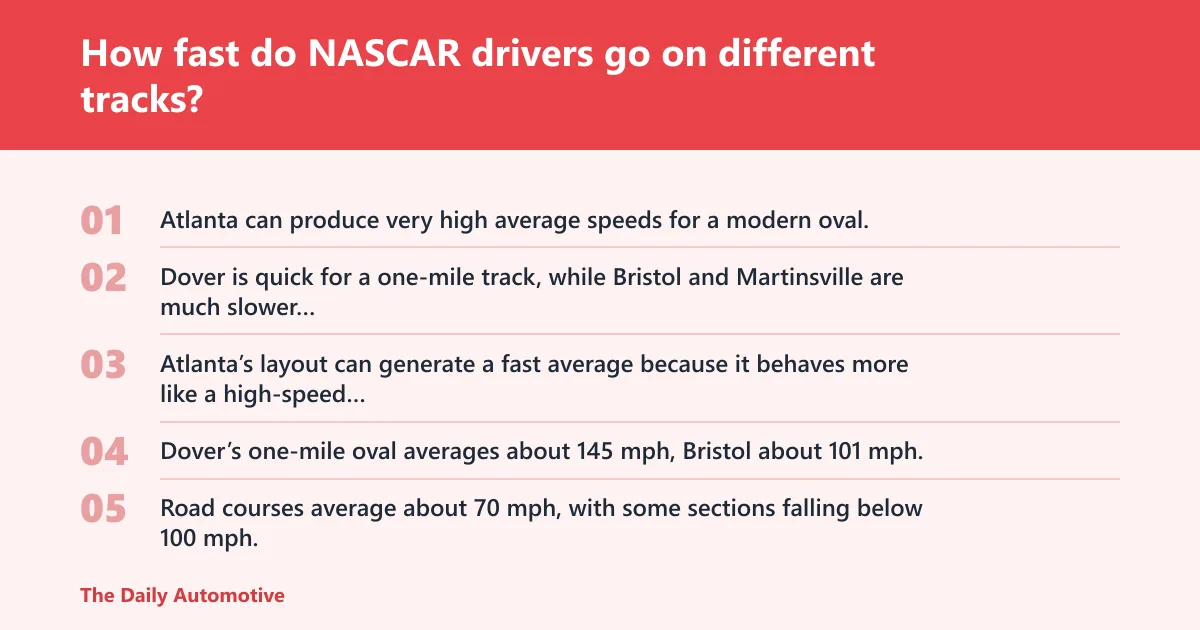
Track size and shape set the speed band. Atlanta can produce very high average speeds for a modern oval. Dover is quick for a one-mile track, while Bristol and Martinsville are much slower because their corners are tighter and their straightaways are shorter. Road courses are slower still.
What to expect from average race speed versus corner speed
Atlanta’s layout can generate a fast average because it behaves more like a high-speed oval than a tight short track. Dover’s one-mile oval averages about 145 mph, Bristol about 101 mph, and Martinsville typically runs between 80 and 120 mph. Road courses average about 70 mph, with some sections falling below 100 mph.
Those numbers are not interchangeable. A track can have a respectable average race speed and still force drivers to crawl through the turns compared with a superspeedway. Corner speed is where the biggest gaps show up, because the car must trade raw speed for control.
Track-by-track NASCAR speed table
| Track | Top speed | Average race speed | Typical corner-speed range | Why it differs |
|---|---|---|---|---|
| Daytona International Speedway | Over 200 mph | Around 188 mph on major superspeedways | Roughly 180-200 mph in the draft, lower in traffic | Long straights and heavy drafting keep speeds high. |
| Talladega Superspeedway | Over 200 mph | Around 188 mph on major superspeedways | Roughly 180-200 mph in the draft, lower in traffic | Big turns and pack racing let cars stay fast for long runs. |
| Atlanta Motor Speedway | High 180s to 190s in race trim | Very high for a modern oval | High 170s to low 190s | Fast intermediate-style layout rewards clean airflow and momentum. |
| Dover Motor Speedway | High 140s to 150s | About 145 mph | Often well below average in the corners | One-mile distance and steep, demanding turns slow cars down. |
| Bristol Motor Speedway | Low 100s | Approximately 101 mph | Much lower than straightaway speed | Short-track layout forces heavy braking and quick acceleration. |
| Martinsville Speedway | Near 120 mph in the fastest sections | Varies widely, often within the 80 to 120 mph band | Roughly 80-120 mph | Tight paperclip corners punish speed on entry and mid-corner. |
| Road courses | Depends on straight length | About 70 mph | Often below 100 mph in several sections | Braking zones, turns, and elevation changes matter more than flat-out runs. |
How do drafting, cautions, and track type change NASCAR speed?
Drafting, cautions, and track layout can move a speed number in very different directions. Drafting raises speed by reducing drag. Cautions lower race average because the cars run slowly behind the pace car. Tight tracks cut corner speed because the driver must brake harder and turn more sharply.
How reduced drag helps on superspeedways
On a track like Daytona or Talladega, the air matters almost as much as the engine. A car in clean air has more drag. A car tucked behind another can go faster for the same throttle input. That is why pack racing often produces the highest speeds of the season.
Why caution laps pull the average down
Caution periods can distort the average speed more than casual viewers expect. A race may have several minutes where the field runs at pace-car speed, then restart and return to full speed. Those slower laps are included in the official average, so the final number can fall far below green-flag pace.
A common first-timer mistake is to hear an average speed of 101 mph at Bristol and assume the cars are always that slow. They are not. The number includes every lap and every slowdown, while the cars may still carry much more speed on straights than in the tightest part of the turn.
Why tight turns force drivers to slow much more than fans expect
Turns are where speed gets spent. The faster the track and the tighter the radius, the more the driver has to brake or lift. That is why a short track can look hectic even when the top speed is modest. The challenge is keeping momentum, not just reaching a high number on the straight.
How fast do NASCAR drivers go around turns and on road courses?
Corner speed is always lower than straightaway speed because the car is loading the tires and changing direction. On road courses, the gap is even bigger because drivers brake for nearly every turn. That is why road-course averages sit around 70 mph, with some sections below 100 mph.
How braking zones and grip change the picture on road courses
Road courses combine left turns, right turns, heavy braking, and short acceleration bursts. Drivers trade top-end speed for lap time through clean exits and late braking. The result is a race that rewards handling and control more than sustained throttle.
Picture a 2.4-mile road course with a hard-braking hairpin and a long straight. The car may reach a strong top speed at the end of the straight, then shed a large amount of speed before the next corner. That pattern repeats all lap long, so the average stays much lower than on ovals.
Frequently asked questions
How fast do NASCAR drivers go
It depends on the track and the type of speed you mean. Cup cars can top about 200 mph at superspeedways, average around 188 mph on major superspeedways, and run much slower in corners or on road courses. Top speed, average speed, and corner speed are three different answers.
How fast do NASCAR drivers go in a race
In a race, average speed depends on cautions, pit stops, track length, and track shape. On superspeedways it can sit around 188 mph, while short tracks and road courses are much lower. A long caution period can pull the final average down sharply.
How fast do NASCAR drivers go around turns
Turn speed is usually far lower than straightaway speed because the driver has to brake, rotate the car, and keep the tires hooked up. At Martinsville, speeds typically run between 80 and 120 mph. On road courses, several corners can fall below 100 mph.
How fast do NASCAR drivers go on average
Average speed depends on the circuit. Superspeedways are the fastest, with major races around 188 mph. Dover’s one-mile oval is about 145 mph, Bristol is approximately 101 mph, and road courses average about 70 mph. Cautions and pit stops can move those numbers around.
How fast do NASCAR drivers go at Daytona
Daytona is one of NASCAR’s fastest tracks. Cars can hit top speeds over 200 mph, and the average race speed on major superspeedway events is around 188 mph. Drafting has a huge effect there, so cars often run faster in packs than in clean air.
How fast do NASCAR drivers go at Talladega
Talladega also produces top speeds over 200 mph, and it is part of the group of tracks where average race speeds can reach about 188 mph. Bill Elliott’s 212.809 mph record from 1987 remains the classic reference point for raw Talladega speed.
Products related to this article
Sponsored / affiliate links. As an Amazon Associate I earn from qualifying purchases. I may earn additional commission from eligible campaigns.