Do You Need a Car in Miami? Pros, Cons and Alternatives
You do not need a car in Miami if you stay in Downtown, Brickell, or South Beach and rely on walking, transit, and rideshare; you do need one for suburban commutes, multi-stop errands, or tight airport timing. Choose wrong and you can rack up parking fees, long transfers, missed flights, or more rideshare charges than a weekly rental. This guide breaks Miami down by visitor, downtown resident, beachgoer, airport traveler, and suburban commuter so you can decide fast.
Do you need a car in Miami?

The short answer: not always. Miami works without a car for people centered in Downtown, Brickell, Miami Beach, or airport-linked stays with light luggage. A car becomes far more useful once your day includes suburban errands, late-night returns, family logistics, or multiple stops across the metro area.
When a car helps more than transit
A car saves time when your schedule crosses neighborhood boundaries. Miami traffic brings rush-hour delays and highway bottlenecks, but even with that pain, door-to-door driving can still beat multiple bus transfers, especially outside the core. It also helps when you need predictable timing, child seats, or luggage space.
When you can skip a car entirely
You can skip a car if your trip stays on a narrow corridor: hotel to beach, condo to office, or airport to downtown with minimal side trips. Miami-Dade County’s public transportation system includes buses, the Metrorail, and the free-to-ride Metromover, which is enough for some visitors and urban residents. It is less useful for scattered suburban stops.
📊 Booking.com says a week of rental in Miami Metropolitan Area costs about BDT 41,476. Source: Cheap car rental in Miami Metropolitan Area: Find and compare….
How easy is Miami to get around without a car?
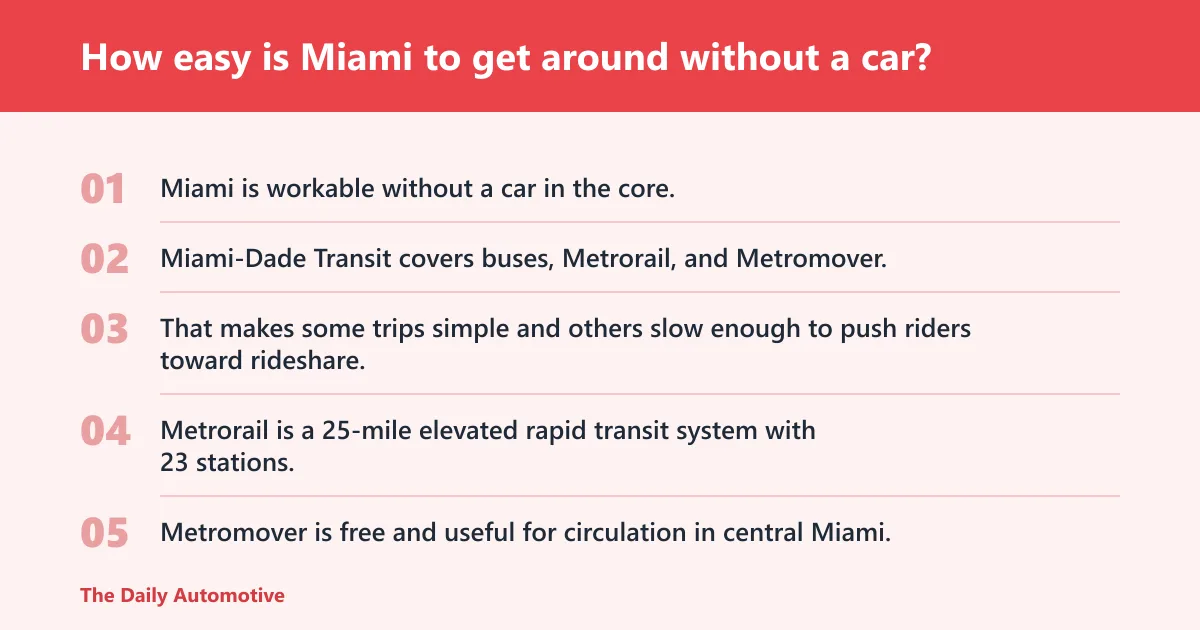
Miami is workable without a car in the core, but the experience depends on where you start and end. Miami-Dade Transit covers buses, Metrorail, and Metromover, yet service gaps widen as you move away from central corridors. That makes some trips simple and others slow enough to push riders toward rideshare.
Miami-Dade Transit basics
Metrorail is a 25-mile elevated rapid transit system with 23 stations, and it connects downtown Miami with the airport. Metromover is free and useful for circulation in central Miami. Buses fill more of the map, but they are slower and more sensitive to transfers, wait times, and route frequency than rail.
Where coverage starts to thin out
Coverage thins when you need cross-town travel, late-night service, or access to low-density areas. Transit can still get you there, but transfer time becomes the real cost. On paper a trip may look short; in practice, a missed connection can add roughly 20 to 40 minutes or more.
Where a car is least necessary in Miami
Downtown and Brickell are the easiest areas to manage without a private car. Miami Beach is also workable for short coastal trips, especially if you are not leaving the barrier island every day. Airport-only stays with light luggage can also make sense without a car, because Metrorail links downtown Miami and the airport.
Where having a car still makes sense
Suburban errands, family schedules, and late-night travel are the clearest reasons to keep a car. Low-frequency transit corridors can be especially awkward after dinner or before sunrise. If you need to reach multiple destinations in one day, the value of direct routing usually outweighs the parking headache.

What neighborhoods in Miami are walkable without a car?
Downtown Miami, Brickell, and parts of Miami Beach are often good candidates for car-free living or visiting. These areas have the highest payoff from walking, Metromover, and short rideshare hops. Once you move into farther-flung neighborhoods, walkability drops fast and daily car dependence rises.
Downtown and Brickell
These areas are the best fit for people whose routine stays near offices, hotels, restaurants, and rail access. Metromover is useful here because it is free and built for central circulation. That matters when you want to avoid repeated parking charges or short rides that are cheap once and annoying ten times.
Miami Beach and short coastal trips
Miami Beach can work without a car if your needs are compact: hotel, beach, dining, and limited shopping. Parking often becomes the sticking point, not the distance. For visitors, this is one of the few places where a walk-and-rideshare strategy can beat daily driving.
Airport-only stays and light luggage trips
If your plan is airport, hotel, meeting, and back to airport, a car may be unnecessary. Metrorail connects downtown Miami and the airport, which helps reduce transfer cost. The tradeoff is luggage handling, especially if your arrival or departure is late, bulky, or weather exposed.
Is parking hard in Miami?
Yes, parking can be hard in popular parts of Miami, and it can also be expensive. Downtown garages, beach lots, and street parking all create friction, especially when you factor in circling time, meter rules, and the chance that a cheap spot is still far from where you need to be.
Garage versus street parking
Garages usually offer better certainty, but you pay for it. Street parking may be cheaper when available, though availability changes quickly and enforcement can be unforgiving. In beach zones, the hidden cost is often time: a “free” spot that adds a long walk in heat or rain is not really free.
Why parking changes the math
Parking does not just add a fee. It adds search time, walking time, and sometimes the stress of feeding meters or moving the car for street-cleaning rules. If you are making several short trips per day, those small costs can exceed the cost of a transit pass plus a couple of rideshares.
Say your hotel is in Brickell and you plan three short outings: lunch, a grocery run, and dinner on the beach. A rented car sounds simple at first. Then you add garage fees, traffic, and repeated parking searches, and the car becomes the slowest part of the day.
What is the best way to travel in Miami without a car?

The best no-car strategy is usually a mix of transit for the backbone, rideshare for last-mile gaps, and walking for short central trips. That combination works better than trying to force transit into every trip or relying on rideshare for every move across the city.
Rideshare for last-mile trips
Rideshare is the most useful backup when transit gets you close but not close enough. It is especially helpful from rail stations to hotels, beaches, or residential blocks. The risk is surge pricing, which can turn a short trip into the most expensive part of the day.
Biking and walking for short distances
Biking and walking are strongest for short, flat trips in the core. Heat and frequent rain showers change that equation fast, and busy roads can make some routes uncomfortable or unsafe. For many people, walking is practical only when the distance is short and the weather is tolerable.
Mixing transit with occasional rentals
A mixed strategy often beats full ownership for visitors, remote workers, and part-time residents. Use Metrorail or Metromover for the regular route, rideshare for nights and gaps, and a rental car only when the trip needs multiple stops or a suburban outing. That cuts parking, insurance, and toll exposure.
- Use transit first for any trip in Downtown, Brickell, or the airport corridor.
- Use rideshare when the last mile would otherwise require a long walk or transfer.
- Rent a car only for heavy errands, family days, or routes that cross several neighborhoods.
- Check parking before you drive, especially in beach and downtown zones.
Is Miami public transit good for tourists?
For tourists centered in the core, yes. For tourists with beach, airport, and downtown plans, transit can be very workable. For tourists trying to reach many outlying attractions, transit is less efficient and may be slower than a rental car or a rideshare-heavy plan.
Best tourist use cases
Transit is strongest for hotel-to-downtown, airport-to-hotel, and short central trips. Metrorail helps on airport access, and Metromover is useful once you are in central Miami. If your itinerary is mostly sightseeing in a few compact areas, you may not need a car at all.
Late-night and transfer limitations
Tourists often discover the weak point of transit only after dinner. Frequency drops matter more at night, and missing one bus or train can add a large delay. If you have reservations, flights, or showtimes, a rideshare backup is worth keeping.
How much does it cost to rent a car in Miami?
Rental costs vary by date, location, and class, but current booking data gives a useful starting point. Booking.com lists an average daily price of about BDT 5,925 for Miami car rentals, which puts a week at roughly BDT 41,000 to BDT 42,000. It also lists 38 rental car companies in the Miami Metropolitan Area.
What the booking data suggests
Booking.com says the most booked company over the past month was Avis, the most popular car group to rent is Premium, and one-way rental is possible with some companies. It also names Miami, Miami International Airport, and Miami Beach as popular pickup locations. Those details matter if your trip starts and ends in different places.
Rental versus rideshare
Rental cars can be cheaper than repeated rideshares once your day includes several cross-town trips or airport transfers plus side errands. Rideshare may win for a single airport ride or one evening out, but surge pricing can erase that advantage fast. The break-even point depends on mileage, parking, and how often you need the car to sit unused.
Is rideshare cheaper than owning a car in Miami?
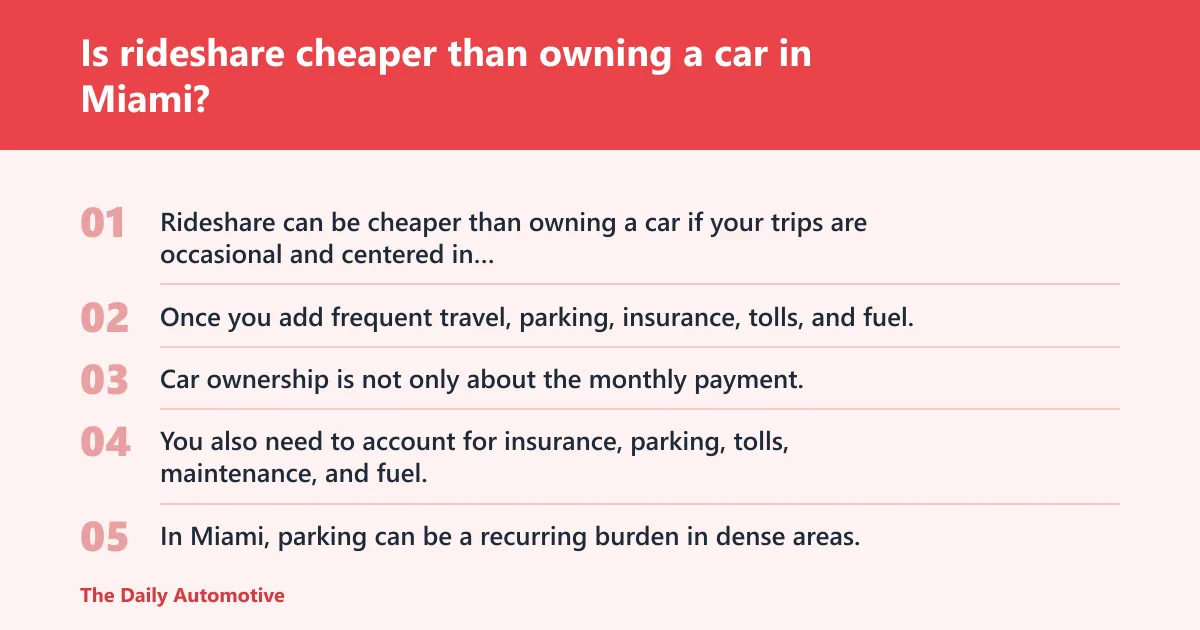
Sometimes, but not always. Rideshare can be cheaper than owning a car if your trips are occasional and centered in a small area. Once you add frequent travel, parking, insurance, tolls, and fuel, ownership may become less expensive than paying for surge pricing and repeated on-demand rides.
Hidden ownership costs
Car ownership is not only about the monthly payment. You also need to account for insurance, parking, tolls, maintenance, and fuel. In Miami, parking can be a recurring burden in dense areas, and congestion increases the time cost of every drive.
When rideshare wins
Rideshare wins when you need point-to-point convenience but not daily access. It is especially strong for airport pickups, late-night returns, and short trips in areas where parking is painful. If your weekly driving would be light, the flexibility can be worth more than a parked car sitting idle.
| Scenario | Best mode | Estimated friction | Hidden costs |
|---|---|---|---|
| Downtown/Brickell resident | Walk + Metromover + rideshare | Low to moderate | Occasional surge pricing, limited late-night transit, parking if you own a car |
| Miami Beach visitor | Walk + rideshare + occasional bus | Moderate | Beach parking fees, time spent searching for a spot, heat on longer walks |
| Airport-only traveler | Metrorail or rideshare | Low if luggage is light; moderate if not | Transfer time, luggage handling, taxi or rideshare surge pricing |
| Family outings and suburban errands | Car rental or owned car | Low for routing, high for parking | Parking, fuel, tolls, child-seat logistics, rental fees |
| Cross-town workdays | Car or mixed transit + rideshare | Moderate to high | Rush-hour delays, transfers, parking, missed connections |
What are the best alternatives to owning a car in Miami?
The best alternatives are not one-size-fits-all. For some trips, transit is enough. For others, rideshare or a short rental beats ownership. The strongest plan is usually a mix that matches each trip to the lowest-friction mode, not a single mode used for everything.
Rideshare for last-mile trips
Use rideshare when transit gets you close but not all the way. That is often the cleanest answer for airport luggage, beach access, or late-night arrivals. Just keep surge pricing in mind, because the fare that looks reasonable at noon may not look reasonable at 11 p.m.
Biking and walking for short distances
Biking and walking work best for short, direct routes in central areas. Miami’s frequent rain showers and high temperatures matter here. A 15-minute walk can feel far longer when the weather is humid or when the route lacks shade and safe crossings.
Mixing transit with occasional rentals
This is the best fallback strategy for many people. Use Metrorail, Metromover, and buses for predictable core trips, then rent a car for a day when you need several stops or a family outing. It avoids the fixed costs of ownership while still giving you a car when Miami’s geography makes one useful.
Frequently asked questions
Do you need a car in Miami?
Not necessarily. If you stay in Downtown, Brickell, or Miami Beach and your plans are centered on walking, transit, and short rideshare trips, a car is optional. It becomes much more useful for suburban commutes, multi-stop errands, and schedules that include late nights or tight airport timing.
Can you get around Miami without a car?
Yes, but the ease depends on where you are going. Miami-Dade Transit offers buses, Metrorail, and Metromover, which work best in central corridors and for airport access. Coverage and frequency thin out outside those areas, so transit-plus-rideshare is usually the practical no-car setup.
Is parking hard in Miami?
In popular areas, yes. Parking can be difficult and expensive in downtown and near the beach, and garage fees often stack up quickly. Street parking may look cheaper, but it can add circling time, walking distance, and meter stress that changes the real cost of the trip.
What is the best way to travel in Miami without a car?
For most people, the best answer is a mix of transit, walking, and rideshare. Use Metromover and Metrorail where they fit, then fill gaps with rideshare for last-mile trips. That approach is usually cheaper and easier than trying to force one mode to cover every possible trip.
Is Miami public transit good for tourists?
It is good for tourists who keep to the core, the airport corridor, and a few compact neighborhoods. It is less helpful for scattered attractions or tight schedules with many transfers. For visitors, the key question is not whether transit exists, but whether it matches the itinerary.
How much does it cost to rent a car in Miami?
Booking.com lists an average daily price of BDT 5,925 and about BDT 41,476 for a week in the Miami Metropolitan Area. That can be reasonable for a family or multi-stop trip, but parking, fuel, tolls, and rental class all affect the final bill.
Products related to this article
Sponsored / affiliate links. As an Amazon Associate I earn from qualifying purchases. I may earn additional commission from eligible campaigns.