When Did Cars Stop Having Crank Windows? Timeline by Trim
Cars did not lose crank windows in one year; by the mid-2010s they were mostly gone from many mainstream trims, though some base models, work trucks, and fleet cars may have kept them later. Guess wrong, and you may pay too much for a trim level, miss a power-window delete on a fleet car, or buy a used vehicle with a different interior than the listing photo suggests. This guide breaks down the timeline by body style, trim, and model year, and shows how to check a specific used car before you buy.
When did cars stop having crank windows?

There was no single universal cutoff year. Power windows became common in the late 20th century, especially through the 1990s, but manual crank windows stayed in base trims, trucks, vans, and fleet vehicles much longer. In many mainstream passenger cars, the change was mostly done by the mid-2010s.
That is the short answer buyers need. The longer answer depends on body style, trim, and market.
How did the change happen by vehicle type?
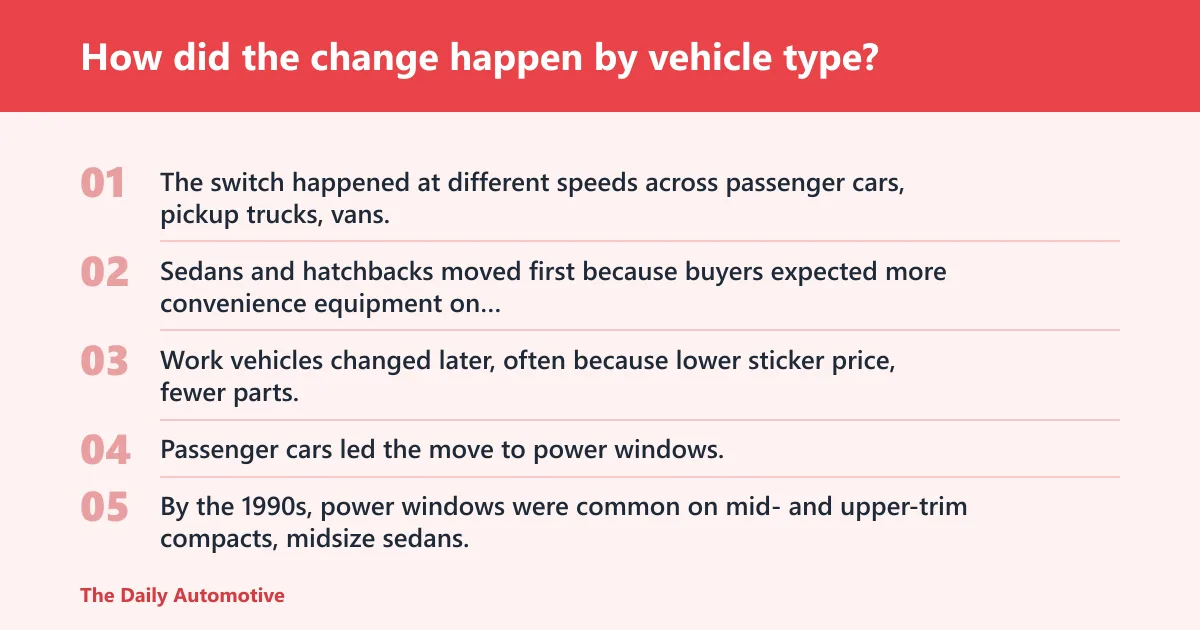
The switch happened at different speeds across passenger cars, pickup trucks, vans, and fleet models. Sedans and hatchbacks moved first because buyers expected more convenience equipment on family cars and mid-level trims. Work vehicles changed later, often because lower sticker price, fewer parts, and simpler repairs mattered more than one-touch operation.
Passenger cars
Passenger cars led the move to power windows. By the 1990s, power windows were common on mid- and upper-trim compacts, midsize sedans, and many SUVs, while base trims could still have manual cranks. By the 2000s, crank windows were uncommon on many mainstream retail passenger cars, though they were not entirely gone.
Pickup trucks and vans
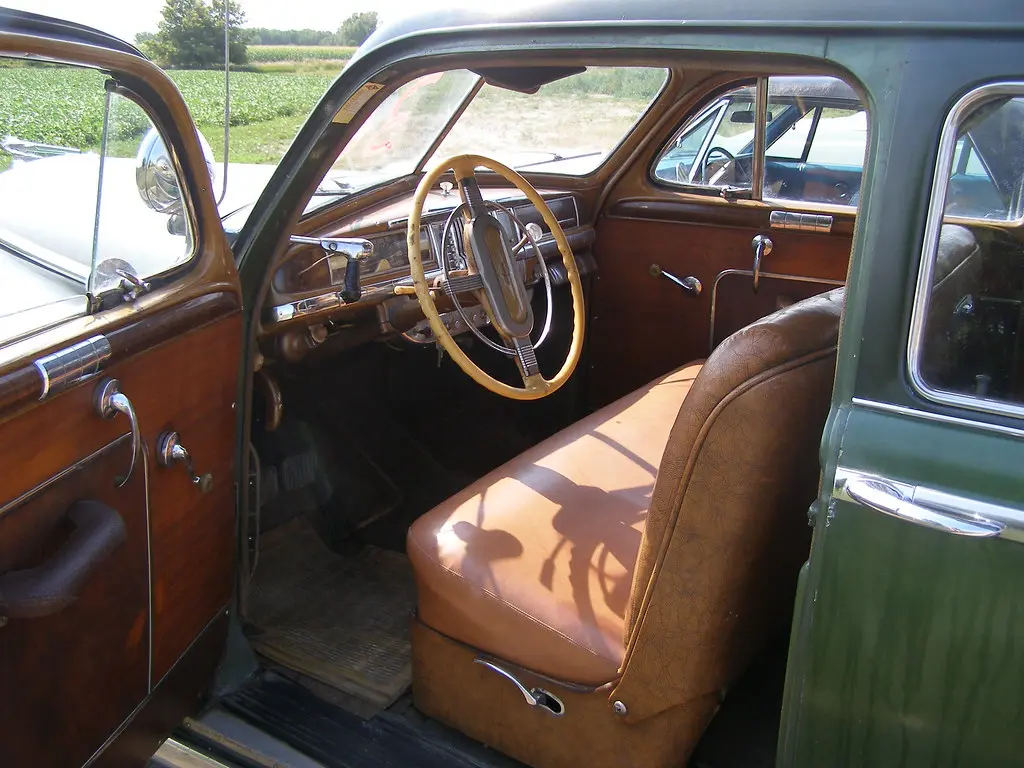
Pickup trucks and cargo or passenger vans kept manual windows longer than sedans. Base work trucks, stripped fleets, and commercial vans often retained crank windows well into the 2000s and, in some cases, into the 2010s. The reason was simple: lower cost, fewer electrical parts, and fewer repairs for hard-use vehicles.
Fleet and commercial trims
Fleet trims often lagged behind consumer trims by years. A rental-spec sedan, utility van, or contractor truck could have crank windows even when the same model in a higher retail trim had power windows standard. Used listings sometimes blur that difference, which is why trim identification matters more than model year alone.
What was the timeline for base trims and higher trims?
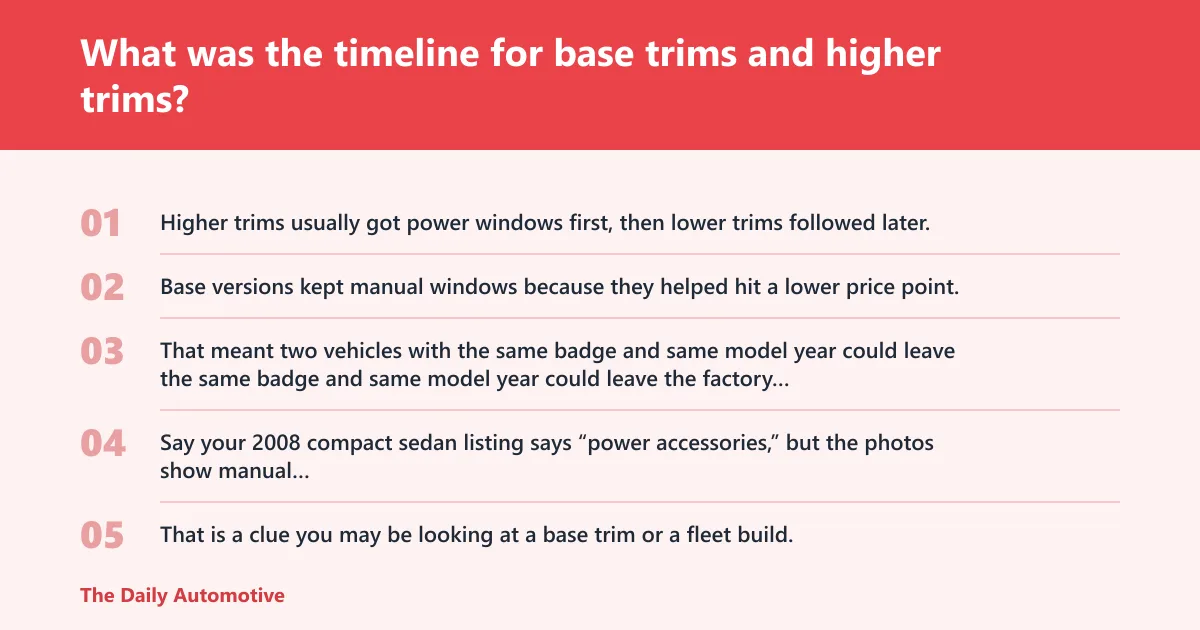
Higher trims usually got power windows first, then lower trims followed later. Base versions kept manual windows because they helped hit a lower price point, and some buyers wanted fewer electrical parts. That meant two vehicles with the same badge and same model year could leave the factory with different window equipment.
Say your 2008 compact sedan listing says “power accessories,” but the photos show manual mirror adjusters and no door switches. That is a clue you may be looking at a base trim or a fleet build, not the higher-spec version most shoppers expect.
How used listings can differ by trim
Used-car ads often list the model, not the exact trim. That can hide a power-window delete or a fleet package. If the listing only says the year and model, you should not assume all examples from that model year share the same interior equipment.
| Vehicle segment | Typical manual windows | Power windows common | Manual windows rare |
|---|---|---|---|
| Economy sedans / hatchbacks | 1980s through early 2000s on base trims | 1990s across many trims, 2000s on most retail trims | Mid-2010s onward in mainstream retail sales |
| Mid-size and full-size sedans | Early 1980s through early 1990s on entry trims | 1990s became the common changeover period | Late 2000s to mid-2010s outside fleet builds |
| Pickup trucks | 1990s through 2010s on work trims | 2000s on many retail trims | Still possible on fleet or base work trucks in the 2020s |
| Vans | 1990s through 2010s on cargo and fleet versions | 2000s on passenger vans and higher trims | Still possible on commercial or stripped vans in limited markets |
| Fleet / commercial trims | Longer than consumer trims, often 2000s-2020s | Later than retail trims, depending on buyer spec | Not unusual on low-cost orders and utility builds |
This table is a practical guide, not a proof of a specific vehicle. A given model year can vary by trim, market, and order code.
Why did manufacturers switch from crank to power windows?
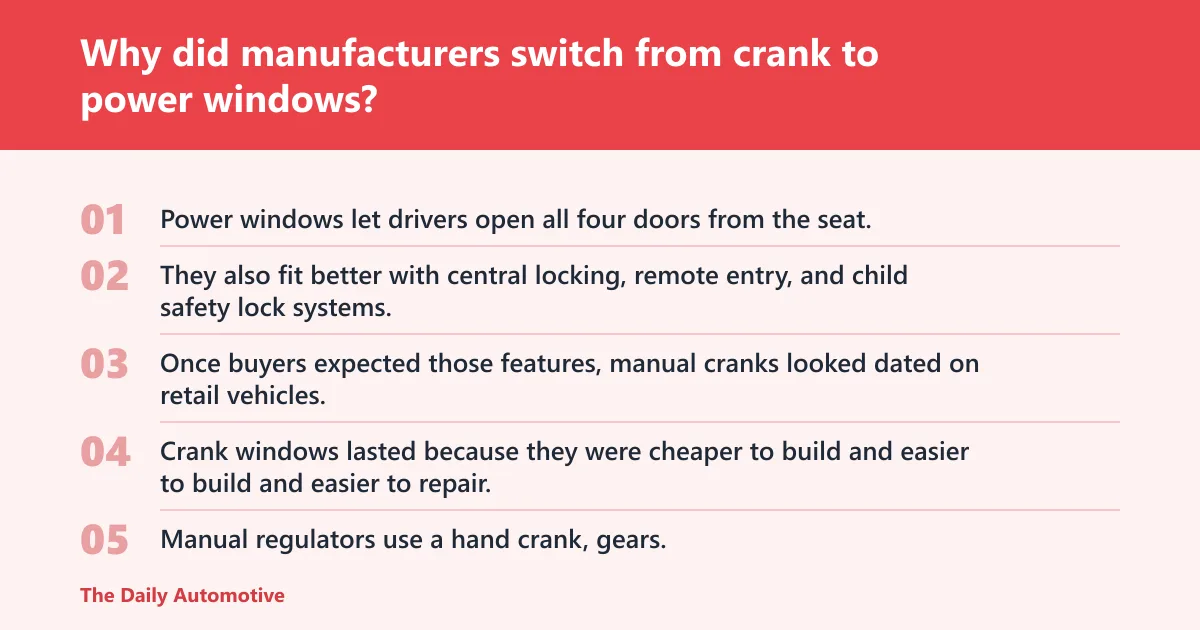
Convenience was the main reason. Power windows let drivers open all four doors from the seat, often with one-touch operation on higher trims. They also fit better with central locking, remote entry, and child safety lock systems. Once buyers expected those features, manual cranks looked dated on retail vehicles.
Cost, wiring, and safety integration
Crank windows lasted because they were cheaper to build and easier to repair. Manual regulators use a hand crank, gears, and a lift mechanism without motors or switches. Power windows add motors, wiring, relays, switches, and control logic, which raises cost and can add failure points.
That said, power windows are not automatically unreliable. They are just more complex. A failed switch can be a small issue; a failed regulator or motor can be more expensive.
Why manual windows stayed in work vehicles
Work vehicles often prioritize low purchase price and simple maintenance. A contractor truck or cargo van may be opened dozens of times a day, sometimes in dirt, heat, or rain. In that setting, a simpler manual system can make sense longer than it does in a family sedan.
What should you know about the timeline?
The useful rule is segment first, year second. Passenger sedans changed earlier than trucks and vans, and fleet trims changed later than retail trims. A model-year cutoff on its own can mislead you because one version of a vehicle may have power windows while another version of the same year and badge still has cranks.
How to read typical, optional, and rare equipment
Typical means the equipment was common for that segment and trim at that time. Optional means it was available but not standard. Rare means you should verify it carefully, especially on work trucks, cargo vans, or fleet-spec cars.
What the timeline can and cannot prove
The timeline can tell you what was normal for a segment and era. It cannot confirm a specific used vehicle without build data or photos. A clean way to think about it is this: the timeline narrows the search, but the vehicle itself confirms the truth.
How can you tell if a used car originally had crank windows?
You can verify original window equipment three ways: decode the VIN and build sheet if available, check the window sticker or original sales listing, and inspect interior photos for the correct door panels and switch gear. Used-car photos often reveal more than the ad copy does, especially on base or fleet trims.
- Check the VIN decode or factory build data for the exact trim and option content.
- Look for a window sticker, original dealer listing, or order sheet that names power windows or manual windows.
- Study listing photos for door cards, switch panels, and armrests. Manual doors usually lack switch pods.
- Confirm whether rear doors match the front doors. Some vehicles have a mixed setup by trim or body style.
- Match the photos to the trim badge and interior material, not just the model year.
Picture a 2012 work van with power door locks but no window switches on the doors. That is not a mistake. It may have left the factory that way. The trim package, not the calendar year, is what tells the story.
Are crank windows more reliable than power windows?
Manual crank windows are usually simpler and cheaper to repair because the regulator has fewer parts. Power windows add switches, motors, wiring, and control modules, so there is more that can fail. That does not make them bad; it makes them more complex, which matters more on older used vehicles.
Manual regulator simplicity and repair cost
A manual regulator is often straightforward to service. If the crank handle breaks or the regulator binds, the repair can be relatively direct. Parts are often cheaper, and there is no motor or wiring fault to chase.
Power regulator parts, motors, and switches
Power systems bring more convenience, but they also bring more diagnosis steps. A dead window might be caused by a fuse, switch, broken wire in the door jamb, failed motor, or regulator. That complexity is why buyers of older used cars should inspect every window, not just the driver’s door.
Which cars were among the last to offer manual windows?
The last holdouts were usually base trims, work trucks, cargo vans, and some entry-level regional-market cars. In the U.S., many mainstream consumer cars had moved on by the mid-2010s, but manual windows could still appear in stripped fleet versions, commercial vans, and budget trims. Regional markets outside the U.S. kept them longer in some cases.
That regional split matters. A model sold in Europe, Latin America, or parts of Asia may keep manual windows longer than its U.S. counterpart, or may offer them on trims that never reached American dealers.
What years did power windows become common?
Power windows became common in the 1990s across many mass-market vehicles, especially mid- and upper-trim passenger cars and SUVs. By the 2000s, they were standard on most retail trims in the U.S. market. Trucks, vans, and fleet vehicles followed later because their buyers often valued cost and simplicity more than convenience.
Do any new cars still come with crank windows?
Yes, but mostly in limited trims, special-order fleet vehicles, commercial vans, or certain regional markets. They are no longer common in mainstream U.S. retail cars. If you see a new vehicle with manual windows, assume it is either a low-spec work build or a market-specific version until you verify the trim sheet.
When did cars stop having hand crank windows?
They did not stop in one year. Hand crank windows faded from mainstream passenger cars over the 1990s and 2000s, then lingered in base trims, fleet vehicles, trucks, and vans into the 2010s and, in some cases, the 2020s. The exact cutoff depends on trim and market.
When did cars stop having crank start?
That is a different question. Crank start refers to hand-cranked engine starting on very old vehicles, not window cranks. Most modern search results mix the two terms, but they are unrelated. Window cranks stayed relevant for decades; crank starting belongs to early automotive history.
Frequently asked questions
When did cars stop having manual windows?
Manual windows faded gradually from the 1980s through the 2000s, with the 1990s marking the biggest shift to power windows. The exact timing depends on vehicle type and trim. Base models and work vehicles held onto manual cranks after upscale trims had already switched.
Products related to this article
Sponsored / affiliate links. As an Amazon Associate I earn from qualifying purchases. I may earn additional commission from eligible campaigns.