Ford Raptor for Sale NJ: What to Check Before You Buy
Start with rust, title status, and garage fit. If the frame, title, or underbody fail inspection, walk away before price talks. In New Jersey, salt, flood exposure, and oversized-truck storage mistakes can turn a Raptor into a fast repair bill. This checklist shows what to inspect first, how to screen title risk, and how to judge ownership cost before you negotiate.
What should you check first on a Raptor?
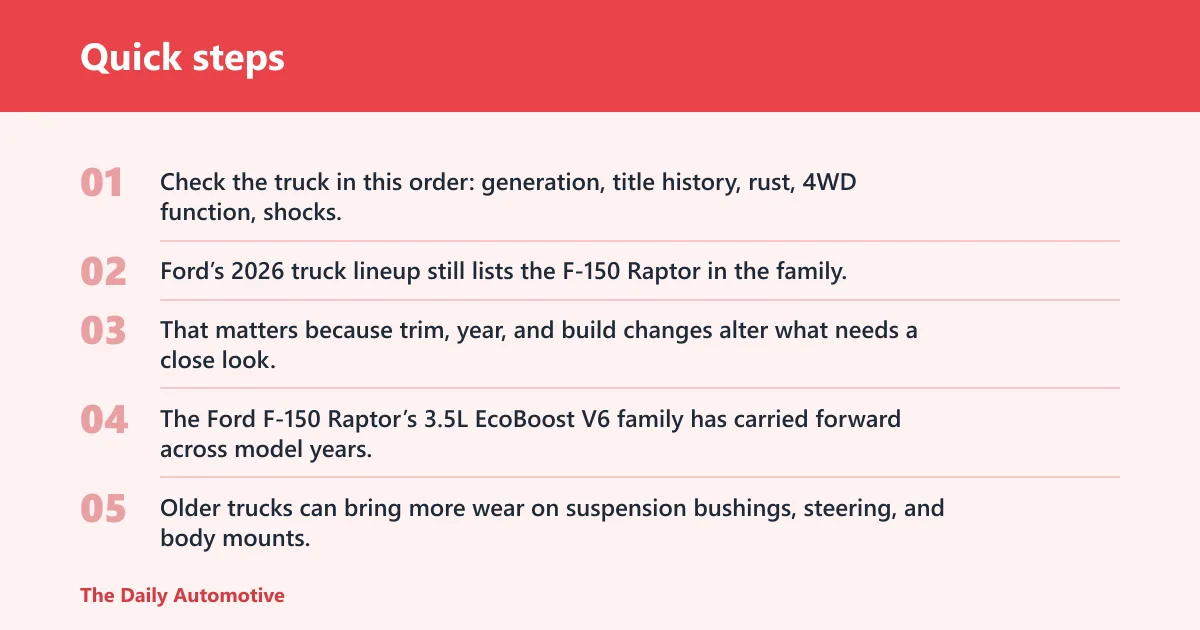


Check the truck in this order: generation, title history, rust, 4WD function, shocks, and whether it fits your garage. Ford’s 2026 truck lineup still lists the F-150 Raptor in the family, and Ford’s showroom tools let you filter by towing, seating, and fuel economy when you compare trucks. That matters because trim, year, and build changes alter what needs a close look.
Match the year to the generation
The Ford F-150 Raptor’s 3.5L EcoBoost V6 family has carried forward across model years, but the parts you inspect change with generation. Older trucks can bring more wear on suspension bushings, steering, and body mounts. Newer trucks may carry more tech, more price, and more repair cost if a sensor or electronic actuator fails.
Confirm trim, mileage, and modifications
Before any offer, confirm you are looking at a true Raptor and not a standard F-150 with appearance parts. Check for lift kits, wheel spacers, oversized tires, and aftermarket lighting, because those changes can affect alignment, ride quality, and garage clearance. Mileage matters too, but miles alone do not tell you whether the truck spent winters on salted roads.
Set a total-cost ceiling first
Raptors bring strong demand, and dealer markups can move pricing above MSRP fast. Ford’s 2026 F-150 starts at MSRP $37,290 on the lineup page, while Ford also lists the 2026 Ranger at $33,350, the 2026 Maverick at $28,145, and the 2026 Super Duty at $45,975. Those numbers are not Raptor prices, but they help frame how far a Raptor sits above the rest of the lineup before fees, insurance, and financing.
How do you verify title and history?
Run the VIN through a history report before money changes hands. You want title status, accident records, rebuilt or salvage flags, flood history, and odometer consistency in one place. A clean title with accident records can be easier to insure and finance than a rebuilt-title truck, but a clean title does not clear the truck by itself.
Read the title flags in context
A clean title means the vehicle has not been branded rebuilt or salvage, though it can still have collision repairs in its history. That is why accident entries matter. A rebuilt title can be acceptable for the right buyer at the right price, yet it usually brings tighter lender rules, lower resale value, and more caution from insurers.
Compare the VIN record with the truck in front of you
Match the VIN on the dash, door sticker, title paperwork, and vehicle history report. Then compare mileage on the listing, odometer, and service records. If the listing says one figure and the cluster says another, stop there until the seller explains it with records.
Look for body and panel clues
Accident history matters most when the repairs affected frame rails, airbags, radiator support, or bed mounts. Uneven panel gaps, overspray, mismatched fasteners, and fresh seam sealer can point to work that deserves a closer look. The history report may not tell you whether a repair was well done; the truck often will.
Frame and rust checks in New Jersey
New Jersey salt exposure can make rust a bigger issue than in many other states. Use a flashlight and inspect the frame rails, suspension pickup points, brake lines, exhaust hangers, and underbody fasteners. Surface rust is commonly reported on used trucks. Structural corrosion is not something to treat lightly.
Separate surface rust from structural corrosion
Surface rust looks brown and flaky but still leaves solid metal underneath. Structural corrosion shows scaling, swelling, holes, or metal that sounds thin when tapped. Pay extra attention near the rear frame, lower control arm mounts, skid plates, and any area where road spray tends to collect.
Check coastal and winter-driven trucks more carefully
Salt-heavy wear shows up faster on trucks driven near the shore or through repeated winter storms. Look for rust on brake lines, fuel tank straps, exhaust seams, wheel wells, and the bottom edge of the cab. If the frame has heavy scaling, the discount should reflect a future repair bill, not just cosmetic cleanup.
Use a flashlight before you make an offer
Bring a bright light and get under the truck if the seller allows it. You do not need a lift to spot the obvious problems. If you can see fresh undercoating hiding heavy scaling, or if a section of frame looks recently painted for no clear reason, slow down and ask for documentation.
Say your Raptor spent three winters near the coast and the rear crossmember shows thick scale, but the seller calls it “normal.” That is a pricing issue, not a detail. If the corrosion is heavy enough to threaten mounts or lines, the truck needs a much larger discount than a clean-looking body would suggest.
NJ Raptor pre-buy checklist
| Checkpoint | Why it matters in New Jersey | Acceptable signs | Red flags | Estimated repair or room to negotiate |
|---|---|---|---|---|
| Title status | Flood, salvage, and rebuilt history can be harder to finance and insure in a salt-state market | Clean title, matching VIN, consistent odometer records | Salvage, rebuilt, flood, mileage gaps, mismatched documents | High room to negotiate; back out or discount sharply |
| Frame rust | Road salt accelerates corrosion on frame rails and mounts | Light surface rust, solid metal, no holes or swelling | Scaling, flaking layers, soft spots, holes, recent cover-up paint | Very high room to negotiate; structural repair risk |
| Fox shocks | Off-road suspension repair cost can change the deal fast | Dry shock bodies, intact seals, clean reservoirs, even ride height | Oil film, dented reservoirs, clunking, uneven stance | Moderate to high room to negotiate; replacement can be expensive |
| Transfer case | 4WD issues become obvious on slippery roads and during test drives | Clean 4H and 4L engagement, no binding, no grind or chatter | Delayed shift, warning lights, binding, shudder, actuator noise | High room to negotiate if engagement is abnormal |
| Tire wear | Lifted or misaligned Raptors can chew through expensive tires | Even tread, matched tires, no feathering or cupping | Inner-edge wear, cupping, mismatched brands, dry cracks | Moderate room to negotiate; tires can be a near-term expense |
| Cold-start noise | Cold mornings expose tick, rattle, and exhaust leaks | Brief startup noise that settles quickly, no warning lights | Persistent knock, chain rattle, misfire, smoke, exhaust leak sound | High room to negotiate if the noise repeats cold and hot |
| Garage clearance | Lifts, antennas, and roof gear can stop the truck from fitting at home | Measured clearance with margin for door hardware and slope | Roof hits, mirror scrapes, door opener interference, no measured fit | Deal breaker if storage is impossible |
What should a test drive tell you?
A test drive should confirm that 4WD, steering, braking, and suspension all behave normally. Engage 4H and 4L if the route and surface allow it, then listen for binding, clunking, or delayed engagement. A healthy Raptor should feel controlled, not loose, shuddery, or unpredictable over bumps and turns.
Check 4H and 4L engagement
The transfer case should generally shift into 4H and 4L without grinding, warning lights, or a long delay. On a low-speed drive, watch for actuator hesitation and any sensation that the driveline is binding. If the truck hops or fights the steering on a dry surface, stop and get a better explanation.
Listen for shock and suspension clues
Fox shocks should not be wet with oil, and the reservoirs should not look dented, loose, or corroded. Bounce or float after a dip can point to worn damping. If one corner sits lower or the ride feels harsher on one side, put suspension repair cost into the negotiation right away.
Watch tires, brakes, and steering together
Uneven tire wear often shows alignment trouble, worn bushings, or damaged suspension parts. Brake shake can point to warped rotors or worn front-end components. Steering pull at highway speed can be simple alignment, or it can be the sign of a truck that has taken hard off-road hits or a poor lift install.
A common buyer mistake is to get distracted by the lifted stance and overlook a hesitation when switching into 4H during a slow parking-lot turn. Suppose the truck feels fine in the parking lot, then binds in a tight turn on a damp lot exit. That is a driveline check failure, even if the sales pitch sounds polished.
Can it fit your garage and budget?
Measure garage height, door opening, and any roof-mounted accessories before you put money down. Lifted Raptors can fit on paper and still strike a garage door sensor, opener rail, or low header. Then add insurance, fuel, financing, and New Jersey sales tax and fees to the purchase price so you know the real monthly hit.
Measure the space, not your guess
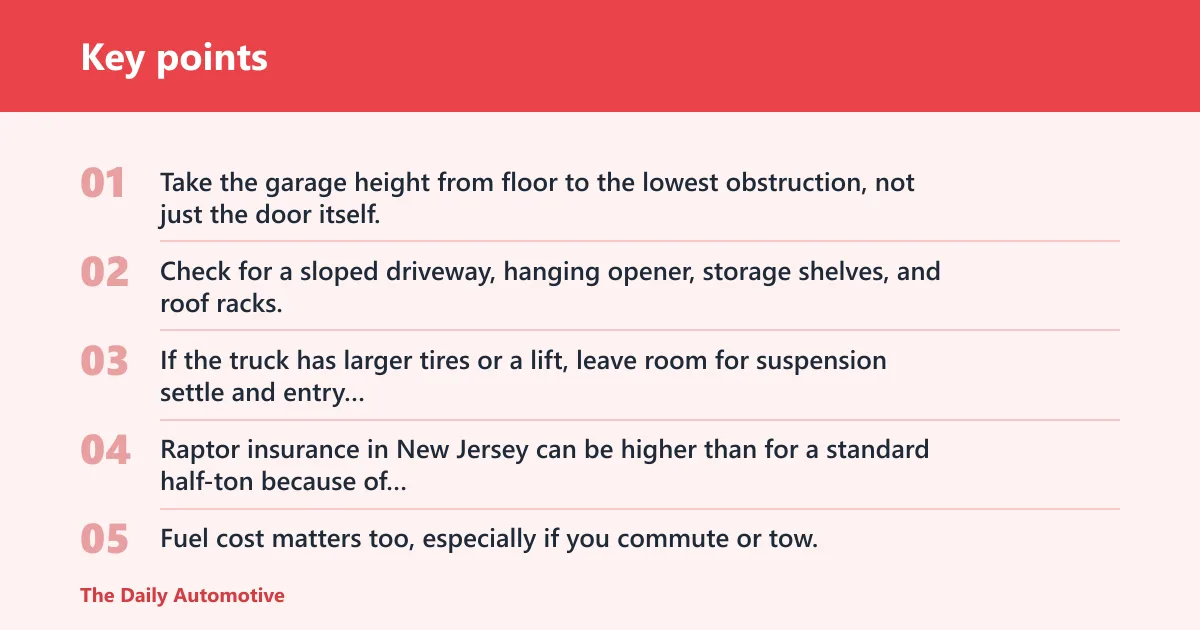
Take the garage height from floor to the lowest obstruction, not just the door itself. Check for a sloped driveway, hanging opener, storage shelves, and roof racks. If the truck has larger tires or a lift, leave room for suspension settle and entry angle, not just the published exterior size.
Price the ownership stack
Raptor insurance in New Jersey can be higher than for a standard half-ton because of repair cost, theft risk, and performance trim pricing. Fuel cost matters too, especially if you commute or tow. Financing adds more if your rate is high or the truck sits in a premium bracket. New Jersey sales tax, title fees, registration, and dealer documentation fees should be figured before you negotiate the sticker.
Compare dealer, private party, and region
Local inventory changes by region and dealer type. High-volume Ford stores may price aggressively on common builds, while specialty dealers and low-supply trucks often carry stronger markups. Private-party listings can look cheaper, but you usually trade away dealer reconditioning, financing convenience, and some warranty comfort.
Suppose a lifted Raptor clears your driveway but leaves only a few inches above the garage door opener. That is not enough margin. One roof rack change, one taller tire, or one loaded cargo box can turn a workable fit into daily contact with the door hardware.
What paperwork should you review before putting money down on a Raptor?
Review the VIN, title, odometer statement, vehicle history report, seller disclosures, service records, and any repair invoices before you leave a deposit. If a dealer is involved, ask for written out-the-door pricing that includes documentation fees, tax, title, and registration so the final number is not a surprise later.
Ask for the right records
Service records matter when they confirm shock replacement, transfer case work, alignment, or body repairs. The more the paperwork matches the truck, the easier it is to judge condition against price. If records are missing on a high-mileage truck, treat that as a risk factor, not a minor inconvenience.
Know when to walk away
If the title is wrong, the frame is heavily rusted, or the truck will not fit your garage, there is no pricing trick that fixes the problem. A clean-looking body cannot cancel a bad title, and a bargain cannot make a corroded frame safe to ignore. Walking away is often the cheapest decision.
Frequently asked questions
What should I check before buying a Ford Raptor in NJ?
Start with title status, rust, 4WD function, shocks, and garage fit. In New Jersey, salt exposure and winter use can matter more than mileage alone. After that, compare insurance, tax, registration, and fuel cost against the sticker price so you know the real out-the-door number.
How do I know if a Ford Raptor has a clean title?
Run the VIN through a vehicle history report and match it to the title, odometer, and listing. A clean title should not show salvage, rebuilt, or flood branding. If accident entries appear, check whether repairs affected the frame, airbags, or structural mounts before you decide the truck is acceptable.
What common problems should I look for on a used Raptor test drive?
Listen for transfer case noise, binding in 4H or 4L, steering pull, brake shake, tire noise, and shock clunk or bounce. Watch for warning lights and delayed engagement. If the truck shudders in tight turns or feels uneven over bumps, budget for diagnosis before you negotiate.
Is a lifted Ford Raptor too tall for NJ garages?
It can be. Measure garage height, door opening, opener clearance, and driveway slope before you buy. A lift kit, larger tires, or roof accessories can erase the margin you thought you had. If the truck barely clears on paper, assume real-world fit will be tighter.
How much more does Raptor insurance cost in New Jersey?
There is no fixed statewide surcharge, but expect it to cost more than a standard F-150 because the truck is pricier to repair and replace. Age, driving record, location, financing, and modifications matter. Get quotes before you sign, especially on lifted or heavily modified trucks.
Should I buy a new or used Ford Raptor in NJ?
Buy new if you want full history, easier financing, and fewer rust questions. Buy used if the price drop offsets inspection risk and possible repair work. In New Jersey, a used Raptor with a clean title, solid frame, and documented maintenance can make more sense than a cheaper truck with hidden corrosion.
Products related to this article
Sponsored / affiliate links. As an Amazon Associate I earn from qualifying purchases. I may earn additional commission from eligible campaigns.
 ACARLUOY Car tire pump portable,Hand held tire inflator, for ford f-150 raptor pickup (2009-2014) accessories,Fit for ford f-150 raptor (2009-2014), 12V dc car tire air pum
 ACARLUOY Portable Air Compressor for Car Tires - 3X Faster Inflation, Fit for Ford F-150 Raptor 2020-2025,6000mAh Battery, LCD Screen, LED Light,Auto Shutoff