How to Know If a Car Has Full Service History: 7 Checks
A car has full service history only when every scheduled service is documented at the correct intervals, with dates and mileages that match the MOT record, dealer database, and invoices. Miss one link and you can overpay for a car with gaps, duplicate stamps, or an incomplete maintenance trail. This guide shows the exact checks that separate genuine full history from a polished but partial file.
What full service history actually means
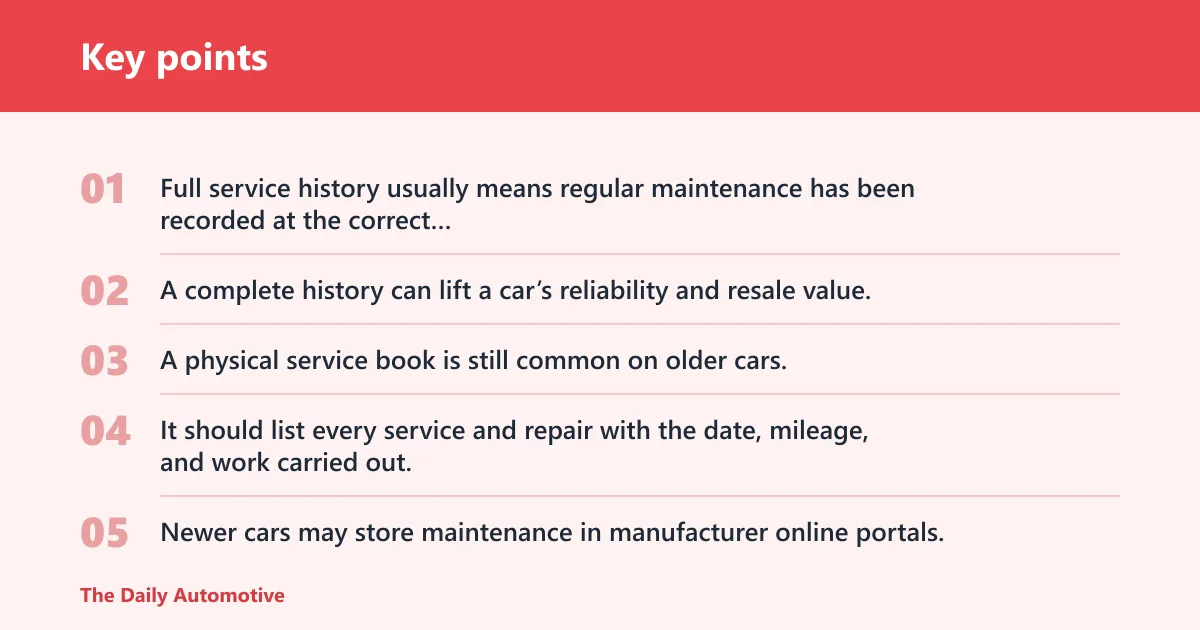

Full service history usually means regular maintenance has been recorded at the correct intervals, with the service book, dealer records, and supporting paperwork lining up. A complete history can lift a car’s reliability and resale value, but only if the entries are coherent and easy to verify.
Paper records versus digital records
A physical service book is still common on older cars. It should list every service and repair with the date, mileage, and work carried out. Newer cars may store maintenance in manufacturer online portals, often entered by authorized dealers. Both count, but both need cross-checking.
What counts as complete enough to trust
Complete enough means there is a continuous maintenance trail, not just a stamped book. Service intervals should fit the car’s age and mileage, and each entry should be backed by matching documents where possible. Gaps in the record are one of the biggest red flags when buying a used car.
How do you check a car’s service history step by step?
Check the service book first, then compare mileage across the MOT history, dealer records, and invoices. If the numbers rise logically and the dates fit the service intervals, the record is more believable. If the paperwork disagrees, ask for copies before you decide.
Start with the service book
Look for dated entries, mileage figures, stamps, and workshop names. A physical record book should show a clear maintenance timeline, not a few blank pages followed by a recent run of stamps. Missing-book risk matters because a book can be lost, replaced, or rewritten.
Match mileage across records
Check whether the mileage rises in a sensible pattern from service to service and year to year. A service entry that shows lower mileage than an earlier MOT reading usually needs an explanation. If the dates fit but the mileage does not, treat the history as incomplete until proven otherwise.
Ask for supporting documents before you decide
Dealer records, receipts, and invoices are the next layer of proof. They should support the service book, not merely repeat it. If the seller cannot produce them, ask the dealer or previous owner for copies before making a final judgement.
Use the service book as your first proof point
The service book is the first place to look because it should show the car’s maintenance timeline at a glance. A stamped book alone does not prove full service history, but it can tell you whether the entries are dated properly, match the mileage, and include workshop details that can be checked elsewhere.
What to look for in stamps, dates, and mileage
Each service entry should include the date, odometer reading, and workshop details. Stamps should fit the dealer or garage named, and the service intervals should be regular. A gap of several years with no explanation is a warning sign even if the final page looks tidy.
Signs the book is missing, replaced, or incomplete
Watch for pages cut out, uneven ink, mismatched fonts, or a book that starts late in the car’s life. A replacement book can be legitimate, but it needs supporting evidence. If the seller only has a recent duplicate book and nothing before that, assume some history may be missing.
When a stamped book still is not enough
A stamped book can still be incomplete if the workshop details cannot be verified, if the mileage sequence is wrong, or if the car’s MOT history shows a different pattern. That is why the service book should be treated as one source, not the whole answer.
Check dealer records, invoices, and receipts next
Dealer records are kept by authorized dealerships, and they should show service dates, service mileage, and the work entered against the car. Receipts serve as proof of the work done on the car, so they help confirm that maintenance really happened rather than being entered later.
What franchised or authorized dealer records should show
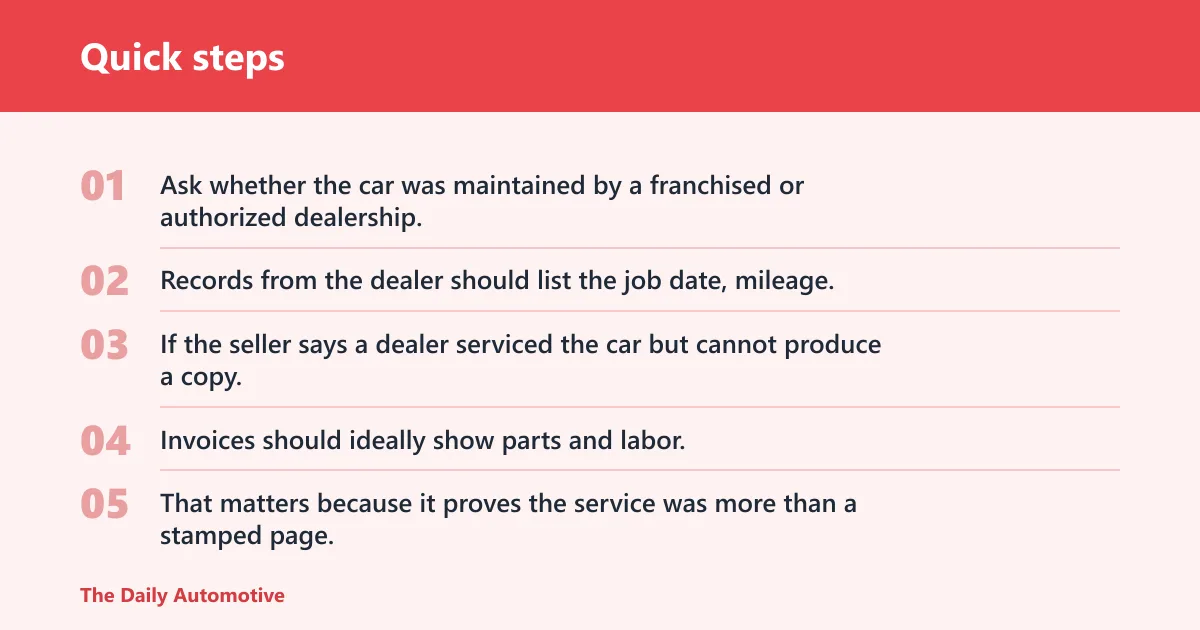
Ask whether the car was maintained by a franchised or authorized dealership. Records from the dealer should list the job date, mileage, and maintenance items carried out. If the seller says a dealer serviced the car but cannot produce a copy, request it directly from the dealer with the VIN.
How invoices confirm work, parts, labor, date, and mileage
Invoices should ideally show parts and labor, plus the date and odometer reading at the time of work. That matters because it proves the service was more than a stamped page. A parts list, labor line, or workshop invoice number gives you something independent to compare with the book and MOT record.
How to ask for copies from a dealer or previous owner
Use the VIN, service dates, and approximate mileage when requesting copies. Dealers may be able to retrieve older entries from their database, while the previous owner may have PDF invoices or scanned receipts. If nobody can produce supporting paperwork for a claimed service, treat the entry with caution.
Can you verify service history online?
Yes, but online checks support the paper trail rather than replace it. Online MOT history helps with mileage checks and annual inspection patterns, manufacturer portals can show digital service records, and VIN-based reports can support verification. None of them is a substitute for the original service documents.
How MOT history helps with mileage checks
Online MOT history is useful because it gives dated mileage points that should generally progress logically. Look for annual inspection patterns and note any unexplained jumps or gaps. If a service book claims a low-mileage service after an MOT showed higher mileage, the record needs a better explanation.
When manufacturer portals show digital service entries
Manufacturer online portals can contain digital service records, especially for brand-specific maintenance carried out by authorized dealers. They are useful on newer cars with digital-only histories. If the portal lists services that the book does not, ask why the paper record was not updated or printed.
How VIN-based reports support, but do not prove, full history
A VIN lookup service can be used to check for full service history, and third-party vehicle history reports can add useful support. They are not proof on their own. Treat them as a cross-check against dealer records, invoices, and the service book, not a replacement for them.
How to spot fake or patched-together records
Fake or patched-together records usually fail when the dates, mileage, or workshop details are compared side by side. Inconsistent entries and gaps in service intervals are common red flags. A neat folder can still hide a poor maintenance trail if the details do not line up.
Mileage that does not rise logically year to year
If the mileage drops, stalls for several years, or rises too fast between entries, ask for an explanation. Say your MOT history shows 42,000 miles in April and the next service book stamp says 38,000 miles in August. That is not a small typo; it is a record problem.
Missing years, duplicate stamps, or mismatched workshop details
Duplicate stamps, repeated handwriting, and workshop names that do not match the invoice are warning signs. Missing years are another issue, especially if the car should have been serviced annually. A common first-timer mistake is to trust a full-looking book without checking whether the garage names can be verified.
Non-franchised servicing that is claimed as dealer history
Independent servicing is not automatically bad, but it should not be described as dealer history unless the paperwork shows an authorized dealership. If the seller says “dealer serviced” yet the invoices come from an independent garage, that is a mismatch worth pressing on.
What if the service book is missing?
A missing service book does not automatically mean the car is poor, but it can raise uncertainty about the maintenance trail. You can sometimes rebuild the record from invoices, dealer data, digital portals, and MOT history. If the seller cannot support the story, the missing book becomes a serious warning sign.
How to rebuild the record trail from invoices and dealer data
Start with the VIN, then request dealer records and check online MOT history for mileage continuity. Combine that with invoices and receipts that show parts, labor, dates, and odometer readings. If the supporting documents line up across sources, the lack of a book may be manageable.
When partial evidence may still be acceptable
Older cars and family-owned cars often have mixed records, especially if they were serviced by several garages. Partial evidence may still be acceptable if the timeline is sensible and the major services can be confirmed. Even then, the price should reflect the extra uncertainty.
Printable 12-point service history verification checklist
Use this checklist before you buy. Match each source against the service dates, mileage, and workshop details. If several rows show red flags, pause the deal until you get better proof or walk away.
| Source checked | What counts as a match | Red flags to note |
|---|---|---|
| Service book | Stamped, dated entries with mileage and workshop details | Blank years, missing pages, unclear stamps |
| Service book mileage | Mileage rises logically between services | Lower mileage than an earlier entry |
| Service intervals | Entries arrive at regular intervals for age and mileage | Large unexplained gaps |
| Dealer records | Authorized dealership data confirms service dates and mileage | No record found, or dealer name does not match |
| Invoices | Parts and labor shown with date and odometer reading | Undated, vague, or handwritten with no mileage |
| Receipts | Proof of the work done on the car | Cash receipt with no car details |
| MOT history | Annual mileage progression fits the record | Sudden jumps, reversals, or missing years |
| Manufacturer portal | Digital service records shown for the VIN | Portal history does not match the book |
| VIN lookup | Supports the stated service history | Report is generic or incomplete |
| Workshop names | Names match invoices, stamps, and dealer data | Different names for the same claimed service |
| Maintenance pattern | Regular servicing with no unexplained omissions | Missing major services |
| Overall file | Paper and digital sources tell the same story | Backfilled entries, duplicate stamps, or contradictions |
How to use the checklist before you buy
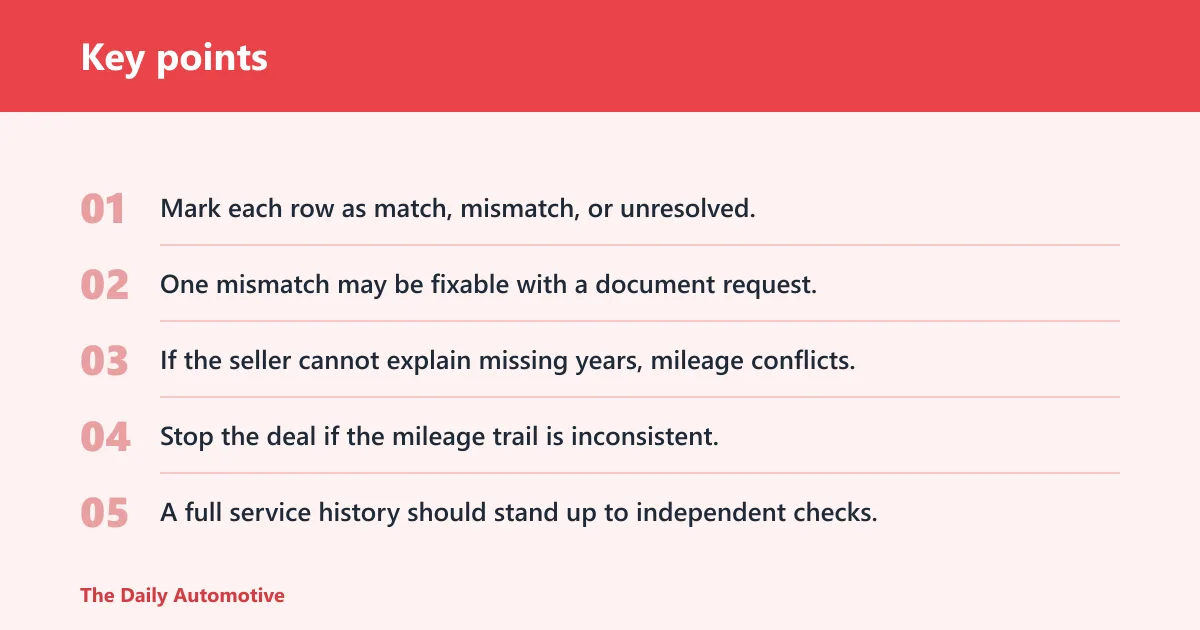
Mark each row as match, mismatch, or unresolved. One mismatch may be fixable with a document request, but several mismatches usually mean the history is incomplete. If the seller cannot explain missing years, mileage conflicts, or non-matching workshop details, assume the file is not full.
What findings should stop the deal
Stop the deal if the mileage trail is inconsistent, the seller cannot produce any invoices, the dealer cannot confirm the claimed work, or the record appears backfilled. A full service history should stand up to independent checks. If it does not, the uncertainty belongs in the price or in your decision to walk away.
How do I know if a car has full service history?
A car is generally considered to have a full service history when the service book, MOT history, dealer records, and invoices all broadly agree on dates and mileage. A stamped book alone is not enough. Look for continuous maintenance, sensible intervals, and supporting documents that can be checked against the VIN.
How can I check if a car has service history?
Check the service book first, then compare it with online MOT history and any dealer or workshop records. Ask for invoices or receipts that show parts, labor, date, and mileage. If the seller only offers a tidy folder with no supporting evidence, treat the history as unproven.
Can you check if a car has full service history before buying it?
Yes. You can check before buying by asking for the service book, VIN, dealer records, and invoices, then comparing them with online MOT history. That process often shows whether the record is genuine, incomplete, or merely neat-looking. It is one of the best pre-purchase checks available.
How do I check my car has full service history?
Start with your own records and build a timeline from the earliest service to the latest. Confirm that dates and mileage match across the service book, invoices, and MOT history. If some entries are missing, contact the dealer or garage that carried out the work and ask for copies.
What documents prove a car has full service history?
The strongest documents are the service book, dealer records, invoices, and receipts, supported by online MOT history. Manufacturer portals and third-party reports can add more proof, especially on newer cars. A single document rarely proves full history on its own; the value is in the match between sources.
Can service history be verified online?
Yes, partly. Online MOT history can confirm mileage progression, and manufacturer portals may show digital service records entered by authorized dealers. Third-party vehicle history reports and VIN lookups can support the picture, but they do not replace original invoices, dealer records, or the service book.
What are the red flags of a fake service history?
Watch for mileage that does not rise logically, missing years, duplicate stamps, mismatched workshop details, and records that appear added after the fact. Gaps in service intervals are one of the biggest warning signs. If the paperwork needs too much explaining, the history is not reliable enough.
Products related to this article
Sponsored / affiliate links. As an Amazon Associate I earn from qualifying purchases. I may earn additional commission from eligible campaigns.