Car Services, Rentals and Memberships: What They Cost
Car services, rentals, and memberships are worth paying for only when annual savings beat the fee or there is a clear need for faster pickup, extra drivers, or mileage flexibility. Ignore that math and you can spend about $60 to $200 a year for perks that may barely reduce the cost of a single booking. This guide compares rental memberships, loyalty programs, warehouse-club booking, peer-to-peer rentals, and car subscriptions by fees, insurance, and best-fit use case.
The trade-off: savings vs convenience
Free rental loyalty programs and paid memberships should not be judged by the same standard. A free program can be worth joining for a shorter pickup process alone. A paid program or subscription needs to return real dollars, or solve a repeated use case that would otherwise cost more in time, insurance, or extra-driver fees.
The advertised daily rate rarely tells the full story. Five cost buckets matter more: annual fees, trip rate, taxes and location surcharges, insurance or protection add-ons, and usage rules such as mileage caps, extra-driver charges, or cancellation limits.
That changes what “worth it” means by renter type. Occasional renters need clear trip savings. Seasonal renters need lower week-by-week cost and flexible cancellation. Frequent renters often get more value from skip-the-counter access, faster vehicle choice, and status thresholds that start to matter only after many rentals.
Hard savings versus convenience perks
Hard savings reduce the bill: a member discount, waived additional-driver fees, redeemable free days, or included insurance in a subscription. Convenience perks make the trip easier but do not reduce the total: priority service, counter-free pickup, or better vehicle choice.
That distinction is where many comparisons fail. Budget Fastbreak can save time, but it does not promise a discount. Alamo Insiders does cut the rate directly, so its value is easier to measure.
The failure cases readers should watch
A membership can lose on price even when the perk list looks strong. A cheaper direct rate, an independent broker, or an off-airport branch can beat a convenience-first loyalty booking. The right comparison is total out-the-door cost, including fees, cancellation rules, mileage limits, and whether a second driver is free.
A common first-timer mistake is choosing a car-share membership based only on the monthly fee while overlooking mileage charges, booking minimums and insurance deductibles. An airport counter can seem close in price at first, then concession fees, taxes, and location surcharges push the final total above a nearby city branch.
What do car services, rentals, and memberships actually cost?
Most free rental loyalty programs have a $0 entry cost and offer modest direct savings, while paid options add a fixed fee that only pays off with enough trips. The useful comparison is category by category: free loyalty enrollment, warehouse-club access, peer-to-peer booking fees, one-off rentals, and monthly car subscriptions.
Free loyalty programs: low risk, uneven savings
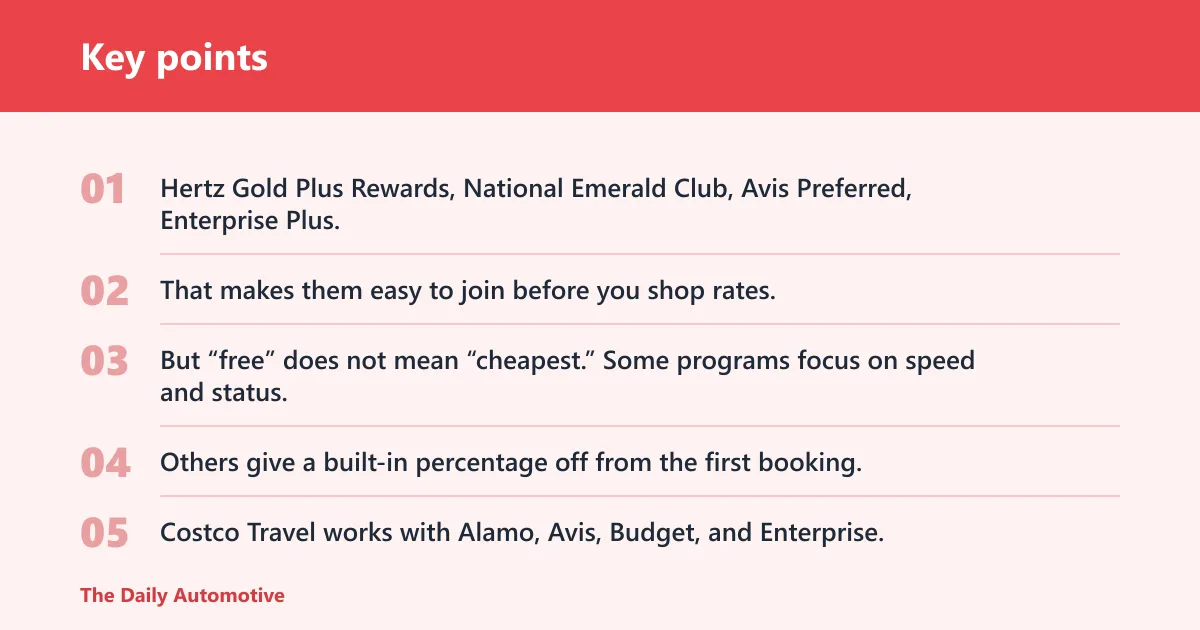
Hertz Gold Plus Rewards, National Emerald Club, Avis Preferred, Enterprise Plus, Sixt Loyalty, Alamo Insiders, Thrifty Blue Chip, and Budget Fastbreak all have a free entry point. That makes them easy to join before you shop rates.
But “free” does not mean “cheapest.” Some programs focus on speed and status, not discounts. Others give a built-in percentage off from the first booking, which is much easier to value for occasional renters.
Warehouse-club booking: annual fee plus possible trip savings
Costco memberships start at $65 annually. Costco Travel works with Alamo, Avis, Budget, and Enterprise, and rental availability includes the U.S., Canada, and some European destinations.
That annual fee is a real hurdle, so the booking has to earn it back. Savings can come from lower rates, the U.S. second-driver-fee waiver, and the ability to cancel any time before pickup and rebook if rates fall.
Peer-to-peer rentals: base rate plus platform rules
Peer-to-peer rentals usually bundle the trip into a host-set daily or hourly rate plus platform fees, protection-plan choices, delivery charges in some markets, and host rules on mileage and return condition. These listings can beat traditional agencies for unusual cars, neighborhood pickup, or short local use.
They can also lose fast if the mileage cap is tight, the trip minimum is longer than needed, or age fees and delivery charges stack up. The lowest listing price often excludes the fees, mileage terms, and protection choices that decide what you actually pay.
Car subscriptions: monthly payment instead of one-off booking
Car subscription services are a month-to-month alternative to ownership. They often include insurance coverage, roadside assistance, and maintenance, though coverage levels, deductibles, and included services vary by provider.
The catch is fixed cost. A subscription can make sense for repeated or near-daily use, but it usually costs more than a few short rentals spread across a year.
Walmart oil change costs and what can raise the bill
If you’re comparing quick-service maintenance options, the main question is whether Walmart’s oil change price is low enough to justify the trade-offs. The supporting guide explains that Walmart Auto Care Centers do offer oil changes, with entry pricing that starts around basic conventional oil and climbs for synthetic blend, full synthetic, and add-ons. It also shows what is typically included, what can change the final total, and when another shop may be the better value. That matters because choosing the wrong oil or skipping needed service can turn a cheap visit into a costly repeat repair. See the full breakdown in Walmart oil changes.
When Jiffy Lube is worth the extra cost
Jiffy Lube can be a smart choice when your priority is speed, walk-in access, or a coupon that meaningfully lowers the bill. The supporting guide breaks down when the brand’s higher price is justified and when it is not, comparing it with independent shops, dealers, and DIY oil changes. It also shows how the final invoice can climb once inspection items or add-ons are included.
If you want the clearest answer on price versus convenience, see this Jiffy Lube pricing guide for a direct breakdown of costs, service inclusions, and the situations where paying more makes sense.
Rental value decision matrix
| Service type | Typical cost structure | Break-even use case |
|---|---|---|
| Free rental loyalty programs | $0 to join; benefits usually center on faster pickup, vehicle choice, points, or status; some programs add a built-in discount | Worth joining even for one rental if the signup is quick, especially when the program gives a direct discount or skip-the-counter access |
| Warehouse-club rental booking | Annual club fee plus the rental price; savings may come from lower rates, waived U.S. second-driver fees, and refundable booking flexibility | Makes sense when projected yearly rental savings exceed the annual fee, often after several bookings or one family trip with an extra driver |
| Peer-to-peer rentals | Trip rate plus platform fees, protection-plan choices, possible delivery fees, and mileage terms set by the host | Best when local pickup, specialty vehicles, or short neighborhood trips beat agency pricing after all fees and mileage limits are counted |
| Car subscriptions | Monthly payment that often includes insurance, maintenance, and roadside assistance; mileage limits and swap fees may apply | Most sensible for repeated monthly use or near-daily driving when replacing frequent rentals or avoiding a second owned car |
Which rental loyalty programs are free to join, and what do you get?
Nearly every major rental loyalty program discussed here has a free entry tier, but they do different jobs. Some cut the price on day one, some speed pickup, and some matter only if you rent often enough to hit status thresholds that improve upgrades or vehicle choice.
Programs that mainly save time
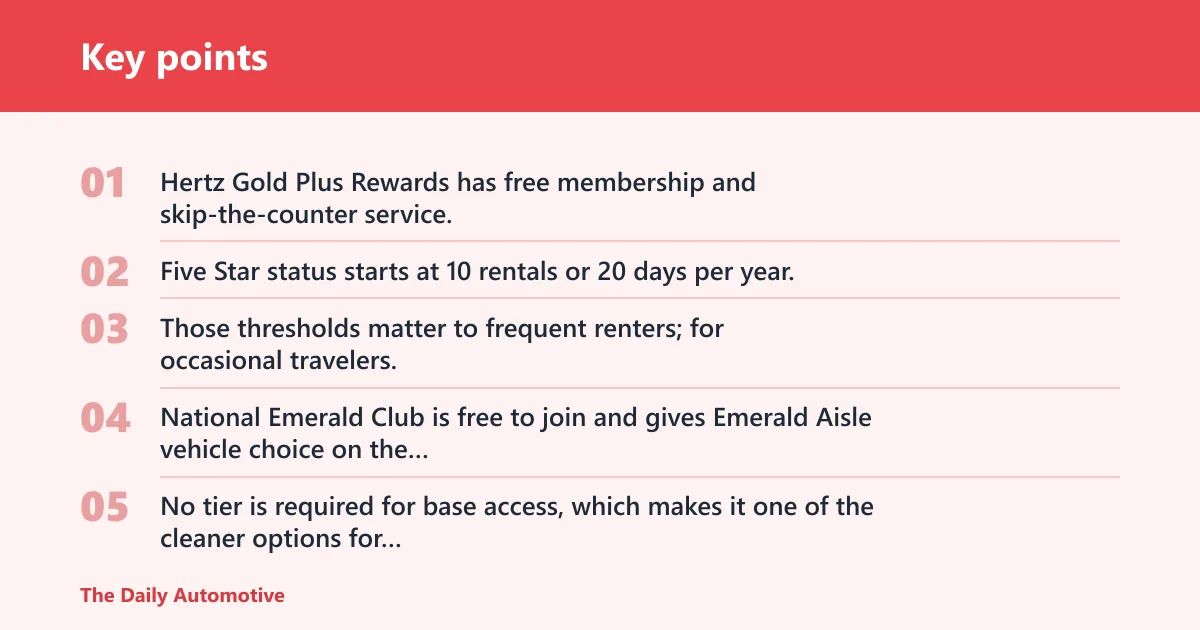
Hertz Gold Plus Rewards has free membership and skip-the-counter service. Five Star status starts at 10 rentals or 20 days per year, and President’s Circle starts at 20 rentals or 40 days. Those thresholds matter to frequent renters; for occasional travelers, the base value is mostly pickup speed.
National Emerald Club is free to join and gives Emerald Aisle vehicle choice on the first rental. No tier is required for base access, which makes it one of the cleaner options for counter-free pickup and car choice without waiting to earn status.
Avis Preferred has a free Preferred tier and skip-the-counter pickup. For infrequent renters, that means the immediate value is convenience, not a guaranteed lower rate.
Budget Fastbreak is free and focuses on expedited counter service. It does not come with a built-in discount and is not structured around a points-heavy tier ladder, so it is useful mainly when time at pickup matters.
Programs with direct discount value
Alamo Insiders is free to join, has no tiers, requires no tracking, and gives an automatic 5% off every rental. That direct discount is easy to value because it applies from the first booking.
Thrifty Blue Chip is free to join. For renters who book Thrifty anyway, that can matter more than a status ladder they may never reach.
Enterprise Plus is free to join, includes Express pickup, and points can be redeemed for free rental days. The useful detail is that free rental day redemptions have no blackout dates, which gives the points more practical value than restricted certificates.
Programs where status starts to matter
Sixt Loyalty gives Gold on free registration. Higher tiers add priority vehicle selection and upgrades, so the program becomes more compelling only when rental frequency is already high.
Suppose two bookings show the same final price. If one includes counter-free pickup and the other does not, the free loyalty signup may still be worth doing. If one rate is lower and the loyalty perk is only faster service, price should still decide the booking.
Is a Costco membership worth it just for car rentals?
A Costco membership can be worth it for car rentals, but only if yearly savings beat the annual fee. The strongest cases are repeated rentals, family trips that use the U.S. second-driver-fee waiver, and refundable bookings that let you re-shop rates before pickup without penalty.
What Costco Travel actually gives you
An active Costco membership is required. Costco Travel works with Alamo, Avis, Budget, and Enterprise. Rental bookings are available in the U.S., Canada, and some European destinations.
Two terms stand out. Costco Travel waives second-driver fees for all U.S. rentals, and it allows cancellation any time before pickup. Those are concrete money and flexibility benefits, not vague VIP extras.
How to think about the annual fee
The annual fee starts at $65, so the rental side needs to produce at least that much value over a year if car bookings are the main reason for joining. That can happen in a few ways:
- Add up expected annual rental savings versus the best direct or broker rate.
- Include any avoided second-driver charges on U.S. family trips.
- Count the value of rebooking a lower refundable rate before pickup.
- Stop if a cheaper independent rate still wins after those adjustments.
Picture a household that takes two U.S. vacation rentals and both adults drive. Even before rate differences, avoiding extra-driver charges can shift the math. A solo traveler booking one weekend rental may not recover the fee at all.
When Costco loses anyway
Costco is not automatically the cheapest channel. An agency’s own prepaid promotion, a corporate code, a credit-card travel portal, or an off-airport independent can still beat it on total cost. That is especially true when the traveler does not need a second driver and can find a cheaper direct rate with similar cancellation terms.
That is the main failure case to remember: a paid membership should be judged on net savings, not on the comfort of seeing a familiar booking portal.
When do car subscriptions cost more than renting?
Car subscriptions usually cost more than renting when driving is occasional and trips are short. The math gets closer for seasonal use lasting weeks at a time, and subscriptions become more plausible for near-daily driving because they often bundle insurance, maintenance, and roadside assistance into one monthly payment.
Short trips and occasional use
If the car is needed for a few weekends or one vacation, a subscription’s fixed monthly cost is hard to justify. Paying for a whole month to cover four or five days of use usually loses against a standard rental, especially when a free loyalty program or warehouse-club booking lowers the trip cost.
Seasonal and repeated monthly use
The comparison changes if the pattern repeats. Someone who rents for one or two weeks every month, or needs a vehicle for a multi-month temporary move, may find the gap narrower. At that point the included insurance, maintenance, and roadside assistance matter because they remove separate decisions and add-on costs.
Near-daily driving and second-car alternatives
A subscription is closest to making sense when it replaces repeated long rentals or an owned second car. That does not make it “cheap.” It means the bundled structure may beat the hassle and add-on costs of stringing together rental after rental.
Do not ignore mileage limits, swap fees, or vehicle availability. Those terms decide whether a subscription is a clean substitute for daily access or an expensive compromise.
What is usually included?
Many car subscriptions include insurance coverage, roadside assistance, and maintenance. Those items are part of the appeal because traditional rentals often price insurance separately, while ownership spreads maintenance and roadside costs over time instead of showing them in one monthly bill.
Coverage levels, deductibles, and included services still vary widely by provider.
When Zipcar makes sense for city drivers
Zipcar can be a smart option if you only need a vehicle a few times a month and your trips stay relatively short. The supporting article breaks down how pricing changes once you add membership fees, mileage charges, fuel rules, and possible parking costs, then compares those totals with rideshares, rentals, and owning a car. That matters because a reservation that looks cheap up front can become more expensive than expected once all the fees are counted. If you want a clear way to judge whether the service fits your driving pattern, see the Zipcar value guide.
U-Haul auto transport costs, fees, and when it beats other options
If you’re trying to move a car without overpaying, this article explains what a U-Haul auto transport usually costs, which checkout fees can push the total up, and how tow dollies and professional car shipping compare. It also helps you avoid a common mistake: choosing equipment that looks cheaper but isn’t safe or suitable for your vehicle. For a clear breakdown of pricing ranges, add-ons, and the situations where U-Haul is the lower-cost choice, see U-Haul auto transport costs.
What rental perks save real money beyond the base rate?

Real money-saving perks are the ones that change the bill: additional-driver waivers, direct member discounts, free-day redemptions, refundable bookings that allow cheaper rebooking, and bundled insurance in subscriptions. Skip-the-counter access, priority service, and better car choice matter, but they are convenience benefits unless they avoid another fee.
Discounts, free days, and waived driver fees
Alamo Insiders’ automatic 5% off is a straightforward example of direct savings. Enterprise Plus can return value through points redeemable for free rental days, and those redemptions have no blackout dates.
Costco Travel’s U.S. second-driver-fee waiver also belongs in the savings bucket. For families or couples sharing long drives, that can matter more than a small daily-rate difference.
Airport versus off-airport pricing
Airport rentals are often more expensive because concession fees, taxes, and location surcharges stack onto the booking. Off-airport branches can be cheaper, sometimes by enough to offset the cost of a short rideshare to the lot.
But “often” is the right word, not “always.” Airport inventory may be better after a late arrival, and the time saved can outweigh a modest price gap. Compare the all-in total, branch hours, and the cost of getting to an off-airport location.
Refundable bookings and rate re-shopping
Refundable rentals are one of the simplest ways to cut cost without joining anything new. Costco Travel allows cancellation any time before pickup, so a renter can book early, watch prices, and rebook if a lower rate appears.
The same logic applies elsewhere when the rate is refundable. Compare like with like: cancellation cutoff, prepaid penalties, mileage terms, and whether a lower rate quietly drops an included benefit.
Credit card rental benefits and insurance checks
Credit card rental-car benefits can change the value of a booking, especially if they reduce the need to buy extra coverage at the counter. Check the card’s coverage type, exclusions, eligible countries, and vehicle exclusions before assuming it replaces the rental company’s protection.
That matters even more with peer-to-peer rentals and subscriptions, where coverage structure can differ from a standard agency rental.
When Hertz adds a young renter fee
If you’re under 25, Hertz may add a daily young driver surcharge, which can change the true cost of a rental by a lot. The supporting guide breaks down who gets charged, how the fee varies by location and car class, and why the price shown online can still change at pickup if the rate terms do not match the renter’s age or booking details. It also explains when AAA discounts can remove the charge on eligible rates and when they cannot.
For a clear breakdown of the rules and edge cases, see Hertz young driver fee.
Choose Costco Travel or free loyalty programs if… / Choose car subscriptions or peer-to-peer rentals if…
Choose Costco Travel or free loyalty programs if…
- You rent occasionally and want easy upside with little or no fixed cost.
- You care about U.S. second-driver savings on family trips.
- You want refundable bookings so rates can be re-shopped before pickup.
- You rent for business often enough that counter-free pickup or status thresholds save time repeatedly.
Choose car subscriptions or peer-to-peer rentals if…
- You need a car for repeated monthly use rather than a single trip.
- You want one payment that often includes insurance, roadside assistance, and maintenance.
- You need a neighborhood pickup, a specialty vehicle, or a host-delivered option that agencies do not match.
- You have checked mileage caps, fees, and coverage terms and they still beat a traditional rental.
Best fit by renter type
Occasional travelers: start with free loyalty programs that either speed pickup or add an immediate discount, then compare against refundable direct rates and warehouse-club pricing.
Seasonal renters: compare Costco Travel, traditional weekly rentals, and subscriptions side by side. This is where bundled insurance and repeated-use convenience start to matter.
Frequent business renters: Hertz, National, Avis, Enterprise, and Sixt become more interesting because status thresholds and counter-free pickup save time repeatedly.
Families needing an extra driver: Costco Travel deserves a hard look because the U.S. additional-driver waiver directly affects the total bill.
Long-term drivers: subscriptions make more sense than weekend rentals, but only after checking mileage limits and whether a normal long-term rental still comes out cheaper.
Car services rentals and checklist
| Use pattern | Best starting option | What to verify before booking |
|---|---|---|
| Occasional: one or two rentals a year | Free loyalty program with direct discount or faster pickup | Total price versus direct and off-airport rates; cancellation rules; credit card coverage |
| Seasonal: several rentals clustered in one part of the year | Costco Travel or weekly rentals compared against a short-term subscription | Whether annual savings beat the membership fee; extra-driver costs; insurance and mileage terms |
| Frequent: regular business or repeat personal rentals | Status-based loyalty program, then compare with subscription if use is near-daily | Tier thresholds, free-day value, airport versus off-airport spread, and whether bundled subscription costs replace repeated add-ons |
Frequently asked questions
How much do car rental memberships and loyalty programs actually cost?
Most loyalty programs cost $0 to join, while warehouse-club access adds an annual membership fee and subscriptions add a monthly payment. The useful measure is not the signup price alone. It is whether discounts, free days, waived driver fees, or included insurance return more than the fixed cost over a year.
Which rental loyalty programs are free to join?
Hertz Gold Plus Rewards, National Emerald Club, Avis Preferred, Enterprise Plus, Sixt Loyalty, Alamo Insiders, Thrifty Blue Chip, and Budget Fastbreak all have a free entry point. The key difference is value type: some focus on faster pickup, while Alamo Insiders gives a direct automatic discount.
Are airport car rentals usually more expensive than off-airport rentals?
Usually, yes. Airport rentals often carry concession fees, taxes, and location surcharges that make the final bill higher than a city branch. Still, airport pickup can be worth it when arrival time, branch hours, inventory, or ground-transport cost erase most of the apparent savings off airport.
What rental perks can save money beyond the base rate?
Look for perks that cut the bill directly: automatic member discounts, waived additional-driver fees, free rental-day redemptions, refundable bookings that let you rebook at a lower rate, and credit card coverage that reduces counter insurance purchases. Skip-the-counter access is useful, but it is mainly a time saver.
Do car subscriptions usually include insurance and maintenance?
Often, yes. Many car subscriptions package insurance coverage, maintenance, and roadside assistance into one monthly payment. That can simplify the comparison against repeated rentals, but the details still matter. Check mileage limits, swap rules, deductibles, and whether the included coverage matches what would otherwise be bought separately.
How do I decide whether to use a membership, subscription, or one-off rental?
Match the product to the usage pattern. One or two trips a year usually point to a free loyalty program or a refundable one-off rental. Several annual bookings may justify Costco Travel. Near-daily driving or repeated monthly need is where a subscription starts to deserve a serious side-by-side comparison.
Products related to this article
Sponsored / affiliate links. As an Amazon Associate I earn from qualifying purchases. I may earn additional commission from eligible campaigns.