Best FWD Drivetrain for Commuters
For most commuters, FWD is the better drivetrain if you want a lower sticker price, better fuel economy, and less complicated maintenance. Choose AWD only if you regularly deal with steep grades, deep snow, or roads that stay unplowed. Pick wrong, and you pay extra every day for traction you barely use. This guide compares FWD and AWD on cost, weather, and commuting convenience.
FWD vs AWD for commuters
The commuter trade-off is plain: FWD keeps the car lighter, cheaper, and easier to own, while AWD adds traction for slippery launches and rough pavement. If your driving is mostly paved, stop-and-go, and predictable, FWD usually creates fewer headaches than AWD. If your route includes frequent snow or steep ramps, AWD can matter.
Quick comparison table
| Criterion | FWD | AWD | Commuter takeaway |
|---|---|---|---|
| Power delivery | Engine power goes to the front wheels only | Power can be distributed to all four wheels when extra traction is needed | AWD helps get moving on slippery surfaces |
| Fuel economy | Usually 3-5 MPG better mileage | Typically uses more fuel because of added weight and drivetrain drag | FWD is easier on fuel over a long commute |
| Purchase price | Lower | Higher by about $1,000–$3,000 on many new vehicles | FWD usually costs less up front |
| Maintenance burden | Lower servicing fees and less hardware to maintain | More complex hardware, plus tire-matching and fluid-service concerns | FWD is simpler to own |
| Winter traction | Good with winter tires, especially in moderate weather | Better for accelerating in snow, rain, ice, and gravel | AWD helps you go, not stop |
| Handling feel | Can show torque steer and understeer under hard use | More stable feel in slippery launches | Neither replaces careful driving or good tires |
FWD drivetrain decision matrix
This matrix scores drivetrain choices on the issues commuters actually feel: traffic, mileage, weather, tire expense, service complexity, and fuel savings. Higher scores are better for a typical commuter. The goal is not to pick a single winner for every route; it is to match the drivetrain to the daily drive.
| Commuter factor | FWD | AWD | RWD |
|---|---|---|---|
| City congestion | 5 | 3 | 3 |
| Annual mileage | 5 | 3 | 3 |
| Winter severity | 3 | 5 | 2 |
| Tire costs | 5 | 3 | 4 |
| Repair complexity | 5 | 2 | 4 |
| Fuel savings | 5 | 2 | 3 |
Simple read: FWD is the strongest commuter pick when the route is mostly paved and repetitive. AWD moves to the top only when winter traction is a regular need, not an occasional inconvenience.
What does FWD mean for commuting?
For commuting, FWD means the engine drives the front wheels only, which keeps the layout lighter and simpler than AWD. That matters in traffic because less hardware usually means less weight, fewer moving parts, and fewer costs over years of stop-and-go driving.
Why compact cars use it so often
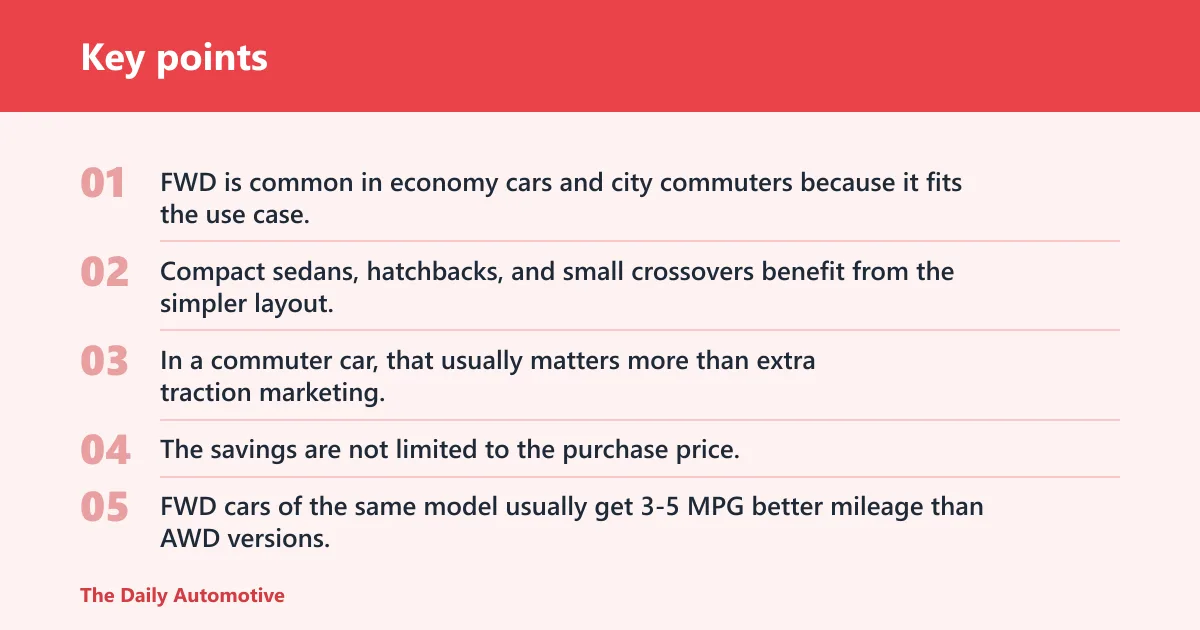
FWD is common in economy cars and city commuters because it fits the use case. Compact sedans, hatchbacks, and small crossovers benefit from the simpler layout, lower manufacturing expenses, and lower servicing fees. In a commuter car, that usually matters more than extra traction marketing.
Where FWD saves money over time
The savings are not limited to the purchase price. FWD cars of the same model usually get 3-5 MPG better mileage than AWD versions, and that fuel gap adds up over a work-week commute. Fewer drivetrain parts also mean fewer service points than an AWD system with extra hardware.
Say your commute is about 18 miles each way on suburban pavement, with only a few slippery mornings each winter. A FWD compact sedan or hatchback usually makes more sense than an AWD crossover, because the extra traction will sit unused most days while fuel and service bills keep coming.
Is AWD better than FWD?
AWD is better than FWD when your main problem is getting moving on low-grip surfaces. It can distribute power to all four wheels when extra traction is needed, which helps in snow, rain, gravel, and uneven roads. It is not a blanket safety upgrade, though, because braking and cornering still depend on tires and speed.
Traction on snow, rain, and gravel
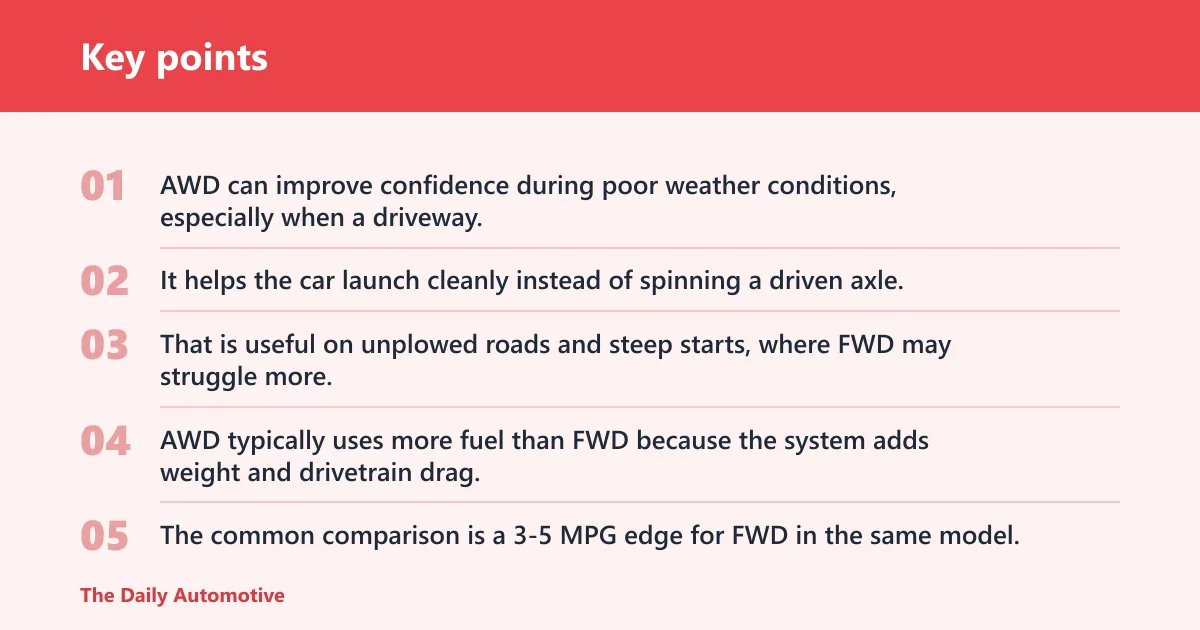
AWD can improve confidence during poor weather conditions, especially when a driveway, ramp, or side street is slick. It helps the car launch cleanly instead of spinning a driven axle. That is useful on unplowed roads and steep starts, where FWD may struggle more.
Fuel economy and added weight
AWD typically uses more fuel than FWD because the system adds weight and drivetrain drag. The common comparison is a 3-5 MPG edge for FWD in the same model. For a commuter, that difference matters because fuel use repeats every day, while extra traction only helps on some days.
Purchase price and drivetrain complexity
AWD typically adds $1,000–$3,000 to the initial price versus FWD, and a used-car guide says that premium carries over to used pricing too. The price gap is only part of the cost. More hardware means more service points, more fluid-related upkeep, and more chances for a used AWD vehicle to have hidden wear.
Picture a commuter who leaves a covered garage, drives 14 miles on plowed roads, and sees snow only a few times a year. AWD may feel reassuring, but the owner still pays for extra weight, extra complexity, and more tire-related rules for a benefit that appears only occasionally.
How do handling and winter tires change the answer?
Handling and tire choice can change the answer more than the badge on the tailgate. FWD can show torque steer under hard acceleration, and understeer in tight turns is common because the front tires are both steering and pulling. Winter tires matter more than AWD alone for stopping and cornering on snow and ice.
Understeer and torque steer in FWD
Torque steer is the sideways pull you can feel when a powerful FWD car puts down hard acceleration. Understeer is the tendency to push wide in a turn when the front tires are busy handling both steering and propulsion. In commuting, these traits are usually mild, but they are part of the trade-off.
Why AWD does not change braking physics
AWD helps the car accelerate on slick pavement, but it does not improve braking physics. If the tires cannot grip, the car still cannot stop quickly just because all four wheels can be driven. That is why winter tires matter so much: they improve braking and cornering on snow and ice, not just takeoff.
Why winter tires matter more than AWD alone
If winter driving is the concern, start with tires before the driveline. A front-wheel-drive car on proper winter tires can outperform an AWD car on worn all-season tires when the road turns icy. For commuters, that is the more useful safety lesson than any traction badge.
Commuter costs you should not ignore
Many comparison pages stop at fuel economy and snow traction. That leaves out the costs that show up in ownership: front tire wear, alignment sensitivity, CV axle wear, and the extra service burden of AWD hardware. Those are the commuter costs that affect a car you drive five days a week.
Front tire wear and alignment sensitivity
FWD puts engine power through the front tires, so they do more work and often wear faster. Alignment matters more, too, because a small alignment issue can show up as feathered edges or pulling sooner on the driven end of the car. For commuters, that means rotation and alignment checks matter.
CV axles and front-end service
FWD layouts depend on front CV axles to deliver power while the wheels turn and move with the suspension. That keeps the system simple, but the front end works hard. With AWD, the front end still carries that load, and the system adds more parts beyond it.
Transfer case and tire-matching rules on AWD
Used AWD can hide a cost that FWD owners do not face: tire matching. Some AWD systems require all four tires to stay within 2/32″ of each other in tread depth, and mismatched tires can damage drivetrain components. Mismatched AWD tires can destroy the transfer case, which is why replacement rules matter.
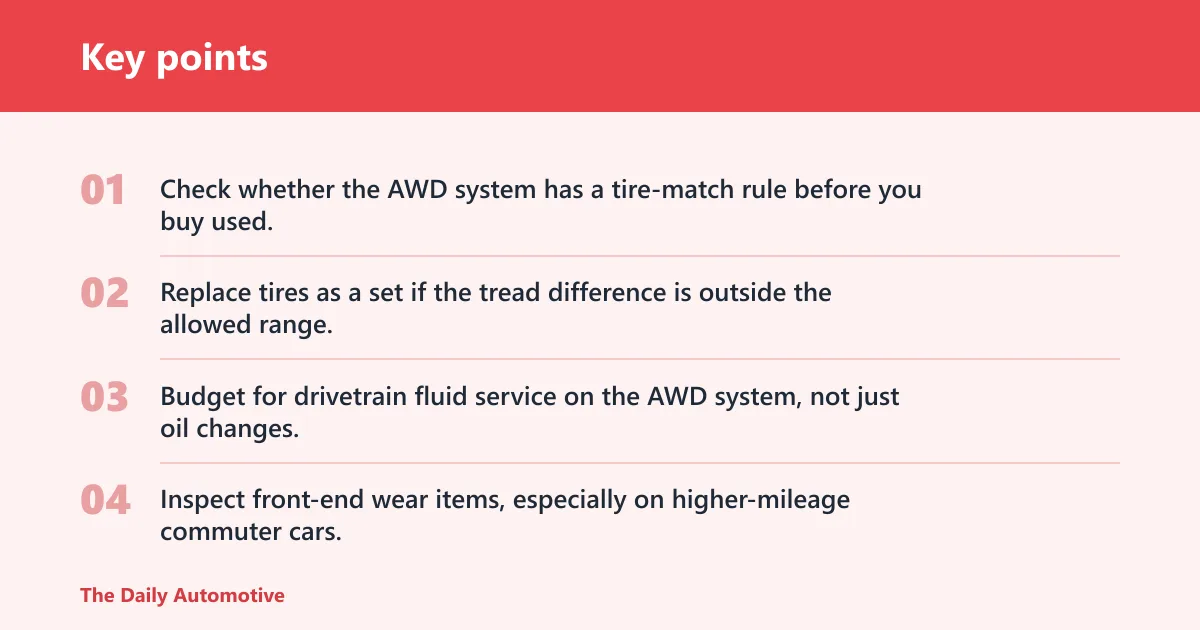
- Check whether the AWD system has a tire-match rule before you buy used.
- Replace tires as a set if the tread difference is outside the allowed range.
- Budget for drivetrain fluid service on the AWD system, not just oil changes.
- Inspect front-end wear items, especially on higher-mileage commuter cars.
Choose FWD if… / Choose AWD if…
Choose FWD if your commute is mostly paved, your winters are moderate, and you want the lowest total hassle. Choose AWD if your route regularly involves steep grades, deep snow, or unplowed roads. For commuting, the right drivetrain is the one that matches the route you actually drive.
Choose FWD if…
- You drive mostly in city congestion or suburban traffic.
- Your annual mileage is high and fuel cost matters.
- You want lower purchase price and simpler maintenance.
- You prefer compact sedans, hatchbacks, or small crossovers for daily use.
Choose AWD if…
- You face frequent snow, ice, or gravel on the way to work.
- You must climb steep ramps, hills, or unplowed access roads.
- You want extra traction for starting, not extra stopping power.
- You are ready for higher purchase cost and stricter tire-matching rules.
A common first-timer mistake is buying AWD for a commute that is mostly dry pavement and then finding out the real penalty is not just fuel. It is tire rules, more parts to service, and a higher upfront bill for traction that rarely gets used.
Frequently asked questions
What is a fwd drivetrain?
A FWD drivetrain sends engine power to the front wheels only. For commuters, that usually means a lighter, simpler layout with lower purchase and maintenance costs than AWD. It is common in economy cars, compact sedans, hatchbacks, and small crossovers because it fits daily paved-road driving well.
What drivetrain is best for commuting
For most commuting, FWD is the best drivetrain because it keeps the car cheaper to buy, cheaper to fuel, and simpler to service. AWD is the better fit only when your route regularly includes snow, steep grades, or unplowed surfaces. Daily hassle matters more than traction marketing.
Fwd vs all wheel drive
FWD is usually the better commuter choice on dry or moderately wet pavement, while AWD is better for getting moving on slippery roads. FWD usually returns 3-5 MPG better mileage and costs less up front. AWD adds traction, weight, and maintenance complexity, so its value depends on weather and route.
Is all wheel drive better than fwd?
AWD is better than FWD when your main problem is traction on snow, rain, gravel, or uneven roads. It is not automatically safer overall, because braking and cornering still depend on tires and speed. For many commuters, FWD remains the better answer because it costs less and uses less fuel.
Is fwd or awd better for handling?
For everyday commuting, FWD is easier to manage and usually feels predictable, but it can show understeer and torque steer under hard use. AWD can feel more planted when starting off on slippery roads. Neither system beats good tires and careful driving when the road is wet or icy.
What drivetrain is best for speed
For straight-line acceleration on slippery surfaces, AWD can put power down better than FWD. For speed in a commuter sense, though, that is the wrong question. Most drivers benefit more from lighter weight, lower fuel use, and lower costs than from extra traction they will rarely use.
Products related to this article
Sponsored / affiliate links. As an Amazon Associate I earn from qualifying purchases. I may earn additional commission from eligible campaigns.