How Long Can You Drive Limp Mode? Essential Guide
You can drive a car in limp mode for a very short distance, typically just to get to a safe place or a repair shop. It severely limits your car’s performance to prevent further engine damage. Ignoring limp mode can lead to costly repairs, so it’s best to address the underlying issue immediately.
Ever noticed your car suddenly feels sluggish, like it’s lost all its power? The check engine light flashes, and the dashboard might display a warning message. This is often your car’s way of telling you it’s in “limp mode.” It’s a protective feature that sounds a bit scary, but understanding what it means and how to handle it can save you a lot of stress and money. This guide will break down what limp mode is, why it happens, and most importantly, how long you can safely drive your car when it’s in this state. Don’t worry, we’ll keep it super simple and straightforward!
When your car enters limp mode (also sometimes called “fail-safe mode” or “reduced power mode”), it’s like your car is consciously holding itself back. It’s not designed for long-term driving. The main goal is to let you get your vehicle to a mechanic without causing more serious damage. We’ll cover everything you need to know, from recognizing the signs to figuring out the next steps, so you can feel confident about what to do next.
What Exactly is Limp Mode?
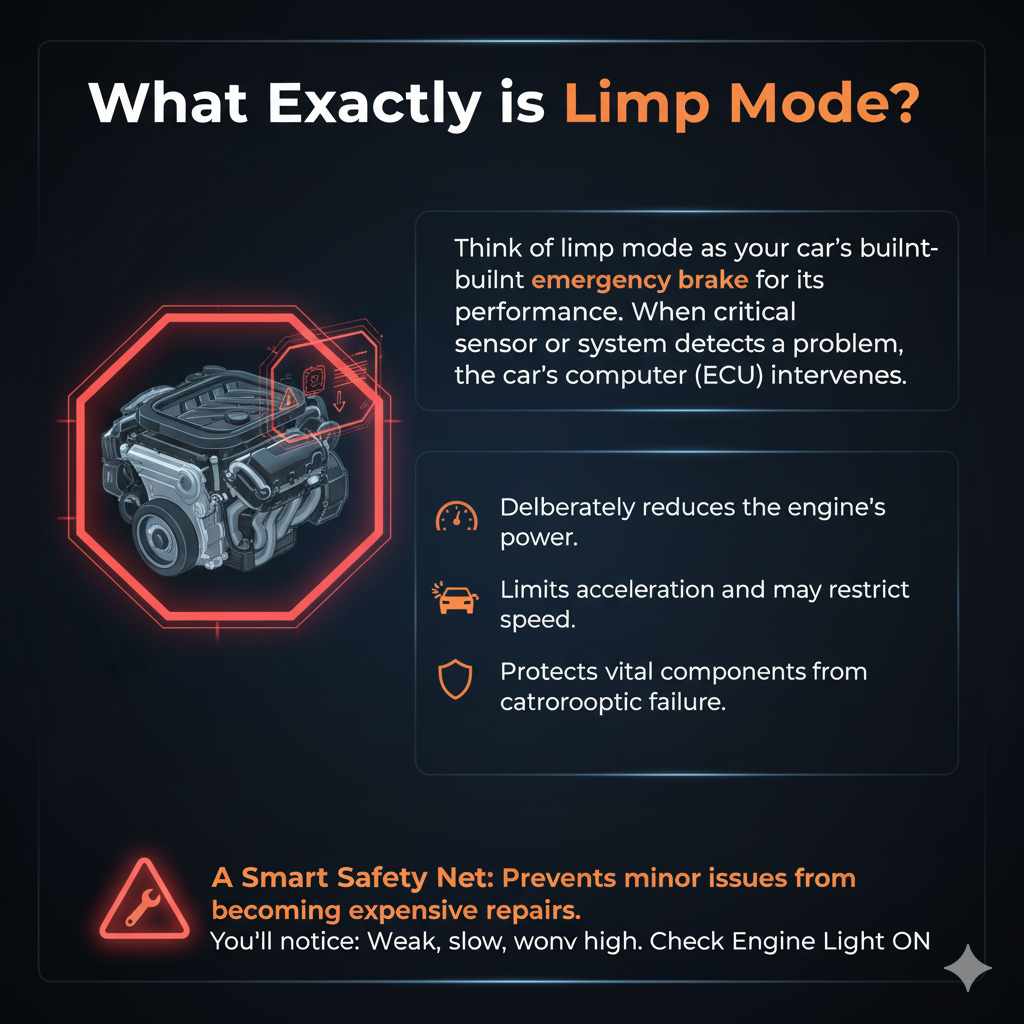
Think of limp mode as your car’s built-in emergency brake for its performance. When a critical sensor or system detects a problem that could cause significant damage if you keep driving normally, the car’s computer (the Engine Control Unit, or ECU) intervenes. It deliberately reduces the engine’s power, limits acceleration, and may even restrict speed. This is to protect vital components like the engine and transmission from suffering catastrophic failure.
It’s a smart safety net. By limiting what your car can do, it prevents a minor issue from snowballing into a major, expensive repair. You’ll usually notice a drastic difference in how the car drives – it will feel weak, slow to respond, and won’t rev up as high as usual. The check engine light will almost certainly be illuminated.
Why Does My Car Go Into Limp Mode?
Limp mode is triggered by a wide array of potential issues. The car’s computer monitors dozens of sensors constantly. If one of these sensors reports data that is far outside its normal operating range, or if there’s a problem with a critical system, the ECU will activate limp mode. Some common culprits include:
- Transmission Problems: Issues with the automatic transmission, like low fluid levels, shifting problems, or sensor failures, are frequent triggers.
- Engine Sensors Malfunctioning: Sensors that measure things like engine temperature, oxygen levels (O2 sensors), airflow (Mass Airflow Sensor – MAF), or wheel speed (ABS sensors) can cause limp mode if they send faulty information.
- Catalytic Converter Issues: A clogged or failing catalytic converter restricts exhaust flow, which the car’s computer can detect.
- Turbocharger Problems: If your car has a turbo, issues with its boost pressure regulation or related sensors can lead to limp mode.
- Electrical System Faults: Problems with wiring, fuses, or power supply to critical components can also trigger the system.
- Overheating: If the engine’s coolant temperature rises too high, limp mode might engage to prevent severe damage.
- Throttle Body Issues: The electronic throttle body controls how much air enters the engine. If it malfunctions, limp mode is a common response.
The specific reason your car is in limp mode will require a diagnostic scan to pinpoint. This is not something you can usually guess; a mechanic uses special tools for this.
How Long Can You Drive a Car in Limp Mode? The Short Answer
The honest answer is: as little as possible. Limp mode is not designed for regular driving. It’s an emergency state. You should only drive your car in limp mode for the absolute minimum distance required to get to a safe location or a repair shop. This might be a few miles or an hour at most, depending on your proximity to help.
Continuing to drive in limp mode for extended periods, or at higher speeds, is strongly discouraged. While it’s designed to prevent catastrophic failure, sustained operation under these conditions can still put stress on other components and potentially worsen the original problem. Think of it as a warning flare, not a green light to continue your journey as usual.
Is It Safe to Drive in Limp Mode? Considerations for Distance
Safety is always the top priority. Driving in limp mode presents a few safety concerns:
- Reduced Acceleration: You might struggle to merge into traffic or accelerate quickly, which can be dangerous on busy roads or highways.
- Lower Top Speed: Many cars in limp mode significantly cap your top speed, making it difficult to keep up with traffic flow.
- Potential for Stalling: In some cases, the underlying issue could cause the car to stall unexpectedly.
- Unpredictable Behavior: While designed to be predictable, the car’s response might feel inconsistent, especially when encountering hills or needing to change speed rapidly.
These factors mean you should avoid highway driving if possible and stick to slower, less traffic-intensive routes. If you are far from a repair shop, towing your vehicle might be the safer and more cost-effective option in the long run.
How to Tell If Your Car is in Limp Mode
Recognizing limp mode early is crucial. Here are the most common signs:
- Drastic Loss of Power: The most obvious sign is that your car feels incredibly weak. It struggles to accelerate, even when you press the gas pedal down.
- Check Engine Light (CEL): This light will almost certainly be illuminated on your dashboard. Sometimes it might be flashing, which often indicates a more severe issue.
- Reduced Top Speed: Your car might refuse to go faster than, say, 30-40 mph (50-65 km/h), regardless of how hard you press the accelerator.
- Transmission Shifting Issues: For automatic transmissions, you might notice rougher shifts, or the car may refuse to shift out of a specific gear (often second or third gear).
- Dashboard Warning Messages: Newer cars might display specific messages like “Reduced Engine Power,” “Transmission Fault,” or “Service Vehicle Soon.”
- Engine Feels Rough or Stumbles: The engine might not run as smoothly as usual.
If you experience any of these symptoms, it’s time to take action. Don’t ignore them!
What Should You Do When Your Car Enters Limp Mode?
Here’s a step-by-step approach to handling limp mode:
- Pull Over Safely: As soon as you notice the signs of limp mode, find a safe place to pull over. Turn on your hazard lights.
- Turn Off the Engine: Give the car a short break. Sometimes, a simple restart can temporarily clear a minor glitch, allowing you to drive a short distance. However, don’t expect this to fix the underlying problem.
- Assess Your Location: Are you close to home or a trusted mechanic? If you’re on a busy highway or far from help, calling for a tow truck is the best option.
- Consult Your Owner’s Manual: Your car’s manual might have specific information about limp mode warnings for your particular model.
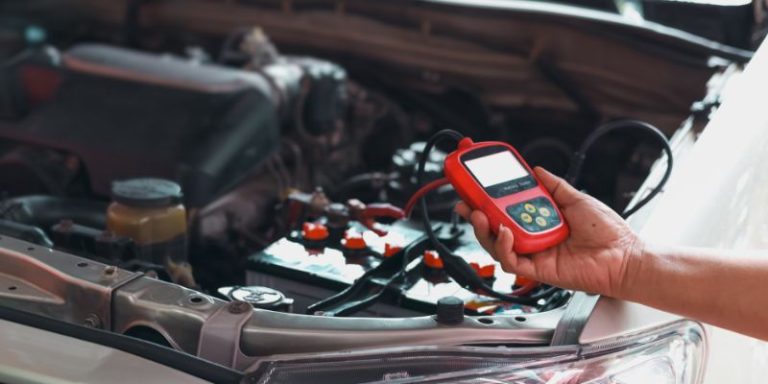
- Get a Diagnostic Scan: This is the most important step. You need to find out why the car entered limp mode. Auto parts stores often offer free OBD-II (On-Board Diagnostics) scans, or you can take it to a mechanic. The scan will provide an error code (like P0420) that points to the problem area. For example, a P0420 code often indicates an issue with the catalytic converter.
- Address the Problem: Once you know the cause, you can decide on the repair. For minor issues, you might be able to fix it yourself if you’re comfortable. For more complex problems, a professional mechanic is your best bet.
Remember, the goal is to get the car repaired promptly to avoid further damage and ensure its reliability and safety.
Can Limp Mode Cause Further Damage?
Yes, continuing to drive extensively in limp mode can lead to more significant damage and higher repair costs. While the mode is designed to protect the engine and transmission, the underlying issue that triggered it is still present and may worsen. For instance:
- If a transmission sensor is faulty, continuing to drive could cause internal transmission wear.
- If an engine sensor is misreporting, the engine might be running too lean or too rich, potentially causing detonation or fouling spark plugs.
- If the issue is related to overheating, continuing to drive without cooling could warp engine parts.
This is why diagnostic and repair should be a priority. The sooner you address the problem, the less likely it is to lead to secondary damage.
Common Issues Triggering Limp Mode and Their Impact
Let’s look at some frequent triggers and what they mean for your driving in limp mode:
| Common Trigger | Potential Underlying Cause | Impact on Limp Mode Driving | Typical Repair Urgency |
|---|---|---|---|
| Transmission Fault | Low transmission fluid, worn clutch packs, faulty solenoid, sensor failure. | Car may refuse to shift gears or shift harshly. Very limited acceleration. | High – risk of catastrophic transmission failure. |
| Engine Overheating | Low coolant, faulty thermostat, bad water pump, coolant leak. | Significant power loss, potential for engine shutdown. | Critical – driving can cause irreversible engine damage. |
| Mass Airflow (MAF) Sensor Failure | Dirty or faulty sensor. | Rough idle, poor acceleration, reduced fuel efficiency, engine sputtering. | Medium – affects performance and emissions, can damage catalytic converter if ignored. |
| Oxygen (O2) Sensor Failure | Sensor degradation or blockage. | Poor fuel economy, increased emissions, sluggish acceleration. | Medium – impacts emissions and engine efficiency. |
| Catalytic Converter Issue | Clogged converter, failure of catalyst material. | Severe restriction means lack of power, engine may stall. | High – can cause significant engine backpressure and damage, failed emissions test. The Environmental Protection Agency (EPA) has strict regulations on emissions systems. Learn more about reducing vehicle emissions. |
| Throttle Body Malfunction | Electronic throttle control issue, dirty throttle plate. | Unresponsive accelerator pedal, inconsistent speed, random stalling. | High – affects drivability and safety. |
As you can see, the severity of the underlying issue dictates how urgently it needs to be addressed. Driving even a short distance in limp mode is a sign that something is not right and needs attention.
What to Expect After Limp Mode is Fixed
Once the problem that triggered limp mode has been diagnosed and repaired, your car should return to its normal operating performance. You’ll notice:
- Full acceleration power is restored.
- The transmission will shift smoothly through all gears.
- The check engine light should turn off (though sometimes a mechanic may need to reset it).
- Your car will feel responsive and drive like it used to.
It’s a good idea to keep an eye on your car for a few days after the repair to ensure the issue hasn’t returned. If the limp mode symptoms reappear, contact your mechanic immediately.
Can You Reset Limp Mode Without Fixing the Problem?
Some people might wonder if they can just “trick” the car or reset the limp mode without fixing the root cause. While there are ways to reset the check engine light or clear diagnostic trouble codes (DTCs) using an OBD-II scanner, this is strongly advised against.
Resetting the system doesn’t fix the problem. It simply clears the temporary error code. The underlying issue will still be there, and the car will likely enter limp mode again, often sooner this time. In some cases, attempting to clear codes without addressing the issue could even lead to more severe and expensive damage. It’s always best to fix the problem identified by the diagnostic scan.
How Long Does it Take to Repair Limp Mode Issues?
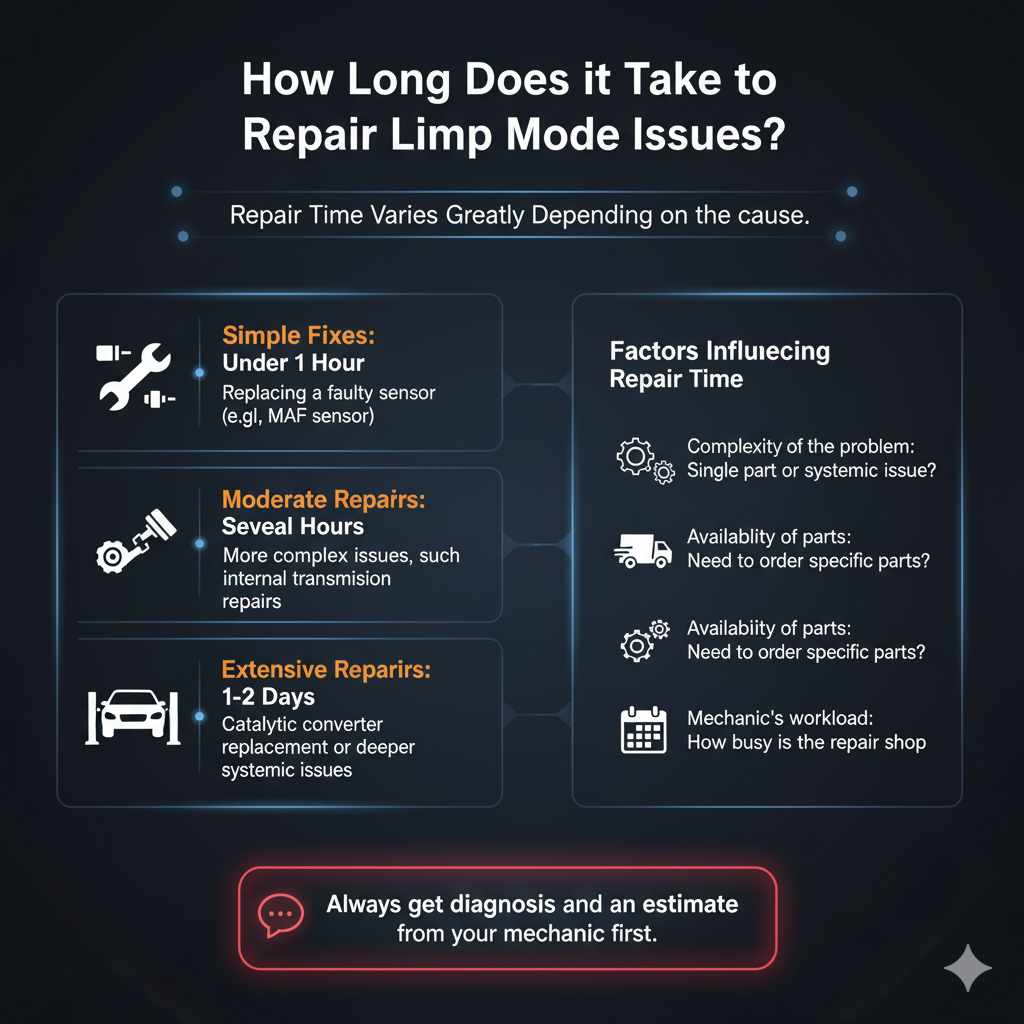
The time it takes to repair a limp mode issue varies greatly depending on the cause. Simple fixes, like replacing a faulty sensor (e.g., a MAF sensor), can often be done in under an hour. More complex issues, such as internal transmission repairs or catalytic converter replacement, can take several hours to a couple of days.
Factors influencing repair time include:
- Complexity of the problem: Is it a single part or a systemic issue?
- Availability of parts: If a specific part needs to be ordered, it can add days to the repair.
- Mechanic’s workload: How busy is the repair shop?
It’s always best to get a diagnosis first and then an estimate for the repair time from your mechanic.
Frequently Asked Questions (FAQ) About Limp Mode
1. What is the main purpose of limp mode?
The main purpose of limp mode is to protect your vehicle from further damage by reducing its performance and preventing critical components like the engine or transmission from failing completely when a serious fault is detected.
2. Will my car be okay if I drive it in limp mode for a short distance?
Yes, driving a very short distance in limp mode to reach a safe location or a repair shop is generally okay. However, it’s not safe for extended driving, as it can still put stress on other parts and the underlying issue can worsen.
3. What are the biggest risks of ignoring limp mode?
The biggest risks include causing more severe and expensive damage to your engine or transmission, leading to greater repair costs, and potentially leaving you stranded with an undrivable vehicle.
4. How much does it typically cost to fix a limp mode issue?
The cost can range from under $100 for a simple sensor replacement to several thousand dollars for major transmission or engine work. It entirely depends on the underlying problem identified by the diagnostic scan.
5. Can my car get stuck in limp mode forever?
No, a car won’t get stuck in limp mode permanently. It enters limp mode as a response to a detected fault. Once the fault is repaired, the car will return to normal operation. If it keeps entering limp mode after repairs, it indicates the original problem wasn’t fully resolved or a new issue has emerged.
6. Is it safe to drive on the highway in limp mode?
It is generally not recommended to drive on the highway in limp mode due to significantly reduced acceleration and speed limits, which can be hazardous in high-speed traffic. If the nearest repair shop is on a highway, drive with extreme caution or consider towing.
Conclusion
Encountering limp mode can be alarming, but with this guide, you should feel more equipped to handle the situation. Remember, limp mode is your car’s way of saying, “I need help, and I need it now,” before something breaks completely. The answer to “how long can you drive limp mode” is always: as little as absolutely necessary.
Prioritize getting your vehicle diagnosed and repaired by a trusted mechanic as soon as possible. By understanding the signs, the potential causes, and the risks involved, you’re taking a proactive step towards maintaining your car’s health and ensuring your safety on the road. Don’t delay; a quick response to limp mode can save you a lot of headaches and money down the line. Happy (and safe) driving!