How Many Oxygen Sensors 2005 Nissan Altima
Figuring out how many oxygen sensors are in your car can be a little tricky, especially if you’re new to car maintenance. You might wonder, How Many Oxygen Sensors Are in a 2005 Nissan Altima? It’s a common question that pops up when a check engine light comes on or when you’re thinking about doing some repairs yourself. Don’t worry, it’s not as complicated as it sounds!
We’ll walk you through it step-by-step to make it super clear. Get ready to learn exactly what you need to know.
Understanding Oxygen Sensors in Your 2005 Nissan Altima
Oxygen sensors, also called O2 sensors, are vital parts of your car’s exhaust system. They help your engine run efficiently by measuring the amount of oxygen in the exhaust gases. This information is sent to the engine control unit (ECU), which then adjusts the fuel-air mixture.
Getting this mix just right helps reduce pollution and improves your car’s gas mileage. For a 2005 Nissan Altima, knowing the number and location of these sensors is key for proper maintenance and diagnosis.
What Is an Oxygen Sensor and Why Is It Important
An oxygen sensor is a small device that sits in your car’s exhaust pipe. Its main job is to detect how much unburned oxygen is in the exhaust stream. Think of it like a nose for your car’s engine, sniffing out how well the fuel is burning.
If there’s too much oxygen, it means the engine is running lean (not enough fuel), and if there’s too little, it’s running rich (too much fuel). The engine’s computer uses this data to make quick adjustments.
This constant adjustment is crucial for several reasons. First, it ensures your engine is getting the best possible fuel economy. Wasting fuel means spending more money at the pump.
Second, it helps your car meet emission standards set by governments. A properly functioning O2 sensor helps the catalytic converter do its job effectively, cleaning up harmful exhaust gases before they are released into the air.
Without accurate readings from the oxygen sensors, the engine computer can’t make the correct adjustments. This can lead to a variety of problems, including rough idling, poor acceleration, decreased fuel efficiency, and of course, the dreaded check engine light turning on. Replacing a faulty O2 sensor is often a straightforward repair that can save you money in the long run by preventing more serious engine issues.
How Oxygen Sensors Help Your Engine Perform
Oxygen sensors play a direct role in how your engine performs day-to-day. When the sensors report accurate data, the engine’s computer can fine-tune the combustion process. This means your engine runs smoother, accelerates more quickly, and generally feels more responsive.
For example, when you accelerate, your engine needs more fuel. The O2 sensors tell the computer this, and the computer increases the fuel supply accordingly. When you’re cruising on the highway, the engine needs less fuel, and the O2 sensors help maintain that leaner mixture for better efficiency.
This continuous feedback loop is what keeps your engine operating at its peak performance.
A failing oxygen sensor can throw off this delicate balance. Your engine might feel sluggish, hesitate when you press the gas pedal, or even stall unexpectedly. The engine’s computer might try to compensate, but without good data, it’s like trying to drive with your eyes closed.
Keeping your O2 sensors in good working order is a simple way to ensure your 2005 Nissan Altima runs its best.

How Many Oxygen Sensors Are in a 2005 Nissan Altima?
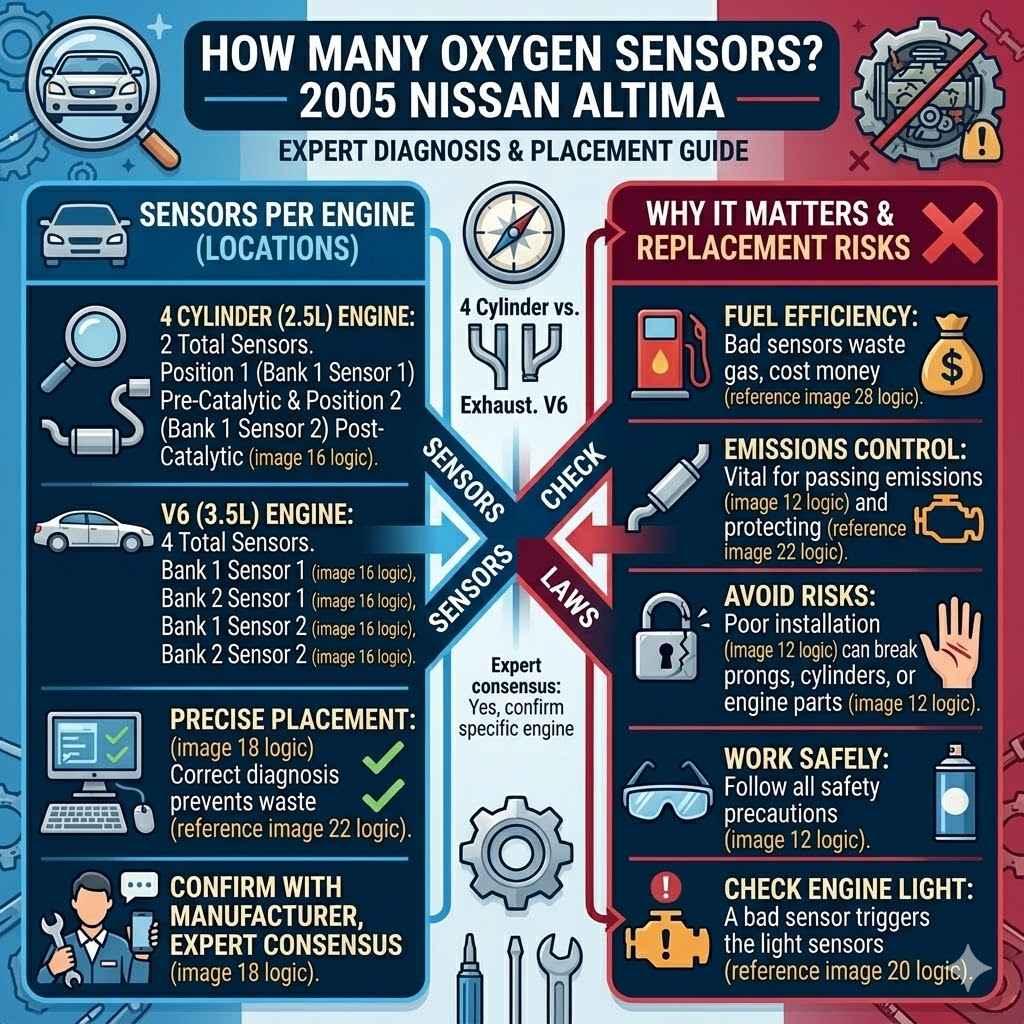
This is the big question many owners ask. For a 2005 Nissan Altima, the typical setup includes four oxygen sensors. These are divided into two main groups: upstream and downstream sensors, with two sensors located before the catalytic converter and two located after it.
Each pair plays a distinct role in monitoring your vehicle’s emissions and engine performance. Understanding these locations can help you pinpoint potential issues and know what to look for when performing maintenance.
Upstream Oxygen Sensors Bank 1 and Bank 2
Your 2005 Nissan Altima, with its V6 engine, has two banks of cylinders. Bank 1 refers to the side of the engine that contains cylinder #1, while Bank 2 is the opposite side. In a typical V6 engine, Bank 1 would be one side of the V, and Bank 2 would be the other.
The upstream oxygen sensors are located in the exhaust manifold or pipe just before the catalytic converter on each bank. These sensors are crucial for providing real-time data to the engine control module (ECM) about the air-fuel ratio entering the catalytic converter.
The upstream sensors are often referred to as “performance sensors” because their readings directly influence how the engine’s computer manages fuel injection. They are responsible for detecting the oxygen content in the exhaust gases as they leave the engine cylinders. If the readings from the upstream sensors are incorrect, the ECM might incorrectly adjust the fuel mixture, leading to suboptimal engine performance, reduced fuel economy, and increased emissions.
These sensors are designed to react quickly to changes, constantly sending feedback to keep the air-fuel ratio near the ideal stoichiometric point (about 14.7 parts air to 1 part fuel).
There are two upstream sensors in your 2005 Nissan Altima: one for Bank 1 and one for Bank 2. These are distinct parts and need to be identified correctly if replacement is necessary. Replacing a faulty upstream sensor can quickly restore proper engine performance and fuel efficiency.
They are typically the first ones to fail and are therefore checked most often when a check engine light related to O2 sensors appears.
Downstream Oxygen Sensors Bank 1 and Bank 2
Following the upstream sensors, you will find the downstream oxygen sensors. These are located after the catalytic converter on each exhaust bank. Their primary role is different from the upstream sensors.
Instead of directly influencing the fuel mixture, the downstream sensors monitor the efficiency of the catalytic converter itself. They measure the oxygen content in the exhaust after it has passed through the catalytic converter.
By comparing the readings from the upstream and downstream sensors on the same bank, the engine control module can determine if the catalytic converter is functioning correctly. If the catalytic converter is working as it should, it will process most of the harmful gases, and the oxygen levels detected by the downstream sensor will be different from those detected by the upstream sensor. If the readings are too similar, it indicates that the catalytic converter is not effectively doing its job, and the check engine light will likely illuminate, often with a code related to catalytic converter efficiency.
Thus, your 2005 Nissan Altima has two downstream oxygen sensors, one for Bank 1 and one for Bank 2. These sensors are sometimes called “monitor sensors” or “catalyst monitors” because their main purpose is to monitor the catalytic converter’s performance. While they don’t directly affect the immediate fuel mixture, a faulty downstream sensor can still lead to poor fuel economy and emissions issues because the ECM cannot accurately assess the catalytic converter’s status.
Location of the Four Oxygen Sensors
Pinpointing the exact location of these four oxygen sensors on your 2005 Nissan Altima can save you time and frustration. For a V6 engine, you’ll typically find the two upstream sensors located on each side of the engine, within the exhaust system leading to the catalytic converters. They are usually screwed into the exhaust manifold or the pipe directly attached to it.
The two downstream sensors are positioned further down the exhaust system, after the catalytic converter. You’ll find one on each exhaust pipe exiting the catalytic converter. It’s important to note that the exhaust system can have multiple catalytic converters, especially on V6 engines, but generally, there will be one pair of upstream and downstream sensors for each catalytic converter that’s directly linked to an engine bank.
Visual inspection is often the best way to confirm their locations. You’ll see wires connecting to them, which run to the engine’s computer. When diagnosing an issue, noting which sensor is throwing a code (e.g., P0130 for Bank 1 Sensor 1, P0150 for Bank 2 Sensor 1, P0136 for Bank 1 Sensor 2, P0156 for Bank 2 Sensor 2) will help you identify the specific sensor you need to inspect or
Common Issues and Diagnostic Tips
Oxygen sensors, like any other automotive component, can fail over time. Several factors can contribute to their degradation, including age, contamination from engine oil or coolant, and extreme temperatures. Recognizing the common signs of a failing O2 sensor can help you address problems before they escalate.
Simple diagnostic steps can also help you identify which sensor might be at fault.
Symptoms of Failing Oxygen Sensors
When one or more oxygen sensors on your 2005 Nissan Altima begin to fail, you might notice a few telltale signs. The most common symptom is the illumination of the check engine light on your dashboard. This light is a general warning, but specific diagnostic trouble codes (DTCs) can often point to a particular O2 sensor or circuit.
Beyond the check engine light, you might experience a noticeable decrease in fuel economy. This happens because the engine control module isn’t receiving accurate data, causing it to run too rich (using more fuel than necessary). You could also notice a rougher idle, especially when the engine is cold or at low speeds.
Sometimes, the engine might hesitate or stumble during acceleration, or you might even smell unburned fuel from the exhaust, indicating that the fuel mixture is not being properly managed.
In more severe cases, a failing oxygen sensor can lead to engine misfires, which can cause a noticeable shaking or sputtering. If the catalytic converter is not functioning correctly due to bad O2 sensor readings, you might even see a drop in engine power. These symptoms can vary depending on which sensor has failed and how severely it has degraded.
Regular checks can help catch these issues early.
How to Diagnose a Faulty Oxygen Sensor
Diagnosing a faulty oxygen sensor typically involves a few key steps. The first and most important step is to retrieve the diagnostic trouble codes (DTCs) stored in your vehicle’s computer. This is usually done using an OBD-II scanner.
The codes will provide specific information about which sensor circuit is reporting a problem.
For instance, codes like P0130 to P0149 often relate to Bank 1 oxygen sensors, while codes from P0150 to P0169 indicate issues with Bank 2 sensors. The code will also specify if it’s Sensor 1 (upstream) or Sensor 2 (downstream). Once you have the code, you can visually inspect the wiring harness and connector for any signs of damage, such as corrosion, loose connections, or frayed wires.
Beyond visual inspection, a mechanic might use a scan tool to monitor the live data stream from the oxygen sensors while the engine is running. This allows them to see the voltage fluctuations of each sensor in real-time. A healthy upstream sensor will show rapidly fluctuating voltage, while a healthy downstream sensor will show a more steady voltage reading, indicating the catalytic converter is working.
If a sensor’s readings are stuck, slow to respond, or out of range, it’s a strong indication of a faulty sensor.
Example Scenario: Check Engine Light for Bank 1 Sensor 1
Imagine you’re driving your 2005 Nissan Altima, and the check engine light suddenly illuminates. You take it to an auto parts store or use your own OBD-II scanner, and it retrieves a P0131 code. This code specifically points to a problem with “O2 Sensor Circuit Low Voltage (Bank 1 Sensor 1).” This tells you that the upstream oxygen sensor on Bank 1 is not sending the expected voltage signals to the engine computer.
This could mean the sensor itself is failing, or there might be an issue with its wiring or the exhaust system before the sensor.
In this scenario, the first step would be to visually inspect the wiring connected to Bank 1 Sensor 1. You’d look for any obvious damage or loose connections. If the wiring appears intact, the next step would be to consider replacing the sensor.
Bank 1 is usually the side of the V6 engine closer to the firewall or the one containing cylinder #1. Bank 1 Sensor 1 is the upstream sensor on that side. Replacing this sensor is often the most effective solution for a P0131 code, and it can quickly restore proper engine function and fuel efficiency.
Maintenance and Replacement of Oxygen Sensors
Proper maintenance and timely replacement of oxygen sensors are essential for keeping your 2005 Nissan Altima running smoothly and efficiently. While O2 sensors are designed to last for many thousands of miles, they do have a lifespan and can be affected by various factors. Understanding when and how to replace them can save you money and prevent more significant problems down the road.
When to Consider Replacing Oxygen Sensors
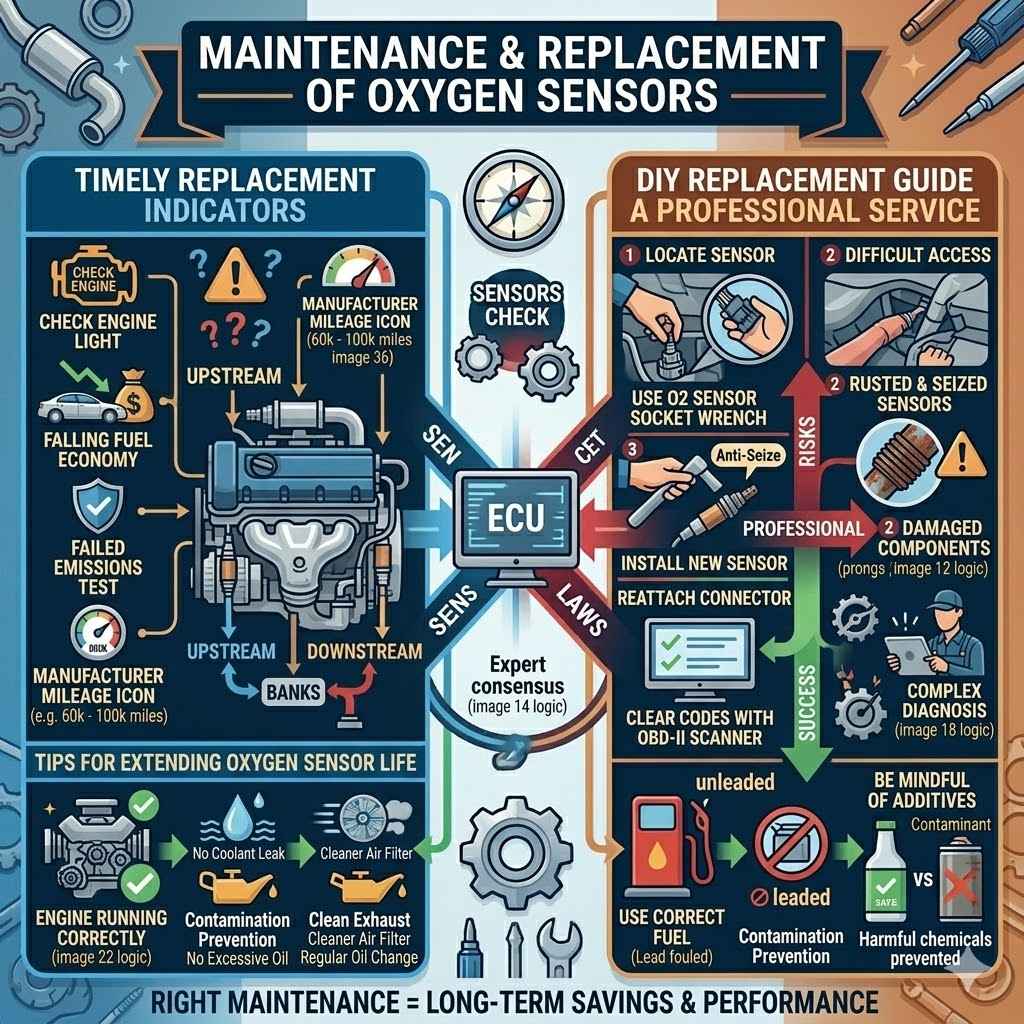
The primary indicator that an oxygen sensor needs replacement is usually the check engine light. However, other signs can prompt you to consider replacement even if the light isn’t on. A significant decrease in your vehicle’s fuel economy is a strong clue.
If you notice your Altima is suddenly using more gas than usual, and you can’t find any other reason, an O2 sensor is a likely culprit.
Symptoms like rough idling, poor acceleration, or a failing emissions test can also signal a need for replacement. Many manufacturers recommend inspecting or replacing oxygen sensors around the 60,000 to 100,000-mile mark, even if they are not showing immediate signs of failure. This proactive approach can prevent issues and ensure optimal engine performance and emissions control.
For a 2005 Nissan Altima, a mechanic might recommend replacing both upstream sensors at the same time, even if only one is throwing a code. This is because they are exposed to similar operating conditions and are likely to have similar lifespans. Replacing them in pairs can save you labor costs and prevent the other sensor from failing shortly after the first one is replaced.
DIY Replacement vs. Professional Service
Replacing oxygen sensors can be a manageable DIY project for individuals with some basic mechanical knowledge and tools. The process typically involves locating the sensor, disconnecting its electrical connector, and then using a specialized O2 sensor socket wrench to unscrew the old sensor. Once removed, the new sensor can be installed, its connector reattached, and any diagnostic trouble codes cleared using an OBD-II scanner.
However, there are instances where professional service is advisable. If your 2005 Nissan Altima has sensors that are particularly difficult to access, or if they are rusted and seized in place, attempting to remove them yourself can lead to damaged exhaust components or stripped threads. Additionally, if you’re not comfortable with diagnostic tools or if the issue is more complex than a simple sensor failure, taking your car to a qualified mechanic is the safer and more efficient option.
They have the specialized tools and expertise to diagnose and repair issues accurately.
Tips for Extending Oxygen Sensor Life
You can take a few steps to help your oxygen sensors last longer and perform optimally. The most crucial factor is ensuring your engine is running correctly. Issues like misfires, coolant leaks into the combustion chamber, or excessive oil consumption can contaminate and damage O2 sensors over time.
Regularly changing your engine oil and air filter also contributes to cleaner exhaust gases, which is beneficial for sensor longevity.
Using the correct type of fuel is also important. Avoid using leaded gasoline, as lead deposits can quickly foul oxygen sensors. Additionally, be mindful of any additives you use in your fuel or oil.
Some additives can contain chemicals that are harmful to O2 sensors. Ensuring your engine is properly tuned and maintained will indirectly help your oxygen sensors by keeping the exhaust gases cleaner and at the right temperature for them to operate effectively.
Frequently Asked Questions
Question: How many oxygen sensors does a 2005 Nissan Altima typically have?
Answer: A 2005 Nissan Altima, especially the V6 models, typically has four oxygen sensors. Two are located upstream of the catalytic converter (one for each exhaust bank), and two are located downstream of the catalytic converter (one for each exhaust bank).
Question: Where are the upstream oxygen sensors on a 2005 Nissan Altima?
Answer: The upstream oxygen sensors are located in the exhaust system before the catalytic converter. On a V6 engine, there will be one on Bank 1 (the side of the engine with cylinder #1) and one on Bank 2.
Question: What is the difference between upstream and downstream oxygen sensors?
Answer: Upstream oxygen sensors measure oxygen in the exhaust before the catalytic converter to help the engine computer adjust the fuel mixture. Downstream oxygen sensors measure oxygen after the catalytic converter to monitor the converter’s efficiency.
Question: Can a bad oxygen sensor affect my car’s performance?
Answer: Yes, a bad oxygen sensor can significantly affect your car’s performance by causing poor fuel economy, rough idling, hesitation during acceleration, and potentially increased emissions.
Question: What does it mean if I get a code for Bank 1 Sensor 2?
Answer: A code for Bank 1 Sensor 2 typically indicates an issue with the downstream oxygen sensor on the exhaust bank that contains cylinder #1. This usually means the catalytic converter’s efficiency might be compromised or the sensor itself is faulty.
Conclusion
So, to answer directly, your 2005 Nissan Altima has four oxygen sensors. Two upstream sensors monitor engine performance, and two downstream sensors check catalytic converter function. Keeping these sensors in good working order ensures your car runs efficiently, saves fuel, and stays emissions compliant.
If your check engine light comes on, knowing this layout helps you understand the diagnostics.