Can You Reprogram a Key Fob for a Different Vehicle?
Yes, sometimes, but only if the fob matches the same FCC ID, part number, frequency, and transponder type, and your vehicle allows onboard programming; many proximity keys cannot move from one vehicle to another. Miss one check and you can buy a dead fob, waste time, or pay for programming that still will not work. This guide shows what to verify first, what parts can be salvaged, and when a used fob is worth buying.
Immobillizer codes block cross-vehicle fob reuse
Usually no, especially across different brands. Most modern fobs are vehicle-specific because the immobilizer and security system must recognize the correct code before the engine will start. A remote may still lock doors, but that does not mean the start authorization will work.
Why modern anti-theft systems block cross-vehicle reuse
A key fob can send radio-frequency signals for lock, unlock, trunk release, or panic. That is only half the job. The vehicle immobilizer checks the transponder chip inside the fob or key head and blocks starting when the code does not match. In many vehicles, the shell and buttons matter far less than the electronic identity inside.
Different makes cannot be reprogrammed across brands. Even same-brand swaps are not automatic, because the receiver, security protocol, and key-memory behavior can change by model year and trim. That is why a fob that looks right can still fail during pairing.
When same-brand exceptions can still exist
Same make, model, year and FCC ID can be a starting point, but it is not a guarantee. That is the narrow lane where reuse can make sense. If the vehicle accepts onboard programming and the fob matches the exact radio and security spec, the result may be reuse or professional reprogramming instead of a full replacement.
Key fob compatibility checklist
Start with the printed identifiers. Then compare frequency, key type, and lock status before you spend money. A used listing that skips any of these details is a risk, because a physically similar unit can still be wrong for your car.
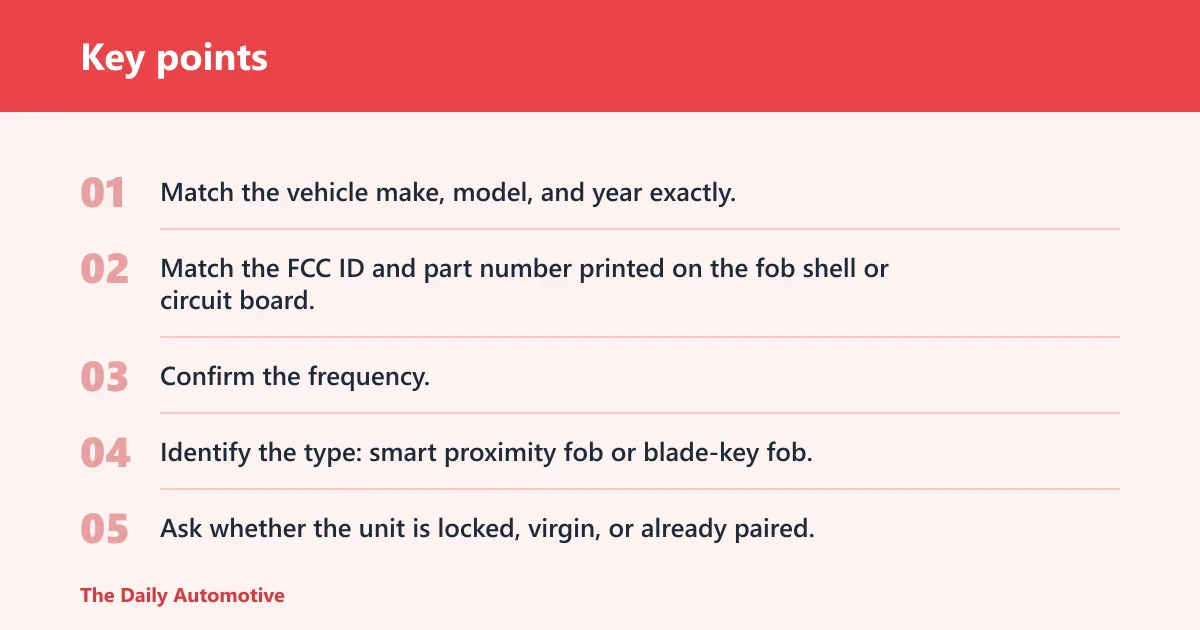
What to verify before buying
- Match the vehicle make, model, and year exactly.
- Match the FCC ID and part number printed on the fob shell or circuit board.
- Confirm the frequency. 315 MHz is a common North American key fob frequency, while 433.92 MHz is common in Europe and Asia.
- Identify the type: smart proximity fob or blade-key fob.
- Ask whether the unit is locked, virgin, or already paired.
- Check whether the vehicle can add keys directly or needs an erase-and-relearn procedure.
Say your 2018 sedan uses a blade-key remote with FCC ID ABC123 and 315 MHz. A used fob from the same year and exact FCC ID may be worth pursuing if the seller can prove it is virgin or relearnable. Swap in a 433.92 MHz unit, and the receiver mismatch can stop the process before programming even starts.
What each check means
The FCC ID and part number identify the exact fob version. The frequency tells you whether the transmitter can talk to the receiver at all. The smart-key versus blade-key split matters because push-to-start and proximity smart fobs can be much harder to DIY than basic remotes. A locked used unit may still be fine for parts, but often not for reuse.
Programming method matters because some systems only accept a limited number of stored keys, while others let a programmer erase existing keys and add new ones. If the vehicle memory is full, a perfectly matched fob may still need dealer or OEM tools.
What the vehicle must accept first
The vehicle has to accept immobilizer authorization before the start button or ignition will work. Remote door functions can succeed while start authorization fails. That is the difference between a fob that opens the car and a fob that lets it run.
Immobilizer authorization versus remote functions
The door-lock side uses RF commands. The start side depends on the transponder chip being paired to the ECU or immobilizer. That pairing is the security gate. If the code is wrong, missing, or already locked to another vehicle, the engine stays blocked.
A common first-timer mistake is buying a used fob because the buttons and case match. Suppose the remote unlocks the doors after battery replacement, but the dash shows a key warning and the engine will not crank. That pattern points to a transponder or immobilizer problem, not a dead battery or bad button board.
Can you reprogram a used key fob?
Sometimes, but only when the used unit is still compatible and not locked in a way that blocks relearning. Used fobs can be a smart buy when the make, model, year, FCC ID, frequency, and key type line up. A locked unit, by contrast, may be a dead end for your vehicle.
Used fobs that can still be reused
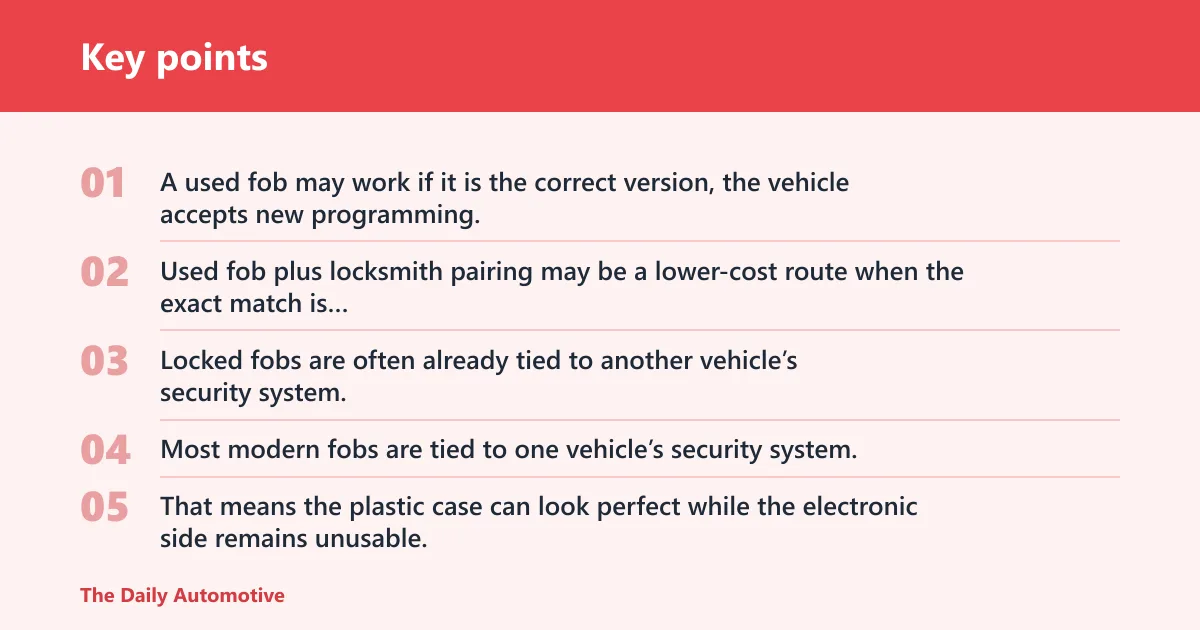
A used fob may work if it is the correct version, the vehicle accepts new programming, and the transponder memory is not tied in a way that prevents reassignment. Used fob plus locksmith pairing may be a lower-cost route when the exact match is available.
Locked units and why they fail
Locked fobs are often already tied to another vehicle’s security system. Most modern fobs are tied to one vehicle’s security system, and key fobs are coded to an immobilizer and security system. That means the plastic case can look perfect while the electronic side remains unusable.
Virgin fobs and why they are safer buys
Virgin or unprogrammed fobs are safer because they have not yet been assigned to another car. They still need the right frequency and part number, but they remove one big uncertainty. If you are shopping used online, ask for a clear statement that the fob is virgin or ready for programming on your exact vehicle.
Who can program it: DIY, locksmith, or dealer?
Older systems may allow owner programming with onboard steps. Many newer vehicles do not. Automotive locksmiths can program some fobs with specialized diagnostic equipment, while dealerships and OEM tools are often required for modern smart keys and higher-security systems.
Older systems with owner-programmable steps
DIY on-board programming can cost nothing beyond the fob. That route usually applies to older blade-key systems with limited security logic. The exact steps vary by make, model, and year, so the owner’s manual matters more than internet shortcuts.
Automotive locksmith programming
An automotive locksmith is often the middle ground. Locksmiths may be able to pair a used unit when the vehicle system supports it. They are not universal decoders, though, and they cannot override every locked or dealer-only system.
Dealer or OEM tools for newer vehicles
Some newer smart keys require official access or brand-specific equipment. Push-to-start and proximity smart fobs are often not DIY. For those systems, dealer or OEM tools may be the only practical path.
Cost breakdown for reprogramming a fob
Price depends on three separate pieces: the fob itself, the programming labor, and whether the vehicle forces dealer-only service. A cheap used remote can still become an expensive mistake if it needs repeated attempts or cannot be paired at all.
Used fob purchase cost
Used listings vary widely because condition does not equal compatibility. A correct used fob can save money, but only if the FCC ID, part number, frequency, and lock status are right. If any of those fail, the purchase price becomes sunk cost.
Programming labor cost
For many common cases, locksmith labor sits below dealer pricing. The gap is useful, but it is not a guarantee that the locksmith can complete the job. Vehicles with limited key slots, encrypted smart keys, or locked modules may still need dealer support.
Dealer-only scenarios and added fees
Dealer programming can be the highest-cost path because it can include security access, key ordering, and module coding. A new OEM fob plus dealer programming is the cleanest but most expensive route when a used unit fails the compatibility check.
Compatibility checklist table
Use this table as a shopping filter before you buy a used fob or book programming. The likely outcome is a practical guess, not a promise. If the listing leaves out FCC ID, part number, or frequency, treat it as incomplete.
| Vehicle make/model/year | FCC ID / part number match | Frequency match | Smart-key vs blade-key type | Locked / virgin status | Spare-slot availability | Likely outcome |
|---|---|---|---|---|---|---|
| 2012 Toyota Camry | Exact match required | 315 MHz or regional match | Blade-key remote | Virgin preferred | Often available on older systems | DIY or locksmith |
| 2018 Ford Escape | Exact match required | 315 MHz common in North America | Either, depending on trim | Virgin or relearnable preferred | May be limited | Locksmith or dealer |
| 2020 Honda Civic | Exact match required | Region-specific match required | Smart proximity fob | Virgin preferred | Often restricted | Dealer or OEM only |
| 2021 BMW 3 Series | Exact match required | 433.92 MHz in many markets | Smart proximity fob | Usually locked to system | Limited | Dealer or OEM only |
Decision flow from check to action
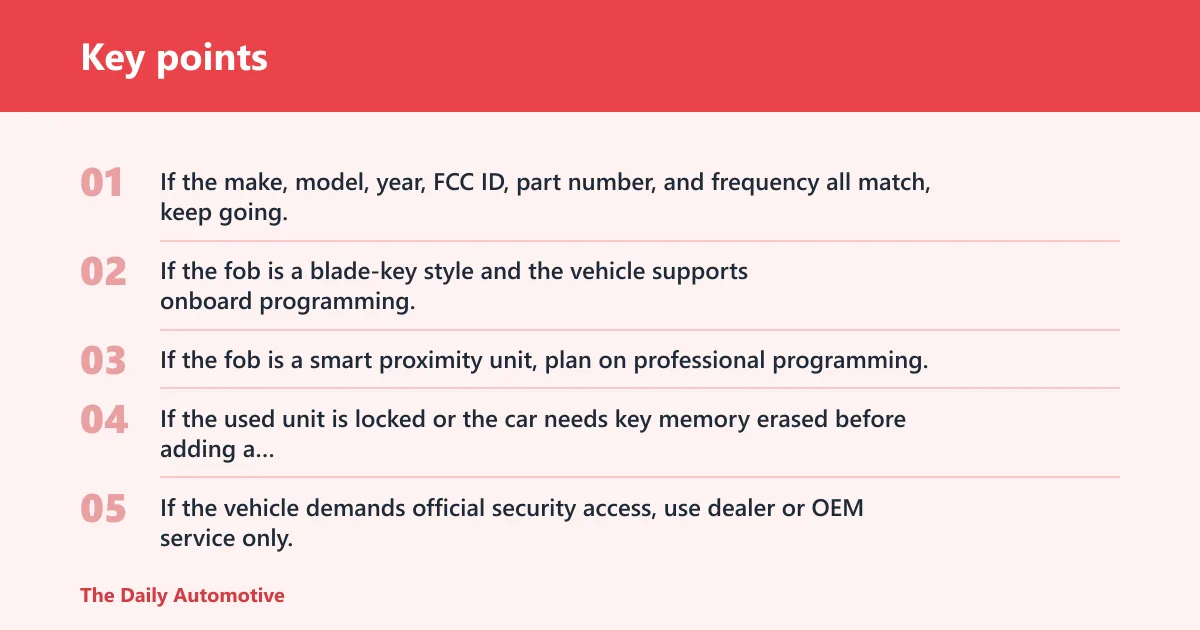
- If the make, model, year, FCC ID, part number, and frequency all match, keep going.
- If the fob is a blade-key style and the vehicle supports onboard programming, try owner programming or a locksmith.
- If the fob is a smart proximity unit, plan on professional programming.
- If the used unit is locked or the car needs key memory erased before adding a replacement, stop and replace it.
- If the vehicle demands official security access, use dealer or OEM service only.
Picture a 2020 Honda Civic owner who finds a used proximity fob online at half price. The shell looks right, but the seller cannot confirm virgin status or the exact part number. That is the point to stop and verify, because the same-model fit can still fail when the security system expects a different version.
Frequently asked questions
Can you reprogram a key fob for a different vehicle?
Usually not across different vehicles, and never across different brands. The fob must match the car’s security logic, frequency, and often the exact FCC ID and part number. Same make, model, year and FCC ID can be the narrow case where reuse may work.
Can you reprogram a used key fob to a different car?
Sometimes, if the used fob is the correct version and the vehicle allows new pairing. A locked unit may fail, while a virgin unit is much more promising. Used fobs are safest when the seller can prove compatibility and pairing status before sale.
Can a locksmith reprogram a used key fob?
Yes, in many cases. Automotive locksmiths often handle older and mid-age systems. They may also pair a used fob when the vehicle supports it, but newer smart keys can still require dealer or OEM tools.
How much does it cost to reprogram a key fob?
DIY on-board programming can cost nothing beyond the fob. The total rises if you also need a new fob, extra key cutting, or dealer-only security access.
What makes a key fob compatible with another vehicle?
The make, model, year, FCC ID, part number, frequency, and key type all have to line up. The vehicle also has to accept the fob’s transponder or immobilizer code. Region-specific differences can matter too, even when the case and buttons look identical.
Can you reprogram a Honda key fob to a different car?
Usually no. A Honda fob still has to match the exact vehicle generation, frequency, and security system, and a 2020 Honda Civic example shows how same-model reuse can still be difficult. If the unit is smart proximity, professional programming is usually the better expectation.
Products related to this article
Sponsored / affiliate links. As an Amazon Associate I earn from qualifying purchases. I may earn additional commission from eligible campaigns.