How Many Oxygen Sensors Are in a 2010 Silverado
Many truck owners wonder about their vehicle’s parts. For a 2010 Chevy Silverado 1500, figuring out the exact number of oxygen sensors can seem tricky. This is especially true if you’re new to car maintenance or just trying to understand your truck better.
Don’t worry, it’s simpler than it sounds! We’ll break down exactly How Many Oxygen Sensors Are in a 2010 Chevy Silverado 1500? step by step, making it easy to grasp. Get ready to learn exactly what you need to know without any confusion.
Understanding Oxygen Sensors in Your Silverado
Oxygen sensors, also known as O2 sensors, are vital parts of your truck’s exhaust system. They play a key role in making sure your engine runs as efficiently as possible and that your emissions are as clean as they can be. Think of them as tiny detectives that constantly check the amount of unburned oxygen in your exhaust gases.
This information is sent to your truck’s computer, called the Engine Control Module or ECM. The ECM then uses this data to adjust the fuel mixture going into the engine. Getting the right amount of fuel is super important for good gas mileage and for reducing pollution.
Without properly working O2 sensors, your truck might not perform as well.
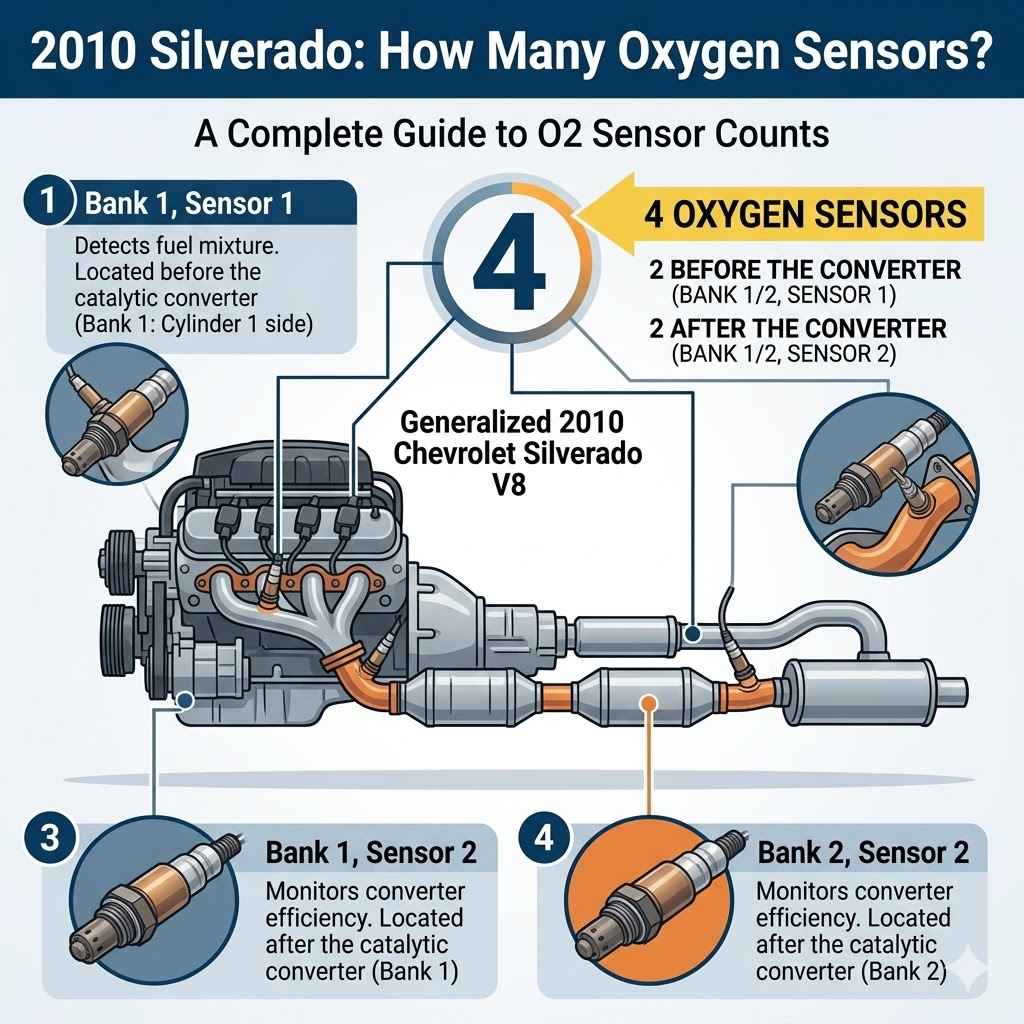
The number of oxygen sensors can vary based on your truck’s engine size and configuration. For a 2010 Chevy Silverado 1500, there are typically four oxygen sensors. These sensors are split into two main groups: upstream and downstream.
The upstream sensors are located before the catalytic converter, and they measure the oxygen in the exhaust before it’s treated. They provide critical data for the ECM to fine-tune the air-fuel ratio in real-time. The downstream sensors are placed after the catalytic converter.
Their main job is to check if the catalytic converter is working correctly by comparing the exhaust composition before and after it.
What Are Oxygen Sensors?
Oxygen sensors are small, screw-in devices typically found in the exhaust manifold or pipes. They have a ceramic tip that is exposed to the exhaust gases. Inside this tip, there’s a special material that generates a voltage based on the amount of oxygen present.
The higher the oxygen content, the lower the voltage output, and vice versa. This voltage signal is then sent to the truck’s computer. The ECM interprets these voltage changes to determine if the engine is running rich (too much fuel, not enough air) or lean (too much air, not enough fuel).
This feedback loop allows the ECM to make constant adjustments to maintain the optimal air-fuel ratio.
The lifespan of an oxygen sensor can be affected by various factors. These include the overall health of the engine, the quality of fuel used, and exposure to contaminants like oil or coolant. Over time, the sensor’s tip can become coated with carbon deposits, which can slow down its response time or cause it to fail entirely.
When an O2 sensor starts to malfunction, it can lead to a range of problems, from decreased fuel efficiency to a lit-up check engine light on your dashboard.
Why Are There Different Types of Oxygen Sensors?
The reason for having both upstream and downstream oxygen sensors is to ensure the entire exhaust system is functioning as designed. The upstream sensors are the primary controllers of the air-fuel mixture. They are crucial for immediate engine performance adjustments.
Their readings directly influence how much fuel is injected into each cylinder. If these sensors provide inaccurate readings, the engine might run too rich or too lean, leading to poor performance, increased emissions, and potential engine damage over time. A rich mixture can cause fouling of spark plugs and the catalytic converter, while a lean mixture can lead to engine overheating and damage.
Downstream sensors act as a sort of quality control for the catalytic converter. The catalytic converter’s job is to convert harmful pollutants like carbon monoxide, unburned hydrocarbons, and nitrogen oxides into less harmful substances. The downstream sensor monitors the exhaust gases after they have passed through the converter.
If the downstream sensor’s readings are very similar to the upstream sensor’s readings, it often indicates that the catalytic converter is not effectively doing its job. This is because a healthy catalytic converter should significantly alter the oxygen content of the exhaust.
Upstream Oxygen Sensors
Upstream oxygen sensors are often referred to as “pre-catalytic converter” sensors. These are the primary sensors that the engine control module (ECM) relies on for real-time fuel mixture adjustments. They are positioned in the exhaust manifold, close to the engine cylinders.
Because they are the first to measure the exhaust gases, their readings are the most critical for maintaining the ideal stoichiometric air-fuel ratio (approximately 14.7 parts air to 1 part fuel). This ratio ensures that the fuel burns most completely, maximizing power and minimizing harmful emissions.
When an upstream O2 sensor detects too much oxygen (lean condition), the ECM will inject more fuel. Conversely, if it detects too little oxygen (rich condition), the ECM will reduce the amount of fuel. This constant monitoring and adjustment process is what helps your truck achieve optimal fuel economy and engine performance.
A malfunctioning upstream sensor can cause your engine to run inefficiently, leading to poor acceleration, rough idling, and increased fuel consumption. Many drivers report a noticeable drop in gas mileage when these sensors begin to fail.
Downstream Oxygen Sensors
Downstream oxygen sensors are also known as “post-catalytic converter” sensors. Their primary function is to monitor the performance of the catalytic converter. They are located in the exhaust pipe downstream of the catalytic converter.
The ECM compares the readings from the upstream sensor to the readings from the downstream sensor. If the catalytic converter is working correctly, it will convert most of the harmful gases, and the oxygen levels measured by the downstream sensor will be relatively stable and show a consistent signal compared to the fluctuating signal from the upstream sensor. A healthy catalytic converter uses oxygen to help convert pollutants.
If the downstream sensor detects a lot of fluctuations in oxygen levels, similar to the upstream sensor, it suggests that the catalytic converter is not functioning properly. This could be due to contamination, overheating, or simply age. When the ECM detects a problem with the catalytic converter based on the downstream sensor’s data, it will typically illuminate the check engine light.
In some cases, a faulty downstream sensor itself can also trigger the check engine light, even if the catalytic converter is fine. Diagnosing this requires careful analysis of the sensor data.
Locating the Oxygen Sensors on a 2010 Chevy Silverado 1500
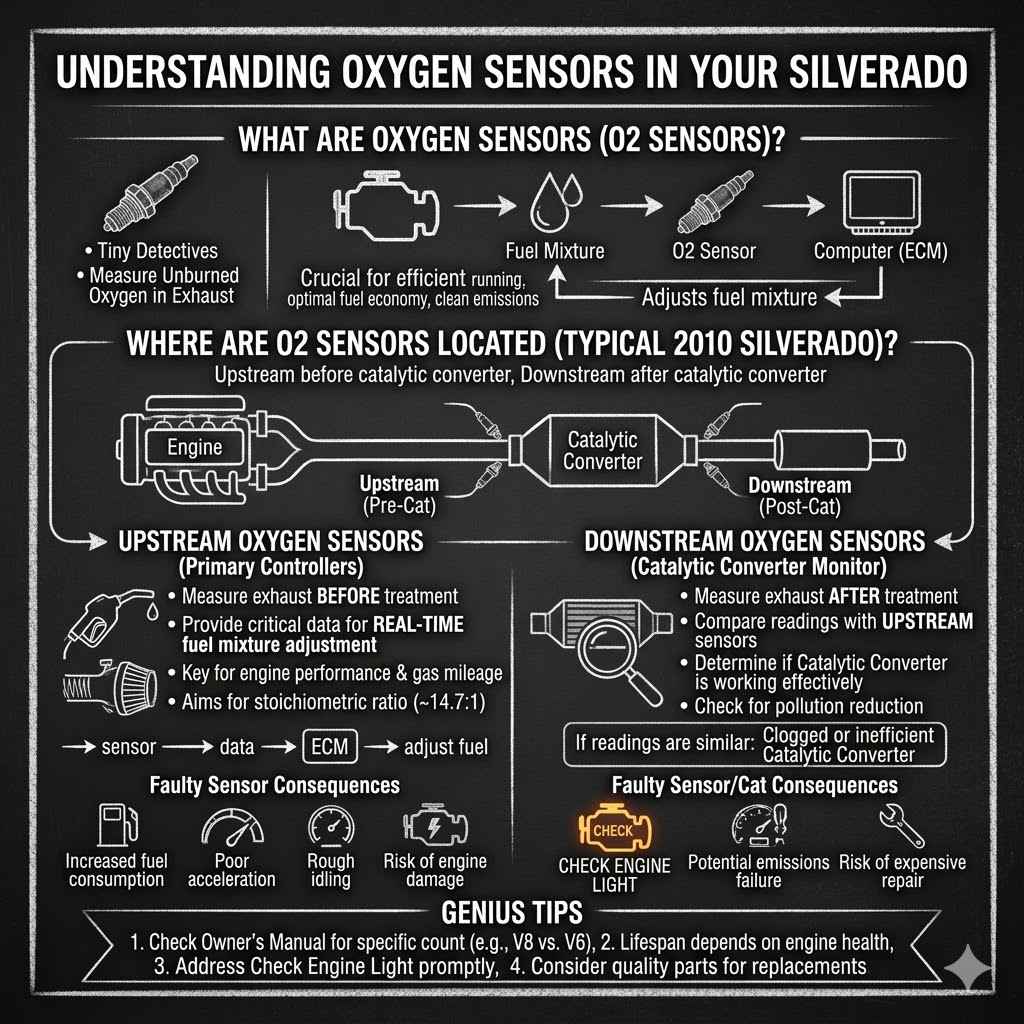
For a 2010 Chevy Silverado 1500, you’ll generally find four oxygen sensors. Two are located on each bank of the V8 engine. Each bank has one upstream sensor and one downstream sensor.
The upstream sensors are typically found screwed into the exhaust manifold, very close to where the exhaust gases exit the engine cylinders. These are usually the first sensors encountered as the exhaust flows away from the engine. They are crucial for immediate feedback to the engine computer regarding the air-fuel mixture.
The downstream sensors are located further down the exhaust system, specifically after the catalytic converter. They monitor the output of the catalytic converter to ensure it’s working efficiently. On most 2010 Silverado 1500 models, you’ll find one upstream and one downstream sensor on the driver’s side exhaust pipe and another pair on the passenger’s side exhaust pipe.
Accessing them might require getting under the truck, and they are often secured with a special O2 sensor socket for easier removal. It’s important to identify the correct sensor for your specific engine configuration if you plan on replacing one.
Driver’s Side Sensors
On the driver’s side of your 2010 Chevy Silverado 1500, you will find two oxygen sensors. The upstream sensor (often labeled as Sensor 1 or Bank 1 Sensor 1) is located in the exhaust manifold on the driver’s side. This sensor is critical for the engine control module (ECM) to manage the air-fuel ratio for that specific bank of cylinders.
Its readings directly influence the fuel injection pulse width to maintain optimal combustion. Without accurate data from this sensor, the engine performance on the driver’s side could be compromised, leading to rough idling or misfires.
The downstream sensor on the driver’s side (often labeled as Sensor 2 or Bank 1 Sensor 2) is positioned after the catalytic converter on the driver’s side exhaust pipe. Its main purpose is to verify that the catalytic converter on that side is functioning properly. It monitors the oxygen content after the converter and provides data to the ECM about the converter’s efficiency.
If the readings from the upstream and downstream sensors on the driver’s side are too similar, it’s a strong indicator that the catalytic converter may be failing or has been deactivated.
Bank 1 Sensor 1
Bank 1 Sensor 1 refers to the upstream oxygen sensor located on the bank of the engine that contains cylinder #1. On a V8 engine like the one in most 2010 Chevy Silverado 1500 models, Bank 1 is typically the passenger side of the engine. However, for clarity and common automotive convention, “Bank 1 Sensor 1” is often used to denote the upstream sensor on the first cylinder bank.
This sensor is crucial for precise fuel trim adjustments. Its rapid response time allows the ECM to dynamically alter the air-fuel mixture, ensuring optimal combustion efficiency and emission control. A faulty Bank 1 Sensor 1 is one of the most common causes for a check engine light related to fuel system performance.
The lifespan of Bank 1 Sensor 1 can be impacted by driving conditions and the overall health of the engine. Frequent short trips where the engine doesn’t reach optimal operating temperature can lead to premature fouling. Also, if there are oil leaks or coolant seeping into the combustion chambers, these contaminants can quickly degrade the sensor’s performance.
When this sensor fails, the ECM often defaults to a pre-programmed “limp mode” fuel map, which is less efficient, leading to noticeable decreases in fuel economy and potentially rougher engine operation.
Bank 1 Sensor 2
Bank 1 Sensor 2 is the downstream oxygen sensor located on the exhaust system after the catalytic converter for Bank 1. Its main role is to monitor the efficiency of the catalytic converter. A properly functioning catalytic converter will significantly alter the chemical composition of the exhaust gases as they pass through it.
The Bank 1 Sensor 2 compares the exhaust gas composition after the converter with the composition before it (as measured by Bank 1 Sensor 1). If the converter is working well, the downstream sensor will show a steady, stable reading for oxygen levels, indicating the conversion process is effectively happening.
A common symptom of a failing Bank 1 Sensor 2 is a check engine light with codes related to catalytic converter efficiency. The ECM interprets inconsistent or fluctuating readings from Bank 1 Sensor 2, similar to those from Bank 1 Sensor 1, as a sign that the converter is not functioning at its designed capacity. While the downstream sensor doesn’t directly control the air-fuel ratio, its data is vital for emissions testing and for alerting the driver to potential catalytic converter issues.
Replacing Bank 1 Sensor 2 is often done when diagnostic codes point towards catalytic converter inefficiency.
Passenger’s Side Sensors
On the passenger’s side of your 2010 Chevy Silverado 1500, you will also find two oxygen sensors, mirroring the driver’s side setup. The upstream sensor on this side, often referred to as Bank 2 Sensor 1, is installed in the exhaust manifold. This sensor is essential for the engine’s computer to precisely control the air-fuel mixture for the passenger-side cylinders.
It works in tandem with the driver’s side upstream sensor, but each independently manages its respective bank of cylinders. This independent control allows for finer adjustments to engine performance and emissions.
Following the exhaust flow, the downstream sensor on the passenger’s side, commonly known as Bank 2 Sensor 2, is located after the catalytic converter on that side. Its function is to assess the performance of the passenger-side catalytic converter. By comparing the exhaust gas readings before and after the converter, this sensor helps the ECM determine if the converter is effectively reducing pollutants.
A clear indication of a problem with either the sensor itself or the catalytic converter will often result in the check engine light coming on.
Bank 2 Sensor 1
Bank 2 Sensor 1 is the upstream oxygen sensor located on the bank of the engine that does NOT contain cylinder #1. On most V8 engines, Bank 1 is usually the passenger side, and Bank 2 is the driver’s side. However, it’s always good practice to verify this for your specific vehicle.
This sensor plays a crucial role in managing the air-fuel ratio for its corresponding bank of cylinders. It provides the ECM with real-time data on oxygen levels, allowing for immediate adjustments to fuel injection to maintain optimal combustion. Its accuracy directly impacts engine performance, fuel economy, and emissions for that side of the engine.
The effectiveness of Bank 2 Sensor 1 is vital for balanced engine operation. If this sensor fails or provides inaccurate readings, the ECM might lean out or enrich the fuel mixture for the entire Bank 2, potentially causing noticeable performance issues. These can include a rougher idle, hesitation during acceleration, and an increase in fuel consumption.
Similar to Bank 1 Sensor 1, contamination from oil, coolant, or excessive carbon buildup can degrade its performance over time. Many mechanics recommend replacing upstream sensors in pairs for optimal engine balance and longevity.
Bank 2 Sensor 2
Bank 2 Sensor 2 is the downstream oxygen sensor found in the exhaust system after the catalytic converter on Bank 2. Its primary responsibility is to monitor the operational status of the Bank 2 catalytic converter. By analyzing the oxygen levels in the exhaust gas after it has passed through the converter, this sensor helps the ECM determine if the converter is efficiently performing its function of reducing harmful emissions.
A healthy catalytic converter will process the exhaust gases in a way that results in a significantly different oxygen signature compared to the upstream sensor’s readings.
When Bank 2 Sensor 2 detects oxygen levels that are too similar to those measured by Bank 2 Sensor 1, it signals to the ECM that the catalytic converter may not be operating at peak efficiency. This often leads to the activation of the check engine light, sometimes with specific diagnostic trouble codes indicating catalytic converter inefficiency. It’s important to note that a faulty Bank 2 Sensor 2 itself can sometimes trigger these codes, making proper diagnosis essential before replacing parts.
This sensor’s data is critical for ensuring your truck meets emissions standards.
Common Issues and Troubleshooting
When oxygen sensors begin to fail, they don’t always break suddenly. Often, they start to give inaccurate readings or become slow to respond. This gradual degradation can lead to subtle issues that are easy to overlook at first.
One of the most common signs of failing O2 sensors is a decrease in fuel economy. You might notice your truck isn’t getting as many miles per gallon as it used to, even if you’re driving the same way. Another common symptom is a rough idle or engine hesitation, especially when accelerating from a stop.
These issues occur because the engine computer isn’t receiving the correct information to maintain the ideal air-fuel ratio.
A lit-up check engine light is the most definitive sign that something is wrong with one or more of your oxygen sensors, or potentially with the catalytic converter they monitor. When this light comes on, it’s important to get the codes read by a mechanic or by using an OBD-II scanner. These codes can often pinpoint which specific sensor is causing the problem, such as “P0420 – Catalyst System Efficiency Below Threshold (Bank 1)” or “P0135 – O2 Sensor Heater Circuit Malfunction (Bank 1 Sensor 1).” Understanding these codes is the first step in diagnosing and fixing the issue.
Ignoring a check engine light can lead to more significant and costly repairs down the line.
Check Engine Light Diagnostics
The check engine light is your truck’s way of telling you there’s a problem that needs attention. When an oxygen sensor starts to malfunction or fail, it sends incorrect data to your truck’s Engine Control Module (ECM). The ECM compares the data it receives from all its sensors, including the O2 sensors, to a set of expected parameters.
If the data from an O2 sensor falls outside these parameters, or if it’s inconsistent with data from other sensors (like comparing upstream and downstream O2 sensors), the ECM will trigger the check engine light. It also stores a diagnostic trouble code (DTC) that can be retrieved using an OBD-II scanner.
To effectively diagnose issues related to oxygen sensors, a proper scan tool is essential. These scanners can read the DTCs and often provide live data from the sensors themselves. Observing the live data from the upstream O2 sensors can reveal if they are oscillating correctly between rich and lean conditions.
If an upstream sensor’s reading is stuck at a high or low voltage, or if it doesn’t change much, it’s a strong indicator of a faulty sensor. Similarly, comparing the readings of Bank 1 Sensor 2 and Bank 2 Sensor 2 against Bank 1 Sensor 1 and Bank 2 Sensor 1 can help determine if the catalytic converters are functioning correctly. A technician will use this information to pinpoint the exact cause of the check engine light.
Symptoms of Failing Oxygen Sensors
One of the most common and noticeable symptoms of failing oxygen sensors is a significant decrease in fuel efficiency. Your truck will start consuming more gasoline than usual because the engine computer is not receiving accurate feedback about the air-fuel mixture. This can lead to the engine running too rich, meaning it’s burning too much fuel, or too lean, meaning it’s getting too much air and not enough fuel, both of which are inefficient.
This inefficiency can manifest as a rough idle, especially when the engine is cold or at low speeds. The engine might shake or sputter more than it normally would.
During acceleration, you might experience hesitation or a lack of power. This happens because the ECM is struggling to maintain the correct air-fuel ratio for optimal performance. In more severe cases, a failing oxygen sensor can cause the engine to misfire.
A misfire means that one or more cylinders are not firing correctly, leading to a loss of power and potentially a noticeable knocking or popping sound from the exhaust. Over time, a failing oxygen sensor can also lead to the catalytic converter becoming damaged due to the unburned fuel or incorrect exhaust gas temperatures. This is why addressing O2 sensor issues promptly is important to prevent further damage.
Replacing Oxygen Sensors
Replacing oxygen sensors is often a DIY-friendly repair for many truck owners, though it can sometimes be challenging depending on accessibility. You’ll typically need a special oxygen sensor socket, which has a cutout to allow the sensor’s wire to pass through. You might also need a ratchet, extension, and possibly some penetrating oil to help loosen a stubborn sensor.
Before starting, it’s a good idea to let the exhaust system cool down completely to avoid burns. The sensors screw into the exhaust system, and sometimes corrosion can make them difficult to remove.
When replacing an oxygen sensor, it’s often recommended to replace them in pairs, especially the upstream sensors (Bank 1 Sensor 1 and Bank 2 Sensor 1). This is because if one upstream sensor is failing, the other is likely not far behind. Replacing them together ensures balanced performance and can save you a second repair job soon after.
When installing a new sensor, make sure to apply a small amount of anti-seize compound to the threads, but be careful not to get any on the sensor element itself, as this can damage it. Ensure the wiring connector is securely plugged in after installation. After replacement, you will likely need to clear the check engine light codes using an OBD-II scanner.
Summary of Oxygen Sensor Count
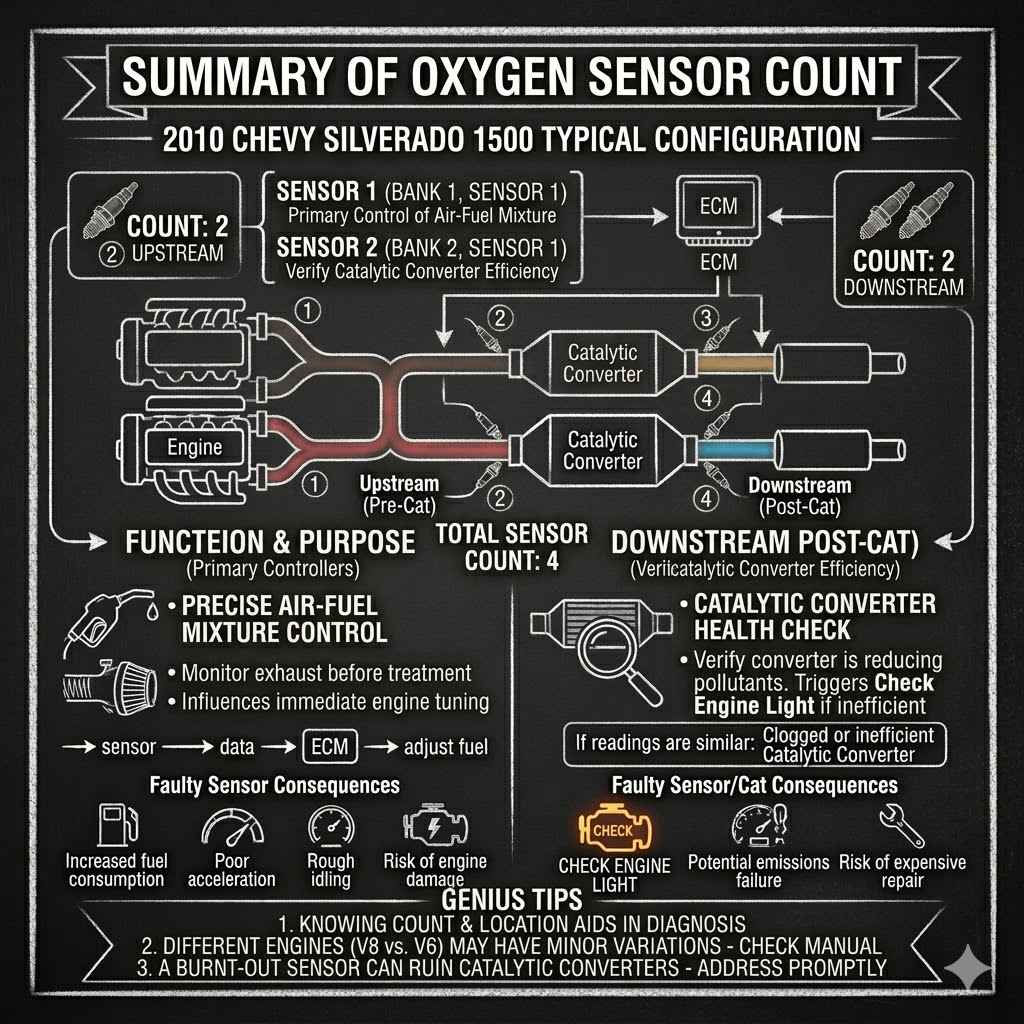
In summary, a 2010 Chevy Silverado 1500 typically comes equipped with four oxygen sensors. These sensors are crucial for monitoring engine performance and emissions. Two sensors are upstream, before the catalytic converter, and two are downstream, after the catalytic converter.
This configuration allows for precise control of the air-fuel mixture and verification of catalytic converter efficiency. Knowing the number and location of these sensors can help in diagnosing and addressing potential issues with your truck’s exhaust system.
Frequently Asked Questions
Question: How many oxygen sensors does a 2010 Chevy Silverado 1500 have?
Answer: A 2010 Chevy Silverado 1500 typically has four oxygen sensors.
Question: Where are the oxygen sensors located on my 2010 Silverado 1500?
Answer: There are two upstream sensors, one on each exhaust manifold, and two downstream sensors, one after each catalytic converter. So, two on the driver’s side and two on the passenger’s side.
Question: What is the difference between upstream and downstream oxygen sensors?
Answer: Upstream sensors monitor the air-fuel mixture for engine control, while downstream sensors check the performance of the catalytic converter.
Question: What happens if an oxygen sensor fails on my 2010 Silverado 1500?
Answer: A failing sensor can cause decreased fuel economy, rough idling, poor engine performance, and trigger a check engine light.
Question: Should I replace oxygen sensors in pairs?
Answer: It’s often recommended to replace upstream oxygen sensors in pairs for balanced engine performance and to prevent future issues.
Final Thoughts
Your 2010 Chevy Silverado 1500 has four oxygen sensors, two upstream and two downstream. These sensors work hard to keep your engine running smoothly and your emissions clean. If you notice poor gas mileage or a check engine light, these sensors are a good place to start your investigation.
Replacing them can often be a straightforward repair, helping your truck perform its best.