How to Check Coolant Level on a Honda Civic Safely
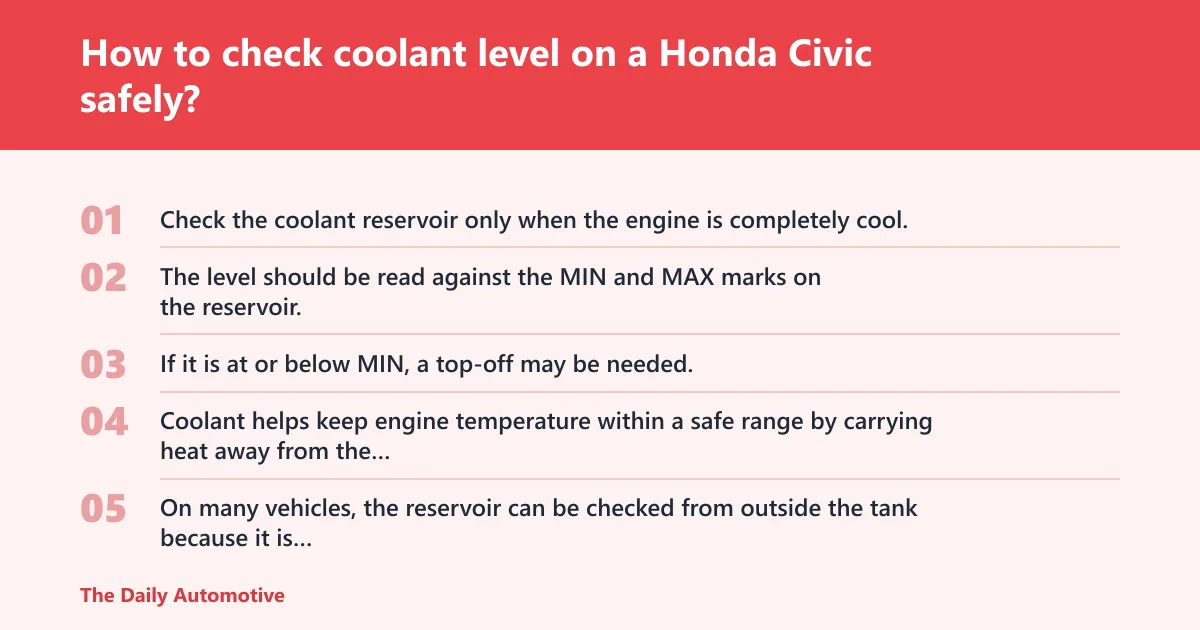
Check the coolant reservoir only when the engine is completely cool, and only if you can do so without opening any pressurized parts. The level should be read against the MIN and MAX marks on the reservoir. If it is at or below MIN, a top-off may be needed; if it keeps dropping or the engine has overheated, there may be a leak or another cooling-system problem.
Coolant helps keep engine temperature within a safe range by carrying heat away from the engine and into the radiator. On many vehicles, the reservoir can be checked from outside the tank because it is translucent. That is safer than opening a hot cooling system.
How to check coolant level on a Honda Civic safely?


Reservoir placement can vary by Civic model year and trim, so if you cannot find it right away, consult the vehicle’s owner’s manual.
What you’ll need before you open the hood
- Gloves
- Safety glasses
- Rag or paper towel
- Flashlight
- Funnel, if you need to top off
- Honda owner’s manual
Where is the coolant reservoir on a Honda Civic?
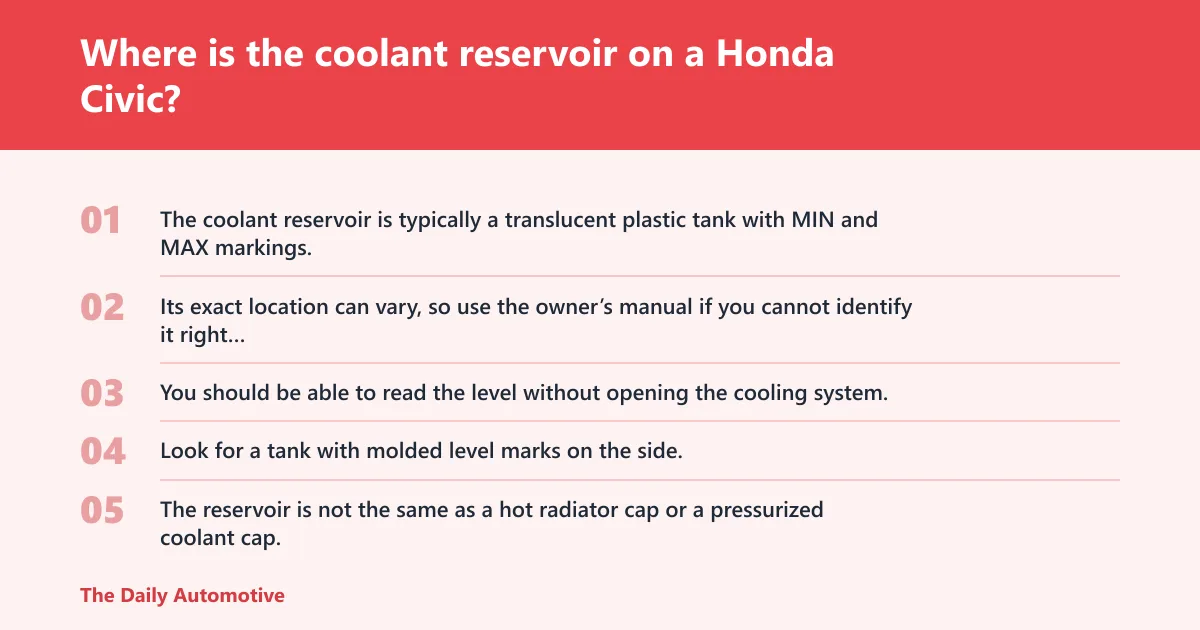
The coolant reservoir is typically a translucent plastic tank with MIN and MAX markings. Its exact location can vary, so use the owner’s manual if you cannot identify it right away. You should be able to read the level without opening the cooling system.
Look for a tank with molded level marks on the side. The reservoir is not the same as a hot radiator cap or a pressurized coolant cap. If your Civic has a different engine or hybrid layout, the tank may sit in a less obvious part of the engine bay.
How to identify it quickly
Trace the hoses in the engine bay to a translucent plastic tank with MIN/MAX marks. A flashlight can help in low light. If several plastic containers are nearby, refer to the owner’s manual to confirm which one is the coolant reservoir.
Check the coolant level step by step
Check the reservoir only after the engine has cooled completely. A cool engine gives a more accurate reading and reduces the risk of burns. Use the marks on the tank rather than estimating by eye.
- Park the car on a level surface and switch the engine off.
- Wait until the engine is fully cool.
- Put on gloves and safety glasses.
- Open the hood and locate the translucent coolant reservoir.
- Use a flashlight if needed, then read the fluid level against the MIN and MAX marks.
- Use the table below to decide what to do next.
The level should be between the marks. If it is below MIN, that may mean a top-off is needed or that coolant has been lost. If the reservoir is empty, treat it as a warning sign.
What does the coolant level mean on a Honda Civic?
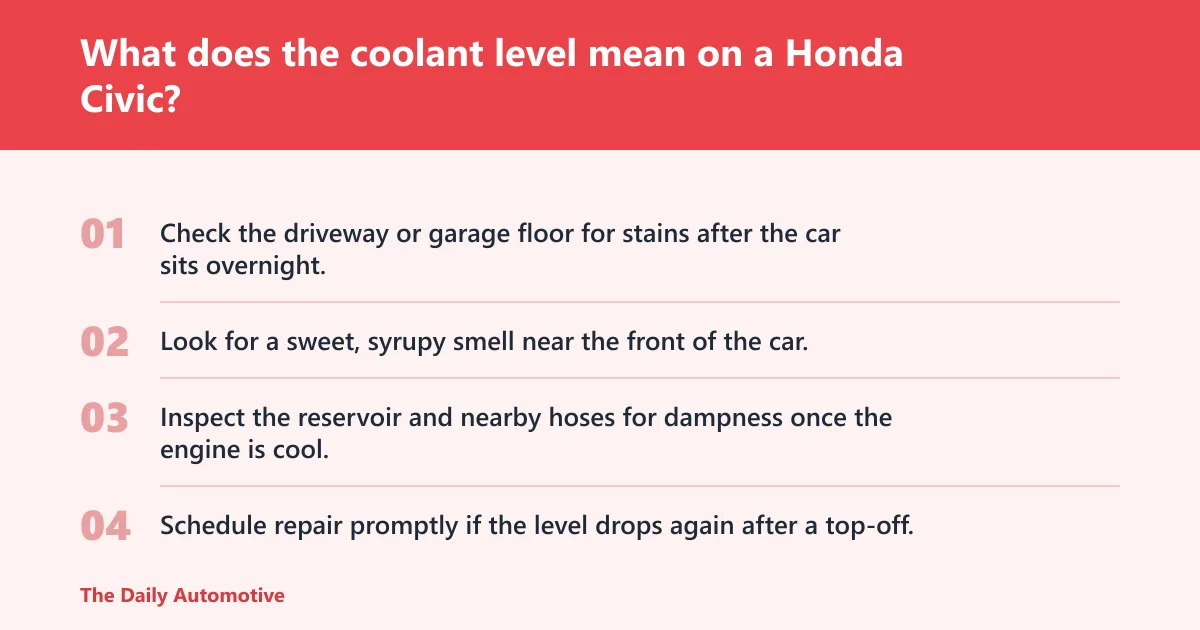
A normal reading is between MIN and MAX on a cool engine. A level slightly below MIN can mean a careful top-off is needed. A reservoir that keeps dropping, or one that is empty, suggests a coolant-loss problem that should be checked before more driving.
| What you see | What it likely means | Next safe action |
|---|---|---|
| Level between MIN and MAX on a cool engine | Normal reading | Close the hood and check again at the next routine service or if a warning appears |
| Level slightly below MIN, no puddles or smell | Possible small loss or normal settling after service | Top off carefully with the correct coolant and recheck later |
| Level repeatedly low, empty, or dropping again | Likely coolant-loss problem | Inspect for leaks and schedule repair promptly; avoid long trips until it is checked |
What to do if the level is low
Top off only after the engine has cooled, and use the coolant type specified in the owner’s manual. Some coolants are premixed, while others must be diluted before use. The wrong coolant can cause corrosion or reduce cooling performance, so do not rely on color alone.
If the reservoir sits just below MIN and there are no spots or smells, a careful top-off and later recheck is reasonable. If the reservoir is empty or the temperature warning came on during the last drive, the car should be checked for a cooling-system problem.
If that didn’t work, try this next
- Check the driveway or garage floor for stains after the car sits overnight.
- Look for a sweet, syrupy smell near the front of the car.
- Inspect the reservoir and nearby hoses for dampness once the engine is cool.
- Schedule repair promptly if the level drops again after a top-off.
Can I open the coolant cap on a Honda Civic myself?
Do not open the radiator cap or any pressurized coolant cap on a hot engine. On a cold engine, the reservoir is the part you usually check first because it is meant to be read from the outside. If a cap must be removed for service, do that only on a cool system.
The owner’s manual can help you identify the correct reservoir and service information, but it does not change the basic safety rule: avoid opening a hot pressurized system. If you only need to read the reservoir, there is usually no reason to open anything.
How do I know if my Honda Civic has a coolant leak?
Look for puddles under the car after it sits, a sweet smell near the front of the car, or stains on the driveway or garage floor. A sweet, syrupy smell can point to coolant. If the reservoir keeps dropping without an obvious spill, that also suggests a leak or another loss of coolant.
Common leak clues
- Bright or crusty stains on the floor after parking
- Wet hoses or damp spots around the reservoir
- Repeatedly low level after a correct top-off
- Overheating or a temperature warning
If the reservoir is empty or the car overheats, do not keep driving far before service. A cooling system can lose fluid with no large puddle visible, especially if the leak is small or dries quickly.
Can I overfill the coolant reservoir on a Honda Civic?
Yes. Overfilling can cause overflow when the engine gets hot, so the level should stay between MIN and MAX on a cold engine. Fill slowly and stop before the fluid reaches the upper mark. A funnel helps control the pour and reduces the chance of spills.
Common mistakes to avoid
- Checking the level on a hot engine
- Opening a pressurized cap without need
- Filling above MAX
- Using the wrong coolant type
- Ignoring a reservoir that keeps dropping
Check the reservoir on a cool engine from time to time, especially before a long trip or after recent service, and note whether the level changes between checks.
Frequently asked questions
How do I check the coolant level on a Honda Civic safely?
Park on level ground, wait for a fully cool engine, and read the translucent reservoir from the outside. The fluid should sit between MIN and MAX. Use gloves, safety glasses, and a rag, and do not open a hot pressurized cap just to inspect the level.
Do I check Honda Civic coolant when the engine is hot or cold?
Check it cold. A hot system can give a misleading reading and can spray scalding fluid if opened. Let the engine cool completely, then read the reservoir on level ground so the mark on the tank reflects the actual level more accurately.
Where is the coolant reservoir on a Honda Civic?
It is usually a translucent plastic tank in the engine bay. The exact location can vary by model year and trim. If you cannot spot the reservoir quickly, the owner’s manual is the safest guide.
What does the Honda Civic coolant reservoir level mean?
Between MIN and MAX on a cool engine is normal. Slightly below MIN usually means a top-off may be needed. If the level keeps falling, or the tank is empty, treat it as a warning sign and look for a leak or another coolant-loss problem.
What coolant should I add if the level is low?
Add the coolant type specified in the Honda owner’s manual. Some products are premixed, while others need water added in the ratio shown on the bottle. The wrong coolant can reduce cooling efficiency or cause corrosion, so do not rely on color alone.
Can I overfill the coolant reservoir on a Honda Civic?
Yes. If you fill above MAX, the extra coolant can overflow when the engine gets hot. Stop at the upper mark on a cold engine. A funnel helps control the fill, and a rag or paper towel helps clean small spills right away.
Products related to this article
Sponsored / affiliate links. As an Amazon Associate I earn from qualifying purchases. I may earn additional commission from eligible campaigns.