How to Disable or Reset TPMS on a Chevy: Reset Button, Light Fix & Bypass Guide
You cannot permanently disable TPMS on a Chevy — US federal law (FMVSS 138) requires a functioning tire pressure monitoring system on all vehicles manufactured after September 2007. What you can do is reset the TPMS warning light in about 3 minutes using the reset button, or use a TPMS bypass emulator to suppress the sensor alert when running aftermarket or winter wheels without TPMS sensors.
Ignoring a TPMS light without addressing the underlying cause means you’re flying blind — a tire losing pressure at highway speed gives you as little as 30 seconds of safe steering control. This guide covers the fastest reset method, model-specific button locations for Silverado, Equinox, Malibu, and Traverse, and the legal bypass options if you’re running non-OEM wheels.
Quick Answer
You can’t permanently disable Chevy TPMS — it’s federally mandated. To turn off the TPMS light: (1) Inflate all tires to the door-jamb spec, (2) Turn key to ON (don’t start), (3) Hold the TPMS reset button under the steering wheel until the light blinks 3 times, then drive 10–20 minutes at 25+ mph. For aftermarket wheels without sensors, use a TPMS bypass emulator (plugs into OBD2 port, ~$50–$150).
How to Reset the Tire Pressure Light on a Chevy (Step-by-Step)
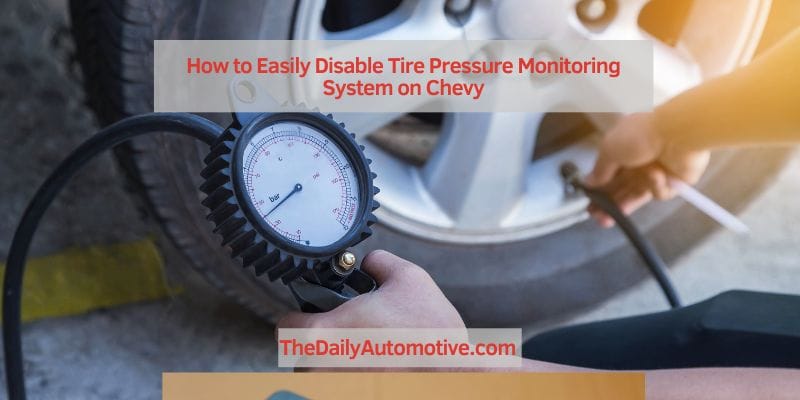
This is the method most people actually need. The TPMS warning light doesn’t mean you need to “disable” the system — it means one or more tires are 25% below the recommended pressure (or the system needs relearning after a tire rotation). Here’s how to clear it:
- Inflate all four tires to the pressure listed on the driver’s door jamb sticker (not the tire sidewall — that’s the max pressure, not the recommended pressure).
- Turn the ignition key to the ON position (or press the start button once without pressing the brake pedal on keyless models). Do not start the engine.
- Locate and hold the TPMS reset button until the TPMS indicator light blinks three times slowly, then release.
- Start the vehicle and drive at 25 mph or faster for 10–20 minutes. This gives each wheel sensor time to transmit its learned position to the TPMS module.
- Verify the light is off. If it flashes rapidly (not slowly), you have a sensor fault — a sensor may be dead, damaged, or out of range.
Reset button doesn’t work? Some Chevy models (Malibu 2013+, Equinox 2018+) no longer use a physical reset button. On those vehicles, use the Driver Information Center (DIC): Settings → Vehicle → Tire Pressure → Re-learn Tires.
TPMS Reset Button Location by Chevy Model
| Model | Reset Method | Button Location |
|---|---|---|
| Silverado (2007–2018) | Physical button | Under steering column, left of brake pedal |
| Silverado (2019+) | DIC menu | Steering wheel DIC buttons → Tire Pressure |
| Equinox (2010–2017) | Physical button | Under dash, left of steering column |
| Equinox (2018+) | DIC menu | Info button on steering wheel → Vehicle Info |
| Malibu (2008–2012) | Physical button | Glove box interior, right side |
| Malibu (2013+) | DIC menu | Home → Settings → Tire Pressure |
| Traverse (all years) | DIC menu | Steering wheel right pad → Info → Tire Pressure |
Why Won’t My Chevy TPMS Light Turn Off After Reset?
If the light stays on or returns within a day, one of these is usually the cause:
| Symptom | Most Likely Cause | Fix |
|---|---|---|
| Light on constantly after reset | One tire still underinflated | Re-check all 4 tires + spare (some models monitor spare) |
| Light flashes rapidly for 60–90 sec on startup | Dead or damaged TPMS sensor | Scan with TPMS tool; replace sensor ($20–$80 each) |
| Light returns after driving | Slow leak in one tire | Inspect for nail/puncture; repair or replace tire |
| Light on after tire rotation | Sensor positions not relearned | Run the reset procedure again; drive 20 min at 25+ mph |

Reasons To Disable TPMS on Your Chevy
Most drivers who want to “disable” TPMS on their Chevy are actually running aftermarket wheels or seasonal winter tires that don’t have TPMS sensors installed. The system triggers a constant warning light because it’s receiving no signal from those wheels. Other common reasons include:
- Running track/autocross wheels without TPMS sensors
- Replacing tires on used rims that never had sensors
- Dead sensors that haven’t been replaced yet
- False readings after suspension lifts that change wheel geometry
Methods To Disable TPMS On Chevy
There are three approaches to dealing with a TPMS alert on a Chevy when you can’t or don’t want to fix the sensor directly:
Avoid False Readings
If you’re getting false low-pressure alerts despite correct tire inflation, the most common culprit is temperature change — tire pressure drops roughly 1 PSI for every 10°F drop in ambient temperature. Check your tires after a cold overnight and inflate to the door-jamb spec. Also verify the spare tire pressure if your model monitors it (Silverado and Traverse do) — see our related guide, Can You Flat Tow a Chevy Traverse? It Depends on the Year.
Use Aftermarket TPMS
If you’re swapping to new aftermarket wheels, the cleanest long-term solution is installing aftermarket TPMS sensors in each new wheel. Universal TPMS sensor kits (compatible with Chevy’s 315 MHz or 433 MHz frequency, depending on model year) typically cost $60–$120 for a set of four and require programming to your vehicle’s ECU — most tire shops can do this for $20–$40.
Using A TPMS Bypass Tool
A TPMS bypass emulator (also called a TPMS delete tool or TPMS suppressor) is a small device that plugs into your OBD2 port and wirelessly transmits signals that simulate functioning TPMS sensors, preventing the warning light from triggering. These devices cost between $50 and $150 and are popular with track-day drivers and off-road builds running wheel swaps.
Legal note: The US federal Clean Air Act (40 CFR Part 85) makes it illegal to disable or render inoperative any federally mandated vehicle safety device on a vehicle that will be driven on public roads. Using a bypass emulator on a street-driven vehicle falls into a legal gray area — enforcement is rare, but be aware of the risk. Track-only vehicles are not subject to this restriction.
Disconnecting The TPMS Sensors
Physically removing or disabling the TPMS sensors means pulling each wheel and unsnapping the sensor from the valve stem. This eliminates the hardware entirely — but the TPMS module will detect missing sensor signals and set a permanent fault code (DTC C0750–C0753 on most Chevy models), which will illuminate the TPMS and potentially the Check Engine light. This approach is not recommended for street vehicles.
Modifying The TPMS Module
Some experienced tuners reprogram or replace the TPMS control module to disable sensor-check routines entirely. This requires GM Tech2 or MDI scan tool access and is beyond DIY scope for most owners. It also voids any applicable warranty and may trigger OBD2 readiness monitor failures that prevent the vehicle from passing state emissions inspections in most states.
TPMS Tool Kit — Recommended Products
Masoll TPMS Sensor for GM Chevy Silverado Buick Cadillac GMC, DIY Install
View on Amazon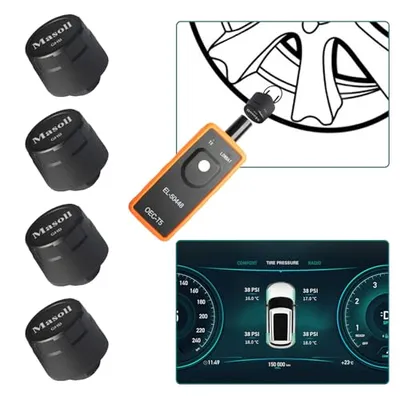
VXDAS TPMS Relearn Tool Only for GM Vehicles (2006-2024 Chevy/Buick/GMC/Opel/Cadillac) Original Sens
View on Amazon
Autel TPMS Sensors Set of 4, Universal 2-in-1 MX-Sensor 315/433MHz Rubber
View on Amazon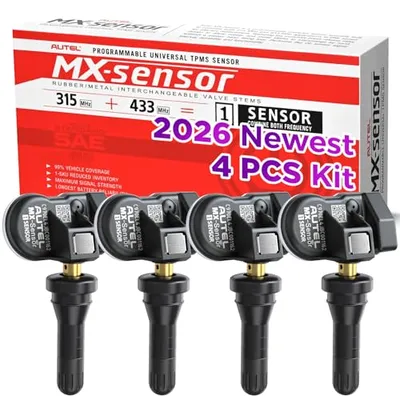
AstroAI Digital Tire Pressure Gauge 150PSI, ±1PSI Accuracy for Car Truck
View on AmazonFrequently Asked Questions
Where is the TPMS reset button on a Chevy?
On most Chevy Silverado (2007–2018) and Equinox (2010–2017) models, the TPMS reset button is located under the steering column to the left of the brake pedal. On 2013+ Malibu and 2018+ Equinox models, the physical button was removed — use the Driver Information Center (DIC) menu instead: Settings → Vehicle Information → Tire Pressure → Re-learn Tires.
How long do I need to drive after resetting TPMS?
Drive at least 10–20 minutes at 25 mph or faster. Each wheel sensor transmits its pressure reading periodically (typically every 30–60 seconds when rolling), and the TPMS module needs to receive several confirmed readings from all four sensors before it clears the warning light. Highway driving speeds up this process.
Is disabling TPMS on a Chevy illegal?
Permanently disabling TPMS on a street-driven vehicle violates federal regulations (FMVSS 138 / Clean Air Act enforcement). However, resetting the TPMS warning light after properly inflating your tires is completely legal and is the intended use of the reset function. TPMS bypass emulators exist in a legal gray area — they’re commonly used for track/off-road applications where wheels are swapped frequently.
Why does my Chevy TPMS light keep coming back on?
The most common causes are: a slow tire leak (nail, damaged valve stem, or cracked bead), a dead or failing TPMS sensor (battery life is typically 7–10 years), or seasonal temperature drops causing tire pressure to fall below the trigger threshold. Check your tire pressure manually with a gauge — if all four tires are properly inflated and the light returns, you likely have a faulty sensor (DTC scan will confirm which wheel).
How do I reset TPMS on a Chevy without the reset button?
On models without a physical reset button, use the Driver Information Center (DIC): Press the info/home button on the steering wheel, navigate to Settings → Vehicle → Tire Pressure → Re-learn Tires, then follow the on-screen prompt to initiate the relearn drive cycle. Alternatively, a TPMS scan tool can manually trigger the relearn sequence for each sensor individually.
For more related troubleshooting, see our guide on how to reset the service side detection system on a Chevy Traverse. If you’re checking tire health more broadly, our car battery health check guide covers related diagnostic steps.
Products related to this article
Sponsored / affiliate links. As an Amazon Associate I earn from qualifying purchases. I may earn additional commission from eligible campaigns.