Chevy Silverado Under Hood Fuse Box Diagram: Full Guide (2026-2026)
You’re on the side of the road, the dash lights up like a Christmas tree, and the truck won’t crank. Or maybe the radio just went dead for no reason. The first place you turn to is the fuse box under the hood, but the diagram printed on the cover is tiny, faded, and about as clear as mud. It’s a common frustration with the 2026 and newer Silverado models.
This guide gives you the full layout of the under-hood fuse block, tells you exactly which fuse does what, and walks you through the fix step by step. You’ll learn the difference between the main fuse block and the small box mounted on the battery, how to test a fuse without pulling it, and which circuits are tied to which fuse numbers. By the end, you’ll be able to diagnose most common electrical issues without a trip to the dealer.

Autoxbtc
Autoxbtc 22798218 Engine Fuse Box Fits for…
- Vehicle Fitment---Fits for 2010-2014 Chevrolet Silverado 1500/2500 HD/3500 HD, 2010-2014 Chevrolet Avalanche, Suburban 1500/2500,…
- OE Number--- #22798218 & #25941369 exactly. The engine wiring junction block maintains OEM-grade reliability and steady electrical…
- Fuse Relay Block---This integrated engine compartment fuse box integrates various fuses and relays into a single module. It optimi…
If you find that your fuse block itself is cracked, melted, or has corroded terminals, a direct replacement is often cheaper than a dealership repair. The Autoxbtc 22798218 engine fuse box fits 2026-2026 Silverado and Sierra models, plus the corresponding Suburban, Tahoe, Yukon, and Escalade variants. It’s a plug-and-play unit that matches the OEM part number, so you can swap it out in an afternoon.
Locating the Under-Hood Fuse Box
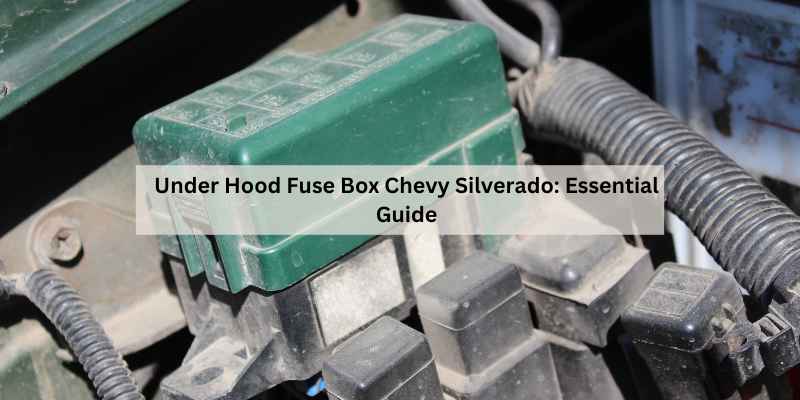
Pop the hood and look toward the back of the engine bay on the driver’s side. The main under-hood fuse block sits right next to the brake fluid reservoir, tucked against the fender. It’s a large black plastic box with a cover that has a diagram printed on top. That diagram is your starting point, but it’s not always accurate for every trim level.
There’s a second, smaller fuse box mounted directly on top of the battery. This one handles a few high-current circuits like the auxiliary power outlet and the battery management system. Don’t confuse the two. The battery-mounted box is small and square, while the main fuse block is long and rectangular.
The cover on the main box has two release clips on the side facing the engine. Press them inward and lift. The cover will hinge up and off. Set it somewhere clean, because you’ll need to reference that diagram when you’re digging around.
Under-Hood Fuse Box Diagram: Full Layout (2026-2026)
The fuse assignments vary slightly between the 5.3L V8, 6.2L V8, and the 3.0L Duramax diesel, but the physical layout of the box stays the same across 2026 through 2026 model years. The following table covers the most common circuits you’ll actually need to check.
| Fuse / Relay Number | Amp Rating | Circuit / Component |
|---|---|---|
| F1 | 60A | Main power feed (battery junction box) |
| F2 | 40A | Electric cooling fan (low speed) |
| F3 | 50A | Electric cooling fan (high speed) |
| F4 | 30A | Windshield wiper motor |
| F5 | 20A | Fuel pump |
| F6 | 15A | Ignition coil / injectors (gas engines) |
| F7 | 10A | Airbag system (SDM) |
| F8 | 20A | Horn |
| F9 | 15A | Daytime running lamps (DRL) |
| F10 | 10A | Powertrain control module (PCM) battery feed |
| F11 | 20A | Trailer brake controller (if equipped) |
| F12 | 25A | Oxygen sensors (heated) |
| F13 | 15A | Transmission control module (TCM) |
| F14 | 30A | Starter motor relay feed |
| F15 | 40A | Anti-lock brake system (ABS) pump |
| F16 | 20A | Trailer wiring (left turn / stop) |
| F17 | 20A | Trailer wiring (right turn / stop) |
| F18 | 10A | Air conditioning compressor clutch |
| R1 | Relay | Starter motor relay |
| R2 | Relay | Fuel pump relay |
| R3 | Relay | Cooling fan relay (high/low) |
| R4 | Relay | Horn relay |
High-Current Fuses (Starter, Alternator, Trailer Brakes)
The starter and alternator circuits use large fuses that are bolted in, not plugged in. These are the ones labeled with 60A, 80A, or 100A ratings. If the starter fuse blows, the truck won’t crank at all. The alternator fuse, often rated at 80A, sits near the front of the box. A blown alternator fuse means the battery won’t charge while the engine runs, but the truck will still start if the battery has enough juice.
Trailer brake circuits run through a dedicated relay and a 20A fuse. If your trailer lights work but the brakes don’t, check F11 first. If the fuse is fine, the problem is likely the relay or the wiring harness on the trailer itself.
Interior Fuse Box (Passenger Compartment) vs. Under-Hood Box
The under-hood box handles high-current loads: engine management, cooling fans, ABS, and trailer wiring. The interior fuse panel, located on the passenger side under the dash, handles the cabin electronics: radio, power windows, door locks, and the OBD-II port. The OBD-II port itself is powered by a fuse in the interior panel, not under the hood.
The 12V power outlet (the cigarette lighter) is the one that confuses people. There are usually two outlets in the cabin. The one in the center console is powered by the interior fuse panel. The one on the dashboard, near the USB ports, is also on the interior panel. Neither is under the hood. If your dash cam or phone charger stops working, don’t waste time under the hood. Check the interior fuse labeled “CIG” or “AUX PWR.”
How to Access and Replace a Blown Fuse (Step-by-Step)
Here’s the process for getting into the under-hood box and swapping a fuse. It takes about five minutes once you know what you’re doing.
- Turn the engine off and remove the key. For hybrid or e-assist models, wait at least 10 minutes after shutdown.
- Open the hood and find the fuse block on the driver’s side near the brake fluid reservoir.
- Press the two release clips on the side facing the engine and lift the cover. The cover has a diagram printed on the underside.
- Look for the fuse puller tool. It’s a small plastic clip stored inside the fuse box cover or clipped to the side of the box. It looks like a pair of tweezers.
- Use the puller to grip the fuse by its body, not the metal prongs. Pull straight out. Do not twist or rock it.
- Check the metal strip inside the fuse. If it’s broken or melted, the fuse is blown.
- Push a new fuse of the same amp rating into the slot. Press down until it clicks.
- Reinstall the cover, making sure both clips snap shut.
Tools Needed (Fuse Puller, Flashlight)
You need the fuse puller that comes with the truck. It’s clipped inside the fuse box cover. A bright flashlight helps, because the fuse numbers are printed in small white text on the box. A pair of needle-nose pliers works in a pinch, but they can crack the fuse body if you squeeze too hard.
How to Test a Fuse Without Removing It
You can test a fuse while it’s still in the box. Use a 12V test light or a multimeter set to DC voltage. Touch the probe to each of the two small metal test points on the top of the fuse. With the ignition on, you should get battery voltage on one side. If you get voltage on one side but not the other, the fuse is blown. If you get voltage on neither side, the circuit has a break elsewhere or the fuse is not receiving power.
This method works best for fuses that are always hot, like the fuel pump or PCM feed. For switched circuits, you’ll need the ignition in the run position.
Common Silverado Electrical Problems and Their Fuse Fixes
Here’s a quick reference for the issues that send people to the fuse box. Match your symptom to the likely culprit.
- No crank, no start: Check F14 (30A starter feed) and R1 (starter relay). If both are good, the problem is likely the ignition switch or the neutral safety switch.
- Battery drains overnight: Pull F10 (PCM feed) and test for parasitic draw. A common cause is a stuck relay, not a fuse.
- Cooling fan runs constantly: Check R3 (fan relay). A welded relay will keep the fan running even with the key off.
- Horn doesn’t work: Check F8 (20A horn fuse) and R4 (horn relay). The fuse blows when the horn wires short against the frame.
- Trailer lights dead: Check F16 and F17. The left and right turn signals are on separate fuses. If only one side is dead, you’ve found the problem.
If you’re dealing with a no-crank condition and the starter fuse checks out, the issue might be deeper. A faulty ignition switch can mimic a blown fuse. The starter ignition switch wiring diagram explains how the circuit flows from the key to the starter solenoid.
Safety Warnings and Best Practices (Amp Ratings, Relays)
Never replace a fuse with a higher amp rating. If a 15A fuse blows, putting in a 20A fuse turns the wiring into a heating element. The wire will melt before the fuse blows. That’s how engine bay fires start.
If a fuse blows twice in a row, you have a short circuit, not a bad fuse. Stop replacing fuses and start looking for the wiring problem. Check for chafed wires rubbing against metal edges, especially near the battery tray and the fender.
Relays can fail in two ways: they stop closing (so the circuit never turns on) or they weld shut (so the circuit never turns off). A relay that’s welded shut will often click when you tap it with a screwdriver handle. That’s a sign to replace it.
When working near the battery, remove any metal jewelry. The high-current fuses in this box can deliver hundreds of amps, and a dropped wrench across the battery terminals will weld itself to the frame.
For older models, the fuse layout is different. The 73-87 Chevy truck fuse box diagram covers the classic square-body trucks if that’s what you’re driving.
What About the Spare Fuses?
The under-hood fuse box has a few empty slots that are not wired. They look like spare fuse locations, but they’re not. The actual spare fuses are stored in the interior fuse panel, under the dash. There are usually two or three spares in different amp ratings, plus the fuse puller. If you blow a fuse and there’s no spare, any auto parts store carries them. Grab a variety pack with 5A, 10A, 15A, 20A, and 30A fuses. That covers most of the circuits on the truck.
One more note on the battery-mounted fuse box. It contains a few small fuses for the battery management system and the auxiliary power feed. If your truck has a stop-start system and it stops working, check these fuses first. They’re smaller than the ones in the main box and easy to overlook.
Diagnosing a Blown Fuse vs. a Bad Relay
A blown fuse is easy to spot once you pull it. The metal strip inside is broken. A bad relay is harder to diagnose. Here’s the trick: swap the suspect relay with an identical one from a circuit that works. For example, if the horn relay is suspect, swap it with the fog light relay if they’re the same part number. If the horn starts working, you’ve found the bad relay.
Relays are cheap, usually under $15 at any parts store. If you’re unsure, just replace it. The same applies to the fuse block itself. If the plastic is melted or the terminals are green with corrosion, don’t try to repair it. Replace the whole unit. That’s where a direct replacement like the Autoxbtc fuse block saves you a headache. It’s a one-to-one swap for the factory part, and you don’t have to rewire anything.
If you’re chasing an intermittent issue, like the radio cutting out on bumpy roads, that’s not a fuse. That’s a loose connection or a broken wire in the harness. Fuses don’t fix themselves, so an intermittent problem points to wiring, not a fuse.
Questions People Actually Ask
Where is the under-hood fuse box on a 2026 Silverado?
It’s on the driver’s side, near the back of the engine bay, next to the brake fluid reservoir. The black plastic cover has a diagram printed on it. The battery-mounted fuse box is a separate, smaller unit on top of the battery.
Which fuse is for the cigarette lighter in a 2026 Silverado?
The 12V power outlet in the center console is on the interior fuse panel, under the dash on the passenger side. It’s labeled “AUX PWR” or “CIG.” The under-hood box does not power any cabin outlets.
Why does my Silverado keep blowing the same fuse?
You have a short circuit. The fuse is doing its job by protecting the wiring. Look for chafed wires, corroded connectors, or a failing component like a blower motor that’s drawing too much current. Don’t keep replacing the fuse without finding the root cause.
Can I use a higher amp fuse in my truck?
No. The amp rating is matched to the wire size. A higher amp fuse allows more current than the wire can handle, which causes the wire to overheat and melt. That’s a fire risk. Always use the exact amp rating printed on the fuse box cover or in the owner’s manual.
What is the fuse puller tool and where is it stored?
It’s a small plastic clip that looks like tweezers. It’s stored inside the fuse box cover, clipped into a slot on the underside. The interior fuse panel also has one. Use it to grip and pull fuses without touching the metal prongs.
Quick Reference Checklist
- Under-hood fuse block lives on the driver’s side, near the brake fluid reservoir.
- The battery-mounted box handles auxiliary circuits, not the main engine loads.
- Always match the amp rating on the replacement fuse to the one you pulled.
- Test fuses with a 12V test light without removing them first.
- The 12V power outlets are on the interior fuse panel, not under the hood.
- A blown fuse twice in a row means a short circuit, so stop replacing fuses and start tracing wires.
- If the fuse block itself is damaged, replace the whole unit instead of patching it.
Products related to this article
Sponsored / affiliate links. As an Amazon Associate I earn from qualifying purchases. I may earn additional commission from eligible campaigns.