How To Turn Off Trailblazer Tire Monitor
Some folks find it a little tricky to figure out how to turn off the tire monitoring system on their newer cars, and the 2026 Chevy Trailblazer LT is no different. You might be wondering why it’s on or how to get that little light to go away. Don’t worry, it’s usually a simple fix!
We’ll walk you through it step-by-step so you can get that dashboard light off without any fuss. This guide will show you exactly what to do next.
Understanding Your Tire Monitoring System
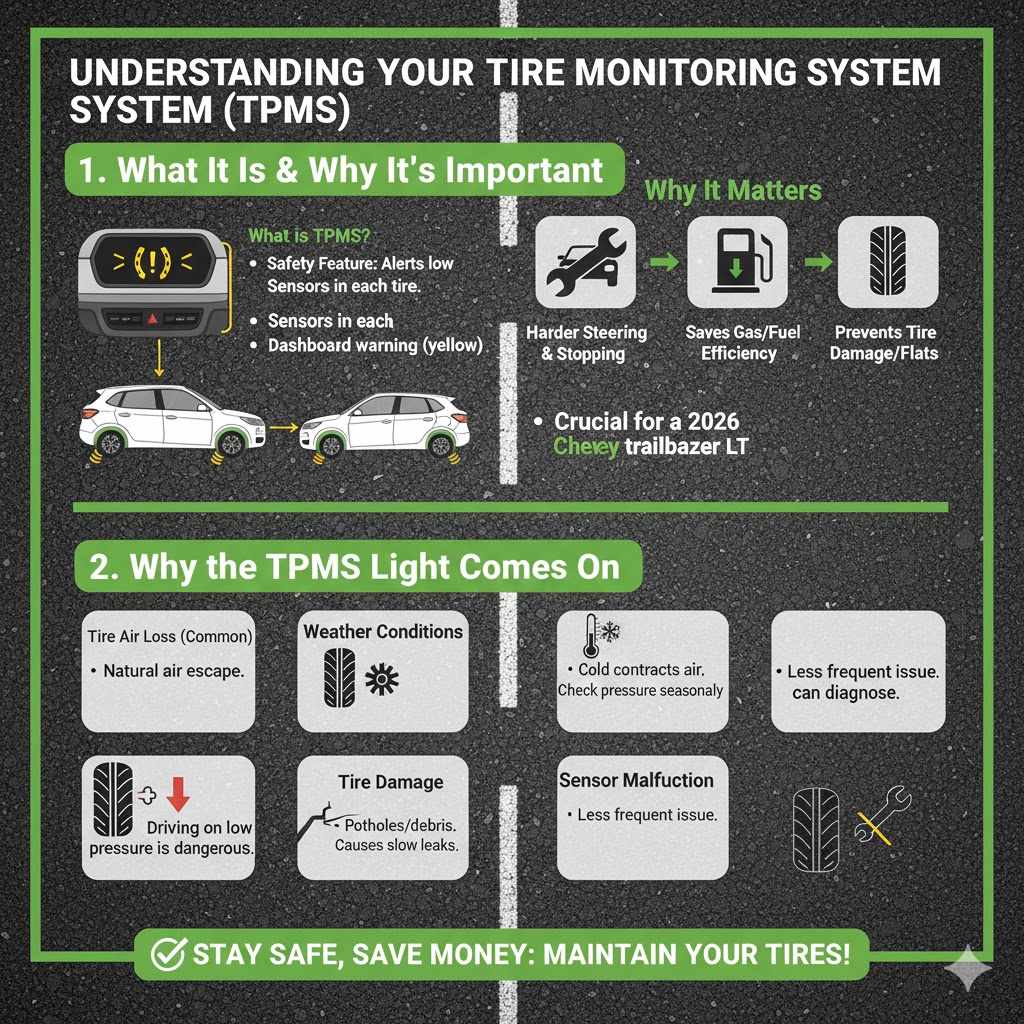
Your vehicle’s Tire Pressure Monitoring System, or TPMS, is a very important safety feature. It helps you know when your tires don’t have enough air. Low tire pressure can make your car harder to steer, stop, and can even cause a flat tire.
Keeping your tires at the right pressure is good for your car and helps save on gas. This system uses sensors inside each tire to check the air pressure. If one or more tires are low, a warning light comes on your dashboard.
This light usually looks like a flat tire with an exclamation mark inside it. It’s a helpful reminder to check your tires regularly.
Why the TPMS Light Might Come On
Several things can cause the tire pressure warning light to show up on your 2026 Chevy Trailblazer LT. The most common reason is simply that one or more of your tires have lost air. This can happen over time as air naturally escapes through the rubber.
Cold weather can also cause tire pressure to drop. If you’ve recently driven through a place with a lot of potholes, a tire might have been damaged, leading to a slow leak. Even a faulty sensor could be the culprit, though this is less common.
Knowing why the light is on is the first step to fixing it.
- Tire Air Loss Common Cause
This is the most frequent reason your TPMS light will turn on. Tires naturally lose a small amount of air over time. Think of it like a very slow leak that happens to all tires. Driving on underinflated tires is dangerous. It affects your car’s handling and can lead to premature tire wear. Always check your tire pressure when the weather changes. - Impact of Weather Conditions
Colder temperatures can cause the air inside your tires to contract, leading to a drop in pressure. This is why you might see your TPMS light come on more often during winter months. When the temperature rises, the pressure might go back up, and the light could turn off. It’s a good idea to check and adjust your tire pressure when the seasons change to maintain optimal levels. - Potential Tire Damage
Hitting a pothole or road debris can sometimes cause a small puncture in your tire. This might not result in an immediate flat, but rather a slow leak. The TPMS will eventually detect the drop in pressure and alert you. If you suspect tire damage, it’s best to have it inspected by a professional to ensure safety. - Sensor Malfunctions
While less frequent, the TPMS itself can have issues. A sensor might fail, or there could be a problem with the system’s communication. If you’ve checked your tire pressure and it’s all good, but the light stays on, there might be an issue with the TPMS components. A mechanic can diagnose and fix sensor problems.
What the TPMS Light Looks Like
The TPMS warning light is designed to be easily recognizable. It typically appears as a yellow or amber icon on your dashboard. This icon looks like a horseshoe with an exclamation point in the middle.
Sometimes, it might just show a tire shape with “TPMS” written underneath it. When you see this light illuminated, it’s a direct signal from your car’s computer that something is up with your tire pressure. It’s important not to ignore this warning, as it’s there to help keep you safe.
How to Turn Off Tire Monitoring System on 2026 Chevy Trailblazer LT
Now we get to the main question: How to Turn Off Tire Monitoring System on 2026 Chevy Trailblazer LT. For most drivers, turning off the TPMS light isn’t about disabling the system permanently. Instead, it’s about resetting it after you’ve corrected a tire pressure issue.
Once you’ve added air to your tires to the correct level, the system needs to be told that everything is okay. If the light stays on after you’ve ensured your tires are properly inflated, it usually means the system needs to be reset. This process can vary slightly between car models, but on the 2026 Chevy Trailblazer LT, it often involves using buttons on your steering wheel or in the infotainment system.
We’ll guide you through the common methods.
Using Your Vehicle’s Infotainment System
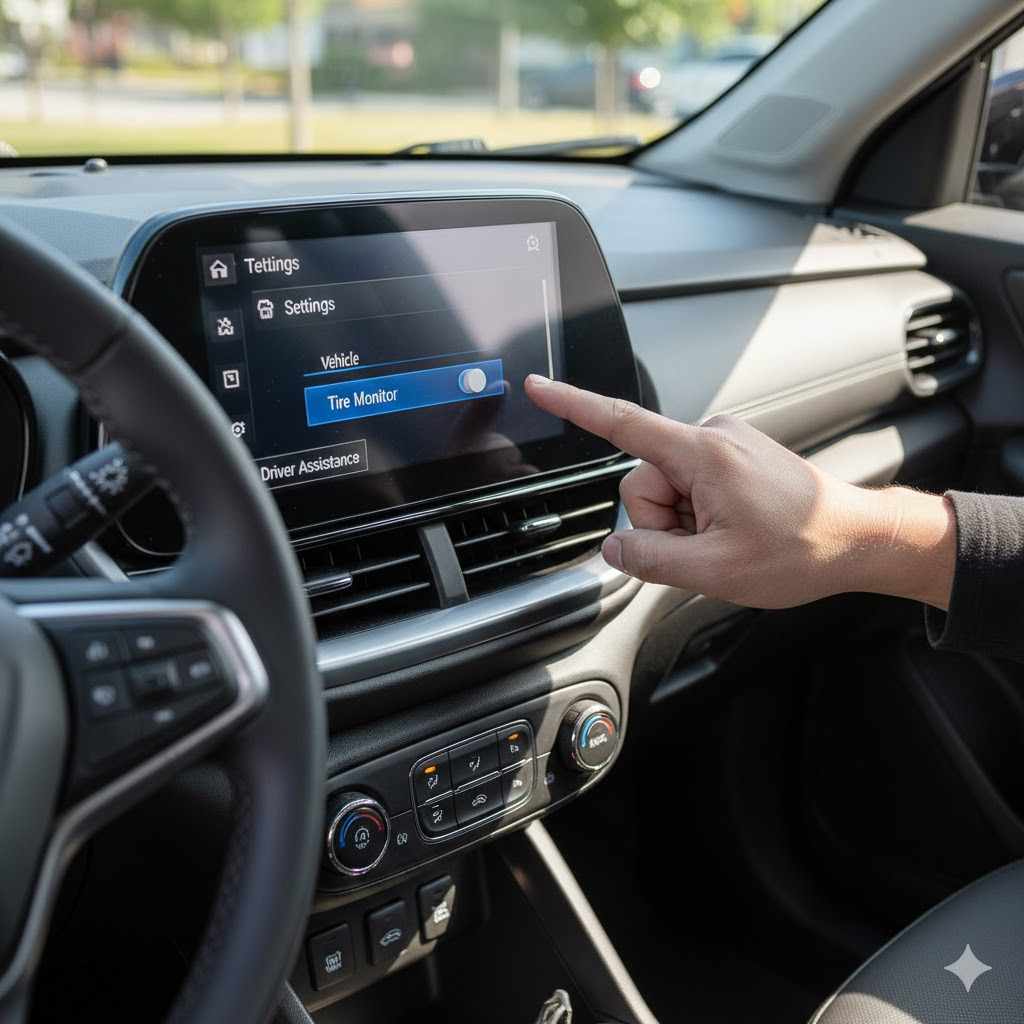
The most modern way to manage your vehicle’s settings, including the TPMS, is through the infotainment system. Your 2026 Chevy Trailblazer LT likely has a touchscreen display that controls many features. To access the TPMS settings, you’ll usually need to go into a menu related to vehicle settings or driver information.
Look for options like “Vehicle,” “Settings,” “Tire Pressure,” or “TPMS.” Once you find the TPMS menu, there should be an option to “Reset,” “Relearn,” or “Calibrate” the system. Selecting this option tells the car to re-evaluate the current tire pressures and turn off the warning light if they are correct.
- Accessing Vehicle Settings
On the infotainment screen, locate the “Vehicle” or “Settings” icon. This is your gateway to many of your car’s customizable features. Tap on it to open a new menu with various categories. - Finding the Tire Pressure Section
Within the vehicle settings menu, look for an option specifically labeled “Tire Pressure” or “TPMS.” Sometimes, it might be under a broader category like “Driver Assistance” or “Vehicle Status.” - Initiating the Reset Procedure
Once you’re in the tire pressure section, you should see an option to perform a reset. This might be called “Reset TPMS,” “Relearn Tires,” or “Calibrate.” Select this option to begin the process. The system will then attempt to recalibrate itself.
Leveraging Steering Wheel Controls
For some vehicles, especially those with slightly less advanced infotainment systems or as an alternative method, you can use the buttons on your steering wheel to reset the TPMS. On your 2026 Chevy Trailblazer LT, you’ll want to look for a set of buttons on the left or right side of your steering wheel. These often include directional arrows, an “OK” button, and possibly a “Menu” button.
You’ll typically use these to scroll through information displayed on your instrument cluster. By cycling through the menus on the instrument cluster, you can find the TPMS option and select it to perform a reset. It’s a bit like navigating a simple computer menu with physical buttons.
Here’s a common sequence:
- Turn your vehicle on, but do not start the engine if possible. This powers up the electronic systems.
- Use the steering wheel buttons to access the vehicle information display on your instrument cluster. This is usually done by pressing a “Menu” or “Scroll” button.
- Navigate through the options until you find “Tire Pressure” or “TPMS.”
- Once you have “Tire Pressure” selected, look for an option to “Reset” or “Relearn.” You might need to press and hold the “OK” button for a few seconds to confirm.
The Tire Relearn Process Explained
The TPMS “relearn” process is essentially how your car’s computer learns the pressure of each tire. When you’ve added air or replaced a tire, the sensors in the wheels transmit their current pressure readings. The car’s computer needs to recognize these new readings.
For a relearn to be successful, all four tires must be inflated to the recommended pressure. After you initiate the reset, you might need to drive your vehicle for a short period, usually a few miles at a moderate speed. This allows the sensors to communicate their data to the car’s central computer and for the system to confirm correct pressures.
This process is vital for the TPMS to function accurately afterward.
- Correct Tire Inflation is Key
Before you even attempt to reset the system, double-check that all your tires are inflated to the pressure recommended by the manufacturer. This information is usually found on a sticker inside the driver’s side doorjamb or in your owner’s manual. The TPMS will not reset properly if the tire pressures are not at the correct level. - Driving for Calibration
After initiating the reset via the infotainment system or steering wheel controls, the system may require a short drive to complete the calibration. This allows the tire pressure sensors to send their updated readings to the car’s computer. Most systems need about 10-15 minutes of driving at speeds above 15 mph. - What If the Light Stays On
If the TPMS light remains on after you’ve followed these steps and driven for a while, it could indicate a more serious issue. This might be a faulty sensor, a problem with the TPMS control module, or a significant air leak that you missed. In such cases, it’s best to visit a qualified mechanic for a thorough inspection.
Troubleshooting Persistent TPMS Lights
Sometimes, even after trying to reset the TPMS, the warning light might stubbornly stay on. This usually points to a problem beyond just low tire pressure. One common issue is a damaged tire pressure sensor.
These sensors are electronic devices and can fail over time, especially if they get hit by road debris or experience extreme temperatures. Another possibility is a leak in a tire that is so slow you might not notice the pressure dropping significantly day-to-day, but the TPMS sensors do. A professional mechanic can use special diagnostic tools to read error codes from the TPMS module, identify which sensor is faulty, or detect subtle leaks.
They can also perform a full system check to ensure everything is communicating correctly.
- Checking Tire Sidewalls for Damage
Take a close look at the sidewalls of all your tires. Look for any visible cuts, bulges, or foreign objects that might be embedded in the rubber. Even a small nick can sometimes lead to a slow leak that the TPMS will eventually detect. - Inspecting Tire Valve Stems
The valve stem is where you add air to your tires. These can sometimes become brittle and crack, or the valve core inside can start to leak. A simple test is to spray a little soapy water on the valve stem; if you see bubbles forming, it’s leaking. - When to Seek Professional Help
If you’ve manually checked tire pressures, topped them up, and reset the TPMS, but the light still persists, it’s time to consult a professional. A mechanic has the tools and expertise to diagnose and repair more complex TPMS issues, such as faulty sensors or wiring problems.
Understanding TPMS Sensor Types and Replacement
Your 2026 Chevy Trailblazer LT uses Tire Pressure Monitoring System (TPMS) sensors that are typically mounted inside each wheel. These sensors are small, battery-powered devices that constantly measure the air pressure within the tire. They then transmit this data wirelessly to the car’s onboard computer.
There are two main types of TPMS systems: direct and indirect. Direct TPMS, which is what your Trailblazer most likely has, uses these internal sensors. Indirect TPMS, on the other hand, uses the Anti-lock Braking System (ABS) wheel speed sensors to infer tire pressure by detecting differences in rotational speed.
A direct TPMS is generally more accurate and provides more detailed information.
Direct TPMS Sensors
Direct TPMS sensors are the heart of your Trailblazer’s tire monitoring. Each sensor is a compact unit containing a pressure transducer, a battery, and a radio transmitter. The pressure transducer measures the air pressure, and if it falls below a certain threshold, the transmitter sends a signal.
This signal is received by a central control module in your vehicle, which then activates the TPMS warning light on your dashboard. The batteries in these sensors have a limited lifespan, typically lasting 5 to 10 years. When a battery dies, the sensor stops transmitting data, and you’ll usually see the TPMS light illuminate.
Replacing a TPMS sensor involves removing the tire from the wheel, which is a job best left to a tire shop or mechanic.
- Sensor Location and Function
The TPMS sensors are located inside each tire, usually attached to the valve stem. They work continuously to monitor the air pressure in that specific tire. - Battery Lifespan and Replacement
The internal battery of a TPMS sensor has a lifespan of about 5 to 10 years. Once the battery dies, the sensor must be replaced. This requires removing the tire from the wheel rim. - Importance of Professional Installation
Replacing TPMS sensors is not a DIY job for most people. It requires specialized tools to remove the tire and often programming or relearning procedures for the new sensors to communicate with your vehicle’s computer.
The Tire Replacement and Sensor Relearn Process
When you get new tires installed on your 2026 Chevy Trailblazer LT, or if a TPMS sensor needs to be replaced, a specific procedure must be followed. After the new tires are mounted and balanced, and any new sensors are installed, the vehicle’s TPMS needs to “relearn” the identity and position of each sensor. This is crucial because the car’s computer needs to know which pressure reading belongs to which tire (e.g., front left, front right).
Your vehicle’s owner’s manual will detail the exact steps for the relearn process, but it often involves using the steering wheel controls or infotainment system to initiate a relearn procedure. You may then need to place a special magnetic tool or follow a specific inflation sequence to prompt each sensor to transmit its ID to the car.
Here’s a general outline of what happens:
- New Tires Mounted and Balanced
The first step is to have your new tires mounted onto the wheels and balanced. If you are replacing TPMS sensors, they are usually installed at this stage. - Initiate TPMS Relearn Mode
Using the vehicle’s controls, you’ll put the TPMS module into a “relearn” or “learning” mode. This tells the car it’s ready to receive new sensor information. - Prompting Each Sensor
With the vehicle in relearn mode, a technician will use a specialized tool or magnetic activator on each wheel, usually near the valve stem. This prompts the TPMS sensor to transmit its unique ID. The car’s computer receives this ID and associates it with that specific wheel position. - Confirmation and Driving
Once all sensors have been recognized, the car will usually confirm the relearn is complete. You may need to drive the vehicle for a short period for the system to finalize the calibration and ensure all pressures are within the correct range.
Understanding Tire Rotation and TPMS
When you rotate the tires on your 2026 Chevy Trailblazer LT, it’s essential to understand how this affects the TPMS. Tire rotation is a maintenance procedure where the front tires are moved to the rear, and the rear tires are moved to the front, often in a specific pattern. The purpose is to ensure even tire wear, extending the life of your tires.
Since the TPMS sensors are located inside each wheel, their position changes during a rotation. After rotating your tires, the TPMS warning light might come on because the car’s computer still recognizes the sensors in their old positions. You will likely need to perform the TPMS relearn procedure we discussed earlier to re-associate the sensors with their new locations.
This ensures the system accurately reports the pressure for each specific wheel position on your vehicle.
- Why Tire Rotation is Important
Tires wear differently depending on their position on the vehicle. Front tires often wear faster due to steering and braking forces. Rotating tires helps to even out this wear, leading to longer tire life and better vehicle performance. - TPMS Recognition After Rotation
When tires are rotated, the sensors move with them. The car’s computer, however, is programmed to expect specific sensors in specific locations. This mismatch often triggers the TPMS warning light after a tire rotation. - Performing a TPMS Reset Post-Rotation
To clear the TPMS light after rotating tires, you must perform the TPMS relearn procedure. This signals the car’s computer to recognize the sensors in their new positions and recalibrate the system to reflect the current tire layout.
When You Might Want to Turn Off The Tire Monitoring System Temporarily
While the TPMS is a crucial safety feature designed to remain active, there are very specific, temporary situations where you might need to bypass its warnings or reset it. For example, if you are intentionally running tires at very low pressure for off-road use, the TPMS light will constantly illuminate. In such off-road scenarios, it’s vital to have a method to reset the system after adjusting tire pressures.
Another situation could be if you have a faulty TPMS sensor that is consistently giving false readings and you need to temporarily silence the warning light until you can get it fixed. It’s important to remember that turning off or ignoring the TPMS light when you have actual low tire pressure is dangerous and should be avoided.
Off-Roading and Tire Pressure Adjustments
For enthusiasts who take their 2026 Chevy Trailblazer LT off the beaten path, adjusting tire pressure is often necessary. Lowering tire pressure can increase the tire’s contact patch with the ground, providing better traction on surfaces like sand, mud, or rocks. When you lower the tire pressure, the TPMS will detect this change and illuminate the warning light.
If you’re engaging in off-road activities where specific tire pressures are required for performance and safety, you will need to reset your TPMS after making these adjustments. It’s a temporary measure for specific driving conditions, and it’s critical to remember to reset the pressures and the TPMS back to normal road specifications once you return to paved surfaces.
- Optimizing Traction Off-Road
Lowering tire pressure allows the tire to conform more to the terrain, increasing the contact area. This significantly improves grip and control on challenging off-road surfaces like soft sand or slippery mud. - The TPMS Warning During Off-Roading
As soon as you deflate your tires for off-road use, the TPMS light will activate. This is normal behavior for the system. It’s alerting you that the tire pressures are outside the recommended range for regular driving. - Resetting After Off-Road Adventures
Once you’re finished off-roading and have reinflated your tires to the correct road pressure, you’ll need to perform the TPMS reset procedure. This clears the warning light and ensures the system is accurately monitoring your tire pressure for safe driving.
Dealing With Temporary Spare Tires
When you encounter a flat tire, you might have to use a temporary spare tire. These are often smaller and designed only for short-distance, low-speed travel to get you to a repair shop. Temporary spare tires typically do not have TPMS sensors installed in them.
Consequently, when you install a temporary spare, the TPMS light on your dashboard will illuminate and stay on because the system cannot detect a sensor in that wheel. This is normal and expected behavior. The light will remain on until you
- Functionality of Temporary Spares
Temporary spare tires, often called “donuts,” are smaller and lighter than regular tires. They are designed for emergency use only and have strict speed and distance limitations. - Lack of TPMS Sensors in Spares
Most temporary spare tires do not come equipped with TPMS sensors. This is a cost-saving measure and is also because they are not intended for long-term use. - TPMS Light Illumination with Spare
Because there’s no sensor in the temporary spare, your vehicle’s TPMS will detect this absence and display the warning light. This is not an indication of a problem with your temporary spare, but rather the system’s normal response.
When a Faulty Sensor Causes Constant Illumination
If you’ve checked your tire pressures, ensured they are correct, and even performed the reset procedure multiple times, but the TPMS light continues to stay on, it’s highly probable that one of your TPMS sensors is faulty. A malfunctioning sensor can send incorrect data or no data at all to the car’s computer, leading to a persistent warning light. In this scenario, the best course of action is to have the TPMS system diagnosed by a professional.
They can identify which sensor is not working correctly,
- Identifying a Faulty Sensor
If all tires are properly inflated and the TPMS light still illuminates, a faulty sensor is a likely cause. The system is designed to alert you to issues. - The Need for Professional Diagnosis
Mechanics use specialized diagnostic tools that can communicate directly with the TPMS control module. This allows them to read specific error codes that pinpoint which sensor is causing the problem. - Repairing vs. Ignoring Faulty Sensors
Ignoring a faulty TPMS sensor means you lose a key safety feature. It’s important to get it repaired or replaced so that the system can alert you to actual tire pressure problems in the future.
Safety and Legal Considerations
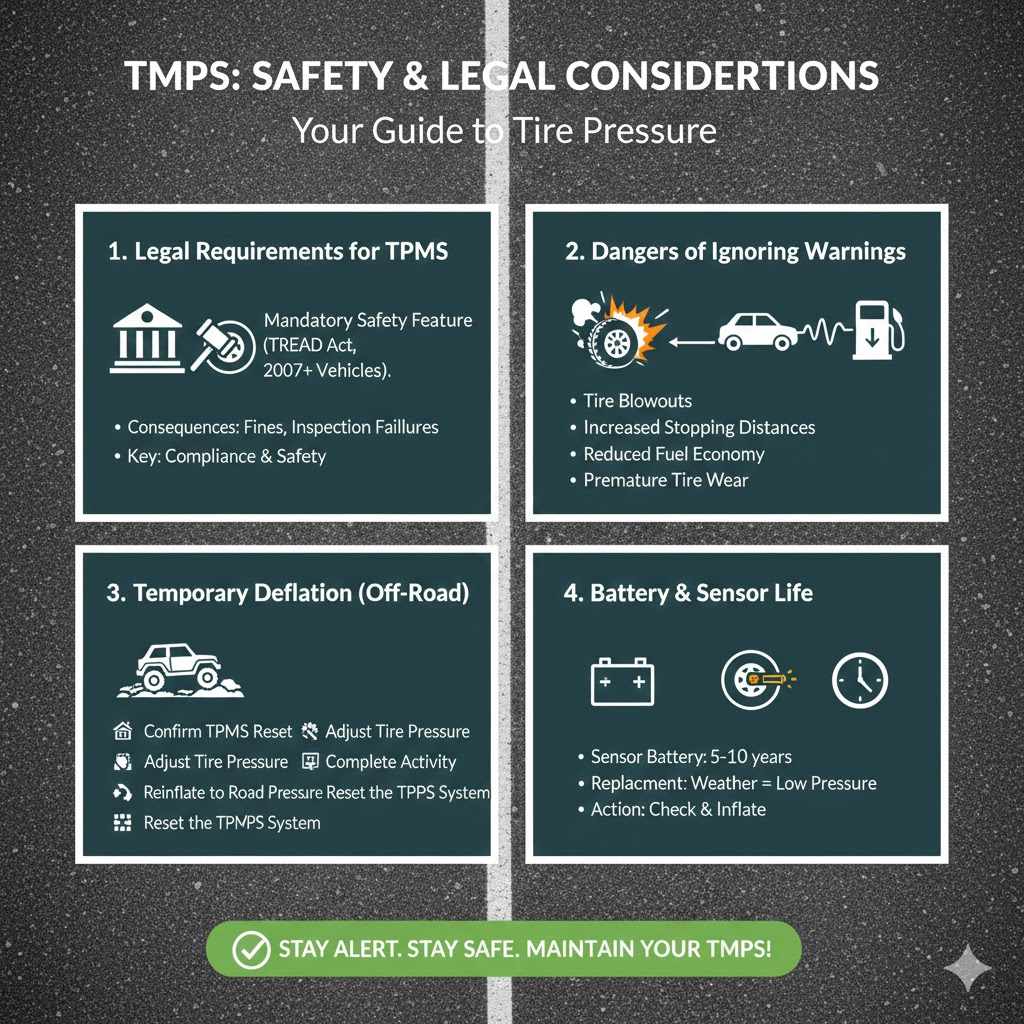
The Tire Pressure Monitoring System (TPMS) is more than just a convenience; it’s a critical safety feature mandated by law in many regions. Its primary purpose is to alert drivers to dangerous underinflation, which can lead to tire blowouts, reduced vehicle control, and increased stopping distances. In the United States, for example, the TREAD Act mandated TPMS on all new passenger vehicles manufactured after September 1, 2007.
Ignoring or attempting to permanently disable your TPMS can have serious consequences. It not only compromises your safety but can also lead to issues during vehicle inspections or if you are involved in an accident. Always prioritize addressing the underlying cause of a TPMS warning light rather than simply trying to turn it off.
Legal Requirements for TPMS
Governments worldwide recognize the safety benefits of TPMS. In the United States, the Federal Motor Vehicle Safety Standard (FMVSS) No. 138 requires that all new light vehicles sold after September 1, 2007, be equipped with a TPMS.
This system must be able to detect underinflated tires and alert the driver within 20 minutes of driving. Similar regulations exist in Europe and other major automotive markets. These laws are in place to reduce accidents caused by tire failures.
Tampering with or disabling a required safety system like TPMS can result in fines or prevent your vehicle from passing safety inspections. It’s important to keep your TPMS functioning correctly.
- Mandatory Safety Feature
TPMS is a legally required safety component on most modern vehicles, ensuring drivers are alerted to potentially dangerous tire underinflation. - Consequences of Disabling TPMS
Attempting to permanently disable a mandated safety system like TPMS can lead to legal penalties and vehicle inspection failures. - Ensuring Compliance
Keeping your TPMS in working order is not just about safety; it’s also about ensuring your vehicle complies with all relevant automotive regulations.
The Dangers of Ignoring TPMS Warnings
Ignoring a lit TPMS warning light can have severe repercussions. Underinflated tires generate excess heat, which can lead to tire degradation and sudden blowouts, especially at higher speeds. This loss of control can be catastrophic, leading to serious accidents.
Furthermore, driving on underinflated tires significantly increases your braking distance, meaning it will take longer to stop your vehicle in an emergency. Fuel efficiency also suffers, as tires with low pressure create more rolling resistance, making your engine work harder and consume more fuel. Lastly, uneven tire wear will occur, leading to premature tire replacement costs.
The TPMS is your early warning system for these issues.
Key risks include:
- Tire Blowouts
Underinflated tires overheat and can experience a sudden, dangerous blowout, leading to loss of control. - Increased Stopping Distances
Low tire pressure negatively impacts your vehicle’s ability to stop quickly, particularly in emergencies. - Reduced Fuel Economy
Operating on underinflated tires forces the engine to work harder, decreasing your miles per gallon. - Premature Tire Wear
Uneven pressure distribution causes tires to wear out much faster, leading to costly replacements.
When Temporary Deflation is Necessary
In rare instances, intentionally deflating tires might be necessary for specific driving conditions, such as extreme off-roading or when using a tire pressure regulation system designed for such environments. If you find yourself in a situation where you are intentionally lowering tire pressures below the TPMS threshold for a temporary period, it is critical to follow a safe procedure. This involves first confirming that your vehicle’s TPMS can be reset after pressure adjustment.
After your specialized driving is complete, you must reinflate your tires to the manufacturer’s recommended pressures and then perform the TPMS reset. Failing to do so could lead to a persistent warning light, masking future real issues, or unsafe driving conditions on regular roads.
- Confirm TPMS Reset Capability
Before intentionally deflating tires for off-road use, verify that your vehicle’s TPMS can be properly reset after the pressure adjustments. - Adjust Tire Pressure as Needed
For the specific terrain or situation, lower the tire pressure to gain the necessary traction or performance. - Complete Off-Road Activity
Enjoy your off-road experience while being mindful of the lowered tire pressures and their impact on handling. - Reinflate to Road Pressure
Upon returning to paved surfaces, always reinflate your tires to the manufacturer’s recommended pressure. - Reset the TPMS System
After reinflating, perform the TPMS reset procedure to clear the warning light and ensure accurate monitoring for safe road driving.
Frequently Asked Questions
Question: How do I know if my 2026 Chevy Trailblazer LT’s TPMS needs a reset
Answer: The most common sign is the TPMS warning light illuminating on your dashboard. If you have checked your tire pressures and they are all correct, the light staying on usually indicates the system needs to be reset.
Question: Can I permanently turn off the TPMS on my Trailblazer LT
Answer: It is generally not recommended or easily possible to permanently disable the TPMS. It is a vital safety feature, and attempting to disable it could have legal implications and compromise your safety.
Question: How long does it take for the TPMS light to go off after a reset
Answer: After performing a TPMS reset and ensuring your tires are properly inflated, the light typically goes off within a few minutes of driving, or after the vehicle has been driven for a short distance at a moderate speed.
Question: What should I do if my TPMS light flashes
Answer: A flashing TPMS light usually indicates a system malfunction, such as a faulty sensor, rather than just low tire pressure. You should have your vehicle inspected by a mechanic as soon as possible.
Question: Do I need to reset the TPMS after rotating my tires
Answer: Yes, when you rotate your tires, the TPMS sensors change positions. You will almost always need to perform the TPMS relearn procedure for the system to recognize the sensors in their new locations.
Final Thoughts
Knowing how to turn off the tire monitoring system on your 2026 Chevy Trailblazer LT is mostly about resetting it after ensuring your tires are correctly inflated. Follow the steps using your infotainment system or steering wheel controls. If the light persists, check for tire damage or a faulty sensor, and seek professional help to keep your safety system working perfectly.