If I Disconnect My Car Battery Will It Stay Charged? The Proven Answer
Yes, disconnecting your car battery will help it stay charged for much longer. It stops the slow, constant power drain from your car’s electronics. However, the battery will still lose charge over time due to a natural process called self-discharge. For long-term storage (over a month), using a battery tender is the best way to keep it healthy.
Have you ever left your car sitting for a few weeks, only to return to a dead battery? It’s a frustrating problem we’ve all faced. You might be planning a long vacation or storing a classic car for the winter. This leads to a common question: if you disconnect the battery, will it solve the problem and keep its charge?
I’m Md Meraj, and I’m here to make car care simple for you. The short answer is yes, disconnecting the battery helps a lot, but it’s not a perfect solution. Don’t worry, I’m going to walk you through everything you need to know. We’ll cover why batteries die, how to safely disconnect one, and the best ways to make sure your car starts right up when you need it. Let’s get your battery questions answered!
Understanding Why Your Car Battery Loses Power
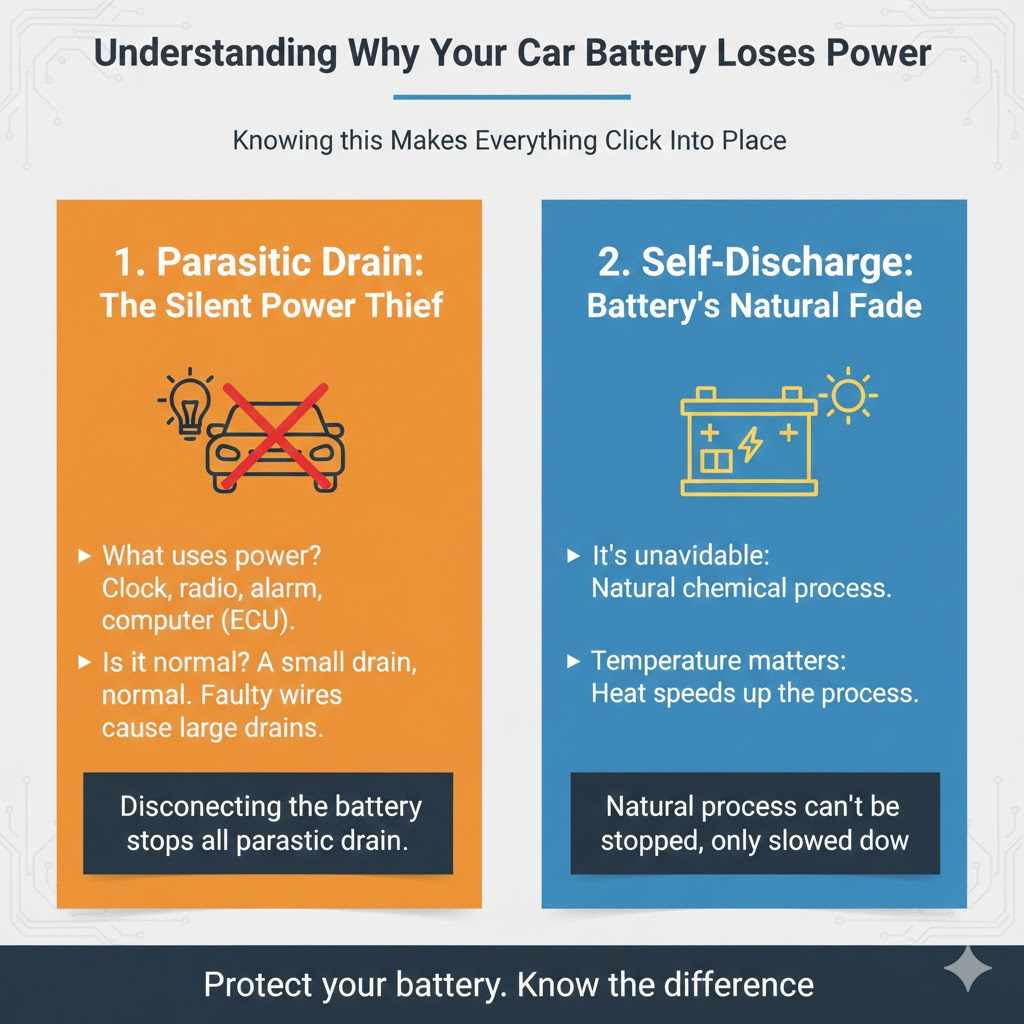
Before we disconnect anything, let’s understand the two main reasons a car battery loses its juice. Knowing this makes everything else click into place.
1. Parasitic Drain: The Silent Power Thief
Even when your car is turned off, it’s not completely asleep. Many electronic components are always drawing a tiny bit of power. This is called parasitic drain.
- What uses power? Your car’s clock, radio presets, security alarm, and onboard computer (ECU) all need a trickle of electricity to remember their settings.
- Is it normal? A small drain is perfectly normal. However, a faulty wire or an aftermarket accessory can cause a much larger drain, killing your battery in just a few days.
Disconnecting the battery completely stops all parasitic drain. It’s like unplugging your toaster from the wall—it can’t use any power if it’s not connected.
2. Self-Discharge: The Battery’s Natural Fade
Every battery, whether it’s in a car or a flashlight, will slowly lose power on its own over time. This is a natural chemical process called self-discharge. You can’t stop it, but you can slow it down.
- It’s unavoidable: The lead plates and acid inside the battery are always in a slow chemical reaction. This reaction causes the battery to gradually lose its charge.
- Temperature matters: Heat speeds up this process. A battery stored in a hot garage will self-discharge much faster than one stored in a cool basement.
So, even a brand-new battery sitting on a shelf will eventually go flat. Disconnecting it from your car protects it from parasitic drain, but it can’t stop the natural process of self-discharge.
How Long Will a Disconnected Battery Actually Stay Charged?
This is the big question! The answer depends on a few key things: the battery’s age, its type, and the storage temperature. A healthy, fully charged battery can last for months when disconnected.
Here’s a simple table to give you a general idea. We’re looking at how long it might take for a fully charged battery to drop to a level where it might struggle to start your car (around 12.4 volts).
| Battery Condition & Temperature | Estimated Time to Lose Significant Charge |
|---|---|
| New Battery (Cool Climate – 50°F / 10°C) | 6 to 9 months |
| New Battery (Warm Climate – 80°F / 27°C) | 3 to 5 months |
| Older Battery (3+ years old) | 1 to 3 months |
| Any Battery (Hot Climate – 100°F / 38°C) | 4 to 8 weeks |
As you can see, heat is the enemy of a stored battery. The cooler the storage place (without freezing), the slower the self-discharge and the longer your battery will hold its power.
Step-by-Step Guide: How to Safely Disconnect Your Car Battery
Ready to disconnect your battery for storage? It’s easier than you think. Just follow these steps carefully. Safety is always number one!
What You’ll Need:
- A wrench or socket set (usually 10mm or 13mm, but check your car)
- Safety glasses
- Gloves
- A clean cloth or wire brush (for cleaning)
The Steps:
- Park on a level surface and turn off the engine. Make sure your car is in “Park” or in gear with the parking brake on. Remove the key from the ignition.
- Open the hood and locate the battery. It’s usually a black box with two posts, or terminals, on top. Some cars have the battery in the trunk or under a seat, so check your owner’s manual if you can’t find it.
- Identify the positive (+) and negative (-) terminals. The positive terminal is often red or marked with a “+” symbol. The negative terminal is usually black or marked with a “-” symbol.
- IMPORTANT: Disconnect the negative (-) terminal first. Use your wrench to loosen the nut on the negative terminal clamp. You don’t need to remove the nut completely, just loosen it enough so you can wiggle the cable off the post. Tuck the cable to the side so it can’t accidentally touch the terminal again.
- Why negative first? Your car’s metal frame is grounded to the negative terminal. If your wrench touches the frame while you’re loosening the positive terminal first, you can create a dangerous spark. By removing the negative cable first, you break the circuit safely.
- Disconnect the positive (+) terminal next. Now, do the same for the positive terminal. Loosen the nut, wiggle the cable off, and tuck it away from the battery post.
- Clean the terminals (optional but recommended). If you see any white or blue fuzzy corrosion, now is a great time to clean it off with a wire brush or a special terminal cleaning tool. This ensures a great connection when you reconnect it.
That’s it! Your battery is now safely disconnected and protected from parasitic drain.
Best Practices for Storing Your Disconnected Battery
If you plan to store your car for more than a month, it’s a good idea to remove the battery completely and store it separately. This allows you to keep it in an ideal environment.
Do’s and Don’ts of Battery Storage
- DO store it in a cool, dry place. A basement or a climate-controlled garage is perfect. Avoid hot attics or sheds.
- DO place it on a piece of wood or plastic. The old belief that concrete floors drain batteries is mostly a myth with modern plastic battery cases. However, it’s still good practice as it keeps the battery clean and off a potentially damp surface.
- DO check its voltage every 1-2 months. Use a simple multimeter to check the charge. A healthy, fully charged 12-volt battery should read around 12.6 volts or slightly higher. If it drops below 12.4 volts, it’s time to give it a charge.
- DON’T let it completely die. Letting a lead-acid battery discharge completely can cause permanent damage and significantly shorten its life.
- DON’T store it near sparks or flames. Car batteries can release flammable hydrogen gas, so keep them away from water heaters, furnaces, or anything that could create a spark.
The Ultimate Solution: Using a Battery Tender
While disconnecting a battery is a good solution for short-term storage, the absolute best way to maintain a battery for months or years is to use a “battery tender” or “smart charger.”
A battery tender is not the same as a regular battery charger. A standard charger pushes a lot of power into the battery to charge it quickly, but it can overcharge and damage the battery if left connected too long. A tender is different.
- It’s smart: It monitors the battery’s voltage.
- It provides a slow, trickle charge: It only gives the battery a tiny bit of power when it needs it to counteract self-discharge.
- It prevents overcharging: Once the battery is full, the tender automatically shuts off or switches to a “float” mode.
Using a tender means you don’t have to disconnect your battery at all. You just connect the tender’s leads to your battery terminals, plug it in, and forget about it. It’s the safest and most effective way to guarantee your battery is healthy and ready to go. The Department of Energy often discusses battery technology, highlighting how proper maintenance is key to longevity for all types, from traditional lead-acid to modern lithium-ion.
Disconnecting vs. Using a Tender: Which is Right for You?
| Scenario | Disconnecting Battery | Using a Battery Tender |
|---|---|---|
| Storing for 2-4 weeks | Good option. Simple and free. | Excellent option. Set it and forget it. |
| Storing for 1-6 months | Okay, but requires checking voltage and occasional recharging. | Best option. Keeps battery at peak health automatically. |
| Storing for 6+ months or in a very cold climate | Not recommended. Risk of deep discharge and damage is high. | Essential. The only way to ensure battery survival. |
| Convenience | Requires tools and manual steps. Resets car settings. | Very convenient. No tools needed after initial setup. |
What Happens When You Reconnect the Battery?
When it’s time to get your car back on the road, reconnecting the battery is simple. You just reverse the process: connect the positive (+) terminal first, then connect the negative (-) terminal last.
Once you start your car, you might notice a few things:
- Your radio stations and clock will be reset.
- The engine might idle a little roughly for the first few minutes.
- Your automatic windows may need to be reset.
This is all perfectly normal! The car’s main computer (ECU) has lost its short-term memory and needs to “relearn” things like the ideal idle speed and fuel mixture. Just drive your car for about 10-15 minutes, and everything should return to normal on its own.
Frequently Asked Questions (FAQ)
1. Will disconnecting the car battery reset the computer?
Yes, it will reset some of the computer’s short-term memory, like your radio presets, clock, and engine idle settings. However, it won’t erase the main programming or important things like your odometer reading.
2. Can I just disconnect the negative terminal for storage?
Absolutely. Disconnecting only the negative terminal is enough to break the circuit and stop all parasitic drain. It’s a quick and effective way to protect your battery for short-term storage without removing both cables.
3. How often should I start my car to keep the battery charged?
Just starting your car and letting it idle for 10 minutes isn’t enough; in fact, it can drain more power than the alternator replaces. You need to drive the car for at least 20-30 minutes at normal speeds to give the battery a meaningful charge.
4. Is it really bad to let a car battery die completely?
Yes, it’s very bad for a standard lead-acid car battery. Each time it’s fully drained, sulfate crystals build up on the internal plates, which reduces its ability to hold a charge. Doing this a few times can permanently ruin the battery.
5. What voltage is a fully charged car battery?
A healthy, fully charged 12-volt car battery should read between 12.6 and 12.8 volts when the engine is off. If it reads 12.4 volts, it’s about 75% charged. Below 12.2 volts, it’s getting low and may struggle to start your car.
6. Does cold weather drain a disconnected battery faster?
This is a common misconception. Cold weather actually slows down the chemical reaction of self-discharge, so a disconnected battery will hold its charge longer in the cold. However, cold temperatures also reduce the battery’s available power, making it much harder to start a cold engine.
7. Can I use a regular battery charger instead of a tender for storage?
It’s not recommended. A regular charger is designed for rapid charging and can overcharge and “cook” your battery if left connected for days or weeks. A battery tender is specifically designed for long-term maintenance with a low, smart charge.
Conclusion: Your Battery Is in Your Hands
So, let’s circle back to our original question: if you disconnect your car battery, will it stay charged? The proven answer is yes—it will hold its charge much, much longer than if it were left connected. By disconnecting it, you eliminate the parasitic drain from your car’s electronics, leaving only the slow, natural process of self-discharge.
For storage of up to a month, simply disconnecting the negative terminal is a great, easy solution. For anything longer, investing in a quality battery tender is the wisest choice. It’s a small cost that protects a much more expensive battery and guarantees your car will be ready to go whenever you are.
Car care doesn’t have to be complicated. With a little knowledge and a few simple steps, you can save yourself the headache of a dead battery and keep your vehicle in top shape. You’ve got this!