What Is the Standard Car Cup Holder Diameter
There is no single standard car cup holder diameter; many measure about 2.6 to 3.1 inches across, though some are smaller or larger. Pick the wrong insert and it can rock, tilt, or bind in the console. This guide shows how to measure your cup holder and match it to an expander or insert.
Actual cup holder opening sizes and fit ranges
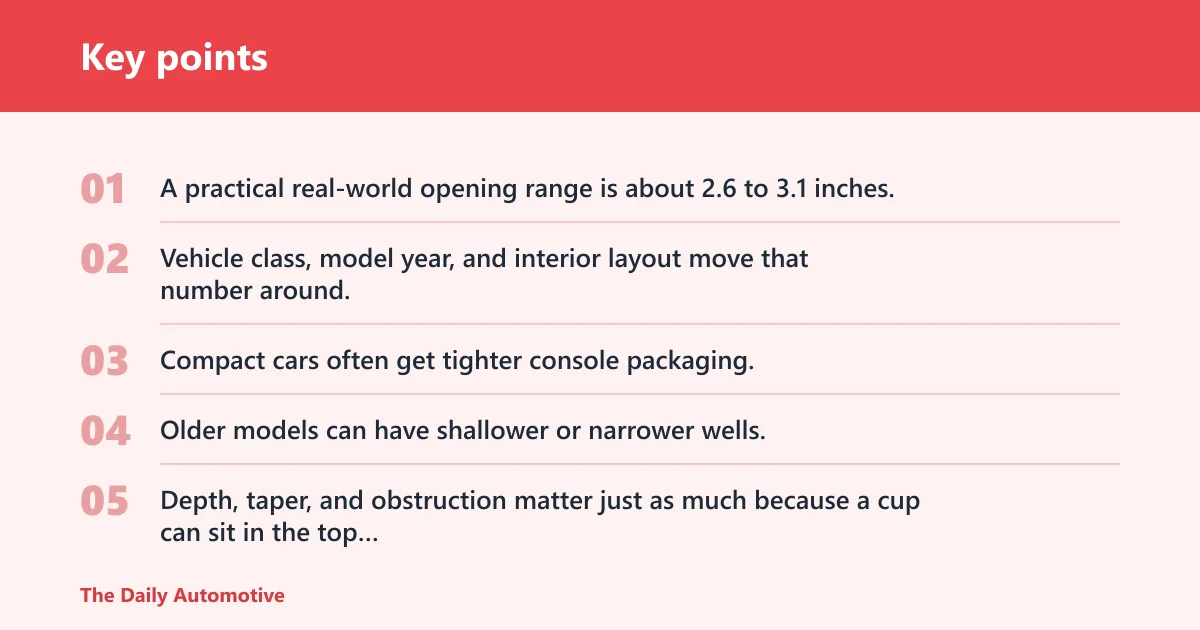


There is no universal factory size. A practical real-world opening range is about 2.6 to 3.1 inches, or roughly 6.6 to 7.9 centimeters, though usable space can be smaller once trim, taper, or side walls are counted. Vehicle class, model year, and interior layout move that number around.
Compact cars often get tighter console packaging, while trucks and larger SUVs may leave more room for wide mugs and bottles. Older models can have shallower or narrower wells, and some newer designs use offset or oval openings to fit center-console controls.
| Opening diameter | Approx. centimeters | Likely fit | Need an expander? |
|---|---|---|---|
| 2.2 to 2.5 inches | 5.6 to 6.4 cm | Small cans, slim bottles, narrow travel cups | Usually yes for most mugs and tumblers |
| 2.6 to 3.1 inches | 6.6 to 7.9 cm | Many standard bottles and medium tumblers | Maybe, depending on depth and shape |
| 3.2 to 3.4 inches | 8.1 to 8.6 cm | Most commuter bottles and some handled cups | Only for oversized drinks or wobble control |
| 3.5 to 4.0 inches | 8.9 to 10.2 cm | Wide tumblers, large insulated cups, some handled mugs | Often no, unless the holder is shallow or irregular |
Opening size is only part of the fit story. Depth, taper, and obstruction matter just as much because a cup can sit in the top opening and still wobble at the base.
Vehicle type changes the number
Small sedans and hatchbacks often use tighter console cutouts. Crossovers, full-size SUVs, vans, and pickup trucks usually have more room, but the opening can still be irregular because of shifters, storage lids, or dual-holder layouts. There is no rule that one class uses one diameter.
A common first-timer mistake is measuring the visible ring and ignoring the inside walls. A cup holder that looks “big enough” at the top can pinch a bottle lower down and leave it unstable.
How do you measure your cup holder?
Measure the inside opening, not the trim ring. Then check depth and shape, because a round top with a tapered well can accept a bottle differently than a straight-sided opening of the same width. A tape measure or calipers both work.
- Measure the inside diameter across the narrowest usable point.
- Measure depth from the top lip to the bottom of the well.
- Check for tapers, slots, tabs, or rubber inserts.
- Look for nearby shifter, armrest, or brake interference.
- Match those numbers to the accessory, not the packaging headline.
| What to measure | How to measure it | Why it matters |
|---|---|---|
| Inside diameter | Place a tape measure across the opening at the narrowest point, or use calipers if the shape is irregular | Shows the actual usable width for the cup or insert |
| Depth | Measure from the top lip to the bottom of the holder | Determines wobble control and bottle retention |
| Obstructions | Check for side slots, raised lips, buttons, vents, and console hardware | These can block an expander base or tilt a tall bottle |
Suppose the top opening measures 3.0 inches, but the well narrows to 2.7 inches halfway down. The holder may still work for a slim bottle, yet a wide tumbler can bind before it reaches the bottom. That is why the lower section matters as much as the opening.
What size cup holder expander do you need?
Choose an expander that matches your holder’s inside diameter and leaves room for the bottle width you carry most often. Common adjustable bases are often reported in the roughly 2.5 to 3.9 inch range, and some products may extend wider.
Adjustable base ranges
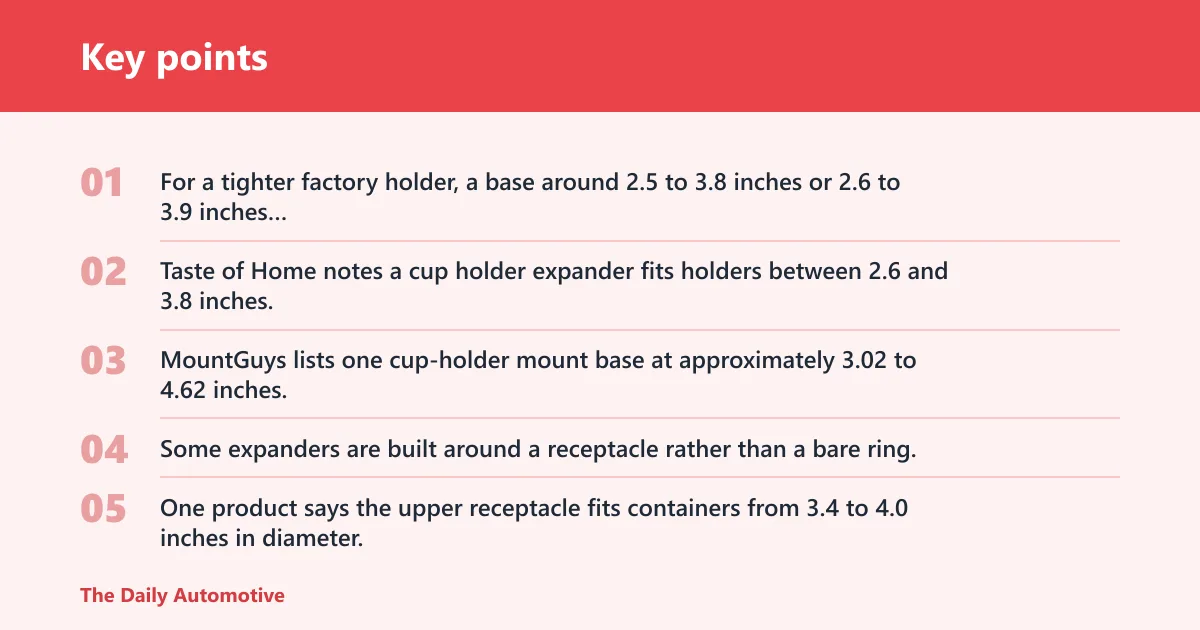
For a tighter factory holder, a base around 2.5 to 3.8 inches or 2.6 to 3.9 inches covers many console openings. Taste of Home notes a cup holder expander fits holders between 2.6 and 3.8 inches. MountGuys lists one cup-holder mount base at approximately 3.02 to 4.62 inches, which is useful when the holder is already wide or irregular.
Bottle and tumbler compatibility
Some expanders are built around a receptacle rather than a bare ring. One product says the upper receptacle fits containers from 3.4 to 4.0 inches in diameter. Jack’s Tire Shop lists a Seven Sparta model that fits 3.4 to 3.8 inch diameter bottles, while another model supports 2.2 to 4.6 inches. RackReveal says one model holds bottles ranging from 16 to 40 ounces.
Stability and retention features
Look for a product with a tight base, a gripping liner, or side support to reduce rattling. Stability features matter because a loose expander can still tip in a corner, even if the diameter looks right on paper. Tool-free installation is common: most versions drop in, twist, or expand by hand.
Check vehicle clearance before buying. A wide adapter can interfere with the shifter, center console lid, parking brake, or armrest, especially in compact interiors. If the holder sits beside those controls, a tall base may fit the diameter and still fail in practice.
Will a 40 oz bottle fit?
A 40 oz bottle may fit in an oversized holder or a suitable expander, but it rarely fits a small factory cup holder without help. Fit depends on the bottle’s actual diameter, the handle style, and how much depth the holder provides. The label size alone does not answer the question.
Many large insulated bottles sit near 3.4 inches or wider at the body, and some handles need extra side clearance. That is why wide-mouth bottle fit often comes down to the holder opening, the shape of the bottle shoulder, and whether the top of the bottle can clear the console.
Thermos-style bottles and handled tumblers can also hit nearby trim before they settle into the well. If the holder is shallow, a long-base expander may help keep the bottle upright by adding lower support. If the holder is deep, the same bottle may sit securely without an adapter at all.
There is no guarantee that a 40 oz bottle fits every vehicle. A 3.0-inch opening can work for some narrow-bodied bottles, while a short and shallow holder may still let the bottle rock side to side. Measure both the holder and the bottle before you buy.
Cup holder shape and clearance
Round openings are easier to size, but many vehicles use oval, offset, or split designs. A non-round holder can squeeze one side of an expander base or block the release tabs on a bottle. That is why shape matters as much as diameter.
Round versus non-round openings
A round cup holder gives the cleanest match. Non-round designs often have one side closer to a shifter, vent, or storage cubby, which reduces usable width. Side-slot bases help in some of those layouts because they can position the bottle a little off-center.
Shifter, armrest, and console conflicts
Even a correct-size insert can fail if the console crowds it. A bottle may strike the gear selector in Park, or a tall tumbler may hit the armrest when the lid is closed. Always check the nearest moving parts before choosing a tall expander.
Deep wells and side-slot designs
Deep wells usually reduce wobble because more of the bottle sits below the lip. Shallow holders do the opposite. Taste of Home notes that a long-base version is recommended if holders are more than 2.75 inches deep, which helps when the drink needs extra lower support instead of only a wider top ring.
Cup holder sizing basics
Use a shallow-holder rule, a deep-holder rule, and an obstruction rule. If the holder is shallow, prioritize a stable base and short overall height. If it is deep, match the expander to the lower well so the bottle cannot rock. If it is obstructed, choose a slimmer or offset design.
Quick rules for shallow holders
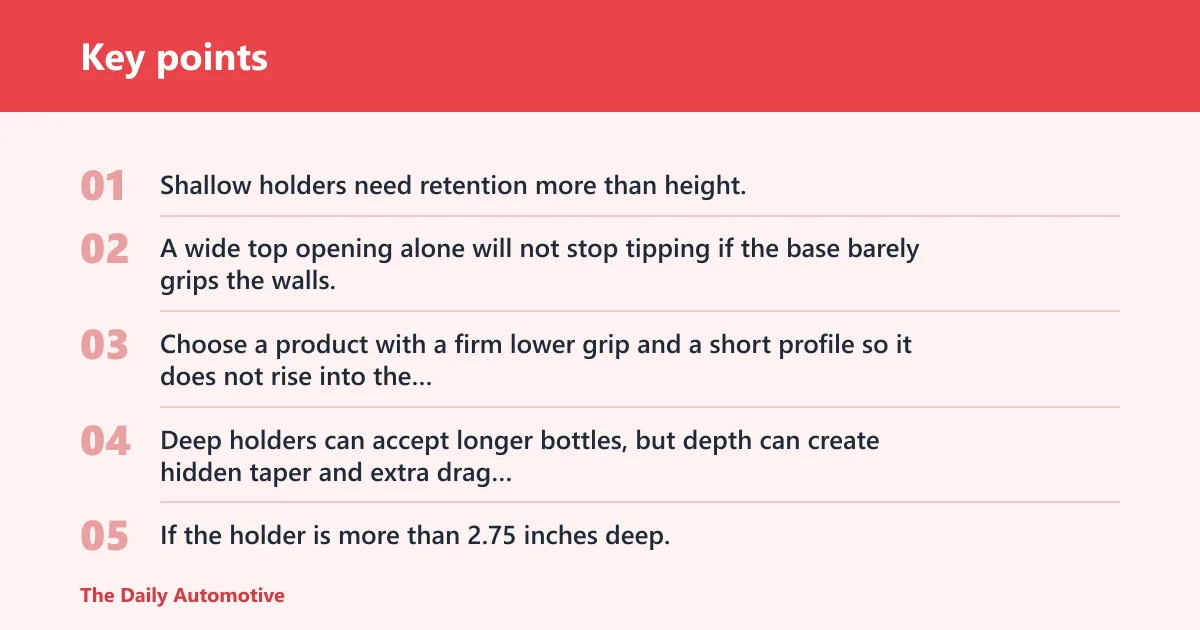
Shallow holders need retention more than height. A wide top opening alone will not stop tipping if the base barely grips the walls. Choose a product with a firm lower grip and a short profile so it does not rise into the shifter or armrest.
Quick rules for deep holders
Deep holders can accept longer bottles, but depth can create hidden taper and extra drag on the sides. If the holder is more than 2.75 inches deep, a long-base version is often the safer choice. It gives the bottle more lower contact and reduces side-to-side movement.
Quick rules for obstructed holders
Obstructions change the fit more than diameter does. If a parking brake, console wall, or seat bolster sits close to the holder, avoid large flared bases. A compact expander or offset mount is usually the better option.
Picture a cup holder that measures 3.2 inches across but sits beside a wide shifter. A standard tumbler may technically fit, yet the handle hits the shifter in Drive. In that case, the better fix is often a narrower base with a taller receiver, not a larger opening.
Frequently asked questions
What is the standard car cup holder size?
There is no single standard car cup holder size. A common real-world range is about 2.6 to 3.1 inches across, but the usable size can shift with trim, taper, and shape. Measure the inside opening rather than the visible ring before buying an insert.
What is the average car cup holder size?
The average car cup holder size is best treated as a range, not one number. Many factory holders land around 2.6 to 3.1 inches in diameter, which works for standard cans and some bottles. Larger insulated drinkware often needs an expander or a wider vehicle-specific holder.
What is the diameter of a standard car cup holder?
There is no universal diameter for a standard car cup holder. A practical everyday range is about 2.6 to 3.1 inches, or roughly 6.6 to 7.9 centimeters. Some vehicles go smaller, and some trucks or SUVs use wider openings.
What size cup holder expander do I need for my car?
Match the expander base to the holder’s inside diameter, then check the bottle width it supports. Common products adjust from 2.5 to 3.8 inches, 2.6 to 3.9 inches, or even 3.02 to 4.62 inches. Make sure nearby controls leave room for the full base and bottle.
Will a 40 oz bottle fit in a standard car cup holder?
Usually not in a plain factory holder. A 40 oz bottle often needs a wider opening, a dedicated expander, or a deep holder with good side support. Bottle diameter, handle clearance, and console space matter more than the ounce rating on the label.
How do I measure my car cup holder diameter?
Use a tape measure or calipers to measure the inside opening at the narrowest usable point. Then measure depth from the top lip to the bottom. Check for taper, side slots, and nearby obstructions, because those can change fit even when the diameter looks right.
What is the standard cup holder size in cars?
There is no single standard cup holder size in cars. Many openings fall around 2.6 to 3.1 inches, but that range is only a starting point. The correct size depends on your vehicle type, model year, holder depth, and whether the opening is round or irregular.
Products related to this article
Sponsored / affiliate links. As an Amazon Associate I earn from qualifying purchases. I may earn additional commission from eligible campaigns.