Why Do Car Chargers Charge Slower: 7 Causes and Fixes
Car chargers slow down when the car, charger, cable, or site cannot accept the same power rate; if power drops after 50–80% state of charge, the battery is usually the reason. Missing that split wastes time and can send you after the wrong fix. This guide shows how to separate battery limits, EVSE or DC charger faults, cable limits, temperature effects, and site load in minutes.
Why is my car charger charging so slowly?


The quickest way to diagnose slow charging is to find the bottleneck first: the car, the charger, or the site. A standard home socket can deliver only 2.3–3.7 kW, a wallbox commonly provides 11–22 kW, and DC fast chargers are listed at 50–150 kW, with ultrahigh-speed units at 150–350 kW.
Start with the three variables that matter most
State of charge, temperature, and equipment rating explain most slow-charge complaints. Above 80%, power usually falls by design. If the pack is cold, the battery management system may limit current. If the station or cable is undersized, the car cannot draw more than the hardware allows.
How to tell whether the car or charger is the bottleneck
The simplest rule is that the weaker component sets the pace. A 150 kW station can still deliver far less if the car accepts only 80 kW, and a capable car will still crawl on a 3.7 kW socket.
Say your EV arrives at a roadside DC station with 18% battery and still shows only modest power. If the battery is cold, the car may be holding back. If two cars are plugged in, the station may be splitting output. If power stays low after a disconnect-and-restart, the dispenser or cable may be the problem.
What charging power you should expect from AC and DC
AC charging is slower by design. A standard socket is fine for overnight top-ups, while a wallbox shortens the wait without changing the fact that AC is still far below DC fast charging. For road trips and transit stops, DC charging is the normal route because the car can accept direct current at much higher power.
📊 Optimal charging temperature is described as 15 to 35 °C. Source: Rychlost Nabíjení Elektromobilů: Klíčové Faktory a Jak je….
Battery state of charge: why charging slows near full
Most batteries charge fastest in the middle of the pack, usually between 10 and 80 percent. Charging slows as the battery nears full because the battery management system tapers current to protect cells and reduce heat. That taper is normal, predictable, and often large enough to double or triple the last part of the session.
Why the 10–80% band is usually the quickest
Fastest charging is usually between 10 and 80 percent. In that range, the pack can take more current without pushing cell voltage too high. Car and Driver says 10 to 90 percent is used for its fast-charging test, and it avoids charging all the way to 100 percent because it is slower near full. (caranddriver.com)
Why power tapers after 80%
Above 80%, the battery has less room to absorb energy safely. The car reduces power to prevent voltage stress and overheating. That taper is why the last 10 to 20 percent often takes far longer than the middle 70 percent, even on a powerful DC charger.
How battery size changes the time you see at the plug
Battery capacity also changes the clock. Larger batteries need more energy, so they usually take longer at the same power level. A 60 kWh battery charged from 10 to 80 percent at 100 kW takes about 30 minutes. The same 40 kWh example at a 22 kW station is about 4 hours.
Does cold weather make car chargers charge slower?
Yes. Cold batteries accept less current, and the car may protect the pack by reducing charge power. Optimal charging temperature is described as 15 to 35 °C, and cold can cut charging speed by 30 to 40 percent. In winter, that slowdown can matter more than charger branding or cable type.
Why cold cells accept less current
Battery chemistry is less receptive when cold. The battery management system monitors temperature, voltage, and current, then cuts charge power to protect cells. If the pack is too cold, the car may limit power even when the station is capable of much more.
The role of preconditioning before DC fast charging
Many EVs can precondition the battery before arriving at a DC fast charger. That warms the pack toward the preferred range, which can restore charging speed that would otherwise be held back by the cold. Without preconditioning, the first part of the session may look disappointingly slow.
When heat can slow charging too
Heat matters as well. If the battery is already hot after highway driving or repeated fast charges, the BMS may trim power to keep cell temperatures within safe limits. The result can look similar to a cold-battery slowdown, but the cause is the opposite.
Home AC, wallbox, public AC, or DC fast: what changes the result?
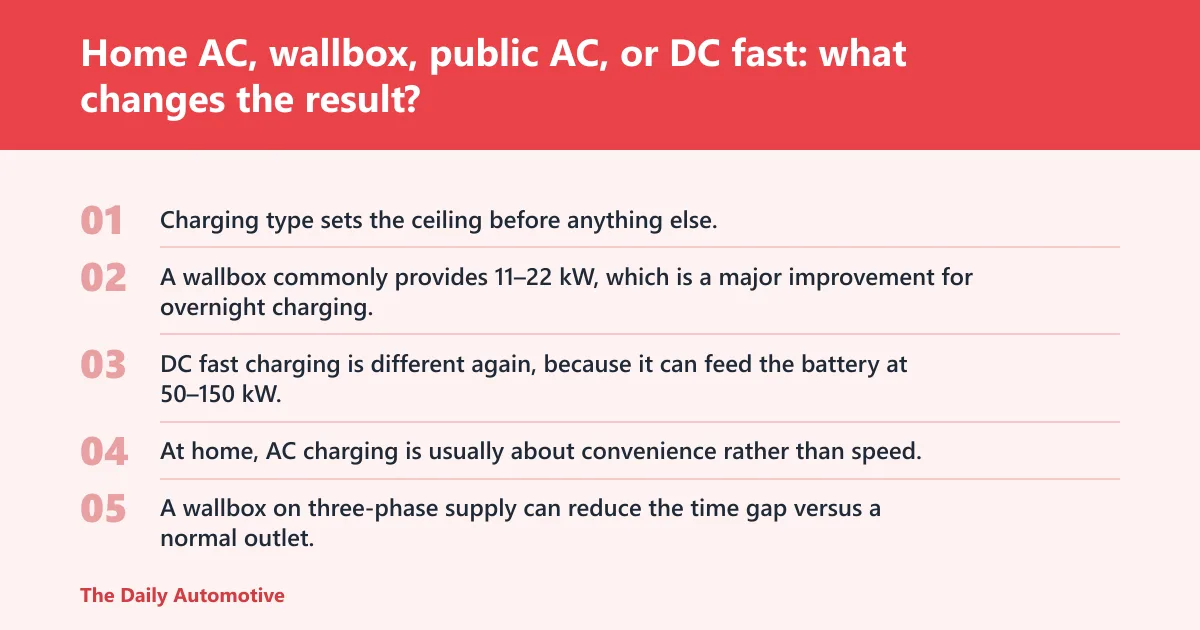
Charging type sets the ceiling before anything else. A standard socket is limited to 2.3–3.7 kW. A wallbox commonly provides 11–22 kW, which is a major improvement for overnight charging. DC fast charging is different again, because it can feed the battery at 50–150 kW, or 150–350 kW on ultrafast units.
Standard socket charging versus three-phase wallbox charging
At home, AC charging is usually about convenience rather than speed. A wallbox on three-phase supply can reduce the time gap versus a normal outlet, but it still depends on the car’s onboard charger and the home electrical setup. If the vehicle accepts only limited AC power, the wallbox rating will not change that.
Why 50–150 kW is normal on many DC chargers
DC fast chargers are listed at 50–150 kW because that range matches many public sites, road-trip stops, and transit locations. For many drivers, that is enough to recover meaningful range during a short break. It is also why the same session can feel fast in one car and ordinary in another.
Why 150–350 kW units still may not deliver that much to your car
A 350 kW dispenser does not guarantee 350 kW at the battery. The station, cable, connector, and vehicle all have limits. If the car’s maximum intake is lower, or the battery is too cold or too full, delivered power will fall below the headline rating.
Why is my fast charger only giving low power?
Low DC power usually comes from one of four places: the battery is asking for less, the station is sharing output, the site is capped, or the hardware is faulty. The battery management system can limit intake when the pack is cold, hot, near full, or worn. Shared power and load management can cut output even when the dispenser looks healthy.
How the battery management system limits intake
The BMS monitors temperature, voltage, and current, and it cuts charge power to protect cells. It can limit power when the battery is cold, hot, or worn. Aging also matters: a pack with more wear may not accept peak power for as long as a newer one.
How station load sharing and site caps cut output
Some public stations split power between two cars. At a two-port fast charger, one car can leave the second with half power. Site or grid limits can reduce output too, especially when a location is busy or the utility feed is constrained.
How to spot a weak cable, faulty dispenser, or car-side limit
Look at the pattern. If one stall is slow while the next stall is normal, the dispenser may be weak. If all stalls are slow during peak hours, the site may be load-limited. If the car charges normally elsewhere, the issue is likely in the vehicle or cable handshake, not the network.
Can two cars on the same charger slow each other down?
Yes. Some public stations split power between two cars, and that can cut the available kW for each driver. A second car arriving at a two-port fast charger can halve the first car’s available power, or do the reverse, depending on how the system allocates output.
Shared-power dispensers in plain terms
Shared-power hardware is common on busy sites. It lets operators install more plugs without increasing the site’s maximum electrical feed by the same amount. That helps the network, but it can surprise drivers who expect the full number on the charger label.
How site load management changes the result
Some chargers reduce output when several stalls are active at once. Others cap power based on the site’s peak demand or grid connection. The charger may still look available, but the delivered kW can fall well below the headline figure.
Why does charging take longer at some stations than others?
Different stations deliver different real-world power because the weakest link changes from site to site. A newer charger, a higher-capacity cable, a warmer battery, and a lightly loaded site can all shorten the stop. An older dispenser, a cold pack, or a shared feed can do the opposite.
Station age, cable rating, and local load
Older stations can underperform, especially if maintenance is overdue or the hardware was designed for lower power. Cable rating matters too, because the station cannot deliver more current than the cable can safely carry. Busy times can lower charging speed when the site is managing load across several vehicles.
Battery capacity and the same power level
A larger battery will generally take longer at the same power level because it needs more energy. That is why two cars on the same charger can leave with very different amounts of range added, even if both saw similar peak kW at the start.
Roadside troubleshooting matrix
| Symptom | Most likely cause | How to verify in under 2 minutes | What to do next |
|---|---|---|---|
| Home AC tops out far below expected | Standard socket limit or car onboard charger limit | Check whether the outlet is a 2.3–3.7 kW socket or a 11–22 kW wallbox | Use the wallbox if available; otherwise accept the lower overnight rate |
| Home AC stops early or trips the breaker | Cable, household circuit, or load-sharing limit | See whether other appliances are on the same circuit; look for the charger reducing current | Move to a dedicated circuit or lower the charging setting if the car allows it |
| Public AC charges more slowly than expected | Site load, time limits, or underpowered equipment | Check whether other plugs are occupied and whether the post shares power | Try another post or another site with a higher-rated wallbox |
| DC fast charger gives low power right away | Cold battery or BMS limit | See whether the pack was preconditioned and whether temperature is near the 15 to 35 °C range | Drive a few minutes to warm the pack, then reconnect if the station allows it |
| DC fast power falls sharply after 80% | Normal taper near full charge | Check SOC; if it is above 80%, taper is expected | Leave earlier if trip time matters, and use the faster middle band |
| Two cars on the same fast charger both slow down | Shared power between ports | Look for paired stalls or a display showing reduced output when both plugs are active | Move one car to an unshared dispenser if possible |
| One DC stall is much slower than the next | Faulty dispenser, weak cable, or site cap | Compare the same car on another stall at the same site | Switch stalls or use a different station if the difference remains |
How do I make my electric car charge faster?
Start by charging in the battery’s fastest window, using the right hardware, and avoiding cold, crowded, or near-full sessions. The quickest practical gains usually come from arriving with a low-to-mid SOC, preconditioning before DC charging, and choosing a station that matches the car’s intake rating.
- Arrive between 10 and 80 percent SOC when trip timing matters.
- Precondition the battery before DC fast charging if the car supports it.
- Use a wallbox instead of a standard socket for home charging when possible.
- Check whether the station is sharing power or looks busy.
- Move to another stall if the charger seems capped or defective.
- Stop DC charging earlier on trips if the taper past 80% is wasting time.
A common first-timer mistake is staying plugged in to chase 100 percent at a fast charger. That last stretch is usually the slowest part of the session, so the extra waiting often buys very little usable range.
Frequently asked questions
Why does EV charging slow down after 80%?
Charging slows after 80 percent because the battery management system reduces current to protect the cells as voltage rises. That taper helps battery life and heat control. It is why the last part of a session can take far longer than the middle part, even on a powerful DC charger.
Is 10 to 80 percent really the fastest charging window?
Usually, yes. Fastest charging is usually between 10 and 80 percent because the battery can accept more power before taper starts. Car and Driver’s fast-charging test uses 10 to 90 percent, but it avoids 100 percent because charging slows near full.
Products related to this article
Sponsored / affiliate links. As an Amazon Associate I earn from qualifying purchases. I may earn additional commission from eligible campaigns.