Is 200 000 Miles A Lot For A Car? Proven Answer
Quick Summary: 200,000 miles is high mileage, but it is not an automatic death sentence for a car. With excellent, consistent maintenance, many modern vehicles can easily exceed this milestone. The real answer depends entirely on the car’s history, model reliability, and current condition.
Is 200,000 Miles A Lot For A Car? The Proven Answer You Need
Buying or selling a car often brings up one big, scary number: the odometer reading. Seeing 200,000 miles on the dash can make your heart sink, especially if you are the buyer. Does this mean the engine is about to fail, or the transmission will quit next week? As your trusted guide, I want to put your mind at ease.
This milestone used to be a major red flag, but times have changed! Modern cars are built much better today. This article will break down what 200,000 miles actually means for today’s vehicles. We will look at reliability, what to check for, and how to judge if a high-mileage car is still a smart buy.
Understanding Mileage: What Does That Number Really Mean?
When we talk about car mileage, we are talking about how many times the wheels have turned over, translating to the distance traveled. Think of it like wear and tear on a favorite pair of shoes—the more you walk in them, the flatter the sole gets.
The Old Standard vs. The New Reality
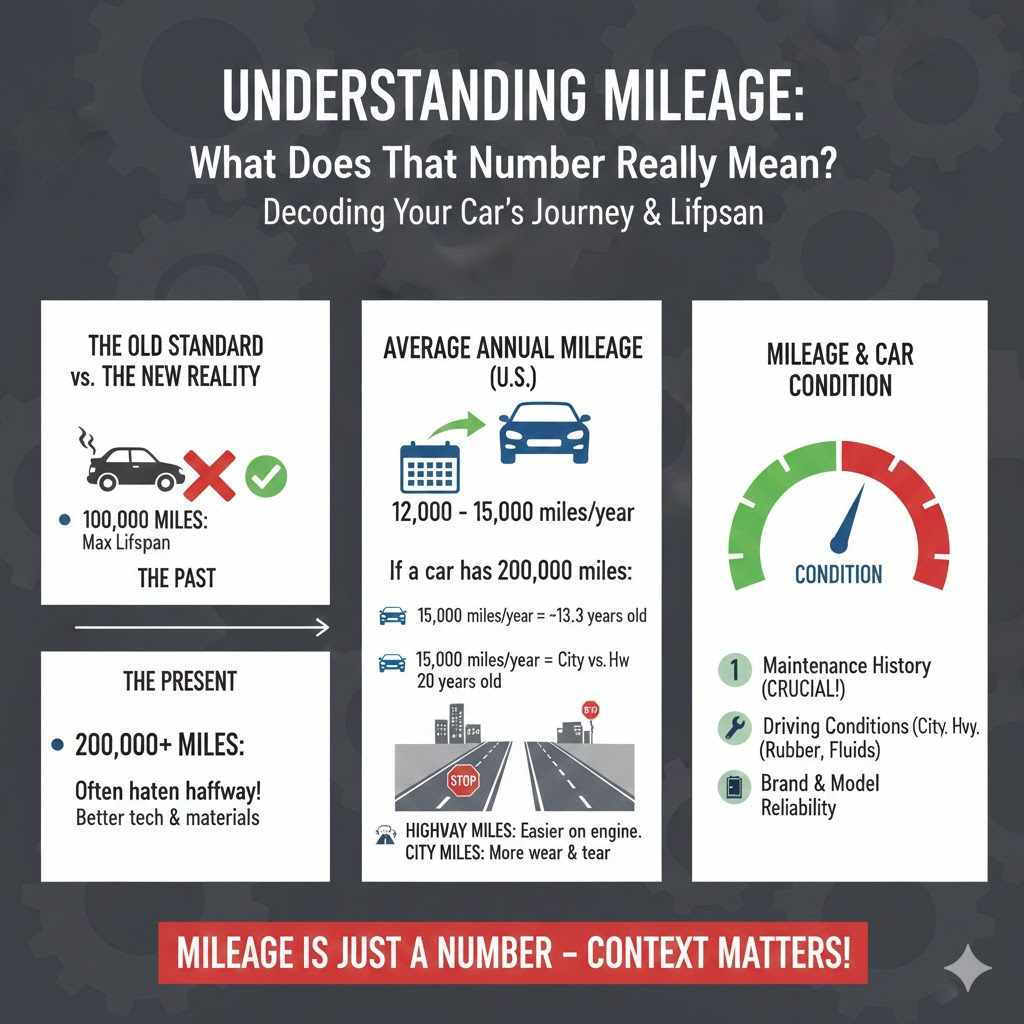
Decades ago, hitting 100,000 miles felt like reaching the finish line. Cars were not as robust, and maintenance schedules were less defined.
The Past: 100,000 miles was considered the maximum lifespan for many mainstream vehicles.
The Present: Thanks to better engineering, synthetic oils, and stronger materials, 200,000 miles is often just the halfway point for well-cared-for cars.
Average Annual Mileage
To put 200,000 miles into perspective, we need to know the average driving habits. In the United States, the typical driver puts about 12,000 to 15,000 miles on a car each year.
If a car has 200,000 miles:
Driven 15,000 miles per year, that car is about 13.3 years old.
Driven 10,000 miles per year, that car is 20 years old.
If the car is only 10 years old and has 200,000 miles, it was clearly driven a lot—perhaps a daily highway commuter or a commercial vehicle. High highway miles are generally easier on the engine than low, stop-and-go city miles.
Is 200,000 Miles A Lot For A Car? The Breakdown
The simple answer is yes, 200,000 miles is high mileage for any used car shopper. However, high mileage is relative to the make, model, and maintenance history.
When 200K Miles Is Too High (The Danger Zones)
Certain car types or specific models struggle to maintain reliability once they pass the 180,000-mile mark without perfect care. These are often cars known for transmission issues, turbo problems, or specific component failures common around this point.
Models with Known Weak Links: Some older models are notorious for expensive repairs (like certain CVT transmissions or specific head gasket designs) that often fail shortly after 150,000 miles.
Poor Maintenance History: If the maintenance records are missing or patchy, 200,000 miles means unknown stresses on the engine and drivetrain.
Luxury Vehicles: High-mileage luxury cars can be deceiving. They might run well, but replacement parts (like air suspension components or complex electronics) are extremely expensive, making repairs costlier than the car is worth.
When 200K Miles Is Perfectly Fine (The Reliable Workhorses)
Many manufacturers design their engines and drivetrains to handle much more. These vehicles are famous for their longevity, often referred to as “indestructible” by enthusiasts.
Toyota and Honda: Models like the Toyota Camry, Honda Accord, and various Toyota trucks are legendary for often hitting 300,000 miles or more with only routine care.
Diesel Trucks: Properly maintained diesel engines (especially heavy-duty trucks) are often just warming up at 200,000 miles.
Well-Maintained Classics: If a car has documented, consistent oil changes every 5,000 miles and all major services completed on time, 200,000 miles is just a number.
The Key Factor: Maintenance, Not Just Mileage
Think of it this way: a meticulously cared-for 200,000-mile car is usually better than a neglected 120,000-mile car. Maintenance history speaks louder than odometer readings. You want proof that the owner invested in preventative care.
What You Must Check When Evaluating a 200,000-Mile Car
If you are seriously considering a vehicle with this much history, you need to be meticulous. This is where basic diagnostic skills or a good mechanic saves you thousands. You are no longer looking for signs of future problems; you are looking for proof that past problems were already fixed.
1. The Maintenance Paper Trail
This is your most powerful tool. Ask for service receipts, oil change stickers, or digital records.
Timing Belt/Chain: If your car uses a timing belt, it must have been replaced around 90,000 to 120,000 miles. If it hasn’t, that huge bill is coming due immediately. Check the service records for this replacement.
Fluids: When was the transmission fluid last changed? Coolant? Brake fluid? These are often skipped by owners trying to save money, leading to major failures later.
Major Tune-Ups: Look for records showing spark plugs, differential fluid changes, and filter replacements.
For more information on when major components should be serviced, you can often consult the manufacturer’s service schedule, which is sometimes available through reliable automotive resource sites like those maintained by the U.S. Department of Energy on vehicle maintenance practices.
2. Engine and Drivetrain Inspection
Listen and feel—the engine should sound smooth and powerful, not rough or shaky.
Startup: Does it start quickly? Does it smoke (blue/white smoke is bad)?
Idle: Does the idle remain steady, or does the car shake when stopped?
Power: During a test drive, accelerate moderately. Does the engine hesitate or feel weak? High mileage can mean worn piston rings, leading to lost compression and power.
Transmission Shift: Automatic transmissions should shift smoothly without hard jerks or slipping (the engine revs high, but the car doesn’t speed up). Manual transmissions should engage easily without grinding.
3. Suspension and Brakes
Wear items on high-mileage cars are often replaced multiple times. You need to see evidence of recent replacement or check the current condition closely.
Shocks and Struts: Drive over a bumpy area. If the car bounces more than twice after hitting a bump, the shocks are likely worn out. Worn suspension components can be uncomfortable and unsafe.
Brakes: Do the brakes feel firm? Does the car pull to one side when you brake? Check the thickness of the brake pads visually if possible.
4. Rust and Body Condition
Rust is the true enemy of any older car. Body rust compromises safety and structure.
Frame Rails: Look underneath the car (safely jacked up, or on a lift) at the main frame pieces. Deep, flaky rust here is often a deal-breaker.
Rocker Panels and Wheel Wells: These areas trap moisture and rust from the inside out. Minor surface rust is cosmetic; major holes are structural damage.
The True Cost of Ownership: Repairs vs. Value
When buying a high-mileage car, you must shift your mindset from “this car is reliable” to “I need a budget for upcoming repairs.” A very cheap 200k-mile car might end up costing you more than a slightly more expensive, better-maintained one.
Table: Expected Maintenance vs. Failure Repairs at 200K Miles
This table shows the difference between predictable, scheduled upkeep and potential catastrophic failures that become more common past 200,000 miles.
| Maintenance Category | Predictable Service (Expected) | Potential Major Failure (Risk) |
|---|---|---|
| Engine | New spark plugs, valve cover gaskets | Head gasket failure, timing chain issues |
| Drivetrain | Transmission fluid flush (if due) | Complete transmission failure |
| Suspension | Replacing worn shocks/struts | Failed control arm bushings, leaking struts |
| Cooling | New water pump, thermostat replacement | Radiator burst, heater core leak |
| Electrical | New alternator or starter (if original) | Complex sensor failures (ECM/TCM) |
The Importance of a Pre-Purchase Inspection (PPI)
If you are serious about a 200,000-mile vehicle, never skip the Pre-Purchase Inspection (PPI). Take it to an independent mechanic you trust—not the seller’s mechanic.
A PPI costs around $100–$200, but it can save you thousands by uncovering hidden transmission wear or serious frame rust. The mechanic will place the car on a lift and check things you simply cannot see in a driveway.
Reliability Ratings: Which Brands Handle 200K Miles Best?
Some vehicles are simply engineered with components designed for longevity. If you see 200,000 miles on one of these, it’s a strong indicator of a solid car.
Top Contenders for High Mileage Success
These brands consistently score well in long-term reliability studies.
1. Toyota: Unmatched reputation for durability, especially their standard four-cylinder engines and conventional automatic transmissions.
2. Honda: Known for robust engines and generally good transmission performance, though some older models had specific transmission weaknesses.
3. Lexus/Acura: The luxury siblings often benefit from the same quality parts as their mainstream counterparts but might have higher repair costs for electronics.
4. Ford (Specific Trucks/V8s): Certain long-running Ford platforms, especially large V8 engines found in F-150s or older Crown Victorias, can go forever if maintained.
Models to Approach with Extreme Caution Over 200K
These vehicles often experience costly, brand-specific failures around or shortly after 150,000–180,000 miles, meaning 200,000 miles might be too late for a budget repair.
Certain German luxury cars (complex electronics).
Vehicles equipped with early versions of Continuously Variable Transmissions (CVTs) from various manufacturers before the technology matured.
Small displacement turbocharged engines that were frequently driven hard.
The Financial Angle: Is It Worth the Risk?
The main reason people buy 200,000-mile cars is the price tag. They are significantly cheaper. But you must calculate the total cost of ownership, not just the sticker price.
The Price Drop Curve
The depreciation curve flattens dramatically after 150,000 miles. A car worth $15,000 at 100k miles might be $7,000 at 180k miles, and only $4,000 at 220k miles. You are paying very little for the miles traveled.
A Simple Cost Comparison
Let’s compare two hypothetical sedans, both reliable models:
| Feature | Sedan A (100,000 Miles) | Sedan B (200,000 Miles) |
|---|---|---|
| Purchase Price | $10,000 | $4,500 |
| Expected Immediate Repairs (Brakes/Tires) | $1,000 | $1,000 |
| Budgeted Repair Fund (Next 12 Months) | $500 | $2,000 |
| Total Initial Investment | $11,500 | $7,500 |
Sedan B is cheaper upfront, but you must accept that you need a larger “Repair Fund” set aside because major components (like the water pump or alternator) are statistically more likely to fail soon. If you do not have that $2,000 buffer, Sedan B is a huge financial risk.
Tips for Extending the Life of Your Own High-Mileage Car
If you currently own a car approaching or passing 200,000 miles, take proactive steps to ensure it keeps going. You can often outrun the average lifespan!
1. Be Religious About Oil Changes
This is the single most important thing you can do. Engine oil keeps moving parts lubricated and clean.
Use the Right Oil: Always use the viscosity (like 5W-30) specified in your owner’s manual. For older, high-mileage engines, switching to a “High-Mileage” specific synthetic blend oil can help seal minor leaks and protect seals.
Frequency: Stick to 5,000 to 7,500 miles, especially if you use synthetic oil. If you drive hard or sit in traffic frequently, change it closer to 5,000 miles.
2. Address Cooling System Health Immediately
Overheating is the fastest way to destroy an engine, especially one that is already running hotter due to age.
Check coolant levels frequently.
Have the thermostat and radiator tested every few years. A $100 thermostat replacement is cheaper than a $4,000 engine replacement.
3. Change Fluids on Schedule (Don’t Skip Them!)
Transmission, brake, and power steering fluids break down over time and absorb contaminants. Fresh fluids dramatically reduce friction and heat in these critical systems. Many drivers skip these because they are expensive, but they are vital insurance policies for high-mileage success.
4. Listen for New Noises
As a car ages, small noises can signal big problems. Don’t ignore a new squeak, groan, or light tapping. Investigate it immediately before it escalates. A $50 belt tensioner replacement can save you from a $500 serpentine belt failure that leaves you stranded.
When to Walk Away From That 200K Car
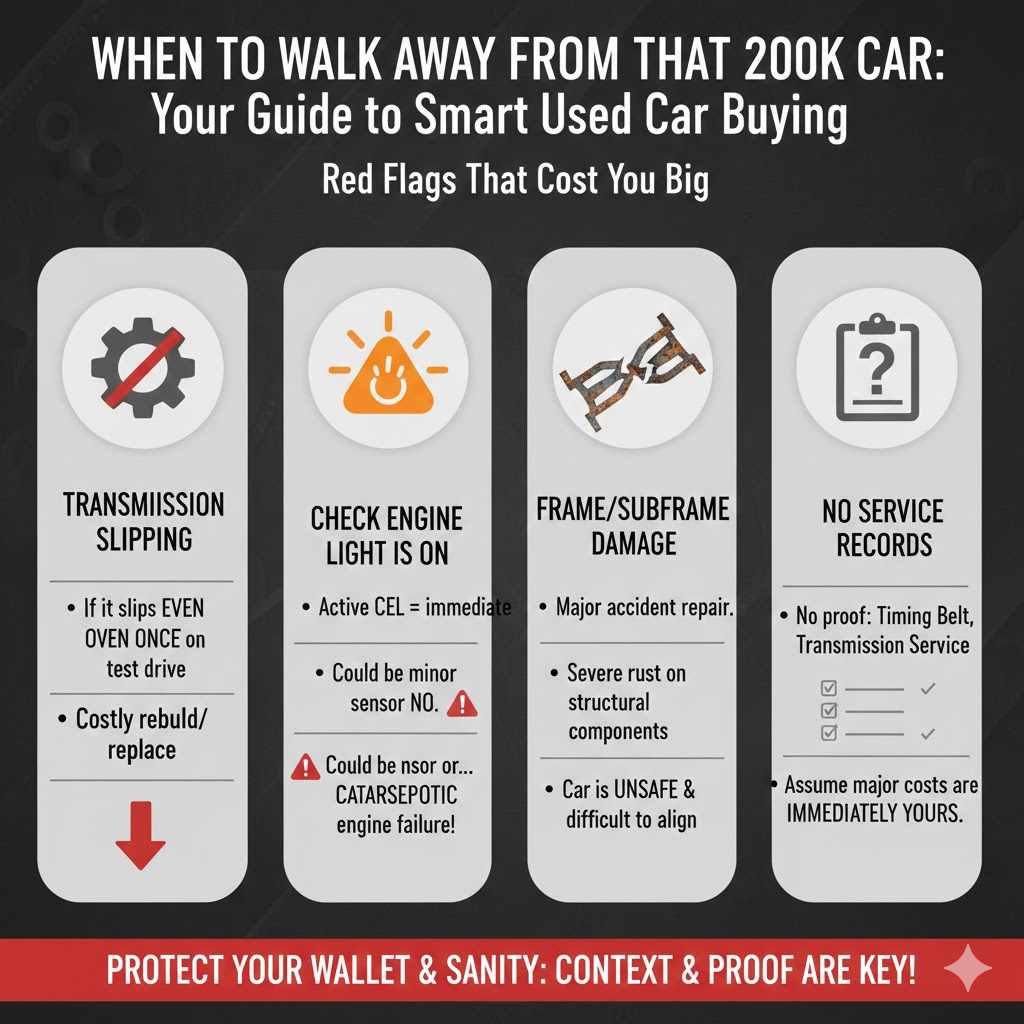
Even the best cars have limits. Knowing when to walk away protects your wallet and your sanity.
Transmission Slipping: If it slips even once during your test drive, walk away. Rebuilding or replacing a transmission usually costs more than the car is worth.
Check Engine Light (CEL) is On: Never buy a car with an active CEL unless the seller agrees to fix it before the sale, and you confirm the fix afterwards. The CEL could signal an expensive sensor, or it could mean catastrophic engine failure. Without diagnosing it, you are guessing.
Frame or Subframe Damage: Evidence of major accident repair or severe rust damage to structural components means the car is unsafe and difficult to align or repair properly.
No Service Records for Major Items: If the seller has no proof the timing belt was done (if applicable) or the transmission service was performed near the recommended interval, assume those major costs are immediately yours.
Conclusion: Confidence in the High-Mileage Market
So, is 200,000 miles a lot for a car? Yes, objectively, it represents significant use. However, thanks to modern engineering, it is no longer a barrier to reliable transportation. The key takeaway for any driver looking at a vehicle with this many miles is this: Mileage is only one piece of the puzzle; history and current condition are everything.**
If you find a 200k-mile Toyota Camry with meticulous oil change records dating back to mile one, it’s likely a fantastic value. If you find a luxury sedan with 200k miles and only vague promises of service, it’s a gamble you should probably avoid. Approach these purchases with an open mind, a healthy budget for potential repairs, and always, always pay for that independent mechanic’s inspection. You absolutely can drive these high-mileage veterans safely and affordably for years to come with smart inspection and ongoing commitment to quality care.
Frequently Asked Questions (FAQ)
Q1: Will my insurance rates increase if my car has 200,000 miles?
Generally, no. Insurance rates are based on the cost to replace or repair the vehicle (its current market value) and your driving history, not the mileage itself. A 200k-mile car is worth less, so the comprehensive/collision coverage cost might be lower, but the basic liability rate remains the same.
Q2: What is the absolute longest a modern car can reasonably last?
While rare, many well-maintained cars easily reach 300,000 miles. Some specific models have proven capable of hitting 400,000 miles or more. The limiting factor is usually corrosion (rust) or a major, catastrophic failure of an expensive component like the engine or transmission, which often happens due to lack of preventative maintenance.
Q3: If I buy a 200k-mile car, should I immediately change all the fluids?
Yes, this is highly recommended, especially if service records are incomplete. At a minimum, perform an oil and filter change immediately. Then, schedule a professional drain-and-fill service for the transmission fluid and check the condition of the coolant. Changing old, dirty fluids is crucial preventive maintenance for high-mileage reliability.
Q4: Are highway miles or city miles better for a car with 200,000 miles?
Highway miles are almost always better. Highway driving keeps the engine operating at optimal temperature, minimizes stop-and-go wear on the transmission, and reduces stress on brake components. A car with 200k highway miles is generally considered healthier than one with 200k city miles.
Q5: What is the biggest difference between a 100k car and a 200k car?
At 100k miles, you are mostly dealing with expected wear items like tires, brakes, and possibly shocks. At 200k miles, you must anticipate dealing with primary mechanical components wearing out—things like the water pump, alternator, radiator, or internal engine wear affecting oil consumption. The cost of repair is potentially much higher.
Q6: Can I finance a car with 200,000 miles?
It is difficult. Many lenders have an internal cap, often between 125,000 and 150,000 miles, for standard auto loans because the collateral (the car) depreciates too quickly. You will likely need to pay cash or secure a personal loan for a vehicle over 200,000 miles.