Is Formula E Car Standardized Across Teams: Expert Explainer
Many people wonder if all the race cars in Formula E are exactly the same for every team. It might seem like a simple question, but it can be a bit tricky to figure out. If you’re new to electric racing, this could be a confusing topic.
Don’t worry! We’ll break it down step by step. Get ready to learn how the cars are made and what makes them unique.
This will help you understand the racing much better.
Formula E Car Standardization Explained
Understanding if Formula E cars are standardized across teams is a common question for fans new to the sport. Many assume that like other racing series, teams build their own cars from scratch. However, Formula E operates on a different model.
This system aims to control costs and focus development on other areas. We will explore the specific parts of the car that are the same for everyone and those that teams can develop themselves. This will give you a clear picture of the balance between standardization and team innovation.
The Shared Chassis And Battery
The core of the Formula E car, its chassis, is a standardized component. This means every team starts with the same basic frame. This chassis is designed to be safe and strong, providing a foundation for all the racing machines.
It is built by a single supplier to ensure uniformity. This approach helps level the playing field, preventing teams with the biggest budgets from having an automatic advantage in the most fundamental part of the car’s structure.
The battery is another critical and standardized element. In Formula E, the high-voltage battery pack is the same for all competitors. This unit stores the energy that powers the electric motors.
Like the chassis, the battery is supplied by a designated manufacturer. This standardization is crucial for safety and for managing the race format. It ensures that all cars have the same energy capacity and discharge rate.
Teams cannot alter the battery itself, focusing their efforts on how they use the energy provided.
This standardization of the chassis and battery is a key feature of Formula E. It allows the series to focus innovation on other areas like powertrain efficiency and aerodynamics. It also helps keep the sport more competitive.
Teams spend less on developing these fundamental parts and more on strategy and driver performance. This makes the racing exciting and unpredictable.
Team-Developed Powertrain Components
While the chassis and battery are the same for all, the powertrain is where teams have room to innovate. The powertrain in an electric race car includes the motor, inverter, and gearbox. Formula E allows teams to develop these components within certain regulations.
This is where the competition heats up, as different designs can lead to performance advantages.
The electric motor converts electrical energy from the battery into mechanical energy to drive the wheels. Teams can design their own motors, aiming for maximum power output and efficiency. Some might focus on a lighter motor, while others prioritize raw power.
The inverter is responsible for managing the flow of electricity from the battery to the motor. This component is also developed by the teams to optimize energy delivery.
The gearbox is another area of development. While many electric cars use a single-speed gearbox, Formula E teams can design their own multi-speed gearboxes. This allows them to tune the gear ratios for different tracks and racing conditions.
A well-designed gearbox can improve acceleration out of corners and top speed on straights. The regulations allow for specific dimensions and weight limits for these powertrain parts, ensuring a balance between innovation and control.
This freedom in powertrain development means that even though the cars look similar on the outside, their performance can vary significantly. Teams invest heavily in R&D to create the most efficient and powerful powertrain. This competition drives technological advancement in electric vehicle technology.
It also makes each team’s car unique in its performance characteristics, despite the standardized base.
Aerodynamics And Bodywork
Aerodynamics plays a vital role in how a race car performs. It affects how the car handles, its speed, and its energy efficiency. In Formula E, the aerodynamic package is also heavily regulated to promote close racing and prevent excessive cost escalation.
The main bodywork, including the front and rear wings, and the floor of the car, are designed by each team. However, these designs must adhere to strict dimensional and performance criteria set by the FIA, the governing body for motorsport. These rules dictate the size, shape, and placement of aerodynamic elements.
The goal is to reduce downforce and drag, making the cars more slipstream-dependent and leading to more overtaking opportunities.
Teams spend a lot of time in wind tunnels and using computational fluid dynamics (CFD) to refine their aerodynamic designs. They aim to generate enough downforce for cornering grip without creating excessive drag that would waste precious battery energy. The specific shapes of the wings and body panels are crucial for managing airflow around the car.
This influences how the car interacts with the air and other cars on the track.
While teams have design freedom, the regulations are designed to ensure that aerodynamic differences are not so vast that they create insurmountable performance gaps. The focus is on clever design within the constraints, rewarding engineering ingenuity. This allows for closer racing and more exciting finishes, as drivers can better utilize slipstreaming to gain positions.
Key Aerodynamic Components
- Front Wing The front wing generates downforce and directs airflow. Teams design these to balance downforce with minimizing drag.
- Rear Wing Similar to the front wing, the rear wing also creates downforce. Its design is crucial for stability at higher speeds.
- Floor And Diffuser The underbody of the car, including the floor and diffuser, manages airflow to create ground effect downforce. This area is tightly controlled by regulations.
- Body Panels The overall shape of the car’s bodywork is also designed by teams. These panels influence cooling and general aerodynamic efficiency.
Each of these components is a subject of intense engineering effort. Teams work to optimize airflow for better grip and reduced energy consumption. The subtle differences in how these parts are shaped can lead to noticeable performance variations on track.
This is a prime example of how innovation happens within the strict framework of Formula E regulations.
Software And Energy Management
Beyond the physical parts of the car, the software and energy management systems are also highly specialized and contribute to team differentiation. While the battery hardware is standard, how teams control and deploy that energy is a major factor in their success.
Each team develops its own software algorithms to manage the flow of energy from the battery to the motors. This includes controlling acceleration, regenerative braking, and power distribution across different parts of the car. Sophisticated software can optimize energy usage lap after lap, extending race distance and improving performance.
Regenerative braking is a key technology in Formula E. When a driver lifts off the throttle or brakes, the electric motor acts as a generator, converting kinetic energy back into electrical energy to recharge the battery. The efficiency and responsiveness of this system are heavily influenced by the software.
Teams strive to maximize the amount of energy recovered without compromising braking performance or driver feel.
The strategic deployment of ‘Attack Mode’ is another area where software plays a huge role. Attack Mode temporarily boosts the car’s power output, but drivers must activate it by driving through a designated zone off the racing line. The software helps drivers manage the timing and duration of Attack Mode usage to gain strategic advantages, often requiring complex calculations to balance the need for extra power against the energy cost.
This development of advanced control software allows teams to extract the maximum performance from the standardized hardware. It is an area where engineering expertise can translate directly into on-track results. The teams that can best manage their energy and optimize their software often find themselves at the front of the grid.
It highlights that racing is not just about hardware, but also the intelligence that controls it.
Tires And Suspension
The tires used in Formula E are supplied by a single manufacturer, Hankook. This means all teams use the same tire compound and specifications. This standardization is crucial for promoting close racing and ensuring that tire wear is a predictable factor across the field.
The focus is on a tire that performs well in various conditions, reducing the need for teams to manage multiple tire types during a race.
The suspension system, which includes components like dampers, springs, and anti-roll bars, is another area where teams have some degree of design freedom. While the fundamental architecture of the suspension might be dictated by the chassis design, teams can tune and develop these components to suit their specific car and driver preferences.
Teams will optimize their suspension settings to match the characteristics of different circuits. For tracks with many bumps or aggressive curbs, a softer suspension might be preferred for better ride comfort and compliance. For smooth, high-speed tracks, a stiffer setup could provide more precise handling and responsiveness.
The goal is to maximize mechanical grip and maintain tire contact with the road surface under all conditions.
The development of suspension components is an ongoing process. Teams constantly seek to improve their car’s handling, braking stability, and acceleration out of corners. This involves detailed analysis of data from previous races and testing.
While they are not starting from scratch with the entire suspension geometry, the ability to fine-tune these elements allows for performance differentiation.
Suspension Development Focus
- Dampers Teams can develop and adjust dampers to control the rate at which the suspension compresses and rebounds. This affects ride quality and tire behavior.
- Springs Different spring rates can be used to manage the car’s ride height and body roll. Teams select springs to optimize balance between grip and responsiveness.
- Anti-Roll Bars These bars help reduce body roll during cornering. Teams can adjust their stiffness to fine-tune the car’s balance.
- Linkages And Geometry While the basic mounting points are often fixed by the chassis, teams can optimize the geometry of suspension linkages for specific track needs.
The fine-tuning of suspension and tires is a critical aspect of race preparation. It allows teams to adapt their cars to the unique demands of each circuit. This attention to detail, even within a regulated framework, is what separates the top contenders from the rest of the field.
It’s a perfect example of how marginal gains are sought in motorsport.
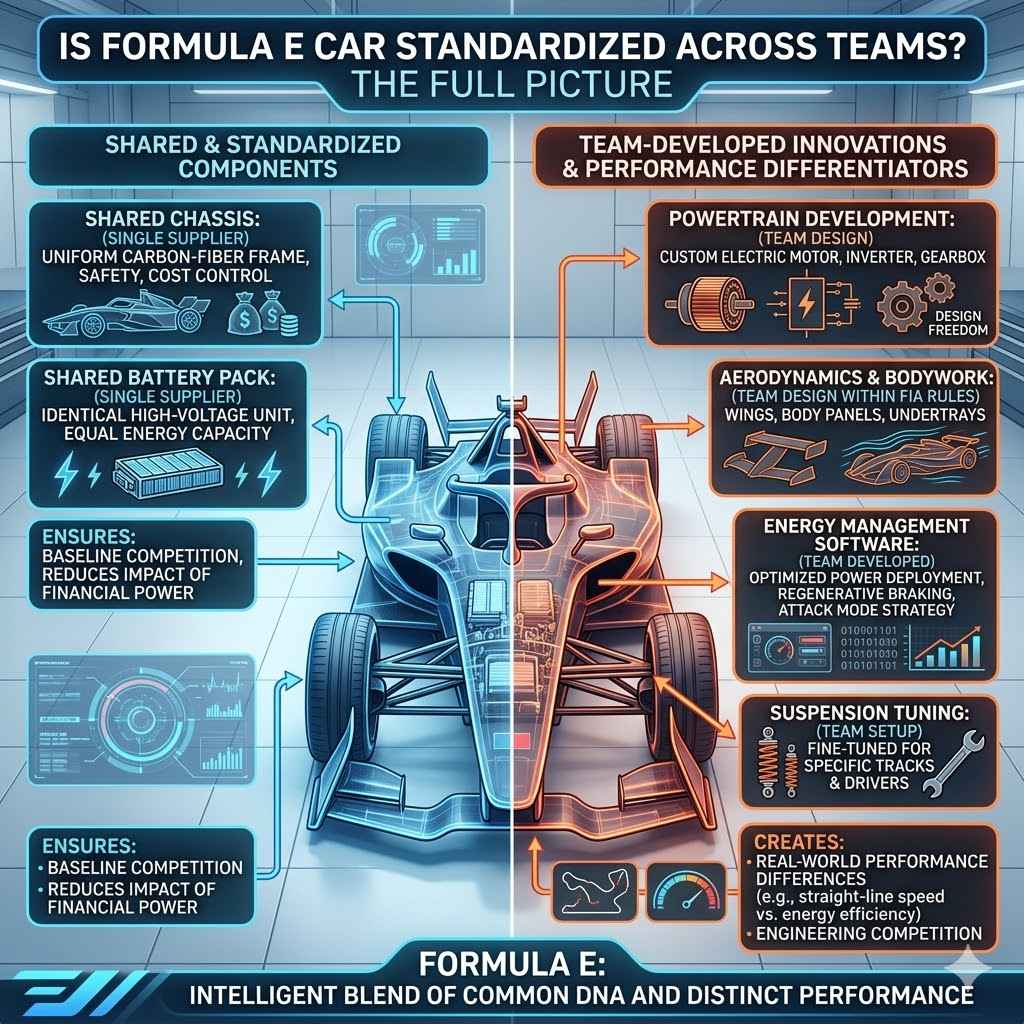
Is Formula E Car Standardized Across Teams? The Full Picture
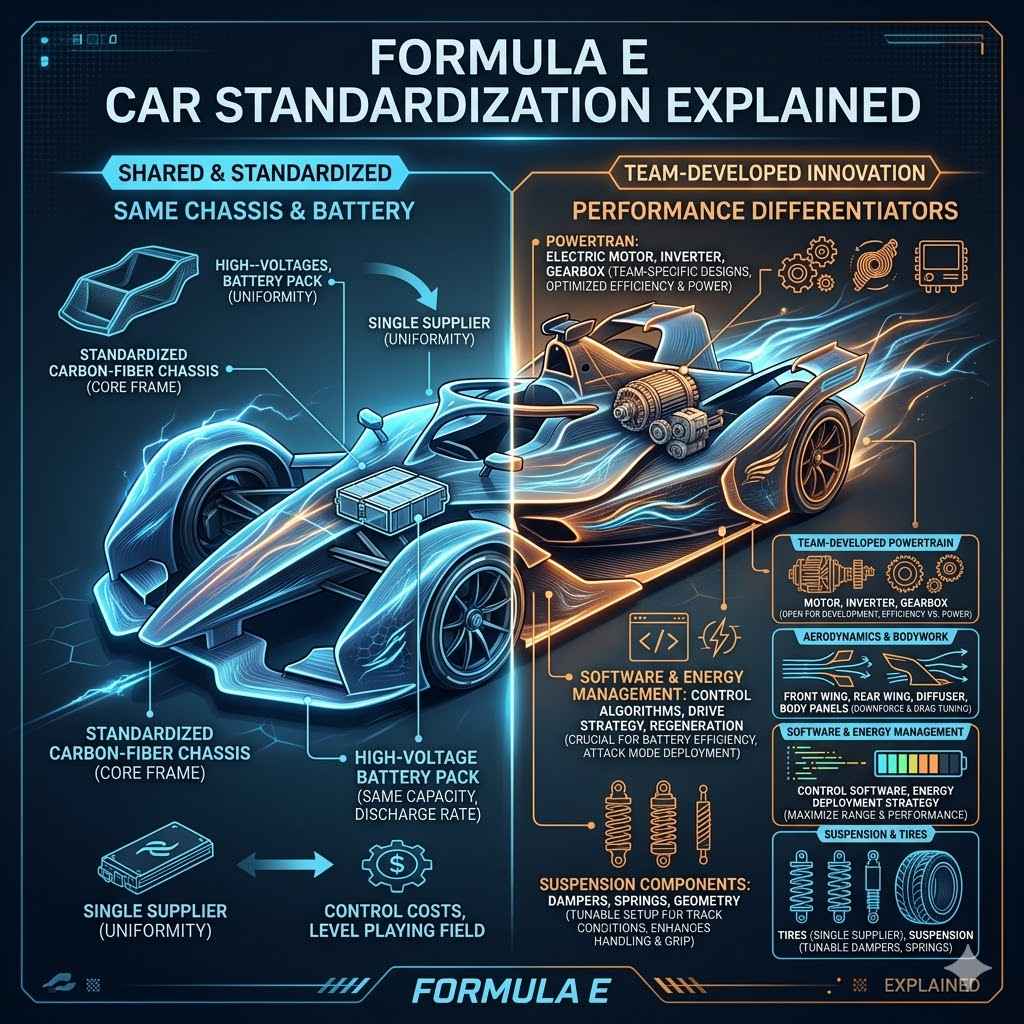
So, to directly answer the question: Is Formula E car standardized across teams? The answer is nuanced. Formula E employs a dual approach.
A significant portion of the car, including the chassis and battery, is indeed standardized. This ensures a baseline of safety, cost control, and fair competition.
However, the standardization does not extend to every single component. Teams are permitted, and indeed encouraged, to develop and design their own powertrains. This includes the electric motor, inverter, and gearbox.
Furthermore, aerodynamic components like wings and bodywork, along with suspension elements and sophisticated software for energy management, are also areas where teams can innovate.
This carefully balanced approach is what makes Formula E so interesting. It creates a level playing field at the fundamental level, making the sport more accessible and reducing the impact of sheer financial power. Yet, it still allows for engineering competition and technological advancement in critical areas.
This blend of standardization and innovation is designed to produce close, exciting racing.
The series mandates a shared chassis and battery for all teams, supplied by specific manufacturers. This core structure provides the foundation for every Formula E car. But beyond that, the creativity of the engineers comes into play.
Teams differentiate themselves through their expertise in developing electric motors, power electronics, and sophisticated control systems.
Aerodynamics is another key differentiator. While governed by strict rules, teams design their own wings, undertrays, and body panels to optimize airflow. This allows for subtle but significant performance gains.
Suspension tuning and software development are also crucial. These aspects allow teams to fine-tune their cars for specific tracks and drivers.
The result is a grid of cars that share a common DNA but exhibit distinct performance characteristics. This is why you see different teams excelling at different types of circuits. It’s not just about the driver; it’s about the engineering prowess behind the machine.
This intelligent blend ensures a highly competitive championship where strategy, driver skill, and technological development all play vital roles.
Real-World Performance Differences
The impact of team-specific developments is clearly visible on track. While all cars may look broadly similar, their performance characteristics can be quite different. For instance, some teams might have a powertrain that offers superior straight-line speed, making them strong on tracks with long straights like in Berlin.
Other teams might have a more efficient energy deployment system, giving them an advantage in races where energy management is critical, such as in Monaco.
Consider the 2022 Formula E season. Different teams showcased unique strengths. For example, DS Techeetah often excelled in qualifying with rapid acceleration out of the corners, attributed to their refined motor and inverter setup.
Meanwhile, Mercedes-EQ Formula E Team might have demonstrated superior tire management over race distance, often linked to their aerodynamic efficiency and sophisticated suspension tuning.
These differences aren’t always massive, but they are enough to create strategic opportunities and influence race outcomes. A car that is slightly more powerful might gain an edge in overtakes, while a more energy-efficient car can hold position or defend more effectively in the closing laps. This is the tangible result of teams investing in their proprietary components.
For example, a team that has developed a lighter and more compact electric motor might achieve better weight distribution, leading to improved agility. Conversely, a team that has optimized its inverter for faster switching speeds could benefit from more responsive acceleration. These are the types of engineering advantages that teams constantly strive for.
They are the subtle details that make one car faster or more efficient than another.
Technical Regulations And Their Impact
The technical regulations in Formula E are meticulously crafted by the FIA. These rules are the foundation upon which all team development is built. They are designed with several key objectives in mind: safety, sustainability, cost control, and promoting close competition.
Safety is paramount. The chassis regulations ensure that all cars meet stringent crash test standards, protecting the drivers. The battery regulations are also critical, ensuring safe operation of the high-voltage systems.
These rules are non-negotiable and are constantly reviewed and updated based on learnings from on-track incidents and advancements in safety technology.
Sustainability is a core tenet of Formula E. The regulations encourage the use of efficient electric powertrains and sustainable materials. This aligns with the series’ broader mission to promote electric mobility.
Teams must operate within an environmental framework that reflects this commitment.
Cost control is another major factor. By standardizing key components like the chassis and battery, the FIA limits the expenditure required for these foundational elements. This prevents an arms race in areas that might not be the most innovative or sustainable.
It allows smaller teams to compete more effectively against larger, more established manufacturers.
Finally, promoting close competition is a primary goal. The regulations are designed to prevent any single team from gaining an insurmountable advantage through sheer technological superiority in all areas. Limits on aerodynamic development, for example, ensure that cars are not overly reliant on downforce, encouraging more slipstreaming and overtaking.
The rules create a framework for innovation that rewards clever engineering within defined boundaries.
Examples Of Regulatory Impact
- Powertrain Efficiency Caps Regulations often limit the maximum power output and efficiency of the motor and inverter. This forces teams to focus on optimizing energy usage rather than just raw power.
- Aerodynamic Freedom Limitations While teams design their aero, there are strict rules on wing sizes, profiles, and diffuser shapes. This prevents extreme designs that could create huge performance gaps.
- Tire Homologation The use of a single tire supplier with specific compounds ensures that tire strategy is more about management than choosing between different performance characteristics.
- Software Control Parameters Certain parameters related to energy deployment and regenerative braking may have regulated limits, ensuring fairness.
These regulations are the silent engineers of the Formula E grid. They shape the competition and drive innovation in specific, approved directions. Understanding these rules provides a deeper appreciation for the technical challenges and triumphs seen in every race.
The Future Of Formula E Car Development
As Formula E continues to grow, the balance between standardization and team development is likely to evolve. The series is committed to pushing the boundaries of electric vehicle technology. This means that new regulations will be introduced to encourage further innovation in specific areas.
For example, future regulations might allow for more development in areas such as battery technology, within defined safety and sustainability parameters. Or perhaps more freedom in aerodynamic design, provided it does not lead to excessive costs or reduced racing action. The FIA regularly consults with teams and manufacturers to assess where development should be focused.
One area that could see more innovation is energy regeneration. As battery technology improves, teams might be able to recover even more energy during braking. This could lead to cars that require less energy from the mains charger between sessions or even have longer race distances.
Software development for energy management will undoubtedly continue to be a key battleground.
The series also aims to integrate more road-relevant technologies into the race cars. This means that advancements made in Formula E could directly influence the development of electric vehicles for consumers. This connection between racing and production cars is a unique selling point for Formula E and will likely guide future regulatory decisions.
The ongoing discussions about the Gen4 car, the next generation of Formula E machinery, signal this forward-thinking approach. While details are still emerging, it’s clear that the series will continue to push for faster, more efficient, and even more sustainable racing cars. The core principle of balancing standardization with team innovation will likely remain, but the specific areas of focus will adapt to technological progress and the sport’s evolving goals.
Frequently Asked Questions
Question: Are all Formula E cars identical?
Answer: No, not entirely. While the chassis and battery are standardized for all teams, teams can develop their own powertrains, aerodynamic components, suspension, and software.
Question: Who supplies the chassis for Formula E cars?
Answer: The chassis is supplied by a single, designated manufacturer to ensure uniformity across all teams.
Question: Can teams design their own electric motors?
Answer: Yes, teams are allowed to develop and design their own electric motors as part of their powertrain innovation.
Question: What is ‘Attack Mode’ in Formula E?
Answer: Attack Mode is a system that temporarily boosts a car’s power output. Drivers activate it by driving through a designated zone off the racing line.
Question: How do regulations ensure close racing in Formula E?
Answer: Regulations standardize key components, limit aerodynamic development, and manage energy deployment to prevent large performance gaps between cars.
Conclusion
Formula E cars are not completely standardized. They share a common chassis and battery, ensuring fairness and cost control. However, teams innovate in their powertrains, aerodynamics, and software.
This blend allows for exciting racing while advancing electric vehicle technology. You can now see how engineering and driver skill combine on track.