Best Vehicle Specific Keywords: Top 3 Picks Reviewed
The best vehicle-specific keyword targets for dealer sites are model, trim, and model-plus-city terms. Model pages fit broad inventory demand, while trim and location pages capture the strongest purchase intent. Pick the wrong type and you either bury inventory pages under impossible competition or send buyers to pages that do not match what they searched. This guide ranks three common keyword types, explains buyer intent, and maps each one to the right place in dealership site architecture.
Vehicle keyword types at a glance
The trade-off is direct: the more specific the query, the higher the purchase intent and the easier the page match, but the lower the raw search volume. Broad branded terms can bring more impressions, yet they often pull mixed intent and tougher competition. For dealer SEO, matchability and conversion usually matter more than volume alone.
| Rank | Keyword type | Example query | Monthly search volume | Competition risk | Conversion likelihood | Best page type |
|---|---|---|---|---|---|---|
| 1 | Make-model-year combinations | 2024 Toyota RAV4 | Medium to high | High, but achievable on the right page | High | Model page or VDP |
| 2 | Trim and body style modifiers | Honda CR-V EX-L AWD | Lower than model-only terms | Medium | Very high | Trim page, category page, or VDP |
| 3 | Condition plus local modifiers | used BMW 3 Series near me | Medium | Medium to high | Very high | Location page, inventory listing, or VDP |
Which vehicle keywords convert best?
Make-model-year terms usually convert best for most dealer sites because they combine clear product intent with a specific inventory match. Trim and body style variants convert even better when the store actually has those units in stock, while condition-plus-local queries often signal a buyer who is ready to visit or call.
Make-model-year combinations
These are the safest high-intent targets for inventory pages and model pages. A query like “2024 Ford F-150” is a practical example of a make-model-year combination that can narrow the search enough to match live inventory while still covering buyers who are comparing trims, cab styles, and drivetrain options.
This is the first pick for most dealers because it maps cleanly to make, model, and year fields in the feed. It also fits buyer behavior: a shopper who includes the year is usually past general research and closer to a shortlist.
Trim and body style modifiers
Trim-level terms such as EX, XLE, X5 xDrive40i, or AMG line are often strong when the dealer has a specific unit or a deep model page. Body style terms like crew cab, coupe, hatchback, or SUV tighten intent further. Those modifiers cut wasted traffic and improve page matchability.
Use these when inventory depth supports the query. If the store has one Silverado 1500 LTZ and no comparable trim stock, a trim page may still work, but only if it is honest about current availability.
Condition plus local modifiers
Condition terms like new, used, and certified add buyer context, and local modifiers add the final shopping filter. A query such as “used Honda Civic near me” belongs near dealer-location pages or local inventory pages, not on a generic national brand page.
Seopital separates vehicle-specific terms into a brand-specific subsection and frames keyword strategy around local search intent. That matters because local modifiers often decide whether the page should rank in the map pack, the organic results, or both.
Brand keywords versus model keywords

Brand keywords are broader and usually less precise than model terms. They can support franchise visibility, but model-level terms are usually the better conversion target on inventory pages because they align with what buyers want to see, compare, and price-check.
Toyota, Ford, Honda, BMW, and Mercedes-Benz examples
For Toyota, Ford, and Honda dealers, brand terms often work best on brand landing pages and broad model hubs, such as Toyota Camry, Ford Escape, or Honda CR-V. For BMW and Mercedes-Benz, brand searches can still matter, but model intent often becomes more valuable faster because shoppers tend to know the badge and the series or class they want.
Brand-specific keywords are a valid category, and Ethical SEO Solutions explicitly includes them. The issue is not whether to use them. The issue is whether the page can answer the query better than a manufacturer site, a major marketplace, or a different rooftop in the same group.
When franchise dealers should target brand-level terms
Target brand-level terms when you have a strong brand landing page, a full model lineup, or multi-location coverage that can support the breadth of the brand. These terms also help dealerships with high brand recognition and a healthy amount of inventory under one franchise.
Use brand terms sparingly if the page is thin, out of stock, or too generic. A page titled only for a brand name often attracts mixed intent and can miss the shopper who actually wants a specific model, trim, or year.
When model-level terms win on inventory pages
Model-level terms win when the site needs to connect a live inventory page to a clear buyer need. A page for “Toyota RAV4” or “Ford Maverick” can rank for multiple variants, while a generic “Toyota” or “Ford” page usually stays too broad for strong purchase intent.
Say your store has six 2024 CR-Vs, two of them EX trims and four of them LX trims. A model page can absorb that demand better than a brand page, because the page can list the actual units and reflect live availability.
Where each keyword belongs on site
Use vehicle keywords by page type, not by habit. VDPs should carry the most specific terms. Category pages should cover model or trim families. Brand landing pages should handle brand demand. Location pages should absorb local shopping terms and “near me” phrasing.
VDPs and inventory listings
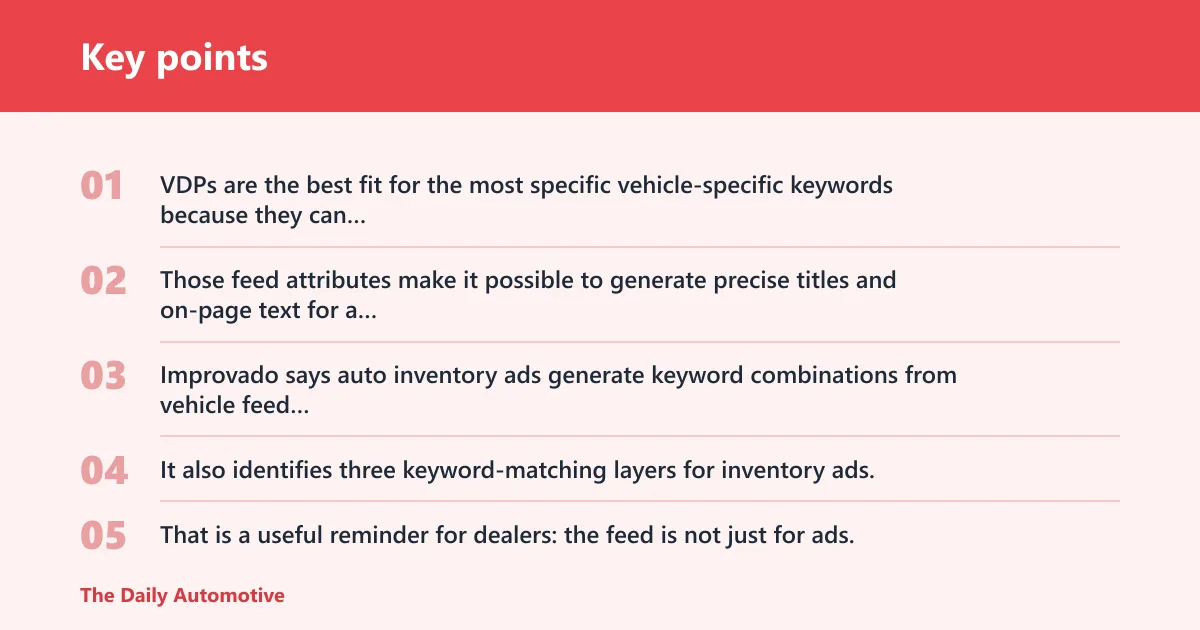
VDPs are the best fit for the most specific vehicle-specific keywords because they can include VIN, make, model, year, price, image URL, and availability status. Those feed attributes make it possible to generate precise titles and on-page text for a single unit.
Improvado says auto inventory ads generate keyword combinations from vehicle feed attributes, and one campaign can produce more than 10,000 active keywords. It also identifies three keyword-matching layers for inventory ads. That is a useful reminder for dealers: the feed is not just for ads; it can power page-level specificity too.
Category pages and brand landing pages
Category pages should cover model families, body styles, and trim families when the dealer has enough inventory depth to justify them. Brand landing pages should target the broader franchise term plus the most relevant models underneath it, especially for Toyota, Ford, Honda, BMW, and Mercedes-Benz.
Ahrefs notes that automotive SEO must account for local search behavior, and that inventory changes constantly. That means these pages need to stay current, or they will drift away from the live stock that searchers expect to find.
Location pages and dealer near me queries
Location pages belong to local modifiers, city names, neighborhood names, and “near me” phrasing. These pages are the best place for local pack relevance because they tie the search term to a real rooftop, address, service area, and inventory pool.
Ethical SEO Solutions explicitly links automotive keywords to local relevance. That connection matters most when a dealer group has multiple rooftops, because the same model term may belong on different location pages, each with its own inventory and map signals.
Vehicle keyword matrix
The ranking below prioritizes buyer intent, page fit, competition risk, and conversion likelihood. Use it as a decision table, not a list of synonyms. The right keyword type depends on the page you have, the stock you can actually sell, and how crowded the result set already is.
| Keyword type | Buyer intent | Estimated page fit | Competition risk | Demand range | Ideal page type | Do | Don’t |
|---|---|---|---|---|---|---|---|
| Make-model-year | High | Strong | High, but manageable with the right page | Medium to high | Model page, VDP | Use when live stock matches the year and model | Do not point it at a generic homepage or stale page |
| Trim and body style | Very high | Very strong | Medium | Lower than model-only terms | Trim page, category page, VDP | Use for inventory with clear trim depth | Do not target a trim you cannot show in stock |
| Condition plus local | Very high | Strong on location pages | Medium to high | Medium | Location page, inventory listing | Use for shoppers ready to visit or contact | Do not ignore city or neighborhood modifiers |
What buyers search before purchase?
Purchase-ready searches usually combine a vehicle, a qualifier, and a location cue. Terms like “used BMW 3 Series near me,” “2025 Toyota Camry lease,” or “Honda Pilot EX-L for sale” show much stronger intent than generic research queries like “best SUVs” or “Toyota reliability.”
High-intent search patterns
Look for model plus year, trim plus drivetrain, condition plus city, and price or payment qualifiers. These patterns tell you that the searcher is closer to a showroom visit, a phone call, or a lead form than to broad comparison reading.
Picture a shopper in a suburban market searching “certified used BMW X3 near me” on a phone during lunch. That query should not land on a generic BMW brand page. It belongs on a local inventory page or a VDP that can show actual certified stock, mileage, and price.
Local shopping intent versus informational queries
Informational searches ask about features, comparisons, or reviews. Local shopping searches ask which dealer has the vehicle, whether it is in stock, and how close it is. The second type is far more valuable for dealer SEO because it supports a real sales path.
The local modifier does not replace the vehicle term. It narrows it. That is why “near me,” city names, and neighborhood names matter on dealer-location pages and local inventory pages.
Choose make-model-year combinations if…
Choose make-model-year terms if your goal is to capture broad inventory demand with a clear match to live stock. This is the right choice when the dealer has enough units in a model family to support a stable landing page and when the site needs a reliable middle ground between broad brand terms and ultra-specific trim terms.
- You have several units in the same model family.
- You want one page to support multiple trim variants.
- You need a strong fit for model pages and VDPs.
- You want higher intent than brand-only terms without narrowing too far.
Choose trim and body style modifiers if…
Choose trim and body style modifiers if your inventory is specific, your stock changes often, or your shopper base already knows the exact configuration it wants. This is the best route when a page can reflect the exact trim, cab, drivetrain, or body style a buyer is searching for.
- You have visible trim depth in stock.
- You can keep the page current as units sell.
- You want the strongest conversion potential per visit.
- You need a clean fit for trim pages or detailed VDPs.
Choose condition plus local modifiers if…
Choose condition plus local modifiers if your main goal is local lead capture. These terms work best for dealer-location pages, “near me” queries, and shoppers who are ready to act. They are especially useful for used and certified inventory, where location and availability matter immediately.
- You operate one or more physical rooftops.
- You want local pack relevance and map visibility.
- You have enough inventory to support city-specific pages.
- You need to align search intent with nearby stock.
What vehicle keyword types should you avoid for dealership SEO?
Avoid generic branded terms when the page cannot answer the shopper’s next step. Avoid model terms on pages with no matching stock. Avoid trim terms if the trim is out of stock or only appears once in a feed that changes daily. The biggest failure is mismatch, not low volume.
Competitiveness and achievability matter together. A keyword can have attractive volume and still be a poor target if the dealer cannot build a page that earns trust, loads current inventory, and satisfies local intent.
How many keyword variations can a vehicle feed generate?
A vehicle feed can produce a large number of page and ad variations because every unit combines multiple attributes. Make, model, year, trim, body style, price, availability status, and location can all generate separate combinations. The same source says one campaign can produce more than 10,000 active keywords, which shows how fast inventory data can multiply search targets.
Frequently asked questions
What are the best vehicle specific keywords for SEO?
The best vehicle-specific keywords are make-model-year combinations, trim-level modifiers, and condition-plus-local terms. Those three types usually offer the best mix of intent, page matchability, and conversion likelihood. They also fit cleanly into model pages, VDPs, and location pages without forcing a generic page to do too much.
Which vehicle keyword type converts best for car dealers?
Trim and body style modifiers usually convert best because they signal the clearest purchase intent. A shopper who types a specific trim or body style is often far closer to a lead or visit than someone who searches only the brand. That said, the page must show that exact or closely related inventory.
Should I target make and model keywords or brand keywords?
Target make and model keywords first for inventory pages and use brand keywords for broader landing pages or franchise hubs. Brand terms are useful, but model terms usually convert better because they align with a specific vehicle search. Toyota, Ford, Honda, BMW, and Mercedes-Benz each support both, but the page type should differ.
How do I use vehicle keywords on inventory pages?
Use the exact make, model, year, trim, and condition in the title, H2s, and meta description when the page reflects live stock. Support that with VIN, price, image URL, and availability status from the feed. Keep the page current, because changing inventory can make stale keyword targeting worse than no targeting at all.
What is the difference between vehicle-specific and local keywords?
Vehicle-specific keywords describe the car itself, such as model, year, trim, and body style. Local keywords add geography, such as city, neighborhood, or “near me.” The first tells search engines what vehicle is being sought. The second tells them where the buyer wants to shop.
Which vehicle keyword types should I avoid for dealership SEO?
Avoid broad branded terms on thin pages, and avoid model or trim terms on pages that cannot show matching inventory. Also avoid local terms on pages that are not tied to a real rooftop or service area. The wrong page type can outrank the right keyword strategy every time.
Products related to this article
Sponsored / affiliate links. As an Amazon Associate I earn from qualifying purchases. I may earn additional commission from eligible campaigns.