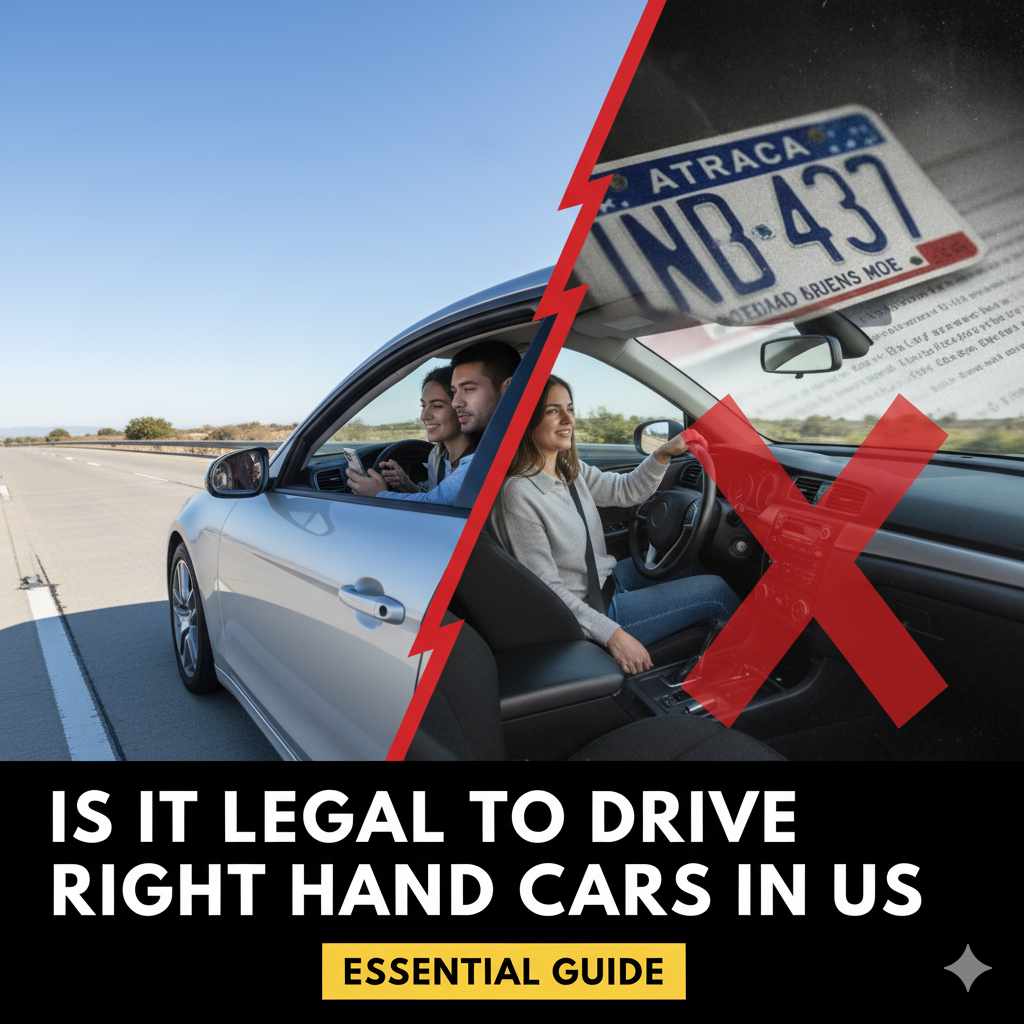
Is It Legal To Drive Right Hand Cars In Us? Essential Guide
Yes, it is generally legal to drive right-hand drive (RHD) cars in the US, but with important considerations and state-specific rules. While the US primarily uses left-hand drive (LHD) vehicles, owning and operating an RHD car isn’t outright banned. Understanding registration, insurance, and safety nuances is key to enjoying your RHD vehicle legally and safely.
Ever seen a car driving on the “wrong” side of the road and wondered if it was legal? Or perhaps you’ve admired a unique Japanese import or a classic British car and thought about bringing one to the US. The question of whether you can legally drive a right-hand drive (RHD) car on American roads pops up quite often. It’s a common point of confusion because, in the United States, we’re used to the steering wheel being on the left side of the car, and driving on the right side of the road. This guide is here to clear up all the confusion. We’ll walk through exactly what you need to know, from federal laws to state rules, so you can confidently enjoy your RHD vehicle without any worries about legality.
The Basics: Left-Hand Drive vs. Right-Hand Drive
Most countries in the world drive on the right side of the road, and consequently, their cars have the steering wheel on the left side, known as Left-Hand Drive (LHD). The United States falls into this majority. This setup is designed for optimal visibility of oncoming traffic when you’re driving on the right side of the road. You can easily see if it’s safe to pass or turn left across oncoming traffic.
On the other hand, Right-Hand Drive (RHD) vehicles are designed for countries where people drive on the left side of the road. Think of the United Kingdom, Australia, India, and Japan. In these countries, the steering wheel is on the right, allowing the driver better visibility of oncoming traffic when they are positioned on the left side of the road.
The US, however, is a bit unique when it comes to RHD cars. While the vast majority of vehicles are LHD, there isn’t a blanket federal law prohibiting the use of RHD vehicles on public roads.
Federal Regulations and RHD Cars
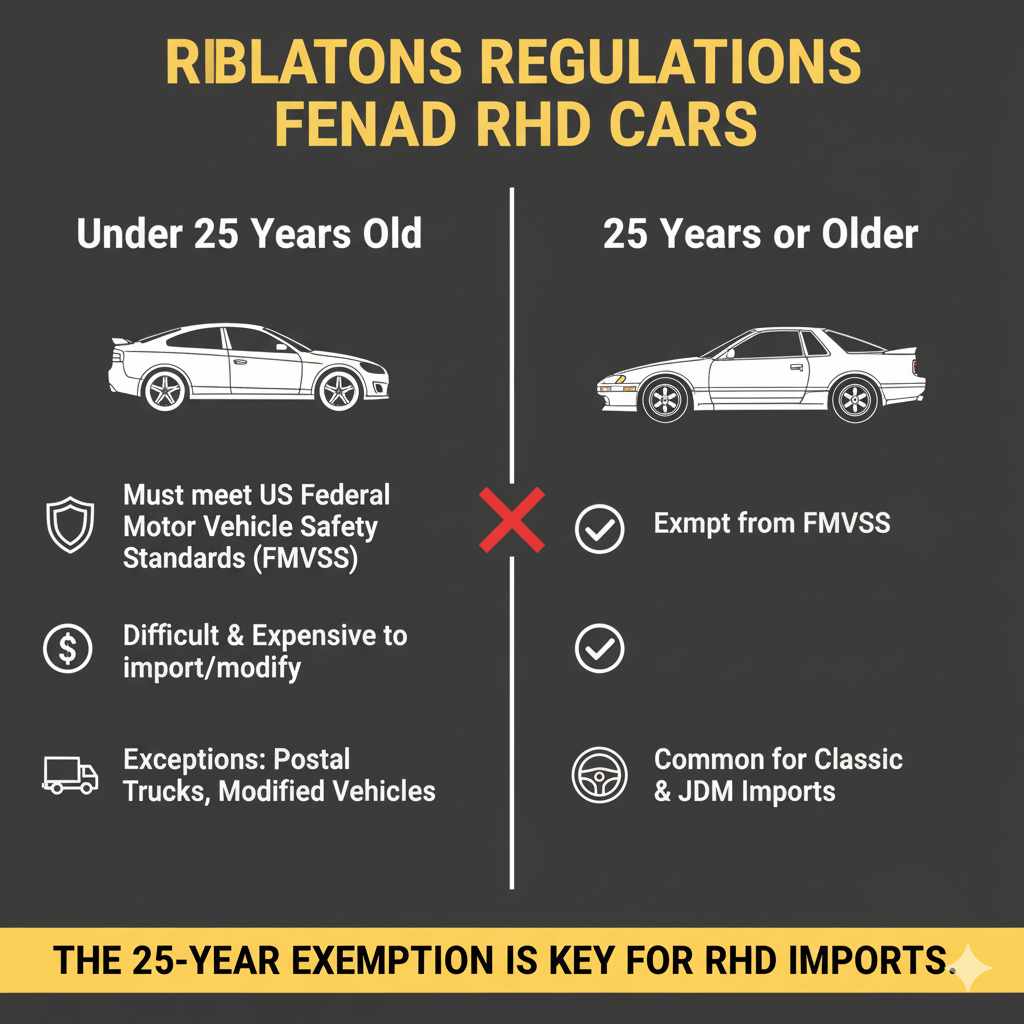
At the federal level, the United States’ Department of Transportation (DOT) and the National Highway Traffic Safety Administration (NHTSA) focus on vehicle safety standards. These standards primarily ensure that vehicles meet certain safety requirements to be legally imported and operated on US roads. For many years, vehicles that were less than 25 years old had to meet these stringent US Federal Motor Vehicle Safety Standards (FMVSS). This was a major hurdle for importing RHD cars, especially those not originally built for the US market, as they often lacked the required safety features or lighting configurations.
However, a significant exception exists: the 25-year exemption rule. This rule states that vehicles that are at least 25 years old are exempt from the FMVSS. This is why you see many older RHD vehicles, particularly classic enthusiast cars and Japanese Domestic Market (JDM) imports, being legally imported and driven in the US. If a vehicle is 25 years or older, it’s generally exempt from needing to meet current US safety standards, making its RHD configuration less of a regulatory issue.
For newer RHD vehicles (less than 25 years old), importing and registering them can be extremely complicated and expensive, often requiring significant modifications to meet US safety and emissions standards. This is why most RHD cars seen on US roads are typically either:
- Vehicles that are 25 years or older.
- Specialty vehicles, like postal service mail trucks, which have unique operational needs and may have separate allowances.
- Vehicles modified to meet US standards, which is a costly and involved process.
State Laws: The Key Factor for RHD Operations
While federal law provides a framework, the day-to-day legality of driving an RHD car largely depends on the specific laws of the state you are in. Most states generally permit RHD vehicles to be registered and driven on public roads, provided they comply with basic traffic laws and registration requirements. However, there can be specific nuances and local interpretations.
Registration and Titling
Registering an RHD vehicle is usually similar to registering an LHD vehicle, but you might encounter more questions or require additional documentation based on the vehicle’s origin and age. For vehicles over 25 years old, the process is typically more straightforward. You’ll need to provide proof of ownership, like a title or bill of sale, and potentially a VIN verification. The key is that the vehicle must be legally imported and have a clean title.
Insurance
Obtaining insurance for an RHD vehicle is generally possible, but you might find that not all insurance providers are as familiar with RHD vehicles. It’s advisable to shop around and be upfront with your insurance agent about the vehicle’s configuration. They may ask specific questions about the vehicle’s safety features and how it was imported. Insuring older or collector RHD cars might fall under classic car insurance policies, which often have specific requirements but can be cost-effective.
Driving on the Road
The primary challenge and safety consideration when driving an RHD car in an LHD country (like the US) is visibility. Since you are driving on the right side of the road with traffic coming towards you on your right, the driver’s position is significantly different from what most drivers are accustomed to.
This can make it difficult to:
- Judge oncoming traffic, especially when overtaking.
- See clearly at intersections, particularly when making left turns.
- Safely navigate tight spaces or parking lots.
Some states might have specific regulations regarding RHD vehicles, although outright bans are extremely rare for private passenger vehicles. These could include requirements for:
- Specific mirror setups to compensate for blind spots.
- Modified lighting to meet US standards, even for older vehicles if they appear non-compliant.
- Being in the correct lane at all times.
State-by-State Variations: A Closer Look
Since state laws are crucial, let’s look at how some states handle RHD vehicles. While most states don’t have explicit laws against RHD vehicles for private use, a few have had historical or nuanced approaches.
California
California generally permits RHD vehicles, especially older ones. The Bureau of Automotive Repair (BAR) and the Department of Motor Vehicles (DMV) oversee vehicle registration. The main focus is often on emissions compliance for vehicles newer than a certain year, and safety standards for any vehicle being imported for the first time. The 25-year exemption is key here, making older RHD vehicles (like many JDM classics) importable and street-legal after passing smog checks (if applicable) and registration requirements.
New York
New York also allows RHD vehicles to be registered and driven. Similar to California, the emphasis is on safety and proper titling and registration. The state’s Department of Motor Vehicles (DMV) handles these processes. For vehicles older than 25 years, the import and registration process tends to be less complicated.
Texas
Texas is a popular state for importing and driving RHD vehicles, especially JDM enthusiasts. The Texas Department of Motor Vehicles (TxDMV) regulations allow for the titling and registration of RHD vehicles, particularly those at least 25 years old, as they are exempt from federal safety standards. The primary concerns are ensuring the vehicle has a valid VIN, proof of ownership, and meets any road legality requirements.
Alaska
While less common due to climate and road conditions, Alaska also permits RHD vehicles. The state’s Division of Motor Vehicles (DMV) guidelines don’t prohibit them. The 25-year rule for importation and exemption from federal safety standards is applicable. Driving an RHD vehicle in Alaska during winter conditions can present additional challenges due to road ice and snow, but the legality remains consistent with other states.
States with Potential Nuances or Historical Restrictions
There aren’t many states with outright bans, but sometimes specific types of RHD vehicles or situations might require extra attention. For example:
- School Buses/Commercial Vehicles: Some states might have stricter rules or specific requirements for converting RHD buses or commercial vehicles for public use, often due to safety regulations focused on the driver’s visibility in high-traffic passenger scenarios.
- Historical Regulations: While current law is permissive, there may have been past legislative attempts or local ordinances that caused confusion. However, current DMV practices in all 50 states generally permit private RHD passenger vehicles.
It’s always best to check directly with the Department of Motor Vehicles (DMV) or equivalent agency in your specific state for the most up-to-date and precise regulations.
Table: Key Factors for Driving RHD Cars in the US
Here’s a quick overview of the main points to consider:
| Factor | Considerations for RHD Vehicles in the US | Importance |
|---|---|---|
| Federal Law (FMVSS) | Vehicles <25 years old must meet US safety standards. Vehicles ≥25 years old are exempt from FMVSS. | Crucial for importation and legality of newer RHD vehicles. |
| State Registration | Most states allow RHD registration; process varies. Requires proof of ownership, VIN, and compliance with age/import rules. | Essential for legally operating the vehicle on public roads. |
| Insurance | Generally available, but shop around. Some insurers are more familiar with RHD classics. | Mandatory in all states to legally drive. |
| Driving on the Road | Requires adaptation due to driving on the right side of the road with RHD. Visibility for passing and turns is key. | Critical for safety and avoiding accidents. |
| Vehicle Age | ≥25 years old: Easier import/registration due to FMVSS exemption. <25 years old: Complex/costly import and modification required. | Determines many regulatory hurdles. |
Importing RHD Cars: The 25-Year Rule in Detail
The 25-year exemption created by the National Highway Traffic Safety Administration (NHTSA) is the golden ticket for many RHD enthusiasts. It means that any vehicle that is at least 25 years old (based on the month and year of manufacture) is exempt from meeting the Federal Motor Vehicle Safety Standards (FMVSS) that currently apply to new vehicles. This significantly simplifies the process because the vehicle doesn’t need to be crash-tested or modified to meet US safety regulations for its age category.
Here’s why this is so important:
- Simplified Imports: It allows popular RHD vehicles from Japan (JDM cars), the UK, and elsewhere to be legally imported into the US.
- Cost Savings: Bringing a car into compliance with FMVSS for newer vehicles can cost tens of thousands of dollars in modifications, making the 25-year rule a massive cost-saver.
- Access to Unique Cars: It opens up a world of interesting and rare vehicles that were never officially sold in the US market.
Important Note: While FMVSS usually doesn’t apply to vehicles over 25 years old, they must still comply with EPA emissions standards for the year they are being imported. However, many states have exemptions for emissions testing for vehicles over a certain age (often 25 or 30 years old), further easing the process.
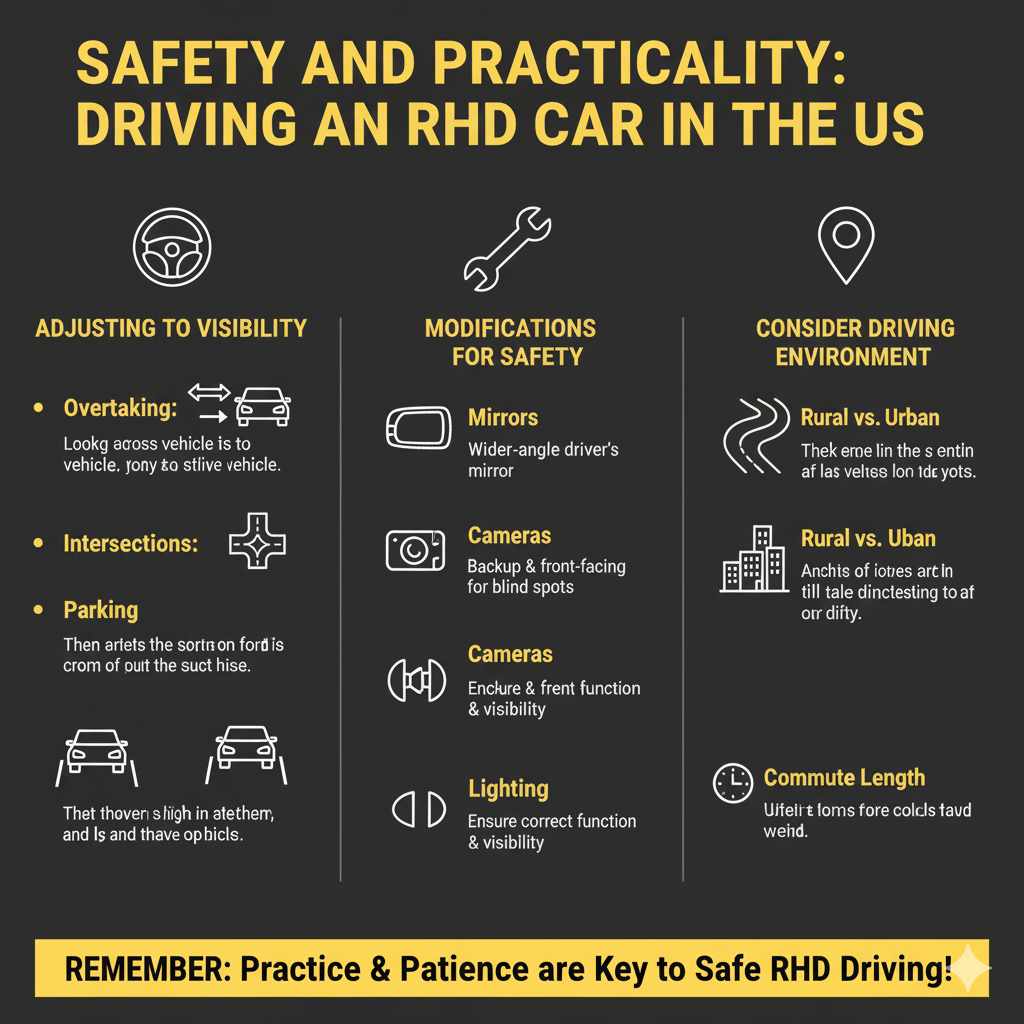
Safety and Practicality: Driving an RHD Car in the US
Legality is one thing, but safety and practicality are another. Driving an RHD car on the right side of the road takes significant adjustment. Here are some tips to help you adapt:
Adjusting to Visibility
The biggest hurdle is judging distances and traffic flow. You’ll need to pay extra attention:
- Overtaking: When passing a vehicle, you’ll be looking across the entire width of the car to judge oncoming traffic. Take it slow and be absolutely sure it’s clear. Many RHD cars have improved mirror systems, but advanced driver-side mirrors can be helpful.
- Intersections: Left turns across traffic are particularly challenging. You need to be able to see oncoming cars clearly, which is directly in your line of sight. Some drivers opt for smaller, less complex intersections when they are first getting used to an RHD car.
- Parking: Maneuvering in tight parking lots can also be tricky, especially if you’re used to the LHD perspective.
Modifications for Safety and Comfort
While you’re not federally required to modify a car over 25 years old, many owners choose to do so for better safety and comfort:
- Mirrors: A larger, wider-angle side mirror for the driver’s side can significantly improve visibility of adjacent lanes and approaching traffic.
- Cameras: Backup cameras and even front-facing cameras can provide extra awareness in blind spots.
- Lighting: Ensure all your lights (headlights, tail lights, turn signals) are functioning correctly and are as visible as possible to other drivers. Some older imported cars might have different bulb types or configurations.
Consider Your Driving Environment
The ease of driving an RHD car will depend on where you live and drive:
- Rural vs. Urban: Rural roads with less traffic might be easier to navigate initially than busy city streets with complex interchanges and heavy congestion.
- Commute Length: A long daily commute in heavy traffic will require more adaptation time and confidence than occasional weekend drives.
Frequently Asked Questions (FAQs)
Can I drive a right-hand drive car on the highway in the US?
Yes, generally you can drive a right-hand drive (RHD) car on the highway in the US, provided it is legally registered and insured in your state. Federal law does not prohibit RHD vehicles, but state registration and safety regulations apply. The primary concern is driver adaptation and ensuring visibility for safe operation.
Is it legal to import right-hand drive cars from Japan to the US?
Yes, it is legal to import RHD cars from Japan to the US, especially if they are 25 years old or older. Vehicles that are at least 25 years old are exempt from federal safety standards (FMVSS). For newer vehicles, extensive and costly modifications would be needed to meet US safety and emissions standards.
Do I need special insurance for a right-hand drive car in the US?
You do not necessarily need special insurance, but you should shop around. Some insurance companies may be more familiar with RHD vehicles, especially classic or collector car policies. Be sure to inform your insurer of the vehicle’s configuration to ensure adequate coverage.
What are the main challenges of driving a right-hand drive car in the US?
The main challenges are related to visibility and adaptation. Drivers need to adjust to judging oncoming traffic, especially when passing or turning left, as the steering wheel is on the opposite side of what is standard for US roads. This requires extra concentration and skill.
Will my RHD car pass inspection in the US?
Whether an RHD car passes inspection depends on state-specific requirements. Most states focus on safety (lights, brakes, tires) and emissions (if the vehicle is new enough to require it). For older vehicles (25+ years old), passing these checks is generally more manageable, but local state inspection protocols must be followed.
Are there any states that ban right-hand drive cars?
There are no states that have a blanket ban on private, passenger right-hand drive vehicles. While specific commercial vehicle types or unusual circumstances might have restrictions, personal RHD cars are generally allowed to be registered and driven across the US.
Conclusion
So, can you drive a right-hand drive car in the US? The answer, happily, is a resounding yes, with the right knowledge. The key lies in understanding the federal 25-year exemption for safety standards, which makes importing and registering older RHD vehicles far more accessible. While state laws are the ultimate authority, most states welcome these unique vehicles, as long as they are properly registered and insured.
The biggest adjustment you’ll make is to the driving experience itself. Getting used to the RHD perspective on our LHD roads takes practice, patience, and a commitment to safe driving habits. By being aware of visibility challenges, potentially making minor safety enhancements, and always checking your local DMV regulations, you can confidently and legally enjoy your right-hand drive car. It’s an exciting way to stand out and own a piece of automotive history or a quirky import, and with this guide, you’re well-equipped to navigate the process.