Is Nitrous Illegal In Cars? Essential Truths
Nitrous oxide (N2O) use in street cars is not universally illegal across the United States, but its legality hinges entirely on where you use it, how it is installed, and if it is street-legal in your specific state or local area. Typically, street use for speed is heavily restricted or banned, while track use is often permitted with specific safety rules.
Have you ever seen a car flash past you, followed by a plume of white vapor, and wondered, “What was that?” That might have been nitrous oxide, often called “NOS.” It’s a popular topic in car communities, but it often comes with confusing questions about legality. It can feel frustrating when you want to understand car modifications but run into a wall of confusing local laws.
Don’t worry! We are here to clear the air—literally. As your trusted automotive guide, I’ll break down exactly when and where using nitrous in your car is okay and when it could get you into trouble. We will cover the basic rules without the heavy mechanic jargon. Let’s find out the essential truths about nitrous legality so you can enjoy your ride safely and confidently.
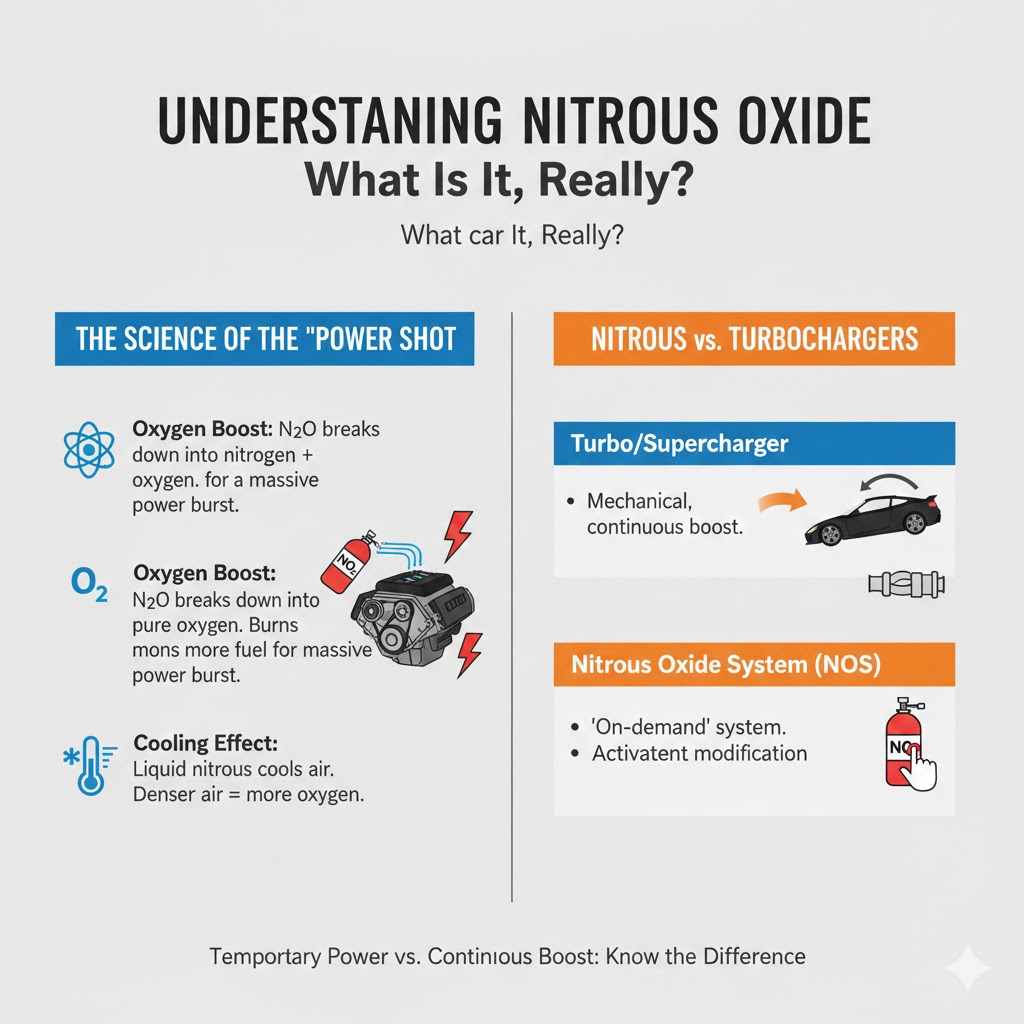
Understanding Nitrous Oxide: What Is It, Really?
Before we dive into the legality, let’s make sure we are all on the same page about what nitrous oxide actually is and how it works in an engine. This knowledge helps explain why lawmakers regulate it.
The Science of the “Power Shot”
Nitrous oxide (N2O) is a simple gas, often stored as a liquid under pressure in a bottle. When injected into an engine, it does two main things:
- Oxygen Boost: When heated in the combustion chamber, the N2O breaks down into nitrogen and pure oxygen. This extra oxygen allows you to burn more fuel than normal, resulting in a massive, short burst of extra power.
- Cooling Effect: The liquid nitrous rapidly expands into a gas, which significantly cools down the incoming air charge. Cooler air is denser, which also helps cram more oxygen into the cylinder for a cleaner burn.
Think of it like giving your engine a temporary, very powerful shot of highly concentrated air. It’s effective, but it’s temporary and puts extra stress on engine components.
Nitrous vs. Turbochargers: A Key Difference
Many people confuse nitrous systems with forced induction systems like turbochargers or superchargers. Here is the simple difference:
- Turbo/Supercharger: These systems use exhaust gases or belts to mechanically force air into the engine continuously while the engine is running. This is usually considered a permanent modification.
- Nitrous Oxide System (NOS): This is an “on-demand” system. You activate it with a button, and it only works when you press that button. It’s an additive boost, not a continuous mechanical change.
Is Nitrous Illegal In Cars? The Straight Answer
This is the million-dollar question! The short answer is: It depends entirely on location and intended use. There is no single federal law that bans the ownership of a nitrous system in your garage. However, laws come into play when you put that system on a vehicle driven on public roads.
Federal Regulations vs. State Laws
In the United States, vehicle safety and emissions are often governed at the state level, sometimes with federal guidelines influencing them. Think of it this way:
- Federal Level: The EPA (Environmental Protection Agency) is mainly concerned with emissions. Installing a nitrous system can be considered tampering with emissions equipment if the car is originally designed for road use, especially if it causes the car to fail state emissions tests.
- State/Local Level: This is where most issues arise. States and cities have laws regarding vehicle modifications that affect speed, safety, and street racing.
The Crucial Distinction: Track Use vs. Street Use
This is the most important factor in determining legality:
- Track Use (Generally Legal): If you install a professionally set up nitrous system on a car strictly used for closed-course racing (drag strips, road courses, etc.), it is usually legal. Tracks have their own safety rules, but local law enforcement usually isn’t involved unless you drive recklessly getting to or from the track.
- Street Use (Often Illegal or Highly Restricted): Using nitrous on public streets is where the legal gray area turns into solid trouble. Many states prohibit any engine modification designed to increase speed beyond factory specifications for street driving.
State-by-State Look at Nitrous Legality
Because the laws are so fragmented, checking local regulations is vital. While I can’t list every single ordinance, here is a general overview of how different states tend to approach this modification. Always verify with your local DMV or state police!
States with Strong Anti-Modification Laws
Some states, particularly those with very strict smog testing or vehicle inspection programs, often categorize nitrous systems as illegal tampering. If your car uses nitrous and needs to pass a state inspection, it will likely fail.
For example, some states specify that any fuel or air induction system modification that exceeds factory output without certification is illegal for street driving. The Federal Highway Administration often defers to state standards for these vehicle alterations.
States with Clear Track-Only Rules
Many jurisdictions focus less on owning the system and more on using it. If the system is professionally installed and only armed when you are at a sanctioned racetrack, you are usually safe from traffic stops regarding the nitrous itself.
Table: General Legal Stance Categories
This table gives you a quick idea of the typical approach, but remember, local city ordinances can still apply even in “lenient” states.
| Legal Category | Typical Stance on Street Use | Primary Concern |
|---|---|---|
| Strict Enforcement States | Illegal to install or use on public roads. | Emissions tampering and safety standards. |
| Permissive (Track Focus) States | Legal to own; use heavily restricted to sanctioned tracks. | Dangerous or reckless operation on public roads. |
| Unclear/Gray Area States | Laws don’t specifically mention nitrous, often falling under “excessive modification.” | Police discretion during traffic stops. |
The Law Enforcement Perspective: Why Nitrous Gets You Pulled Over
If you have nitrous installed, even if you aren’t using it, an officer might cite you if they suspect it’s designed for illegal street use. Here are the common reasons why nitrous can lead to a ticket:
1. Excessive Speed and Reckless Driving
The primary legal risk isn’t the gas itself; it’s the resulting illegal speed. If you use nitrous to accelerate past the speed limit dangerously, the citation will be for reckless driving or street racing, and the nitrous system will be used as evidence of intent to operate a dangerous vehicle.
2. Emissions Tampering
In areas with mandatory annual vehicle inspections (smog checks), nitrous systems are often flagged. An officer conducting a traffic stop might also cite you if they believe the system violates environmental regulations designed to keep your vehicle compliant with its factory emissions rating. This is particularly true if the car has a “Check Engine Light” on due to the modification.
3. Insurance and Liability
While not strictly illegal in the criminal sense, installing performance modifications like nitrous without notifying your insurance company can void your policy coverage in an accident. If you are involved in a crash and the insurance adjuster finds an undisclosed, high-performance system, they may deny your claim. This is a massive financial risk!
How to Legally Install and Use Nitrous Oxide
If you are serious about running nitrous, the path to legal ownership and operation is clear: focus on dedicated track use and professional installation.
Step 1: Determine Your Intended Use
Be honest with yourself. Are you aiming for weekend track days, or do you plan to use it on your daily commute? If it’s the latter, you are significantly increasing your risk of fines, insurance issues, and potential vehicle impoundment, depending on your state.
Step 2: Choose a Dedicated Track Vehicle
The safest legal route is to use nitrous only on a vehicle that is explicitly not street-legal or is maintained solely for competition use. This often means:
- No current registration or license plates.
- No emissions testing required.
- Transported to and from the track on a trailer.
Step 3: Professional Installation and Safety Checks
If you do install a system (even for the track), safety is paramount. Nitrous systems are powerful tools, and a bad installation can destroy an engine quickly or cause the pressurized bottle to become dangerous. Look for kits from reputable brands like Nitrous Oxide Systems (NOS) or ZEX, and consider having them installed by a certified performance shop.
A professional installer will ensure:
- The correct jetting for your engine’s current modifications.
- Proper safeguards (like fuel pressure switches) are in place.
- The bottle is securely mounted according to safety standards (often required by race tracks).
Step 4: Check Local Vehicle Inspection Rules
Before driving the car anywhere near public roads, research your state’s vehicle inspection requirements. Some states require an inspection sticker, and any non-OEM (Original Equipment Manufacturer) air/fuel system is an automatic fail. You can often find basic inspection guidelines on your state’s Department of Motor Vehicles (DMV) website.
The Legal Risks Summarized: What to Expect If Caught
Understanding the potential penalties helps you make an informed choice. Being pulled over with a nitrous system installed and actively being used on a public road is usually treated much more seriously than simply having the bottle in your trunk.
Potential Penalties Table
| Violation | Typical Consequence | Severity |
|---|---|---|
| Simple Possession (Uninstalled/Inactive) | Usually none, unless state law explicitly bans possession. | Low |
| Use During Traffic Violation (e.g., speeding) | Reckless driving citations, fines, points on license, possible vehicle seizure. | High |
| Tampering with Emissions Equipment | Mandatory repair orders, significant fines, failure to pass inspection. | Medium to High |
| Street Racing Charges | Misdemeanor or felony charges depending on jurisdiction and injury, large fines, license suspension. | Very High |
Remember, the law often focuses on the danger created. Using a system that dramatically alters your car’s performance on public roads—where traffic patterns and obstacles are unpredictable—is seen as a severe safety risk by traffic enforcement.
What About Emissions and the EPA?
The U.S. Environmental Protection Agency (EPA) has rules about tampering with emission control devices on vehicles used on public roads. Since nearly all passenger cars sold today are required to meet strict emission standards, adding a performance modification that alters the air/fuel ratio without proper certification is technically a violation.
The Tampering Rule (Section 203(a)(3) of the Clean Air Act)
This federal act prohibits tampering with or removing any device installed on a vehicle to conform to EPA emission standards. While specialized racing components are often given exceptions for competition use, street-driven cars rarely qualify for these exemptions. If your car is originally built for the street, adding nitrous falls into this gray area that most states enforce via inspection programs.
For the average driver, this means if you live in a state that requires emissions testing (like California or New York), your nitrous setup will almost certainly prevent you from getting the necessary sticker to legally renew your registration.
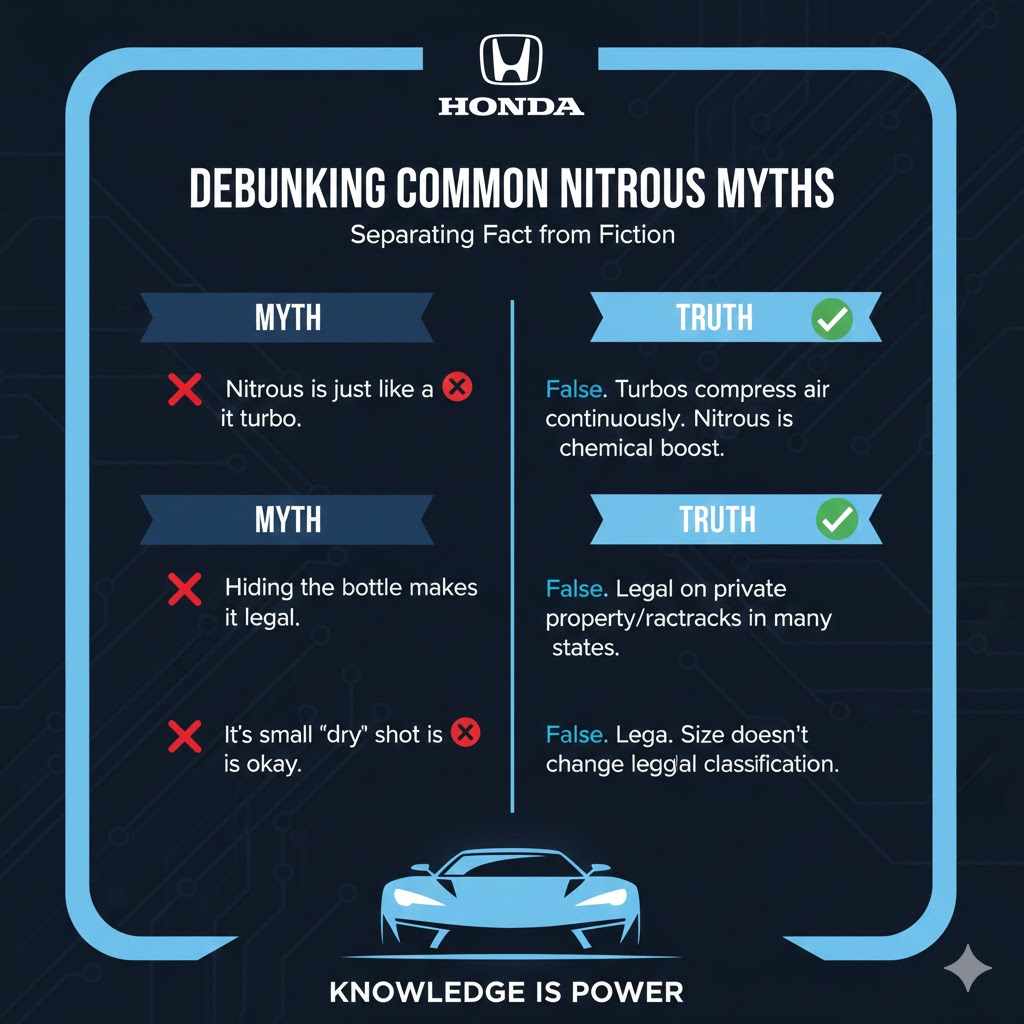
Debunking Common Nitrous Myths
The topic of nitrous is full of rumors. Let’s clear up a few common misunderstandings about its legality and safety.
Myth 1: Nitrous is just like having a turbo.
Truth: False. Turbos are mechanical systems that compress air continuously. Nitrous is a chemical additive that provides a brief, intense boost. The legal and mechanical implications are different.
Myth 2: As long as the bottle is hidden, it’s fine.
Truth: Hiding the hardware doesn’t change the law regarding its use or capability. If police have probable cause to search or if they witness you using it, the hiding spot won’t protect you from charges like reckless driving or emissions tampering.
Myth 3: Nitrous is illegal everywhere in the US.
Truth: False. It is perfectly legal in many states if you are using it strictly on private property or a sanctioned racetrack. Legality hinges on the venue, not the existence of the hardware.
Myth 4: If it’s a small “dry” shot, it’s okay.
Truth: The size of the injection (dry shot vs. wet shot) doesn’t change the legal classification of the modification. It might change how quickly you trigger an inspection failure, but the modification itself still exists on a street-driven vehicle.
Frequently Asked Questions (FAQ) About Nitrous Legality
Q1: Can I get pulled over just for having a nitrous bottle in my trunk?
A: Usually, no. Simply possessing the equipment is generally not illegal. However, if the system is installed and clearly ready for use (hoses run to the engine bay), an officer may use that as probable cause for further inspection or issue a citation related to illegal vehicle modifications, depending on local laws.
Q2: Does running nitrous affect my standard car insurance coverage?
A: Yes, it potentially does. If you are in an accident and your insurance company discovers an undisclosed, high-performance engine modification like nitrous, they have grounds to deny your claim, arguing the vehicle was modified beyond its agreed-upon specifications.
Q3: What is a “wet” vs. a “dry” nitrous system, and does the type matter legally?
A: A dry system only sprays nitrous oxide into the intake. A wet system sprays both nitrous and extra fuel. Legally, both are generally treated the same on public roads because both significantly boost power beyond factory specifications.
Q4: Are drag racing tracks responsible for reporting my car modifications to the police?
A: Generally, no. Racetracks operate under their own safety rules, which are usually separate from state vehicle codes. They are primarily concerned with safety during the run. They do not typically report vehicle setups to local police unless the car is involved in illegal street activity outside their facility.
Q5: If I live in a state with no yearly inspection, is nitrous definitely legal?
A: It is much safer legally, but not 100% guaranteed. While you avoid emissions checks, you can still be cited for excessive speed, reckless driving, or noise violations resulting from the use of the nitrous system on public roads.
Q6: If I remove the system before getting an inspection, will I pass?
A: If you remove all components, including mounting brackets, wiring, and any tell-tale signs, you should pass the visual portion of the inspection. However, some advanced diagnostics might reveal past performance tuning related to the system, though this is less common for basic nitrous setups.
Conclusion: Drive Smart, Know Your Laws
Understanding the question, “Is nitrous illegal in cars?” leads us to one main conclusion: Responsibility is key. Nitrous oxide is a powerful performance enhancer that, when used correctly, offers incredible gains at the racetrack. When used carelessly on public streets, it shifts from a performance modification to a serious legal liability.
For the everyday driver interested in performance, the safest, smartest route is to reserve nitrous use exclusively for closed courses where speed and modification limits are clearly defined by track rules. If you plan on installing a system, always check your state’s specific Department of Motor Vehicles and inspection guidelines first. By respecting the laws designed to keep our roads safe, you can confidently enjoy your vehicle modifications without the fear of fines or insurance headaches. Keep your wrench turning, and drive smart!