Finding a Local Car Audio Shop Near You
Choose the local car audio shop that can show vehicle-specific install proof, explains wiring and fitment, and gives a written estimate with labor, parts, and trim removal listed. Skip shops that cannot prove compatibility, or you risk rattles, warning lights, and surprise charges. This guide shows the checklist for install quality, compatibility checks, and hidden-cost traps.
What to look for when comparing local shops
Start with your city, ZIP code, or “near me,” then compare the shops that appear on maps and store locators. Look for a physical location, clear hours, and a phone number you can actually reach. Then compare specialty installers, big-box retailers, and authorized dealers before you call.
A nearby storefront is not enough. You want a shop that lists installation, not only product sales, because a strong shop can help you buy the right gear and put it in correctly.
What to shortlist first
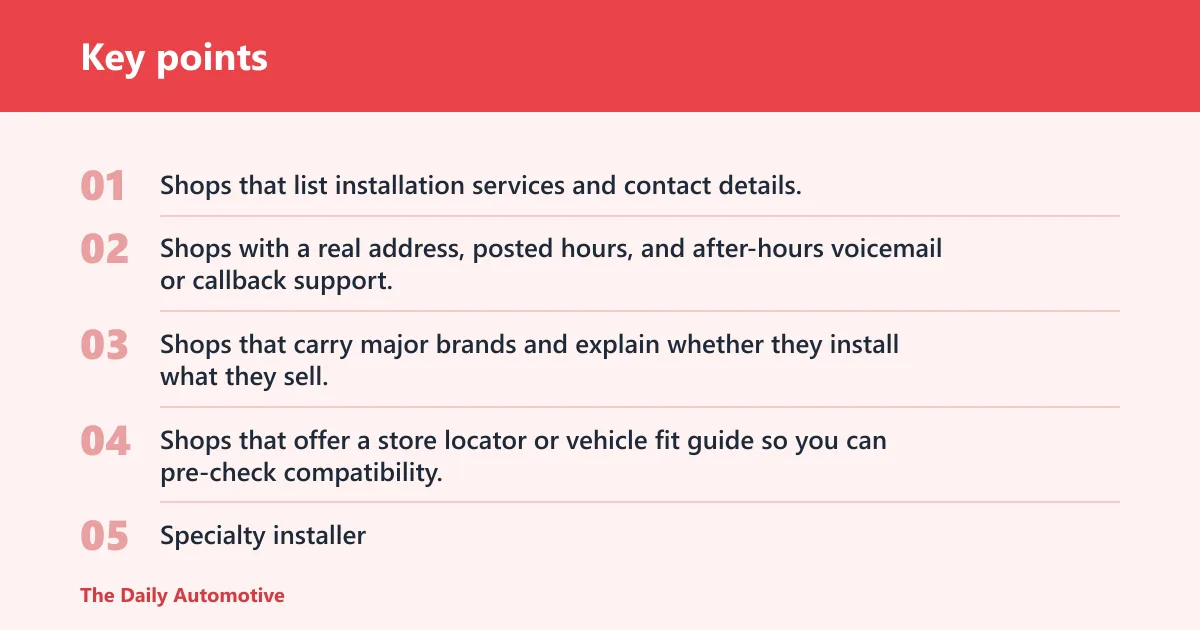
- Shops that list installation services and contact details.
- Shops with a real address, posted hours, and after-hours voicemail or callback support.
- Shops that carry major brands and explain whether they install what they sell.
- Shops that offer a store locator or vehicle fit guide so you can pre-check compatibility.
Freeman’s Car Stereo is one example of a multi-location business worth checking as a benchmark. It has seven store locations, serves Charlotte and Asheville metro areas, and lists Charlotte, Concord, Cornelius, Fletcher, Gastonia, Hickory, and Rock Hill among its locations.
That kind of footprint matters because it usually means easier scheduling, more consistent contact options, and better follow-up access if a problem shows up after the install.
How to compare shop types
- Specialty installer: Best when you want fitting help, custom wiring, tuning, or a more complex system.
- Big-box retailer: Useful for common head units, speaker swaps, and straightforward installs, but confirm the specific installer and labor scope.
- Authorized dealer: Helpful for brand-specific products and support, but brand authorization does not replace install skill.
Freeman’s says its team is MECP certified. MECP is commonly described as a credential covering automotive information technology, entertainment, navigation, safety, and security systems. That is a useful qualification signal when you are comparing installers.
What should a good shop help you verify?
A good shop should verify fitment before you buy anything. That includes your vehicle year, make, model, trim, and existing factory system. It should also explain whether your build needs a dash kit, interface module, amplifier integration, or speaker adapters.
Ask for that proof before you pay. If the counter staff cannot explain compatibility in plain terms, the chance of the wrong part or a surprise labor add-on goes up fast.
Fitment questions that matter
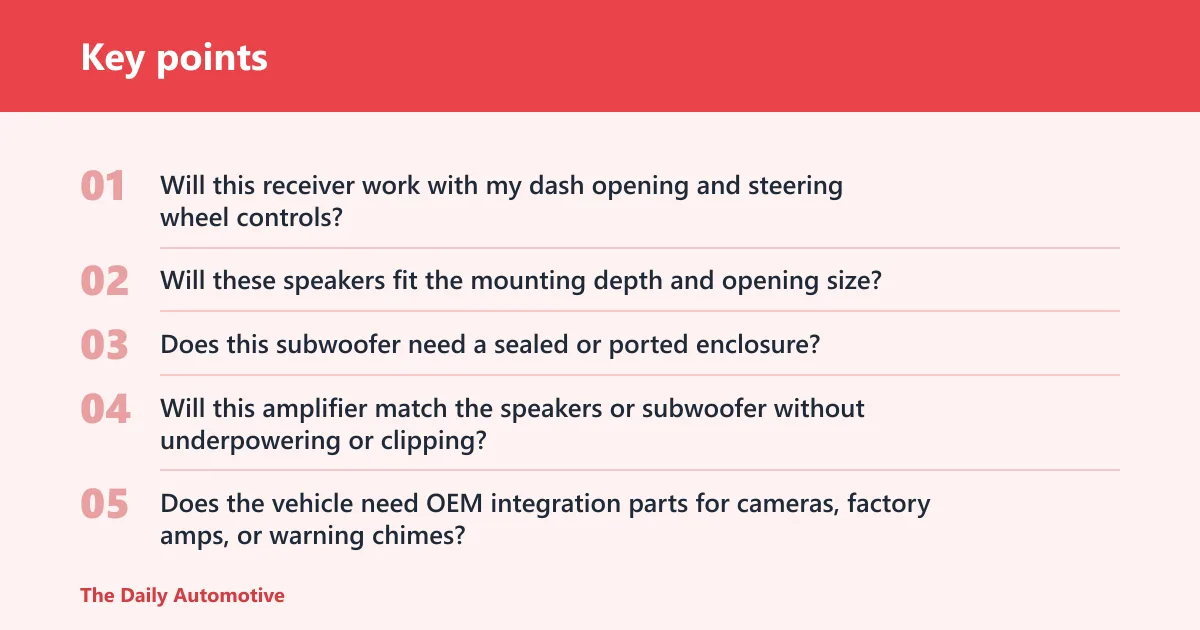
- Will this receiver work with my dash opening and steering wheel controls?
- Will these speakers fit the mounting depth and opening size?
- Does this subwoofer need a sealed or ported enclosure?
- Will this amplifier match the speakers or subwoofer without underpowering or clipping?
- Does the vehicle need OEM integration parts for cameras, factory amps, or warning chimes?
Picture a sedan owner buying a double-DIN receiver without asking about the dash kit. The radio fits the face opening, but the trim surround leaves a gap and the steering wheel buttons stop working until the correct interface is added. That is a fitment miss, not a product defect.
Freeman’s offers a vehicle fit guide, which is exactly the sort of tool a shopper should look for. A fit guide helps you avoid wrong parts before you pay for them, and it is especially useful when you are comparing receivers, speakers, amplifiers, and subwoofers for a specific vehicle.
What fitment proof should sound like
The best answer is specific. For example, “Your truck needs a dash kit and an interface for steering wheel controls,” or “That 6.5-inch speaker fits, but the mounting depth requires an adapter.” Vague answers like “It should fit” are not enough.
For speakers, the shop should be able to explain component versus coaxial choices. For subwoofers, it should discuss enclosure needs and power handling. For amplifiers, it should explain power output matching and why a bigger number is not always a better result.
Car audio shop scorecard
Use this 0-2 scorecard when you call local shops. Score each column, then total it. Low scores mean you should keep calling. Mid scores mean you need tighter follow-up. High scores merit an in-person visit.
| Credential signals | Install services offered | Vehicle fitment help | Pricing transparency | Warranty policy | Red-flag answers to ask on the phone | Total score interpretation |
|---|---|---|---|---|---|---|
| 0 = no installer credentials or proof | 0 = sells gear only, no install help | 0 = no fitment lookup or vehicle check | 0 = “prices vary” with no breakdown | 0 = no written support or follow-up answer | 0 = vague, rushed, or evasive replies | A score of about 0-3 generally means to keep searching. |
| 1 = mentions credentials or brand training, but gives little detail | 1 = installs common parts only | 1 = basic compatibility check by year/make/model | 1 = parts and labor separated verbally, not written | 1 = limited warranty or partial support | 1 = some detail, but not enough for a booking decision | A score of about 4-7 generally means to call back with follow-up questions. |
| 2 = MECP certification or equivalent proof plus clear installer role | 2 = installs receivers, speakers, amps, subs, and damping materials | 2 = vehicle-specific fitment help, interfaces, and trim guidance | 2 = written estimate with labor, parts, and vehicle-specific items | 2 = clear labor warranty and post-install support process | 2 = direct answers to wiring, fitment, and warranty questions | A score of about 8-12 is often a strong candidate for an in-person visit. |
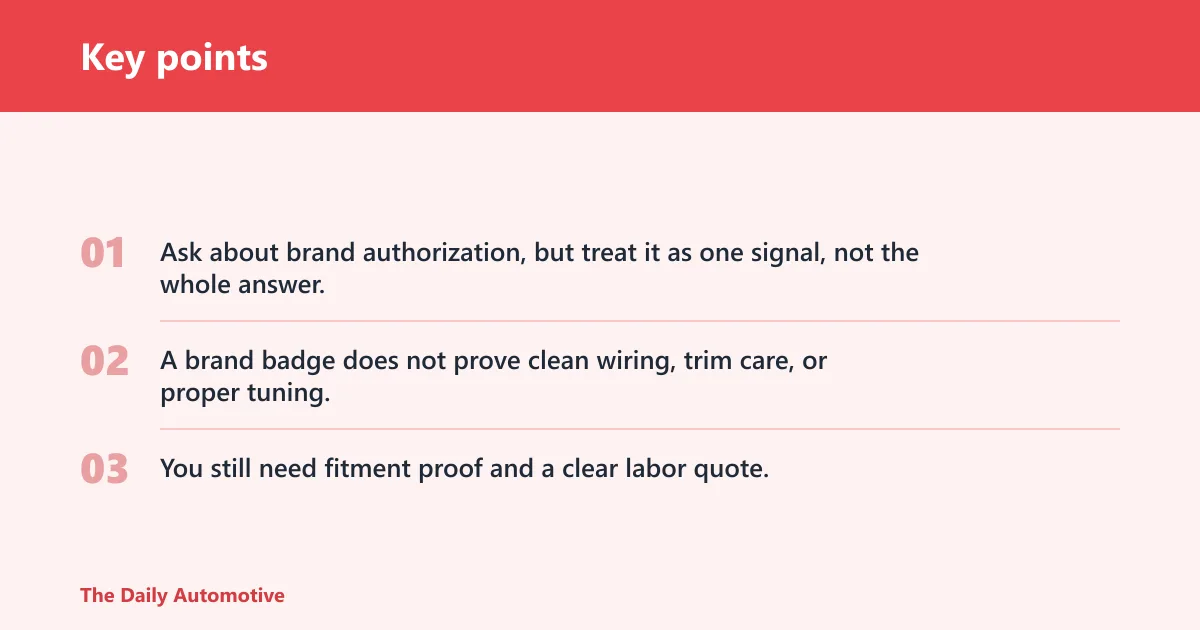
Ask about brand authorization, but treat it as one signal, not the whole answer. A brand badge does not prove clean wiring, trim care, or proper tuning. You still need fitment proof and a clear labor quote.
What services and products should you compare?
Compare the shop’s install menu, not just its brand list. The categories matter because each one creates different labor, parts, and compatibility needs. A clean car audio install is usually more about the vehicle than the box on the shelf.
Receivers, speakers, amps, subs, and damping
- Car stereo receivers: Ask about dash kits, steering wheel controls, backup camera integration, and OEM feature retention.
- Car speakers: Ask about replacement fitment, mounting depth, component versus coaxial layouts, and brand matching.
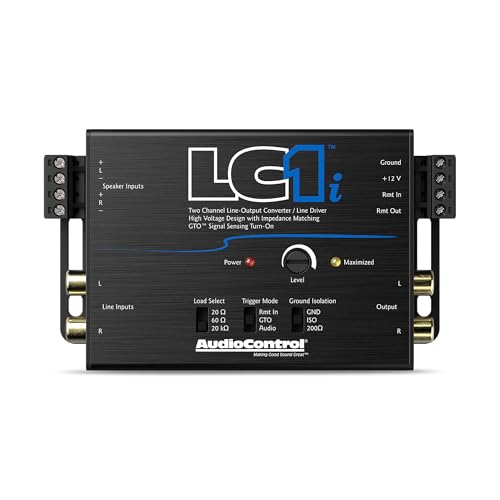
- Car amplifiers: Ask about power output matching, speaker or sub pairing, and whether the install includes clean routing and fuse protection.
- Car subwoofers: Ask about bass extension, enclosure requirements, size variants, and power handling.
- Sound damping materials: Ask whether they install noise reduction and rattle-control material for doors, trunks, or panels.
Freeman’s lists car amplifiers, car subwoofers, car stereo receivers, and noise reduction and sound damping as categories. That range is useful because it signals more than a single-product counter. It suggests the shop is set up for complete system planning, not only retail sales.
Suppose you want deeper bass in a hatchback. A shop that sells a subwoofer box but does not discuss enclosure size, power match, or the factory charging system may still take your money, but the result can be weak output or clipped sound. Ask those questions before booking.
Some shops also handle adjacent work such as motorcycle audio, marine audio, or remote-start-adjacent installs. If you need one of those, ask directly whether the installer has relevant vehicle experience, because a car-only shop may not be prepared for weatherproofing, battery limits, or different mounting constraints.
How much does installation near you cost?
Installation cost near you depends on the vehicle, the system, and the labor needed. A simple speaker swap costs less than a receiver install with interface modules, and both cost less than an amplifier and subwoofer build with tuning. Always ask what labor is included and what costs extra.
Do not compare quotes until the scope is identical. A lower number may exclude harnesses, adapters, tuning, custom brackets, or vehicle-specific labor.
How to ask for a clean estimate
- Request a written estimate that separates parts, labor, and vehicle-specific items.
- Ask whether trim removal, dash kits, harnesses, and adapters are included.
- Confirm whether tuning, system integration, or final checks cost extra.
- Ask what happens if the first-fit part does not work on your vehicle.
Freeman’s says orders placed before 3:00PM EST Monday through Saturday ship same day, and it offers free overnight shipping on some Soundstream radios. That is a reminder to compare service speed as part of the buying process, but do not confuse shipping convenience with local install quality.
For local labor, the important question is whether the shop explains every line item before you leave the vehicle. Hidden costs often show up in dash kits, harnesses, amp wiring, tuning time, and vehicle-specific mounting hardware.
Which red flags should stop you?
Walk away from shops that give vague answers about fitment, labor, or warranty terms. Also leave if there is no clear address, hours, or contact path. Reviews that mention poor wiring, broken trim, or unresolved repeat visits deserve serious attention.
Pressure is another warning sign. If a shop wants you to buy before checking your vehicle or existing system, the chance of a mismatch goes up.
Review details that matter
- Comments about clean wiring versus messy routing.
- Mentions of rattles, trim damage, or dashboard gaps.
- Reports of repeat visits for the same issue.
- Follow-up support after the install.
- Whether staff explained compatibility before selling parts.
Check Google reviews and star ratings, but read the comments closely. A high rating means little if the notes keep mentioning poor fitment advice or no support after the install.
Frequently asked questions
Where to get car audio installed locally
Look for local specialty installers, larger retailers with installation bays, and authorized dealers with a physical address, posted hours, and a reachable phone number. Search your city or “near me,” then compare store locators, fitment tools, and install availability before you visit.
How do I find the best car audio shop near me?
Start with nearby options, then rank them by fitment help, installation scope, and pricing clarity rather than distance alone. A good shop explains compatibility, lists what labor is included, and gives a written estimate that separates parts from vehicle-specific work.
What should I ask a local car audio shop before booking?
Ask whether the shop can verify fitment for your exact vehicle, what installation support is included, whether MECP-certified staff handle the job, and what happens if a part does not fit. Also ask about warranty coverage, hidden labor charges, and expected turnaround time.
How much does car audio installation cost near me?
Cost depends on the vehicle and system complexity. A simple receiver or speaker install is usually less involved than an amplifier, subwoofer, or OEM integration job. Ask for a written quote that lists labor, parts, wiring, adapters, and any tuning or trim work.
What brands or services do local car audio shops usually offer
Many local shops carry car stereo receivers, speakers, amplifiers, subwoofers, and sound damping materials, plus related installation parts. Some also handle backup camera integration, steering wheel controls, and vehicle fit checks. Brand selection matters, but install quality and fitment support matter more.
How do I know if a car audio shop is qualified?
Look for installer credentials such as MECP certification, clear answers about wiring and compatibility, a written estimate, and a warranty policy that covers labor or support after the install. Qualification is strongest when the shop can prove fitment and explain the job without guessing.
Products related to this article
Sponsored / affiliate links. As an Amazon Associate I earn from qualifying purchases. I may earn additional commission from eligible campaigns.