Transmission Replacement Cost
Transmission replacement cost is often reported in a broad range, with dealer quotes and some CVT units higher; if repair costs under about 60% of replacement and the case is sound, repair often wins. If you skip the line items, you can pay for parts you do not need or replace a transmission that could have been repaired. This guide shows how to compare repair, rebuild, remanufactured, used, and new quotes line by line, spot add-ons, and decide which option makes the most financial sense.
Typical cost range
Most drivers will see an installed transmission replacement quote in the mid-thousands, but the spread is wide because unit type, labor time, and vehicle layout matter. A remanufactured replacement often lands around $3,000 to $5,000, while the average replacement runs between $6,238 and $6,764. Luxury, AWD/4WD, and European vehicles usually sit higher.
Why parts usually cost more than labor
On many jobs, the parts bill is the larger line item. Labor generally accounts for about 18% to 24% of the total cost, which means the unit itself, core charge, fluid, electronics, and related hardware often drive the final number more than wrench time.
That split matters because a low labor quote can still turn into an expensive job if the transmission assembly is pricey or the vehicle needs programming and extra cooling service. The headline number is not enough.
How vehicle layout changes the bill
A full transmission replacement generally takes about six to 12 hours, and complex vehicles can take up to about 20 hours. Front-wheel-drive layouts often take longer because access is tighter. AWD systems add more driveline removal time, and body-on-frame trucks can raise the bill through heavier components and related seals or mounts.
Automatic transmission pricing is the common benchmark in most cost guides because it is common in sedans, SUVs, and trucks. CVT pricing often runs higher, especially when the maker prefers replacement over rebuild.
What drives the quote higher?
Labor hours, shop rate, and required add-ons are the main reasons one estimate climbs above another. Core charge, torque converter, programming, fluid service, seals, and cooler flushing can move the total by hundreds of dollars. If a quote omits those items, it is incomplete, not cheaper.
Labor hours and shop rate
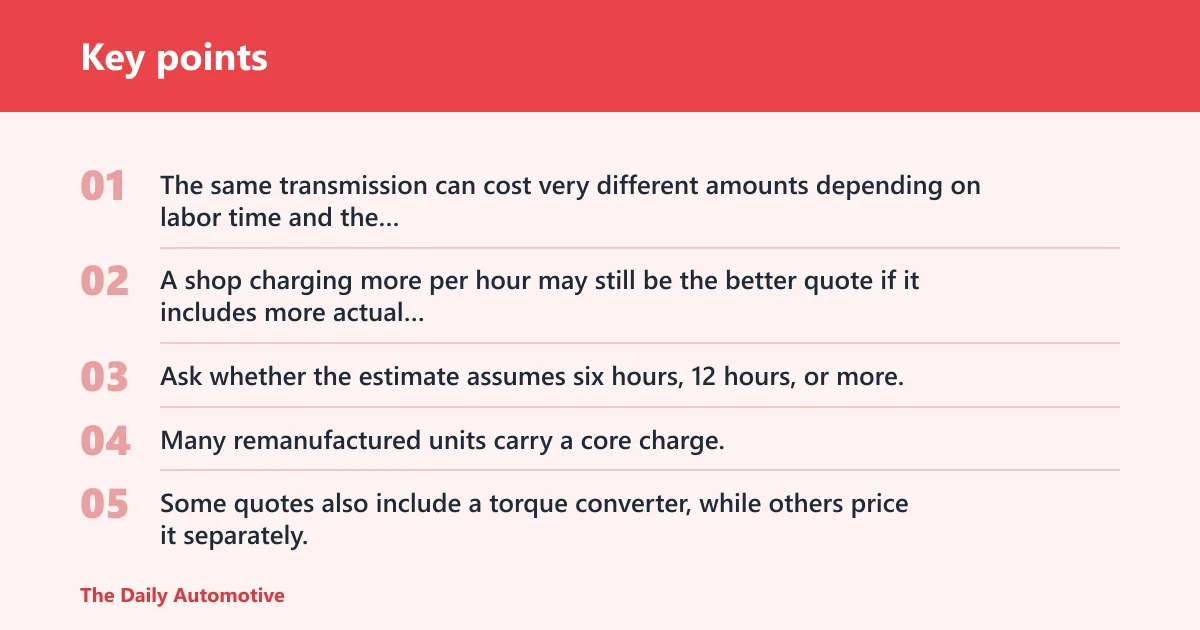
The same transmission can cost very different amounts depending on labor time and the local rate. A shop charging more per hour may still be the better quote if it includes more actual work, warranty coverage, or required setup. Ask whether the estimate assumes six hours, 12 hours, or more.
Core charge and torque converter
Many remanufactured units carry a core charge, which is a refundable deposit tied to returning the old transmission. Some quotes also include a torque converter, while others price it separately. That single part can change the quote enough to make two estimates look similar when they are not.
Programming, fluid, seals, and cooler service
Many modern transmissions need programming or relearn after installation. That can add labor and shop time, and some shops list it as its own fee. Fresh fluid, a new filter, mounts, seals, axle seals, and a cooler flush may be recommended when the failed unit shed debris. That debris can damage the replacement if the cooler is not addressed.
A transmission fluid and filter service is often about $150 to $200, which can help frame the gap between routine service and replacement. It is not a fix for broken internal parts. If a shop suggests replacement, ask what failed and whether the case, cooler, and electronics were inspected.
Transmission quote checklist
| Unit type | Core charge | Labor hours | Shop rate | Fluid/filter | Cooler flush | Programming | Mounts/seals | Diagnostics | Towing | Warranty terms | Total out-the-door price |
|---|---|---|---|---|---|---|---|---|---|---|---|
| Used/salvage | Often none | 6-12 | Ask for hourly rate | Verify included | Verify included | Often extra | Often extra | Ask if billed separately | Ask if included | Short warranty common; labor may not be covered if it fails | Should include every charge before approval |
| Rebuilt/remanufactured | Usually applies | 6-12 | Ask for hourly rate | Often included | Often recommended | May be separate | Common add-ons | Ask if billed separately | Ask if included | Usually the longest warranty among aftermarket options | Compare after core return and add-ons |
| New OEM | May apply | 6-12 or more | Dealer rate often higher | Verify included | Often recommended | Often required | Common add-ons | Ask if billed separately | Ask if included | Check mileage limit and labor coverage | Use the final total, not the parts line alone |
Use this table to force each shop to quote the same work. If one estimate includes a torque converter, cooler flush, programming, and mounts while another does not, the lower number is not really lower.
Which replacement option fits your car?
The best fit depends on vehicle value, how long you plan to keep it, and the type of transmission. Used units are the cheapest, rebuilt and remanufactured units sit in the middle, and new OEM units are the most expensive. The right choice changes with mileage and how long the vehicle needs to stay on the road.
Used or salvage
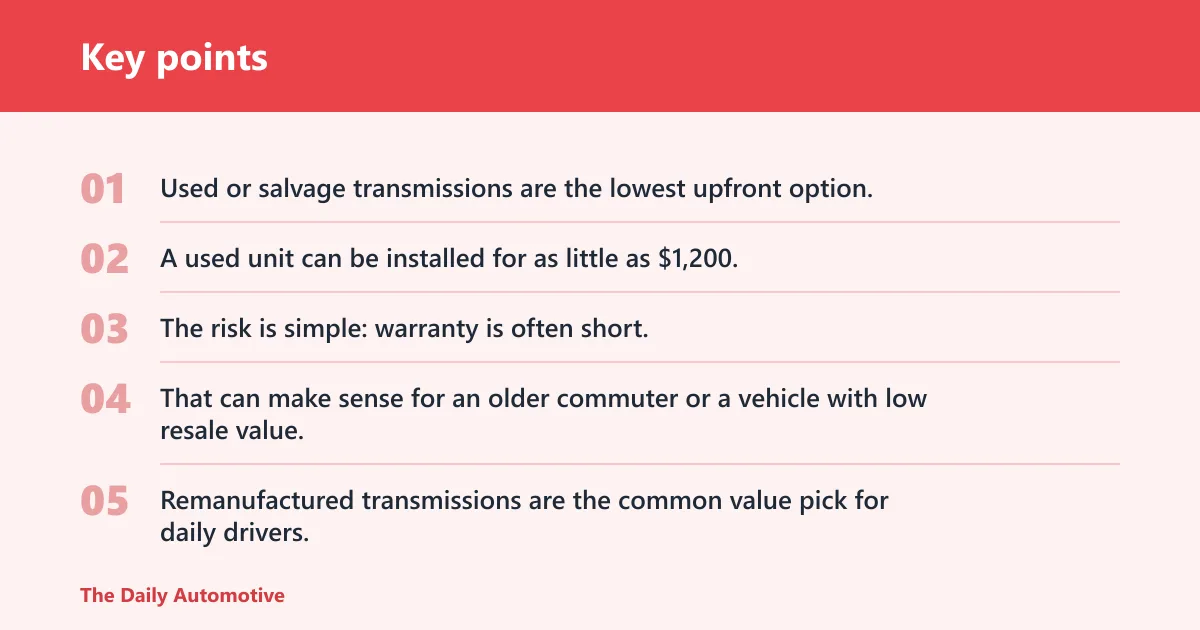
Used or salvage transmissions are the lowest upfront option, often about $1,200 to $2,500 installed. A used unit can be installed for as little as $1,200. The risk is simple: warranty is often short, and labor may not be covered if the unit fails later.
That can make sense for an older commuter or a vehicle with low resale value, but it is a poor fit when the car still has significant value or the transmission family is known for repeat problems.
Rebuilt and remanufactured
Remanufactured transmissions are the common value pick for daily drivers. Independent-shop remanufactured replacements often land around $3,000 to $5,000, and the typical installed range is also $3,000 to $5,000. A typical reman installed transmission is about $3,900.
Factory-style remanufacturing is a major price driver because the unit is disassembled, inspected, and brought back to spec with updated parts where needed. These units usually carry the longest warranty among aftermarket choices, which matters if you plan to keep the vehicle.
New OEM
New OEM transmissions typically cost $5,000 to $8,000+ installed, and dealer pricing can push totals much higher. A new OEM dealer unit often runs $5,000 to $8,000 or more. This option makes the most sense for newer or high-value vehicles, or when the owner wants factory parts and the strongest support.
Say your 2022 SUV needs a transmission and the quote is near half the vehicle’s value. A new OEM unit may still be sensible if the rest of the vehicle is in good shape and you expect several more years of use. On a ten-year-old commuter, the same quote is harder to justify.
Repair or replace: what is cheaper?

Repair can be the better choice when the fault is limited to a solenoid, valve body, sensor, clutch pack, or torque converter. Replace when internal damage is widespread, metal contamination is present, or the case itself is compromised. The right call depends on diagnosis, not panic.
When a repair may be enough
A bad sensor, worn solenoid, or valve body problem can mimic a failed transmission. If the fluid is clean enough, the case is sound, and the failure is isolated, repair often costs far less than a full swap. That is where diagnosis pays for itself.
A common first-timer mistake is approving a replacement after a rough-shift complaint without asking for the failed component. If the issue is only electronic, the transmission assembly may be intact.
When replacement is the smarter choice
Once the unit has heavy debris in the pan, slipping across multiple gears, or repeated loss of drive, replacement starts to make more sense. If the quote plus the repair history approaches the car’s market value, you need a hard financial decision, not a hopeful one.
Use the car’s value against the full installed quote, not the parts number alone. A $4,500 transmission on a $6,000 vehicle is a different decision from the same quote on a $20,000 vehicle.
Is a CVT transmission more expensive?
Yes, CVT quotes often land higher because many shops replace them instead of rebuilding them, and coverage can vary by manufacturer and VIN. CVT repair is common in Nissan, Honda, and Subaru models, so the quote can look different from a conventional automatic even when the car is similar in size.
Why CVT quotes often land higher
CVT units are sensitive to fluid condition, calibration, and internal wear patterns. That makes diagnosis and replacement more expensive in many cases, and the parts market is narrower. When a CVT fails, replacement is often the practical path rather than an internal rebuild.
Coverage limits and manufacturer differences
Warranty terms vary by maker and VIN, so do not assume a CVT is covered the same way as a conventional automatic. Check mileage limits, whether labor is included, and whether the warranty is honored nationwide. Those details matter more than the word “warranty” on the estimate.
For reference, a Honda Civic CVT total installed cost is listed at $3,200 to $4,900, while a BMW 3 Series replacement is higher, at $5,600 to $8,800. A Ford F-150 or Chevrolet Silverado 1500 reman installed total is listed at $4,400 to $6,700.
What should be in a fair quote?
A fair quote lists the unit type, labor hours, shop rate, core charge, fluid, cooler work, programming, mounts, seals, diagnostics, towing, and warranty terms. If those items are missing, the estimate is incomplete. Apples-to-apples comparison only works when every shop quotes the same scope.
How to compare three quotes apples-to-apples
- Match the unit type first: used, rebuilt, remanufactured, or new OEM.
- Check whether the quote includes the torque converter.
- Confirm labor hours and the posted shop rate.
- Verify programming, relearn, cooler flush, mounts, and seals.
- Ask whether diagnostics and towing are included.
- Compare warranty length, mileage cap, labor coverage, and who honors it.
- Use the final out-the-door number after core return, taxes, and shop fees.
Warranty details to check in writing
Do not stop at the warranty length. Ask whether the coverage applies only to parts or to parts and labor, whether the mileage cap starts at installation or purchase, and whether another shop can honor it if you travel. Short warranties are common on used units and more protective on remanufactured ones.
Dealer pricing is usually higher than independent-shop pricing, but the quote may also include more setup and a stronger warranty. Price alone does not settle the question.
Frequently asked questions
How much transmission replacement cost
Transmission replacement cost varies by unit type, labor time, and vehicle layout. Used units are cheaper, and new OEM units can move well above $8,000 installed.
Is replacing a transmission expensive?
Yes. It is one of the larger repairs most drivers face because the unit is expensive, labor is long, and add-ons are common. Labor generally takes six to 12 hours, and the final bill often includes fluid, programming, seals, and sometimes a cooler flush or torque converter.
Transmission rebuild vs replace cost
Rebuild and replace can overlap in price, but remanufactured units often give the clearest value comparison. Independent-shop remanufactured replacements often land around $3,000 to $5,000. Rebuilds can be cheaper or similar, but the details matter more than the label because warranty, parts quality, and labor coverage vary.
Cost of new transmission vs rebuilt
The new unit usually costs more because it is factory fresh and often tied to dealer pricing. For many daily drivers, remanufactured is the better value.
How much does transmission repair cost?
Transmission repair can range from a modest electronic fix to a major internal job. If the problem is a solenoid, sensor, valve body, or torque converter, repair may be far cheaper than replacement. Once the unit has internal damage or debris, the quote can move close to full replacement pricing.
Is it worth replacing a transmission?
It is usually worth replacing only when the car still has enough value and expected life to justify the bill. Compare the full installed quote against the vehicle’s market value and planned use. If the repair is under about 60% of replacement and the case is sound, repair often wins.
Products related to this article
Sponsored / affiliate links. As an Amazon Associate I earn from qualifying purchases. I may earn additional commission from eligible campaigns.