Center Differential Review: Is It Worth It?
Locking the center differential makes sense only when you need maximum front-to-rear traction and can live with tighter turning, more drivetrain bind, and worse road manners. For mixed street use, a selectable or reversible setup usually wins. Done badly, it can scrub tires, stress axles and transfer cases, and make snow or wet pavement harder to control. This review breaks down when locking the center diff pays off, when it does not, and which setups are easiest to undo.
Verdict


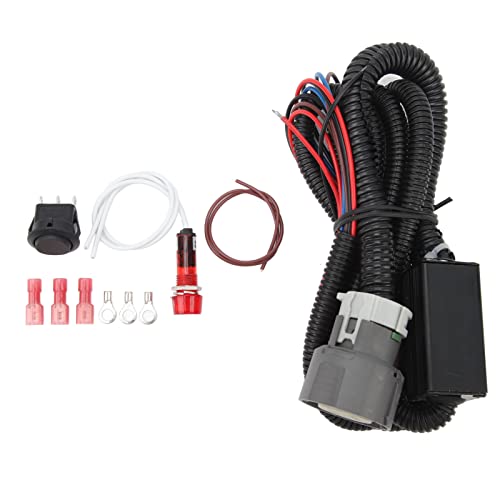
The product examples below are differential-lock hardware rather than true center-differential parts, so they are a poor match for a general center-differential buyer. For a daily driver, the tradeoff is hard to justify. For a drag or off-road project, it is a more defensible buy.
Pros and cons
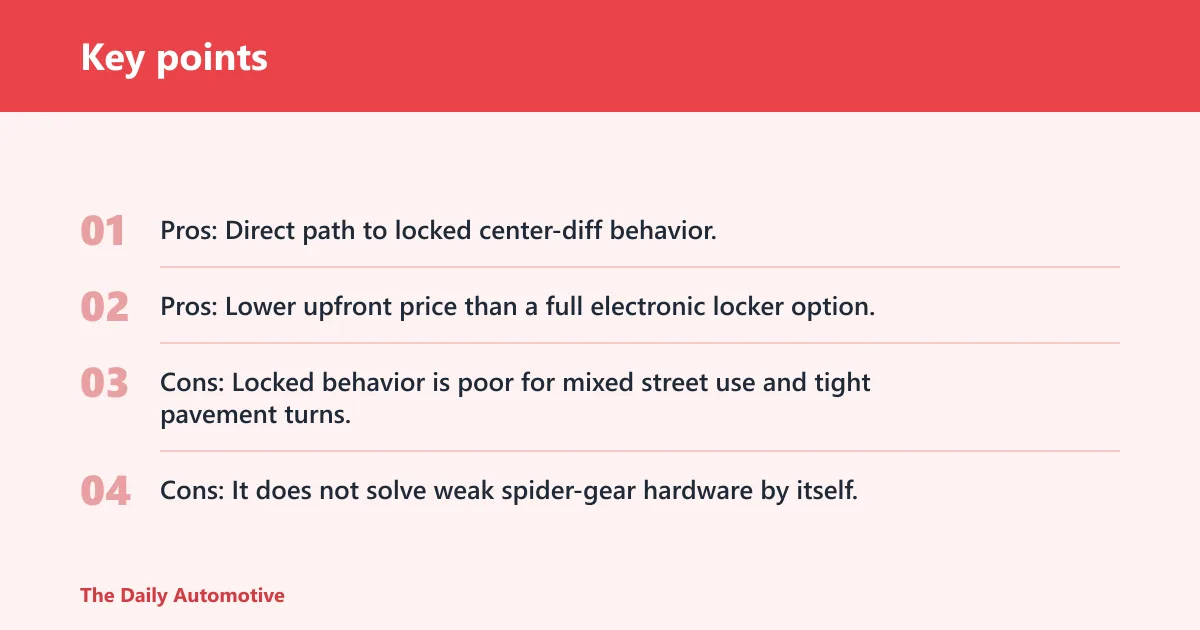
- Pros: Direct path to locked center-diff behavior; useful where maximum traction matters more than turn-in comfort.
- Pros: Lower upfront price than a full electronic locker option.
- Cons: Locked behavior is poor for mixed street use and tight pavement turns.
- Cons: It does not solve weak spider-gear hardware by itself.
Specs at a glance
| Product | Brand | Price | Best for | Key drawback |
|---|---|---|---|---|
| Alloy USA Differential Lock Kit 451100, Fits 1987-1995 Jeep Wrangler YJ | Alloy USA | $92.74 | Dedicated traction-focused builds that need a locked center-diff solution | Locked behavior can hurt street manners and cornering |
| EATON 19818-020 Eaton Elocker4 Differential 27 Spline 3.73 Ratio Dana 30 | Eaton | $1,449.99 | Drivers who want selectable traction rather than a permanent lock | Higher price and model-specific fitment need careful checking |
Who it
A locked center differential is for owners who care more about straight-line traction than calm street driving. That usually means a drag car, an off-road build, or a snow commuter that sees short, controlled stretches of low-grip driving. It is a poor fit if your vehicle spends most of its life on dry pavement, in parking lots, or in tight urban turns.
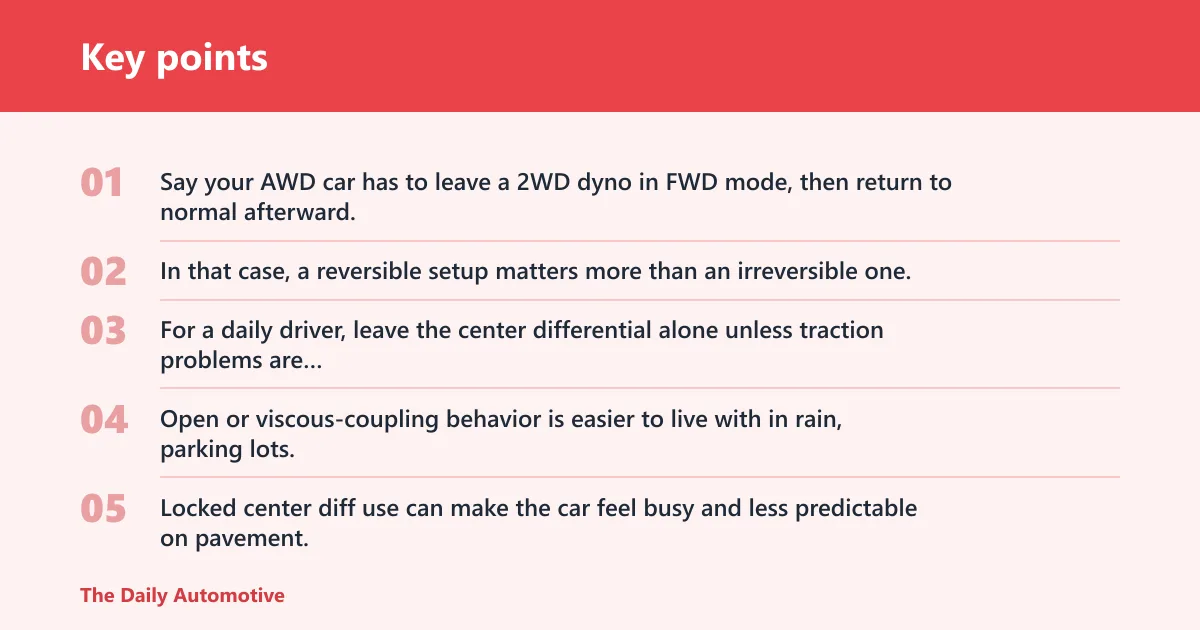
Say your AWD car has to leave a 2WD dyno in FWD mode, then return to normal afterward. In that case, a reversible setup matters more than an irreversible one, because the car needs to change roles without major teardown.
Daily driver
For a daily driver, leave the center differential alone unless traction problems are severe and the vehicle has a clear secondary role. Open or viscous-coupling behavior is easier to live with in rain, parking lots, and U-turns. Locked center diff use can make the car feel busy and less predictable on pavement.
Drag car
A drag car can benefit from a locked center differential because launch traction matters more than cornering comfort. A fixed split can help keep both ends working during hard acceleration. If the car only sees strip duty, reversibility matters less than strength and simplicity.
Snow commuter
A snow commuter sits in the middle. Locking the center diff can help when the surface is slick and traction is uneven, but it can also make the car less agreeable once the roads clear. For mixed winter driving, a selectable or removable setup is usually the safer compromise.
Off-road build
An off-road build is the strongest fit for lockup because loose dirt, rocks, mud, and cross-axle traction loss are exactly where a locked center diff helps. If pavement use is occasional, the street penalty is easier to accept. For dedicated trail use, reversibility is less important than durability.
What a center differential does
A center differential sits in the AWD drivetrain and manages the front-to-rear torque split. When it is open, it lets the front and rear shafts turn at different speeds, which matters in turns and on uneven grip. When it is locked, it pushes both ends to act together, which can improve traction but can also create bind on pavement.
AWD vehicles typically have three different differentials, and the center unit is the one that ties the two axles together. That is why its behavior changes the whole car, not just one axle. Lock it and the system behaves more like a rigid link. Leave it open and traction can still be limited when one end loses grip.
Open versus locked behavior
Open behavior is easy to live with on pavement because the front and rear can rotate at different speeds in a corner. The downside is traction loss when one end has less grip. Locked behavior fixes that by forcing more equal drive to both ends, but the penalty shows up as tire scrub, extra noise, and driveline stress when the vehicle is turning on high-traction ground.
Viscous coupling and LSD-style behavior
A viscous coupling is not the same as a mechanical LSD, and it does not behave like a simple lock. It can help limit speed differences between the front and rear sections, but its response depends on the system and the amount of slip. Without the viscous coupling, the center diff would be an open differential. That matters because a mild slip-control device is often easier to live with than a hard lock.
What works
Locking the center differential works best when low-grip traction matters more than street manners. Snow, mud, loose dirt, and hard launches are the classic examples. On a drag strip, locking the center can help the car leave harder because both ends are being asked to work together instead of letting one end spin away the available torque.
In a low-grip launch, an open center diff can let more torque go to the end with less resistance. A locked center diff reduces that split and can make the car feel more planted during launch or recovery.
FWD-mode testing and AWD dyno setup
A VCE exists in part because some AWD cars need to run in FWD mode on a 2WD dyno. The article notes that a VCE can often be installed and removed in under about 30 minutes, though the process may require dropping the transfer case and/or driveshaft. That makes it useful when the goal is temporary configuration, not permanent conversion.
- Confirm whether the vehicle needs a temporary FWD setup for dyno testing.
- Check whether the transfer case and/or driveshaft must be removed.
- Choose a lock method that matches how often the car must return to stock behavior.
- Inspect the center diff hardware, especially the spider gears, before locked use.
- Verify the vehicle manual before altering drivetrain configuration.
Snow and low-traction use
Does a locked center differential help in snow? Yes, when the surface is slippery enough that one axle starts to spin away the available grip. The benefit is strongest in deep snow, packed snow, and mixed-traction situations. The downside is that the same lock can make the car less forgiving once you are back on dry pavement.
What does not?
Locked center diff behavior does not belong on dry pavement as a casual daily setup. The car may feel as if it is fighting itself in tight turns, especially in parking lots or during slow U-turns. That is the classic driveline bind problem. Tire scrub and extra stress are part of the package.
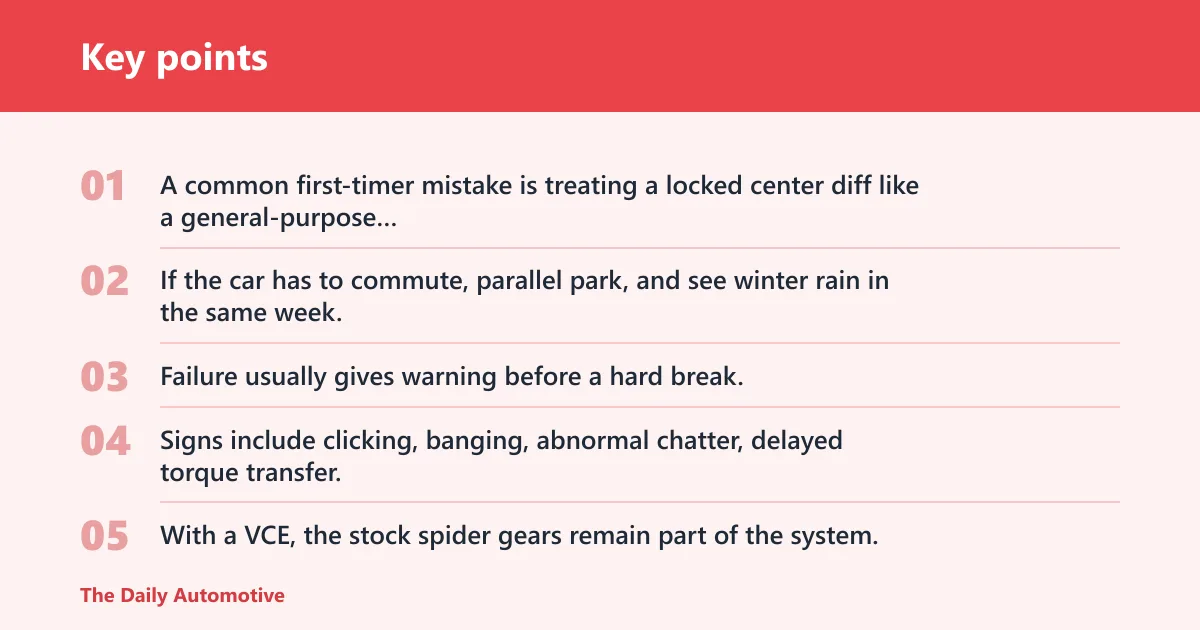
A common first-timer mistake is treating a locked center diff like a general-purpose traction upgrade. It is not. If the car has to commute, parallel park, and see winter rain in the same week, the better answer is often a reversible or partial-control setup instead of a hard lock.
Failure signs and spider gear risk
Failure usually gives warning before a hard break. Signs include clicking, banging, abnormal chatter, delayed torque transfer, or debris in the fluid. With a VCE, the stock spider gears remain part of the system, so they become a weak point under locked use. A 4-spider gear upgrade is worth noting if the build will live locked for long periods.
Welded center diff setups are especially unforgiving because they are irreversible. That makes them suitable only for dedicated use cases. A blown core can be used for welding, which keeps a good core off the bench, but that does not reduce the street penalty.
Center differential decision matrix
| Use case | Traction gain | Street manners | Reversibility | Installation effort | Failure risk | Recommendation |
|---|---|---|---|---|---|---|
| Daily driver | Low to moderate | Best left stock; lockup hurts tight turns and parking-lot behavior | High if you stay stock or use VCE; low with weld | Low if untouched; moderate for reversible kits | Low in stock form, higher if locked on pavement | Leave it alone unless the car has a narrow winter or motorsport job |
| Drag car | High on launch | Poor to fair, depending on whether it still sees street miles | Moderate with spool or VCE; none with weld | Moderate to high, depending on the method | Moderate, especially if spider gears stay stock | Lock it if the car is strip-first and pavement use is limited |
| Snow commuter | Moderate in deep or mixed snow | Fair in snow, poor on dry pavement | High with VCE; moderate with spool | Low to moderate | Moderate if lockup is used on clean roads | Choose a reversible setup, not a permanent weld |
| Off-road build | High in mud, rocks, and loose climbs | Usually acceptable if pavement time is short | Moderate with spool or VCE; low with weld | Moderate | Moderate to high if the center section stays stock | Lockup makes sense, with a durability check first |
Alternatives
The three main lock methods are different in one important way: whether you can undo them. That matters as much as traction. A permanent solution is fine for a dedicated vehicle. A reversible one is better when the same car has to commute, dyno, or switch roles between seasons.
Welded center differential
Welding the center differential creates an irreversible lock. It is the simplest hard-lock path for a dedicated build, and it can use a blown core. That makes it cheap in donor terms, but expensive in street comfort. Once it is welded, the vehicle is committed to locked behavior.
Spool
A spool locks the center diff from the inside and is reversible. It requires a good core, which matters if you want to return the vehicle to normal operation later. Compared with welding, it keeps the door open for future changes, but it still behaves like a hard lock when installed.
Viscous coupling eliminator
A VCE locks the center diff from the outside. It can be installed and removed in under 30 minutes, and it is commonly used so an AWD car can run in FWD mode on a 2WD dyno. It still relies on the stock spider gears, so it is not a complete durability fix by itself.
Open diff versus LSD-style behavior
An open differential can let the end with less grip take a disproportionate share of the available torque in low-traction situations. That is the baseline to compare against. LSD-style behavior gives you partial control by allowing some slip while improving traction, which is why viscous couplings are often easier to drive than a hard lock. For many mixed-use cars, that middle ground is enough.
Should you buy it?
Buy a center-diff lock solution only when the use case justifies the street penalty. If the car is mostly a daily driver, leave the center differential alone or choose a reversible setup. If the car is a drag, off-road, or dyno-oriented build, lockup can be worth the traction gain.
Reversibility should guide the choice. Welded setups are for dedicated vehicles. Spools are better when you want a hard lock but may want to undo it later. VCEs are the most practical when temporary configuration matters, especially for AWD dyno work or short-term FWD mode use.
Cost matters too. The two products here sit at very different price points, and that difference reflects different goals. The Alloy USA kit is the lower-cost, dedicated-style option. The Eaton locker is the expensive route when you want selectable behavior rather than a permanent compromise.
Frequently asked questions
What is a center differential?
A center differential is the AWD component that manages torque between the front and rear axles. It lets the two ends rotate at different speeds in a turn, which reduces bind. Locked behavior gives more equal drive, while open behavior is smoother on pavement but weaker when traction is uneven.
Is a center differential worth it for daily driving?
Usually no, at least not in locked form. Daily driving asks for easy cornering, predictable parking-lot behavior, and low driveline stress. A locked center diff can add tire scrub and bind that make ordinary commuting less pleasant. A reversible or stock setup is usually the smarter choice.
Does a locked center differential help in snow?
Yes, especially when snow depth or mixed grip causes one axle to spin more than the other. Locking the center can keep both ends working together. The tradeoff is that the same setup can feel less cooperative on dry pavement, so the benefit is strongest for winter-specific use.
Can you drive with a locked center differential on pavement?
You can, but it is not ideal. On high-traction pavement, a locked center diff can create driveline bind, tire scrub, and extra stress during tight turns. Short trips are one thing. Long-term street use is another. That is why permanent lockups are usually reserved for dedicated vehicles.
What is the difference between a spool, welded center diff, and VCE?
A welded center diff is an irreversible lock. A spool locks the center diff from the inside and can be reversed later. A VCE locks from the outside and can be removed in under 30 minutes. The VCE still uses the stock spider gears, so durability depends on the rest of the hardware.
Does a center differential affect traction front to rear?
Yes. It is the part that determines how torque is shared between front and rear in an AWD drivetrain. Open behavior can let the path of least resistance dominate. Locking it forces a fixed split.
Is a center differential better than an open differential?
For traction, a center diff with some control is often better than a plain open setup because it can limit how much power escapes to the easier end. But “better” depends on the job. Open behavior is friendlier on pavement; locked or LSD-style behavior is better when traction loss is the real problem.
Products related to this article
Sponsored / affiliate links. As an Amazon Associate I earn from qualifying purchases. I may earn additional commission from eligible campaigns.