How Mindfulness Improves Your Driving Experience Calmly
Mindfulness can help some drivers stay more focused on the road, ease rumination after a trigger, and turn a red light, cutoff, or tailgater into a brief reset before reacting. Ignore that, and small commute irritations can become speed changes, hard braking, or a sourer drive that lasts long after you park. This guide explains the driving habits, cue-based resets, and simple attention checks that make commutes calmer and safer.
What mindfulness means on the road

On the road, mindfulness means paying attention on purpose, in the present moment, and without judgment. In plain driving terms, that means noticing traffic, speed, mirrors, body tension, and emotion without letting one irritation steer the next decision.
Mindfulness and meditation are not the same thing
Mindfulness is the skill of present-moment awareness. Meditation is one way to build it. You can practice mindfulness while seated, walking, standing, or moving, so a driver can use it before a trip, at a stop, or after parking without turning the drive itself into a formal meditation session.
Jon Kabat-Zinn’s wording is still the cleanest working definition for drivers: paying attention on purpose, in the present moment, and without judgment. That matters because driving demands fast perception and quick judgment, but the mind often tries to relive the last merge or rehearse the next meeting.
Why present-moment attention matters for driving
Driving asks for attention that stays with the lane, the signal, the gap, and the speed around you. A wandering mind can miss a braking pattern, a late lane change, or a pedestrian at the edge of the crosswalk. Mindfulness does not replace defensive driving; it supports it by reducing mental drift.
Mindfulness is also not relaxation. It can reduce stress, but the point is clearer contact with what is happening now, not zoning out. That distinction matters in traffic, where dull calm is less useful than alert steadiness.
📊 A study of 144 nurses examined mindfulness, emotion regulation, and sleep over two weeks. Source: New Research Reveals How Mindfulness Improves Your Sleep.
How can mindfulness help you drive better?
Mindfulness can help driving by reducing rumination, which is repetitive negative thinking, and by improving emotion regulation when traffic gets slow or rude. It can also improve focus and performance, but it does not make bad weather, fatigue, or impatient driving safe. The gain is usually in steadier reactions, not perfect trips.
Why a wandering mind matters in traffic
Commutes create easy triggers: a missed turn, a merging bottleneck, a late pickup, or a driver cutting across a lane. Once the mind starts replaying the problem, reaction time shifts from the road to the story in your head. That delay is where rough braking, tailgating, or a missed gap can start.
Mindfulness helps people respond appropriately rather than simply react emotionally. A study of 144 nurses examined mindfulness, emotion regulation, and sleep over two weeks, and linked mindfulness to fewer negative emotions and less rumination. The driving lesson is narrow but practical: less mental replay can leave more attention for the next safe choice.
What mindfulness can and cannot change behind the wheel
Mindfulness can lower the chance that a honk, delay, or bad merge turns into a bigger reaction. It can also help you notice anger earlier, before it leaks into steering, speed, or lane choice. It cannot control traffic, erase a bad commute, or make a tired driver alert again.
Say your usual 18-minute commute starts with a construction lane closure. Instead of replaying the delay for the next 10 minutes, a short reset at the first stoplight can keep the problem from spreading into the rest of the drive.
What changes when your attention stops drifting?
When attention stops drifting, you catch more of the small signals that shape safe driving: brake lights, gaps, speed changes, and tension in your own grip. The practical win is not mystical calm. It is fewer lost seconds spent on rumination and fewer snap reactions under pressure.
How stress narrows your response options
Stress can narrow attention. In traffic, that can mean fixating on one rude driver or one late appointment while ignoring the broader scene. Mindfulness helps widen the pause between trigger and reaction, which gives you more than one response: slow down, hold lane, breathe once, or wait for the next safe opening.
That pause matters most when the road is noisy, crowded, or stop-and-go. A mind locked on irritation tends to oversteer emotionally. A mind that notices irritation can still choose the next legal and safe action.
Why brief reset moments matter before reactions turn risky
Brief reset moments work because they happen before anger becomes a lane change, a horn blast, or a hard acceleration. A 5-second check at a red light is small, but it is long enough to interrupt a loop of rumination and short enough to stay inside normal traffic flow.
Picture a driver behind a truck in slow traffic, hands tight on the wheel, jaw clenched, and the next exit three minutes away. A single reset can turn that moment from “I can’t stand this” into “Hold lane, breathe once, leave room.”
Can mindfulness make you a calmer driver?
Yes, but only in a limited sense. Mindfulness can make commutes calmer by reducing rumination and improving emotion regulation, which helps prevent small triggers from turning into sharp reactions. It cannot remove every stressor, and it should never be treated as a substitute for rest, route planning, or defensive driving.
How it can reduce rumination during commutes
Rumination is repetitive negative thinking and worrying. During a drive, it often sounds like replaying a meeting, a text, or a delay from earlier in the day. Mindful breathing, even for a few breaths, can bring attention back to the breath and away from the loop without needing a long practice.
Mindful breathing means noticing the natural breath without changing it. That makes it useful as a low-distraction anchor before the drive or at a complete stop. It is not a command to breathe deeper, faster, or in any dramatic pattern while moving.
How it supports emotion regulation under traffic stress
Emotion regulation matters when someone cuts in, traffic stalls, or a merge lane compresses into one open gap. Mindfulness does not delete irritation. It helps keep irritation from steering the car. That is useful because calmer responses can reduce the odds of escalation, abrupt motion, or lost attention.
Common first-timer mistake: trying to calm down by closing the eyes at a stoplight. That is too risky for driving. A safer move is to keep eyes open, keep the car stopped, and use one short breath check or one body-softening cue instead.
Which mindfulness practices fit driving, and which do not?
Short, low-distraction practices fit driving best. Mindful breathing can be used as a brief anchor. Body scan belongs before or after the trip. Mindful movement can be done as you walk to and from the car. Anything that needs closed eyes, extended inward focus, or full attention away from traffic does not belong while the vehicle is moving.
Mindful breathing as a brief anchor
Use the breath as a focal anchor for one to three natural breaths at a stop. Notice the inhale and exhale, then return attention to traffic. If the mind wanders, bring it back. That is the practice. Keep it short enough that you remain fully aware of signals, cross traffic, and pedestrians.
Body scan before or after the drive
A body scan focuses attention on bodily sensations and is useful for noticing tension and discomfort. Do it before you start the engine or after parking, when you can sit without needing to watch the road. It can help you notice clenched shoulders, a tight jaw, or fatigue that should change the plan.
Mindful movement on the way to and from the car
Mindful movement can involve noticing the sensation of each step during a walk. That makes the walk from office to parking lot, or from the car to home, a good place to settle the mind before the drive begins or after it ends. It also gives your attention a clean transition point.
Practices to avoid while the vehicle is moving
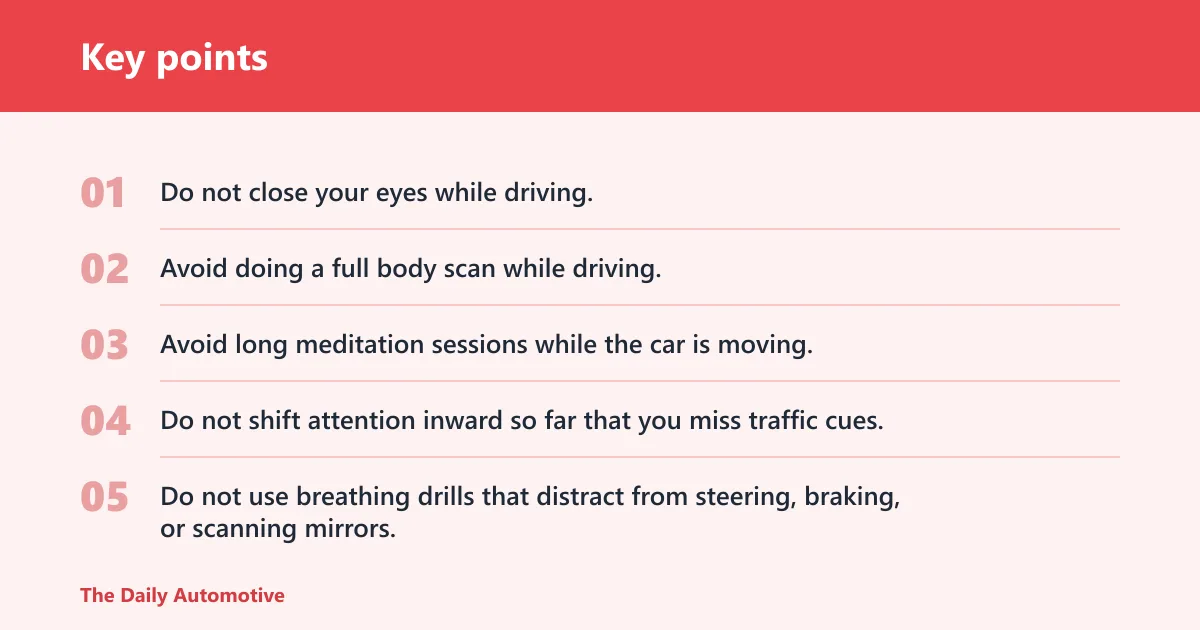
- Do not close your eyes while driving.
- Avoid doing a full body scan while driving.
- Avoid long meditation sessions while the car is moving.
- Do not shift attention inward so far that you miss traffic cues.
- Do not use breathing drills that distract from steering, braking, or scanning mirrors.
Use this commute mindfulness checklist
Use this checklist as a driving-specific reset plan. It keeps mindfulness tied to exact commute moments: before you start, at a red light, in slow traffic, and after parking. The goal is shorter reaction time spent on rumination, not a longer in-car wellness routine.
| Commute moment | Do this | Avoid this while moving |
|---|---|---|
| Before you start the engine | Pause briefly, check your jaw, shoulders, and grip, then take a few natural breaths. | Starting the trip while already replaying an argument or checking messages. |
| At red lights and full stops | Notice one breath, one body sensation, and the next traffic cue. | Eyes-closed exercises, phone use, or a long inward scan. |
| In slow traffic and merge lanes | Relax hands slightly, lengthen the following distance you can safely keep, and say one neutral cue: “Wait for space.” | Changing lanes out of frustration or using the stop-and-go time to rehearse the day’s stress. |
| After parking and before the next task | Do a short body scan, notice any tension, and leave the car without carrying the last traffic event into the next room. | Jumping out while agitated and bringing the commute into the meeting, home, or school pickup line. |
- Before departure: set the route, silence nonessential alerts, and check if you are already tense.
- At the first stop: take one breath and name the current condition, such as “late,” “crowded,” or “hot.”
- During congestion: keep the car moving only as traffic allows, and use one short reset instead of argument rehearsal.
- After parking: release your grip, scan shoulders and face, and let the drive end before the next task starts.
How do you handle anger, lateness, and overload without reacting?
Handle them with short resets that fit the road situation. For anger, notice the body before it turns into a move. For lateness, choose a calm next action instead of speed. For overload, reduce input when safe and keep attention on the lane, the gap, and the next legal decision.
A short reset for tailgating pressure
If a driver is too close behind you, do not fixate on the insult. Keep steady speed when safe, increase your own following distance where traffic allows, and return attention to mirrors and road position. One or two natural breaths at a stop can keep the pressure from turning into retaliation.
A short reset for running late
Lateness can trigger a rush that leads to missed exits or aggressive lane changes. The safer reset is simple: accept the time pressure, choose the next legal opening, and stop narrating the delay. Mindfulness is useful here because it reduces the mental replay that makes haste worse.
A short reset for noise, heat, or crowded roads
Noise, heat, and dense traffic can overload attention. If safe, lower the cabin load, keep the breath natural, and narrow your goal to the next block, exit, or stop. You do not need to solve the whole commute while your nervous system is already on edge.
What is the difference between mindfulness and meditation?
Mindfulness is the capacity to pay attention on purpose, in the present moment, and without judgment. Meditation is a method that can train that capacity. For drivers, the distinction matters because mindfulness can be used in very short moments around the drive, while meditation is better kept to parked, seated time.
Can mindfulness help with commuting anxiety?
Yes, it can help with commuting anxiety by reducing rumination and supporting calmer responses to stress triggers. But it is not a cure, and it should not be used to push through fatigue or panic while driving. If anxiety is severe, the safer step may be changing the commute plan.
Frequently asked questions
Can mindfulness reduce road rage and stress while driving?
It can reduce the stress and reactivity that feed road rage, especially when you catch irritation early. It is not a cure, and it cannot stop other drivers from acting badly. The useful part is the brief gap it creates between the trigger and your response.
What mindfulness exercises can you do in the car?
In the car, keep it to short, low-distraction tools: a few natural breaths at a stop, a quick notice of shoulder tension, or a simple cue such as “hold lane.” Save body scans, longer meditation, and anything eyes-closed for before or after the trip.
Does mindfulness improve focus while driving?
It can improve focus by training present-moment attention and reducing mental replay. That matters when traffic, time pressure, or boredom pull your mind away from the road. It does not make inattention safe, so the basic driving habits still have to come first.
Is mindful breathing safe to do while driving?
Brief mindful breathing can be safe if it stays low-distraction and does not pull your eyes or attention away from traffic. Use natural breaths at a stop or a brief attention check while moving. Anything that requires closed eyes, counting for long periods, or deep inward focus should wait.
How do you stay present on long or stressful drives?
Break the drive into small road-based checkpoints: the next light, the next exit, the next safe gap. Use each stop as a reset point, not a refuge from the road. That keeps attention tied to what matters now, which is where safe driving happens.
Products related to this article
Sponsored / affiliate links. As an Amazon Associate I earn from qualifying purchases. I may earn additional commission from eligible campaigns.