The Psychology of Road Rage and Driving Behavior Guide
Road rage usually starts as a four-step chain: trigger, interpretation, body arousal, behavior. Cut it off at interpretation or arousal, and you can stop aggressive driving before it starts. Left alone, it can lead to crashes, tickets, license points, and a fast fight-or-flight reaction behind the wheel. This guide explains the psychology of road rage and the exact interruption points drivers can use before anger turns into action.
What is road rage in driving psychology?
In driving psychology, road rage is an anger-and-threat response that can stay internal or spill into dangerous behavior. It is not the same as aggressive driving, which is the outward act. A driver can feel intense rage without acting on it, or act aggressively without full-blown rage.
Road rage vs. aggressive driving vs. criminal behavior
Road rage describes the emotional state. Aggressive driving describes the behavior, such as tailgating, honking, cutting off, or brake-checking. Road-rage behavior can cross into criminal conduct when retaliation turns into assault, property damage, reckless driving, or another offense. The categories overlap, but they are not identical.
Why the same traffic event does not affect every driver the same way
The same merge, delay, or horn blast can land differently depending on sleep, time pressure, prior stress, and personality. A driver with spare time may shrug it off. A driver already running late, tired, and overheated may read the same event as a challenge and react much faster.
How psychology studies this problem
Psychology treats road rage as behavior shaped by biological, cognitive, and environmental forces. Temple’s psychology major is a 123-credit bachelor’s degree, its curriculum emphasizes the scientific basis of psychology, and it includes biological bases of cognition and behavior. Temple is also classified as an R1 research institution. (temple.edu)
Its psychology PhD offers four areas of study: clinical psychology, cognition and neuroscience, developmental psychology, and social psychology. Temple also offers an optional emphasis in human neuroimaging and behavioral neuroscience, plus a concentration in Quantitative Methods. Its research guide points students to APA PsycInfo, which covers material from 1806 to the present, and Web of Science for highly cited science and social science journals. (guides.temple.edu) (temple.edu)
📊 Temple’s psychology major is a 123-credit bachelor’s degree. Source: Psychology Major.
Why do people road rage?
People road rage because a trigger is read as a blocked goal or a threat, which pushes the body into fight-or-flight and makes control harder. The frustration-aggression hypothesis explains why traffic delay, lane cutting, and perceived disrespect can turn irritation into anger and, sometimes, retaliation.
Blocked goals and the frustration-aggression hypothesis
If the goal is to get to work, a stalled lane or slow merge feels like an obstacle. The frustration-aggression hypothesis says blocked goals increase anger and can increase aggression. On the road, that can show up as tailgating the slow driver, honking repeatedly, or swerving to punish a merge.
Hostile attribution bias: reading intent into ambiguity
Hostile attribution bias is the habit of assuming another driver meant harm. A late lane change may be a mistake, not a slight. A brief drift in speed may reflect distraction, not disrespect. When the brain treats ambiguity as provocation, anger rises before the facts are clear.
The amygdala, prefrontal cortex, and sympathetic nervous system
The amygdala helps detect threat and drives emotional reactivity. The prefrontal cortex supports judgment, inhibition, and self-regulation under stress, but it works less well when a driver is fatigued or overloaded. The sympathetic nervous system then adds racing heart, muscle tension, and narrowed attention, which can make a snap reaction feel automatic.
What triggers road rage most often?
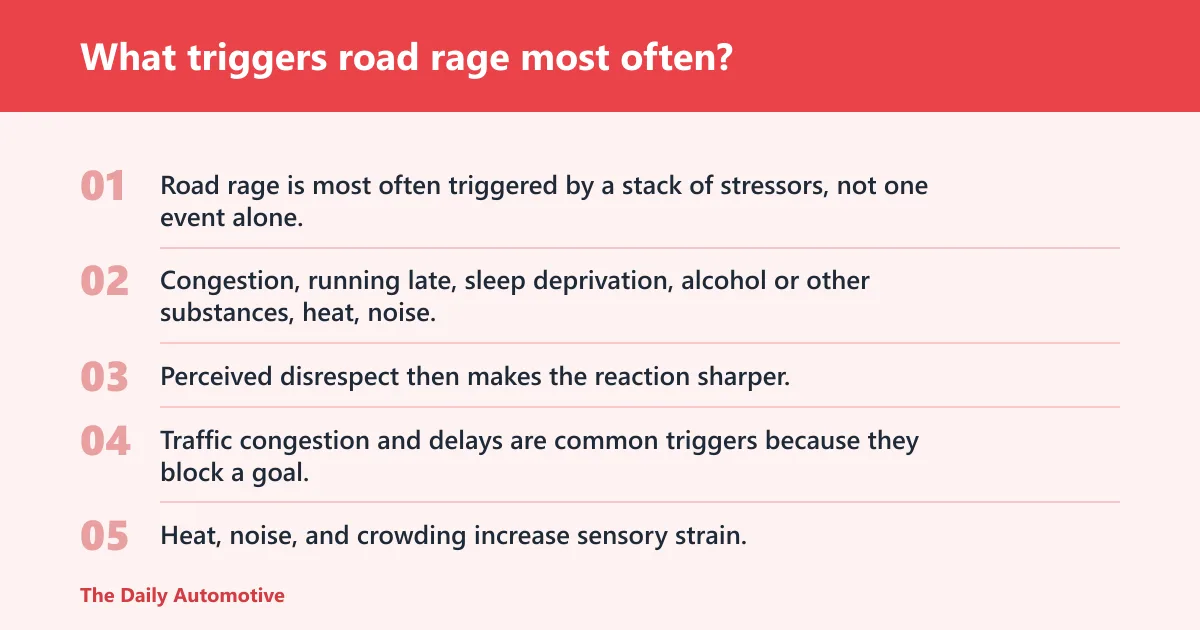
Road rage is most often triggered by a stack of stressors, not one event alone. Congestion, running late, sleep deprivation, alcohol or other substances, heat, noise, crowding, and prior stress load can all lower patience and speed up anger. Perceived disrespect then makes the reaction sharper.
The trigger stack in real traffic
Traffic congestion and delays are common triggers because they block a goal. Running late adds urgency. Sleep deprivation lowers inhibitory control. Alcohol or substances reduce judgment. Heat, noise, and crowding increase sensory strain. When several of these stack up, even a minor cut-in can feel personal.
Perceived disrespect: tailgating, cutting off, and lane changes
Drivers often react hardest to behaviors that seem intentional: tailgating, cutting off, and abrupt lane changes. Those moves can feel insulting even when they are not meant that way. The danger is that a felt insult invites retaliation, which raises the risk of a crash or confrontation.
Why low sleep and high stress make reactions faster and harsher
Fatigue reduces the time gap between trigger and action. High stress narrows attention so the brain notices the threat signal and misses alternatives. That is why a tired commuter may honk sooner, accelerate harder, or follow too closely after a small mistake by another driver.
Trigger-and-intervention matrix for real driving situations
| Driver type | Trigger | Likely cognitive distortion | Body cue | Risky behavior | Safest countermove |
|---|---|---|---|---|---|
| Commuter | Traffic jam plus being late | “They are wasting my time on purpose.” | Racing heart, jaw tension, tight grip | Tailgating, horn use, cutting off | Drop speed by 5 to 10 mph, create space, accept a later arrival |
| Rideshare or commercial driver | Schedule pressure and repeated stops | “Every delay is a threat to earnings or ratings.” | Shoulder tension, shallow breathing, tunnel vision | Hard braking, abrupt merges, verbal threats | Reset after each stop: one slow breath cycle, mirror check, wider following gap |
| Anxious driver | Sudden honk, close pass, crowded merge | “This driver is trying to start something.” | Clenched stomach, trembling hands, narrowed attention | Overcorrecting, braking hard, staring back | Keep eyes forward, hold lane, reduce speed smoothly, plan an exit if needed |
How stress affects aggressive driving
Stress changes both the body and the decision process before the driver notices it. Heart rate rises, attention narrows, and the brain becomes more likely to treat a driving problem as a threat. That makes aggressive driving more likely, especially when fatigue or substances are also in the picture.
What the body feels before the behavior changes
Common body cues can include a racing heart, a warm face, tight shoulders, a clenched jaw, and faster breathing. These are signs that the sympathetic nervous system is active. When those signs appear, the driver is already closer to an impulsive response than the calm mind assumes.
How narrowed attention and faster reactions raise risk
Narrowed attention makes the driver lock onto the offending car and miss the larger traffic picture. Faster reactions can sound useful, but in anger they often become harsher reactions. The result may be tailgating, lane blocking, or a sudden brake check that surprises everyone behind.
Why fatigue and alcohol or substances make self-control worse
Fatigue weakens the prefrontal cortex’s inhibitory control. Alcohol and other substances add another layer of poor judgment and slower correction. Put simply, tired or impaired drivers are less able to pause between feeling provoked and doing something risky.
How can careful driving reduce road rage?
In practice, cautious driving may reduce road rage by avoiding common triggers, calming the body, and giving your thinking brain more time to stay in control. Smooth spacing, early lane planning, and realistic time buffers cut the chance that a small delay becomes a personal conflict.
Practical habits that lower trigger exposure
- Leave earlier if you can, keep a bigger following distance, and avoid driving when you are sleep deprived, intoxicated, or highly agitated.
- Keep a larger following distance.
- Use the lane and route with the fewest last-second decisions.
- Avoid driving when sleep deprived, intoxicated, or already highly agitated.
- Set expectations for delays before you start the trip.
Why careful driving helps the psychology, not just the traffic
Careful driving lowers the number of moments that can be read as disrespect. It also reduces the feeling of being trapped. Less trapping means less frustration, and less frustration means a lower chance that the nervous system will switch into a defensive, retaliatory mode.
How do you de-escalate road rage safely?
The first few seconds matter a lot in de-escalating road rage. Create space, stop signaling anger, and give the body time to come down before behavior follows. If the other driver keeps escalating, pull over when safe or contact authorities rather than trying to settle the conflict yourself.
The first 10 seconds after a trigger
- Relax your grip and stop looking for eye contact.
- Do not gesture back or shout.
- Increase following distance if you can do so safely.
- Take one slow breath in and a longer breath out.
- Shift attention to speed, lane position, and the next legal exit.
What not to do
Do not answer a horn with a hand signal. Do not chase. Do not brake-check. Do not cut off the other driver to “teach a lesson.” Those actions move the event from irritation to aggression and can turn one mistake into a chain reaction.
When to pull over and when to call authorities
Pull over in a safe, public place if you need to reset and the situation is not actively dangerous. Call authorities if another driver is following you, threatening you, or trying to force contact. If you feel trapped, keep driving to a populated area and avoid stopping in an isolated location.
What are the effects of road rage on accidents and legal risk?
Road rage raises crash risk because it pushes drivers toward tailgating, abrupt lane changes, hard braking, and attention loss. It also creates legal exposure. What begins as anger in traffic can become reckless driving, assault, or property damage, especially if a retaliatory move causes contact or injury.
How aggression raises crash risk
Aggressive driving reduces space and time. Tailgating leaves no buffer. Cutting off shortens reaction time. Brake-checking turns a normal gap into a sudden hazard. Intentional ramming is even worse, because it can cause injury, multi-car collisions, and immediate police involvement.
What conduct can become a criminal offense
Road rage can cross into criminal behavior when the driver uses the vehicle as a threat or weapon, or exits the car to confront another person. Assault, reckless driving, and property damage are all possible outcomes. Legal consequences depend on the conduct, not on whether the driver felt justified.
Why retaliating turns a traffic conflict into a legal one
Once retaliation starts, the event is no longer only about bad manners or frustration. A second driver, a witness, or a police officer may see reckless conduct that is independently punishable. A dashcam can also matter; Essex Police released dashcam footage in a road-rage case, and RT reported attackers forcing a car off the road three times before running at the target car on foot.
Frequently asked questions
why do people road rage
People road rage when a driving event is read as a threat, insult, or blocked goal. That reading activates the body’s stress system and narrows judgment. Fatigue, time pressure, heat, and prior stress make this more likely, which is why the same event does not provoke every driver.
what is true about road rage
What is true about road rage is that it can be internal without visible aggression, or it can spill into honking, tailgating, and worse. It is also predictable. Most episodes follow a chain: trigger, interpretation, body arousal, then behavior. Interrupting early is safer than reacting later.
what is road rage in driving psychology
In driving psychology, road rage is an acute anger-and-threat response in traffic. It is different from general aggression because it is tied to the driving context and often starts with blocked movement or perceived disrespect. The key issue is how the brain reads the event, not only what happened.
how does stress affect aggressive driving
Stress makes aggressive driving more likely by narrowing attention, raising physiological arousal, and reducing inhibition. A stressed or tired driver is quicker to assume hostile intent and slower to choose a calm response. That is why long commutes, poor sleep, and schedule pressure are such powerful amplifiers.
what triggers road rage
Common triggers include congestion, being late, sleep deprivation, alcohol or substances, heat, noise, crowding, and perceived disrespect such as tailgating or cutting off. These triggers matter most when several stack together. A single delay is often manageable; a delay plus fatigue and anger usually is not.
how do you de-escalate road rage safely
De-escalation starts in the first 10 seconds: stop gesturing, create space, keep your eyes forward, and lower your speed smoothly if needed. If the other driver is escalating, do not argue. Pull over only in a safe place, or call authorities if you are being followed or threatened.
Products related to this article
Sponsored / affiliate links. As an Amazon Associate I earn from qualifying purchases. I may earn additional commission from eligible campaigns.