The Social Aspects of the Automotive Lifestyle Explained
The automotive lifestyle is a social network built around shared identity, rites of passage, clubs, meetups, and car talk that turns ownership into belonging. Ignored, it can leave new drivers isolated, limit access to help and knowledge, and turn a car into a solo purchase instead of a community link. This guide explains how cars shape relationships, status, access, and local culture, plus where community forms around them.
What makes car ownership a social force?


Car ownership affects social life because it changes who can move, when they can move, and how far they can reach people, work, and services. It also signals identity. The page says car ownership shapes social life through independence for teenagers, mobility for dating couples, and shared meetups for enthusiasts, and that cars are now a central part of daily identity.
Independence, mobility, and access
A car can help widen access to jobs, medical appointments, late-night shifts, sports practice, and family visits. That matters most when transit is sparse, schedules are irregular, or destinations sit outside a walkable corridor. In those settings, the vehicle is transport, but it is also the key that makes participation possible.
Why the effect differs by place
Urban drivers often trade speed for parking fees, congestion, and longer trips across crowded streets. Suburban drivers may depend on a car for nearly every errand. Rural drivers often face the largest gaps in access to services, which makes car ownership feel less like a preference and more like a baseline requirement.
Why is the first car such a milestone?
The first car is a common milestone because it marks a shift from supervised movement to personal scheduling, peer access, and visible status. The page suggests a first car is often associated with teen independence, and that car availability and affordability may have helped people see cars as necessary. For many teens, that change carries social weight as much as practical value.
Freedom and status for teen drivers
Teen drivers often read the first car as proof of trust. It can mean the ability to reach school events, part-time work, and friends without asking for a ride. It also changes status inside a peer group, because mobility can translate into plans, inclusion, and a wider social circle.
Family rules shape the milestone
That milestone does not land the same way everywhere. Some families set tight limits on passengers, night driving, or trip length. In places with weak transit, the first car can arrive earlier as a practical need. In cities with strong rail or bus service, the emotional value may exceed the utility.
Say your teen gets a compact sedan and the commute to school is 12 miles each way. The car may make after-school clubs and a weekend job possible, but the family may still limit night driving until the driver builds experience. That is a social bargain, not only a transportation one.
How do cars change dating and relationships?
Cars shape dating because they create a private, mobile space for two people to talk, travel, and set the pace of a relationship. The page says dating couples found the car to be a private and mobile space, and that car ownership shapes social life through mobility for dating couples. That changes norms around pickup, timing, and where a date can happen.
The car as private mobile space
For new couples, the cabin can lower the social pressure of a crowded restaurant or a public sidewalk. It also adds control over the route, the music, and when the date ends. That privacy can support intimacy, but it can also blur boundaries when one person owns the car and the other depends on it.
New relationship norms
Pickup culture, shared road trips, and late-night drives all shape modern dating routines. In places with thin transit and tight parking, the car often becomes the default venue for early relationship logistics. That can be convenient. It can also create inequality if one person must always drive, pay, or wait.
What changes in dense cities
In crowded areas, the social value of a car can rise even as daily ownership becomes less attractive. Parking scarcity, towing risk, and traffic delays make each trip feel more expensive. Couples may use rideshare for dates, then reserve a private car for weekend escapes, grocery runs, or visits outside the city core.
How do clubs, meets, and online groups build car culture?
Car culture creates belonging through repeated contact: local meets, garage projects, forum threads, group chats, and social feeds where people compare parts, repairs, and styling choices. The page says cars enable shared meetups for enthusiasts. That turns ownership into a community with its own language, norms, and status markers.
Local meets and garage culture
Meetups give enthusiasts a place to inspect builds, swap advice, and compare maintenance decisions. The setting matters because the social reward is not only the car itself, but the conversation around it. A Saturday morning lot can function like a neighborhood club, with knowledge traded in plain view.
Forums, group chats, and social media
Online spaces let owners discuss wheel fitment, repair issues, paint care, and event plans without geography getting in the way. Social media also spreads identity faster than old club models did. A driver with a 20-year-old hatchback can find the same brand community as someone with a new performance coupe.
How belonging works across body styles
Belonging does not require a luxury badge or rare model. Owners of family vans, pickups, kei cars, and restored classics all build identity around what their vehicles do and what they signal. That breadth matters. It means car culture can include commuters, weekend builders, and first-time owners, not only collectors.
What jobs and industries grew around automobiles?
The auto sector created new jobs and spurred growth in parts and fuel supply industries, according to the page. That growth reached assembly plants, repair shops, dealerships, tire makers, glass suppliers, logistics firms, insurers, road builders, and service stations. Cars also changed where people work and how supply chains connect regions.
| Industry area | Social function | Why it matters |
|---|---|---|
| Assembly and manufacturing | Factory employment | Supports wages and local spending |
| Parts supply | Replacement and repair | Keeps older cars on the road |
| Fuel supply | Daily mobility | Connects stations, refiners, and freight |
| Repair and service | Maintenance access | Reduces downtime for work and family |
| Roads and parking | Infrastructure demand | Shapes land use and neighborhood design |
Why the auto sector links city and rural economies
Cars tie distant places together. A rural parts distributor may depend on city freight hubs, while city commuters depend on suburban parking lots and exurban road networks. That interdependence is one reason the car industry affects more than auto buyers. It reaches builders, mechanics, office workers, and delivery crews.
What is the social cost of driving more cars?
More driving brings tradeoffs: traffic congestion, lost time, parking pressure, noise, higher accident exposure, and a heavier public safety burden. The page says automobiles brought both benefits and challenges to society, and that traffic jams were experienced for the first time. It also says automobiles led to traffic accidents and fatalities.
Traffic congestion and lost time
Congestion is not only an inconvenience. It changes work start times, school drop-offs, caregiving routines, and the reliability of transit buses caught in the same queue. A jam turns time into a social cost because it steals it from family schedules, shift workers, and service appointments.
Parking pressure and neighborhood conflict
Parking scarcity can reshape how people use curb space, garages, and streets. In dense neighborhoods, that leads to tension over overnight parking, visitor permits, and delivery access. Noise, idling, and block-by-block competition for space can strain relationships between residents, businesses, and local officials.
Accidents and fatalities
Traffic accidents and fatalities are the clearest reminder that car access carries risk beyond maintenance and fuel. Every driver accepts a social tradeoff: more mobility in exchange for exposure to collision, injury, and loss. That tradeoff is especially serious for teens and for people who must drive long distances every day.
Suppose a family of five moves from a rail corridor to a suburb 18 miles from the nearest station. The car may cut trip time to grocery stores and after-school activities, but it also adds school-zone driving, parking costs, and more exposure to crash risk. The gain is real, and so is the bill.
How do the benefits differ for teens, couples, families, and enthusiasts?
The social value of driving changes by life stage. Teens often gain freedom and status. Couples gain privacy and flexible time together. Families gain access to errands, schools, and trips. Enthusiasts gain identity and community. The same car can meet all four needs, but rarely at the same time.
Teen drivers: freedom, risk, and supervision
Teens usually care most about independence. Why do teenagers value driving so much? Because it opens access to friends, work, and activities without relying on parents or limited transit. The downside is clear: inexperience, peer pressure, and a stronger need for rules on passengers, speed, and night travel.
Couples: privacy and routine travel
For couples, the car can be a private mobile space that supports conversation, errands, and short trips that fit into busy schedules. It can also create a routine in which one person drives more often. That is manageable, but it should be discussed early so convenience does not become imbalance.
Families and enthusiasts
Families often value cars for school runs, vacation travel, grocery loads, and care visits across town. Enthusiasts value them for craft, identity, and meets. One group uses the car to hold the week together. The other uses it to build a social world around a shared machine.
How does car ownership affect social life?
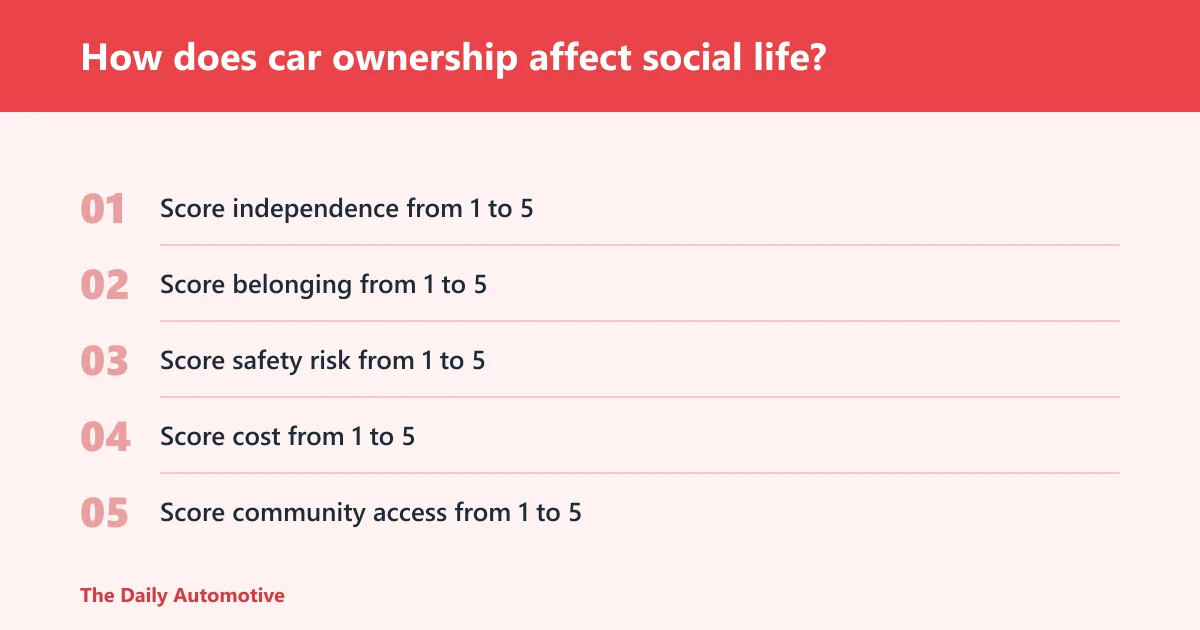
Car ownership affects social life by widening or narrowing access to people, work, and services. It can help teens gain independence, allow couples to travel privately, and let families manage crowded schedules. It also creates hierarchy, because those who can afford cars move more easily than those who cannot.
A practical social impact checklist helps you judge that tradeoff before the car becomes a default solution.
Social impact checklist
- Score independence from 1 to 5. Use 1 if the car adds little freedom, 5 if it is the main way to reach work, school, or care.
- Score belonging from 1 to 5. Use 1 if the car is isolated use, 5 if it connects you to clubs, family routines, or peer networks.
- Score safety risk from 1 to 5. Use 1 if trips are short and low stress, 5 if driving means night travel, heavy traffic, or inexperienced drivers.
- Score cost from 1 to 5. Include fuel or charging, insurance, parking, repairs, and time lost in congestion.
- Score community access from 1 to 5. Use 1 if transit, rideshare, and walking already cover most needs, 5 if the car is the only reliable bridge to services.
| Scenario | Independence | Belonging | Safety risk | Cost | Community access |
|---|---|---|---|---|---|
| Teen with first car in a suburb | 5 | 4 | 4 | 3 | 4 |
| Couple in a dense city with scarce parking | 3 | 3 | 3 | 5 | 2 |
| Family in a rural area | 5 | 3 | 3 | 4 | 5 |
| Enthusiast who attends monthly meets | 4 | 5 | 3 | 4 | 4 |
How to use the checklist by segment
For teens: weight safety and supervision heavily. A first car should increase access without creating unnecessary exposure. For couples: judge whether privacy justifies parking friction and shared costs. For families: focus on access to school, care, and work. For enthusiasts: separate community value from total ownership cost.
What are the social benefits of car culture?
Car culture offers belonging, shared knowledge, and access to wider networks of people. It can help shy owners find a niche, give new drivers practical guidance, and create routines around meets, repairs, and road trips. The strongest benefit is social connection, not horsepower.
Shared identity without one mold
Car culture can include commuters, restorers, off-road drivers, and people who simply enjoy learning how things work. That variety matters because it lowers the entry barrier. You do not need a rare car to join a conversation. You need interest, time, and a willingness to learn.
What are the negative social effects of automobiles?
The negative effects include traffic congestion, accident risk, parking conflict, noise, and a stronger divide between those with reliable access and those without it. Automobiles can also pull attention and money away from other mobility options, which changes how communities organize daily life.
Access and inequality
When car ownership becomes the default, people who cannot drive, cannot afford a car, or cannot absorb repair bills can end up isolated. That affects job searches, school schedules, and family visits. In that sense, the social cost is not only traffic. It is exclusion.
How did automobiles change cities and suburbs?
Automobiles influenced the way people travel, work, and live, and the page says small towns and suburbs began to grow. Cars made it easier for people to live farther from jobs and stores, which helped suburban growth and changed where daily life happens. Cities then had to respond with roads, parking, and congestion control.
Urban and rural communities
In urban areas, the car often competes with transit, cycling, and walking for space and attention. In rural areas, it can be the main link to essential services. That split explains why the same vehicle can feel like a burden in one zip code and a lifeline in another.
Modern pressures: rideshare, EVs, and parking
Rideshare changes the social role of ownership by letting some people skip full-time car costs while still reaching events and dates. EVs shift daily rituals toward charging instead of fueling. Parking scarcity pushes many city residents toward shared mobility, which weakens the old assumption that every household needs its own car.
What jobs and industries grew because of cars?
Assembly work, repair, parts supply, fuel distribution, logistics, insurance, road building, and parking management all expanded around the car. The page says the auto industry created new jobs and spurred growth in parts and fuel supply industries. Those jobs connect factory floors to family errands and freight routes.
Why this still matters
Even when the vehicle count changes, the surrounding system remains large. Mechanics, tow operators, warehouse workers, and road crews still depend on car-centered demand. That is one reason the automotive lifestyle is social and economic at the same time.
Why do teenagers value driving so much?
Teenagers value driving because it opens mobility, privacy, and peer access at a stage of life where those things carry extra weight. A car can mean freedom from parent schedules, better access to work and events, and a stronger sense of status among friends. It also brings real responsibility.
Frequently asked questions
Why is the first car such a big milestone?
The first car matters because it often marks a move from dependence to self-directed movement. For teens, that can mean work, school, and social plans without asking for a ride. It also signals trust and responsibility, which is why families often treat it as a step, not a gift.
Products related to this article
Sponsored / affiliate links. As an Amazon Associate I earn from qualifying purchases. I may earn additional commission from eligible campaigns.