What Does Ci Mean on BMW? Coupe Injection Explained
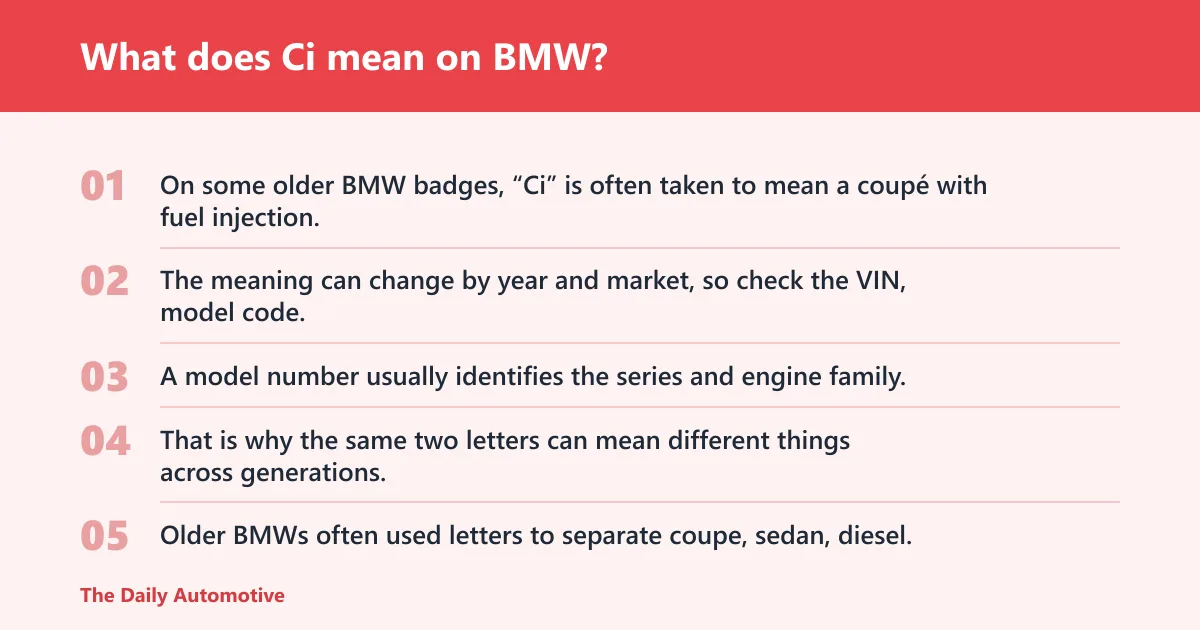
On some older BMW badges, “Ci” is often taken to mean a coupé with fuel injection, though the exact meaning can vary. The meaning can change by year and market, so check the VIN, model code, or build sheet before you treat it as body style or engine setup.
What does Ci mean on BMW?


How BMW badge naming works
BMW badges have never used one fixed code. A model number usually identifies the series and engine family, while suffix letters can point to body style, drivetrain, market language, or fuel-system history. That is why the same two letters can mean different things across generations.
Older BMWs often used letters to separate coupe, sedan, diesel, and long-wheelbase versions. Modern cars rely more on the model number plus drivetrain markers such as xDrive, while the engine itself is often less obvious from the badge alone.
Is BMW Ci the same as coupe?
Often, yes, but not in a simple one-to-one way. On many older BMWs, Ci appeared on two-door coupé versions, so the badge strongly signals a coupe body style. Still, the badge alone cannot identify every car, because BMW naming changed by market and era.
Coupé versus coupe spelling
BMW and many other automakers use both spellings depending on the market. “Coupé” is the original French spelling; “coupe” is the anglicized version. In practice, BMW listings and enthusiast references may use either form for the same two-door body style.
Body style matters more than the letters alone. A two-door BMW 3 Series from the early 2000s may wear Ci, while a similar market in another region may describe the car differently in paperwork even when the metal badge looks identical.
Why body style is the safer clue
Say your BMW has frameless windows, two side doors, and a sloping roofline. That points to a coupé, even before you read the trunk badge. The badge helps, but the body shape and the factory designation are the stronger checks.
Does BMW Ci mean fuel injection?
Yes, in older BMW usage, Ci can also be read as “injection,” because fuel injection mattered when carburetors were still common enough to distinguish in a badge. That reading fits older models particularly well, but it is not a universal rule for every BMW with Ci on the back.
Why injection appeared in badges
When fuel injection was a feature worth calling out, manufacturers used letters to tell buyers the car had it. On BMWs, that helped separate injected engines from earlier or lower-spec versions. Once injection became standard, the letter lost much of its usefulness.
That is why Ci can mean two things in older BMW context: coupé body style and injected engine. The ambiguity is exactly why year and model family matter. A badge on a 1970s or 1980s car should not be read the same way as one on a 2000s 3 Series.
Where the injection reading fits, and where it does not
On many later BMWs, Ci was used more as a model-family suffix than as a literal fuel-system label. By that point, injection was already the norm, so the badge often functioned as shorthand rather than a technical description of a single component.
Which BMW models used the Ci badge?
The Ci badge appeared most visibly on BMW coupé variants, especially the 3 Series in the late 1990s and early 2000s. Examples such as 320Ci and 330Ci are often seen, and the badge typically marked a two-door version with a particular engine setup for that generation.
BMW 3 Series Ci examples
On the E46 3 Series, 320Ci and 330Ci were common coupé designations in many markets. In that era, the number identified the model tier, while Ci pointed to the coupé body style and the naming system BMW used then. The exact engine varied by year and region.
For example, a 330Ci in one market could use the M54 inline-six family, while the same badge in another market year may align with a different calibration or equipment set. The badge alone does not tell the full story.
Other BMW families and market-specific use
Ci did not belong only to the 3 Series. BMW used similar suffix logic on other coupe models in some markets and eras, though the pattern was never perfectly uniform. That is why a model-code check beats guessing from the rear emblem.
A common first-timer mistake is reading “Ci” as if it always means the same thing as on a modern spec sheet. On older BMWs, the badge can be a blend of body-style shorthand and engine-era language, not a single clean definition.
How BMW naming works now
Modern BMW badges are less about one suffix carrying multiple meanings and more about a mix of model number, drivetrain marker, and market packaging. Ci is far less common now, because BMW generally identifies body style and drivetrain with different naming logic than it used in older decades.
What current badges usually tell you
Today, a BMW badge may include the series number, xDrive for all-wheel drive, and letters that hint at engine family or trim strategy. The lettering is more standardized than older naming, but it still varies by region and model line.
That means a current BMW should not be decoded by an old Ci rule. If the badge does not match the paperwork, the VIN and model code settle the question.
Nearby badge confusion
- i often points to a gasoline model designation or, on newer cars, an electric model family.
- d usually indicates diesel.
- xDrive means all-wheel drive.
- Li typically marks a long-wheelbase sedan in some markets.
- CiA is not a standard BMW badge in most mainstream naming, so treat it as a market-specific or misread emblem until verified.
BMW badge decoder table
This one-page table gives a practical starting point. Use it as a guide, then confirm the exact car with the VIN, option list, or model code. Badge meanings change by year, and BMW market naming is not perfectly uniform.
| Badge suffix | Likely meaning | Era used | Body style | How to verify |
|---|---|---|---|---|
| Ci | Coupé, injection; on later cars, a coupé-related model suffix | Older BMW naming, especially late 20th century and early 2000s | Usually two-door coupé | Match VIN, model code, and factory build data to confirm both body style and engine family |
| CiA | Not a standard broad BMW suffix; may be misread or market-specific | Varies by market | Unknown until checked | Verify against the badge photo, VIN, and official model designation |
| i | Model designation or electric model family, depending on year | Long-running, with newer EV usage added later | Sedan, coupe, hatch, or EV-specific body | Check model year and BMW model line, since meaning shifts over time |
| d | Diesel | Common across many BMW eras | Any body style | Confirm through VIN decoding or the engine code on paperwork |
| xDrive | All-wheel drive | Modern BMW naming | Any body style | Check the drivetrain listing on the window sticker or build sheet |
| Li | Long-wheelbase variant | Market-specific, often sedan-focused | Usually sedan | Confirm wheelbase and trim code in the VIN lookup or dealer data |
How to verify your BMW badge from the VIN
The VIN is the most reliable way to confirm what a BMW badge means on a specific car. It identifies the exact model code, market, and build details, which is far more useful than trying to decode letters that changed meaning over time.
- Find the VIN on the car, paperwork, or registration.
- Read the model code or factory designation from a BMW VIN lookup or build sheet.
- Check whether the car is listed as coupe, sedan, convertible, or another body style.
- Match the engine family and transmission against the badge year.
- Confirm market-specific naming if the car was sold outside your region.
What to confirm on the car versus the paperwork
The rear badge tells you what BMW wanted to communicate publicly. The paperwork tells you what the car actually is. If the two disagree, trust the VIN decode and the build data, not the emblem.
Picture a 2001 BMW with a 330Ci badge, but the seller says it is “just a 330.” The VIN can resolve that immediately by showing the coupe body code, the engine family, and the market the car was built for.
When market or year differences change the answer
BMW naming has shifted over different generations. A Ci badge on an older European-market car may mean something slightly different from a badge on a North American example, even when the cars look similar. Year and market are part of the answer, not fine print.
Why do some older BMWs say 320Ci or 330Ci?
Those badges are classic examples of BMW’s older naming system. The number identifies the model tier, while Ci usually points to a coupé version with injected fuel delivery. On the E46-era 3 Series, that made sense to buyers because it separated the two-door car from the sedan.
What those badges usually meant by generation
On a 320Ci, the “320” tied the car to the 3 Series lineup and a lower-displacement engine family than a 330Ci. The “Ci” told the buyer it was the coupé version. The exact engine and output still depended on year and market.
That is why a badge can be helpful and incomplete at the same time. It often tells you the body style and general model family, but not every mechanical detail.
Does Ci still mean anything on new BMWs?
Not in the same way. Modern BMWs use a more standardized naming approach, and Ci is far less common as a current, universal badge. If you see it on a newer car, check whether it is a market-specific designation, a legacy badge choice, or a trim label rather than a direct technical code.
Current naming versus older naming
Older BMWs used badges to communicate more of the car’s identity at a glance. Newer cars often rely on the model family, drivetrain badge, and official configuration data. That makes modern naming easier in one sense, but less obvious if you are looking for the old Ci pattern.
Frequently asked questions
What does Ci mean on BMW?
On older BMWs, Ci most often means a coupé model with fuel injection, often read as “Coupé, injection.” The exact meaning depends on the year, model family, and market, so the badge should be confirmed against the VIN or model code instead of assumed.
Is BMW Ci the same as coupe?
Often, yes. Ci commonly appears on BMW coupé versions, especially on older 3 Series models. But it is safer to read it as a clue rather than a full identity, because BMW used suffixes differently across markets and model years.
Does BMW Ci mean fuel injection?
Sometimes. In older BMW naming, the “i” part of Ci can point to injection, which separated injected engines from older carbureted setups. In later eras, that reading became less literal, so the badge should not be treated as a technical fuel-system specification on its own.
Which BMW models used the Ci badge?
The best-known examples are 3 Series coupés such as the 320Ci and 330Ci, especially around the E46 era. BMW also used similar naming ideas on other coupé models in some markets, but the exact pattern changes by generation and region.
How can I tell what my BMW badge means?
Check the VIN, the factory build sheet, and the model code first. Then compare that information with the body style and the market where the car was sold. The badge is useful, but the VIN is the cleanest way to verify what the car actually is.
Does Ci still mean anything on new BMWs?
Only sometimes, and not in the old blanket sense. Modern BMWs usually rely on model numbers, xDrive, and other suffixes rather than Ci for broad identification. If a newer car wears Ci, treat it as market-specific or legacy naming until the paperwork confirms it.
Products related to this article
Sponsored / affiliate links. As an Amazon Associate I earn from qualifying purchases. I may earn additional commission from eligible campaigns.