Wheels for Ford Lightning: Sizes, Fit and Buying Guide
For a Ford F-150 Lightning, the safest wheel choice is usually a 20-inch wheel that keeps factory overall diameter, uses the 6×135 bolt pattern, and matches or exceeds OEM load ratings. Wrong fitment can cause rubbing, vibration, lower range, and overload a wheel that looks fine on paper. This guide covers sizes, offset, materials, load capacity, and which choices fit without hurting drivability.
What fits a Ford Lightning?
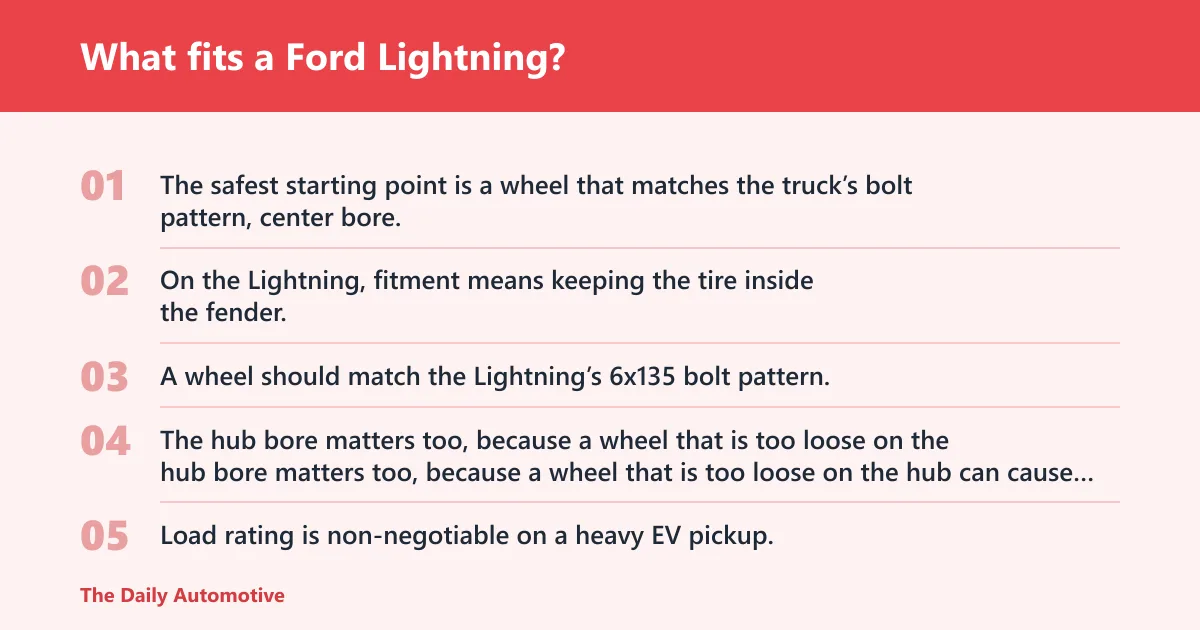
The safest starting point is a wheel that matches the truck’s bolt pattern, center bore, and load rating before you think about diameter or style. On the Lightning, fitment means keeping the tire inside the fender, clear of suspension parts, and close to factory rolling diameter so the truck drives as intended.
Start with bolt pattern, hub bore, and load rating
A wheel should match the Lightning’s 6×135 bolt pattern, meaning six lug seats on a 135 mm bolt-circle diameter. The hub bore matters too, because a wheel that is too loose on the hub can cause vibration unless you correct it with hub-centric rings. Load rating is non-negotiable on a heavy EV pickup.
That order matters. A nice-looking wheel with the wrong bore, wrong lug-seat shape, or a weak load rating can still be the wrong wheel. Ford truck fitment also depends on brake clearance, so barrel shape and spoke design should leave room for calipers.
Use diameter and width only after clearance is confirmed
For most buyers, 20-inch wheels are the practical center point because they preserve a stock-like overall diameter while leaving enough tire sidewall for comfort and impact absorption. Smaller diameters can add sidewall and comfort, while larger diameters can sharpen steering feel but reduce cushion and raise the chance of curb or pothole damage.
Width changes tire choices and clearance. A wider wheel can support a broader contact patch, but it also increases the chance of rubbing at full lock, on compression, or with a lower-profile tire. A narrower wheel is easier to package, but it may not suit every tire size you want.
How wheel size changes ride, range, and handling
Increasing wheel diameter usually means less tire sidewall. That often makes impacts feel sharper and can hurt comfort on rough roads, while also raising the risk of wheel damage from potholes. Larger wheels can still look cleaner and feel more direct, but the tradeoff is real.
Wheel and tire diameter also affect speedometer accuracy and effective gearing. If the outside diameter grows, the truck travels farther per revolution, so the speedometer may read low and acceleration can soften slightly. If diameter shrinks, the opposite happens. Keep overall tire diameter close to factory when possible.
Decision rule: choose the smallest wheel diameter that clears the brakes and gives you the tire sidewall you want, then verify load rating and total tire diameter before ordering.
📊 Mounted wheel and tire packages receive a 10-point quality-control inspection. Source: Rimsoutlet.
What wheel size fits a Ford Lightning?
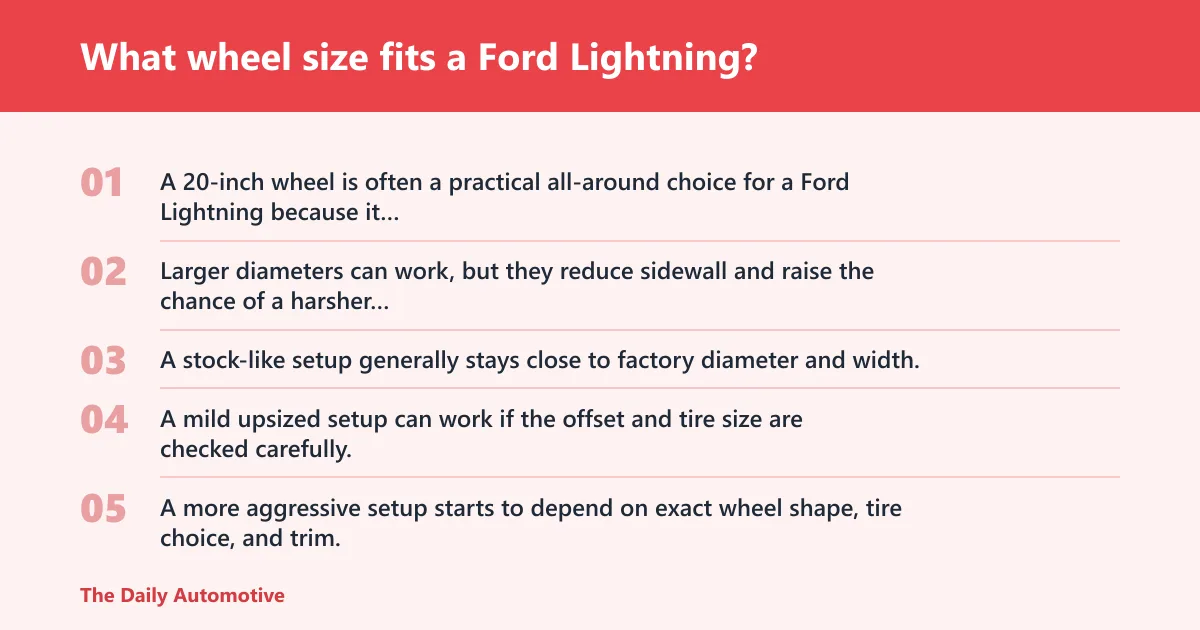
A 20-inch wheel is often a practical all-around choice for a Ford Lightning because it can keep the rolling diameter close to factory and leave enough tire sidewall for comfort, load support, and curb protection. Larger diameters can work, but they reduce sidewall and raise the chance of a harsher ride or tire damage.
Common size bands and what they do
A stock-like setup generally stays close to factory diameter and width, which helps preserve ride quality, speedometer accuracy, and brake clearance. A mild upsized setup can work if the offset and tire size are checked carefully. A more aggressive setup starts to depend on exact wheel shape, tire choice, and trim.
| Wheel size band | Width | Offset range | Tire-sidewall change | Likely outcome |
|---|---|---|---|---|
| Stock-like | 20×8.5 to 20×9 | Near factory spec | Minimal change | Best for daily use, speedometer accuracy, and low rub risk |
| Aggressive but safe | 20×9 to 20×10 | Slightly lower than stock, but not extreme | Modest sidewall loss | Works with careful tire selection and full-lock checks |
| High-risk | Wider than 20×10 or very tall diameter | Strongly negative or heavily pushed out | Large sidewall loss or major diameter increase | More rub risk, vibration risk, and possible load issues |
Say your Lightning is still on factory suspension and you want a 20×9 wheel with a tire close to original diameter. That is the kind of setup that usually keeps drivability intact. Push that same wheel much farther out or fit a shorter sidewall, and the margin for error drops fast.
How width and diameter change the truck’s behavior
Width changes steering response because it changes tire support. A wider wheel can make the truck feel quicker to turn in, but it also narrows the list of tires that fit correctly. Diameter changes the sidewall. Less sidewall usually means less cushion and more feedback from the road.
If you change tire diameter, expect changes in effective gearing. A taller tire can make the truck feel slightly taller geared and may soften low-speed punch. A shorter tire can do the opposite. Keep the total outside diameter close to stock unless you are ready to handle the tradeoffs.
Decision rule: if you want the least drama, stay close to factory diameter and keep width conservative; if you go wider or taller, treat tire selection and clearance checks as part of the purchase, not after it.
What bolt pattern does a Ford Lightning use?
The Ford F-150 Lightning uses a 6-lug pattern, and the wheel must match that pattern exactly. The usual fitment is 6×135, which means six bolts arranged on a 135 mm bolt circle. A wheel with the wrong pattern will not mount safely, no matter how close everything else looks.
Why the bolt pattern is only the first filter
Matching the bolt pattern is necessary, but not enough. You still need the right center bore, lug-seat type, and load rating. A wheel may bolt on and still vibrate if the hub fit is wrong or if the lugs do not seat correctly.
TPMS sensors also matter. If you replace wheels, you may need compatible sensors or transfer the existing ones. Many packages also require the correct valve hardware, and the wheel seller should state what is included before checkout.
Fitment parts that people miss
Hub-centric rings can correct a wheel whose center bore is larger than the hub. They are not a cure for bad offset or a weak wheel, but they can reduce vibration when the wheel otherwise fits correctly. That is why a wheel that is lug-centric only can feel loose at speed if the hub support is poor.
Hardware quality matters too. If the wheel uses a different lug-seat style than stock, you may need the right nuts. TPMS sensors should match the wheel package so the warning light does not become a surprise after installation.
Decision rule: match 6×135 first, then verify hub bore, lug seat, TPMS compatibility, and hardware before you pay for tires or mounting.
What offset should you run on Ford Lightning wheels?
Offset controls how far the wheel sits inboard or outboard relative to the hub face. Positive offset pulls the wheel inward, zero offset centers it more, and negative offset pushes it outward. On a Lightning, the wrong offset can cause fender poke, suspension contact, or steering lock rub.
Positive, zero, and negative offset in plain terms
Positive offset usually keeps the tire tucked in closer to the suspension. That helps fender clearance, but too much positive offset can crowd the inside of the wheel well or interfere with calipers and control arms. Zero offset moves the wheel outward compared with many factory truck wheels.
Negative offset increases track width and pushes the wheel face outward. That can look aggressive, but it also raises scrub, adds load to wheel bearings, and makes rub at the fender lip more likely. If you want that look, verify clearance at full compression and full steering lock.
When a spacer is not a substitute for the right wheel
Wheel spacers can change track width, but they do not fix the wrong wheel width, a poor barrel shape, or the wrong load rating. They also add another interface that must be torqued correctly. If a wheel needs a spacer to fit, a wheel with a better offset is usually the cleaner answer.
Picture a 20×9 wheel with too much positive offset. It may clear the outside fender but rub the inside at full lock. Add a spacer, and you move the whole assembly outward, which may solve one problem while creating another. That is why offset should be selected before the wheel is bought.
Decision rule: choose the offset that preserves both inner and outer clearance without forcing a spacer, then check full steering lock and suspension travel.
Fitment decision table: stock-like, aggressive, or high-risk
This table turns fitment into a decision rule, not a style choice. The same wheel size can be safe on one Lightning and a problem on another if the offset, width, or tire diameter change too far. Always verify against your trim and brake package.
| Category | Wheel width | Diameter | Offset tendency | Tire-sidewall change | Likely result |
|---|---|---|---|---|---|
| Stock-like | 8.5-9 inches | 20 inches | Near factory | Near factory | Best chance of no rub, correct speedometer behavior, and familiar ride quality |
| Aggressive but safe | 9-10 inches | 20 inches | Slightly reduced positive offset | Slightly shorter sidewall | Possible fit with careful tire choice, but requires a rub check and load verification |
| High-risk | Over 10 inches | 22 inches or larger | Low or negative offset | Much shorter sidewall or large diameter change | Higher risk of rubbing, vibration, reduced comfort, and a speedometer error |
Decision rule: if a setup moves into the high-risk column, stop and check caliper clearance, fender contact, suspension travel, and tire load rating before buying.
Which wheel material is best: steel, alloy, or forged?
Steel wheels are usually the toughest low-cost choice, cast aluminum alloy is the common middle ground, and forged alloy is the lightest and strongest per pound. The right pick depends on whether you care more about price, weight, or durability under heavy use.
Steel wheels and when durability matters more than weight
Steel is heavy. That extra mass can work against acceleration and steering response, but it also makes steel a practical choice for work-truck duty, winter use, or drivers who value low replacement cost. Steel can also be easier to live with when curb rash is likely.
The downside is clear: more unsprung weight and less crisp response. If range, braking feel, or quick turn-in matter, steel is usually not the first choice.
Cast aluminum alloy as the common middle-ground choice
Cast aluminum alloy is the most familiar upgrade path. It usually weighs less than steel, offers more design flexibility, and is common in 20-inch truck fitments. For many Lightning owners, it is the balanced choice between cost and performance.
The tradeoff is strength-to-weight ratio. Cast wheels are fine when properly rated, but they generally do not match forged wheels for mass savings or impact resistance. That matters on a heavy truck that may see rough pavement and curb strikes.
Forged alloy for lower mass and higher cost
Forged alloy usually gives the best strength-to-weight ratio. That is why forged wheels are often chosen for performance or load-minded builds. The penalty is cost, which is often much higher than cast or steel.
For the Lightning, forged wheels make the most sense when lighter unsprung weight is a priority and the budget allows it. They are not mandatory, but they are the premium path for buyers who want less rotational mass without giving up load capability.
Decision rule: choose steel for rough-duty simplicity, cast alloy for balance, and forged alloy when lower mass is worth the extra spend.
How do wheel size and offset affect Lightning handling?
Wheel size and offset change how quickly the truck responds, how much road shock reaches the cabin, and how the steering feels at speed. Lighter wheels and careful offset choices can make the truck feel more eager, while oversized or poorly offset wheels often slow response and add strain.
Unsprung weight and rotational mass
Unsprung weight is the mass not supported by the suspension, including the wheel and part of the tire. Less unsprung weight can help the suspension follow bumps more cleanly, which can aid ride control and braking response. It can also reduce the effort needed to start and stop wheel rotation.
That is why lightweight wheels matter. They can help acceleration feel cleaner and steering response feel sharper. They are not magic, though, and a badly sized light wheel is still a bad wheel.
Offset and track width changes
Offset changes track width when it moves the wheel outward. A wider track can change the stance of the truck and may alter steering effort and bearing load. Too much outward movement also makes fender contact more likely, especially with larger tires.
Suppose a Lightning gets a wider wheel with lower offset and a tire that runs broad for its label. The truck may feel more planted in a straight line, but turn-in can become heavier, and the tire may contact the liner when the suspension compresses over a driveway dip.
Decision rule: use lighter wheels and moderate offset if you want response without losing clearance, and treat large track-width changes as a handling and wear decision, not just a visual one.
Are alloy wheels better than steel wheels for a Ford Lightning?
For most Lightning owners, alloy wheels are the better everyday choice because they are lighter than steel and usually improve steering response and braking feel. Steel is the tougher budget option, though, and forged alloy is the premium move when lower mass and higher strength justify the price.
Budget and durability tradeoffs
Alloy usually wins on weight and appearance flexibility. Steel often wins on price and resilience to simple abuse. Forged alloy is the best technical option when weight matters most, but it costs more and is not necessary for every truck.
The competitor article notes that steel wheels are heavy, forged wheels have a superior strength-to-weight ratio, and larger wheels can hurt comfort on rough roads. Those points line up with the basic tradeoff: lighter usually drives better, but heavier can be cheaper and tougher.
Decision rule: choose alloy for the best everyday balance, steel for low-cost durability, and forged alloy when you want the best mass reduction and can pay for it.
Should I choose lightweight wheels for better acceleration and ride quality?
Lightweight wheels can help acceleration, braking, and steering response because they reduce unsprung weight and rotational mass. They do not fix poor fitment, and they cannot make an oversized tire package behave like a factory setup. Still, they are one of the few wheel changes that can help performance without changing the truck’s character.
Where lighter wheels matter most
A lighter wheel helps most when it keeps the same or near-same diameter and load rating. In that case, the truck can feel more responsive without adding rub risk. The gain is usually more noticeable in steering feel and brake response than in headline speed.
If a lightweight wheel is also forged, the benefits can stack. If it is simply lighter but too wide, too low in offset, or mismatched to the tire, the fitment problems can cancel the benefit.
Budget split: where to spend first
Spend first on the wheel spec, then on the tire, then on hardware and balancing. A correct wheel with a poor tire is still a poor setup. A good wheel and tire with bad mounting can still vibrate.
- Wheel: prioritize correct width, diameter, offset, bolt pattern, hub bore, and load rating.
- Tire: choose the right load index and keep overall diameter close to target.
- TPMS sensors and hardware: make sure the package includes compatible sensors, lug hardware, and any needed rings.
- Balancing: standard dynamic balancing should be included, and a Hunter Road Force balancing upgrade can be worth it if you want the best chance of vibration-free highway use.
RimsOutlet says mounted wheel and tire packages receive a 10-point quality-control inspection, standard dynamic balancing is included at no extra charge, and an optional Hunter Road Force balancing upgrade is available. It also lists free mounting and balancing, free shipping and easy returns, a 60-day returns policy, a 100% fitment guarantee, and financing with 0% APR options for qualified customers. The seller also mentions premium Hamaton TPMS valves, Gorilla spline lug hardware, and precision hub-centric rings when needed.
Decision rule: put money into correct fitment, tire quality, and balancing before you pay for cosmetic details.
Mistakes to avoid when buying Lightning wheels
The biggest mistakes are simple: ignoring bolt pattern, center bore, lug-seat type, or load rating. After that, the most common problems are too much width, too little offset clearance, and skipping TPMS, balancing, or alignment after installation. Those are the issues that turn a wheel upgrade into a vibration or rub complaint.
- Do not buy by appearance alone. Check 6×135, center bore, and load rating first.
- Do not assume every Lightning trim fits the same. Brake package and suspension details matter.
- Do not use a spacer to solve a wheel that needs different offset.
- Do not forget TPMS sensor compatibility and the correct lug-seat hardware.
- Do not skip balancing, and consider Road Force balancing if the package is sensitive to vibration.
- Do not ignore alignment after an offset change, especially if track width changes.
A common first-timer mistake is fitting a wider wheel and tire because the numbers “almost” match. The setup may bolt on, then rub the liner at full lock or buzz at highway speed because the hub fit or balance is off. That is an avoidable expense if the specs are checked in order.
Decision rule: verify fitment variables before purchase, then confirm vibration control and alignment after installation.
Our picks by need
Best for stock-like fit and daily comfort: Vision 353 TURBINE

Based on the spec sheet and reviews, this 20×9 wheel with 18 offset and a 6×135 bolt pattern is the closest match here to a fitment-first Lightning setup. The 87.1 mm hub note is useful for Ford truck compatibility. The drawback is that it is a custom wheel, so load rating and tire pairing still need a careful check.
The strength here is simple: it gives you a workable size without pushing straight into extreme offset territory. That makes it the most natural pick if you want a cleaner swap with less drama around clearance.
Best for a tougher work-truck setup: Road Ready 20-inch powder-coated black steel rim

This steel rim is the pragmatic choice for buyers who want OEM-style replacement behavior and durable construction. The listing says it fits 2004-2025 Ford F-150 models, is compatible with factory hardware and TPMS, and uses a powder-coated steel finish. The drawback is weight, since steel is heavy and not the best path for lighter steering response.
For a Lightning used in rougher conditions, the appeal is durability and simplicity. It is less about chasing a sharper feel and more about keeping a truck on the road with a familiar fit path.
Best for lighter weight and sharper response: Method Race Wheels 305 NV

This forged-style aluminum wheel is the performance-leaning choice here. The listing calls out A356 aluminum with T6 heat treatment, a 20×9 size, and a 25 mm offset, and it also mentions strong load ratings. The drawback is price, and the 5×150 bolt pattern means it is not the Lightning fitment from the listed spec, so it is not the direct match to buy for this truck.
That mismatch is the point: a wheel can be excellent on paper and still be wrong for the Lightning if the bolt pattern does not fit. It is a good example of why fitment comes before brand reputation.
Frequently asked questions
What wheel size fits a Ford Lightning?
A 20-inch wheel is usually the safest starting point because it keeps overall diameter close to stock and preserves a usable sidewall. Width and offset still matter, so a wheel that fits one trim may not fit another without clearance checks. Always confirm brake, hub, and load specs before buying.
What bolt pattern does a Ford Lightning use?
The Ford F-150 Lightning uses a 6-lug pattern with a 6×135 bolt circle. That means the wheel must match six bolts on a 135 mm pattern exactly. The bolt pattern is only the first filter, though; hub bore, lug-seat type, and load rating still need to line up.
What offset should I run on Ford Lightning wheels?
The best offset is the one that keeps the tire clear of suspension parts inside and the fender outside. Mild changes are usually safer than extreme positive or negative offset. If a setup needs a spacer to fit correctly, a different wheel offset is usually the better answer.
Are alloy wheels better than steel wheels for a Ford Lightning?
For most drivers, yes. Alloy wheels are usually lighter than steel, which helps response and can trim unsprung weight. Steel wheels are heavier but often cheaper and tougher for rough use. Forged alloy sits above both on strength-to-weight ratio, but it costs more.
Will bigger wheels on a Ford Lightning rub the fenders?
They can. Bigger diameter often means less sidewall, and wider wheels or lower offset can move the tire closer to the fender lip and liner. Rub risk rises fast when width, offset, and tire diameter all move outward at once, especially at full steering lock or suspension compression.
Do I need hub-centric rings or special hardware for Lightning wheels?
Maybe. If the wheel’s center bore is larger than the truck’s hub, hub-centric rings can help center the wheel and reduce vibration. You may also need the correct lug-seat hardware and TPMS-compatible parts. Those details matter as much as the wheel size itself.
Should I choose lightweight wheels for better acceleration and ride quality?
Usually yes, if the wheel still meets load, size, and offset requirements. Lower unsprung weight can help steering response, braking feel, and suspension control over bumps. The gains are real, but they disappear if the wheel is the wrong size or needs a bad tire compromise.
Products related to this article
Sponsored / affiliate links. As an Amazon Associate I earn from qualifying purchases. I may earn additional commission from eligible campaigns.