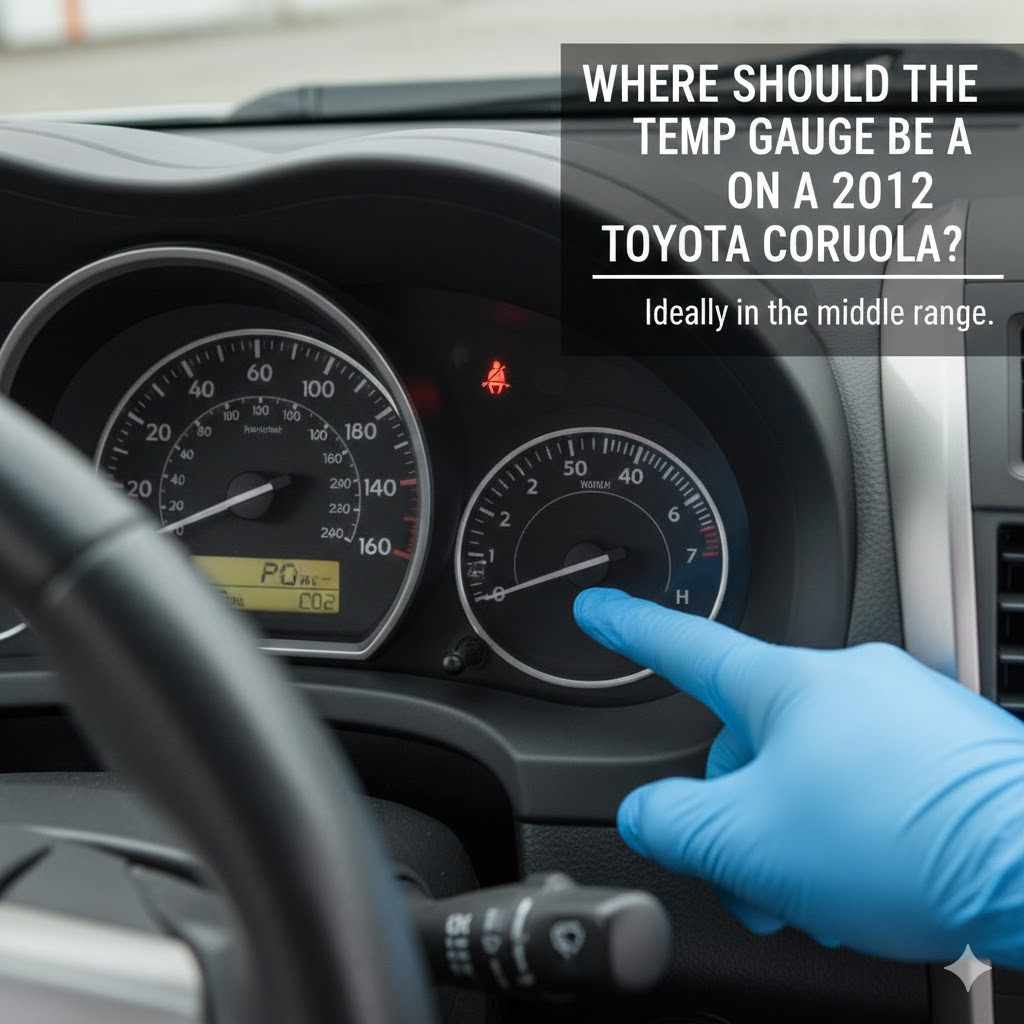
Where Should the Temp Gauge Be on a 2012 Toyota Corolla?
Ever wonder about your car’s temperature gauge? It’s a common question, especially for new drivers or anyone unfamiliar with their 2012 Toyota Corolla. This little gauge tells you important things about your engine’s health, and knowing where it should sit can save you a lot of worry. Don’t stress if you’re unsure; this guide will walk you through it step-by-step. We’ll show you exactly what’s normal and what’s not, so you can drive with confidence. Let’s get your questions answered about Where Should the Temp Gauge Be on a 2012 Toyota Corolla?
Understanding Your Toyota Corolla’s Temperature Gauge
Your car’s temperature gauge is a vital instrument that monitors the engine’s operating temperature. It provides a visual cue to ensure your engine is running within its optimal temperature range. Knowing where this gauge should normally rest is key to maintaining your vehicle’s performance and preventing potential damage.
This section will break down what you need to know about this important dashboard indicator and why it matters for your 2012 Toyota Corolla.
What the Temperature Gauge Represents
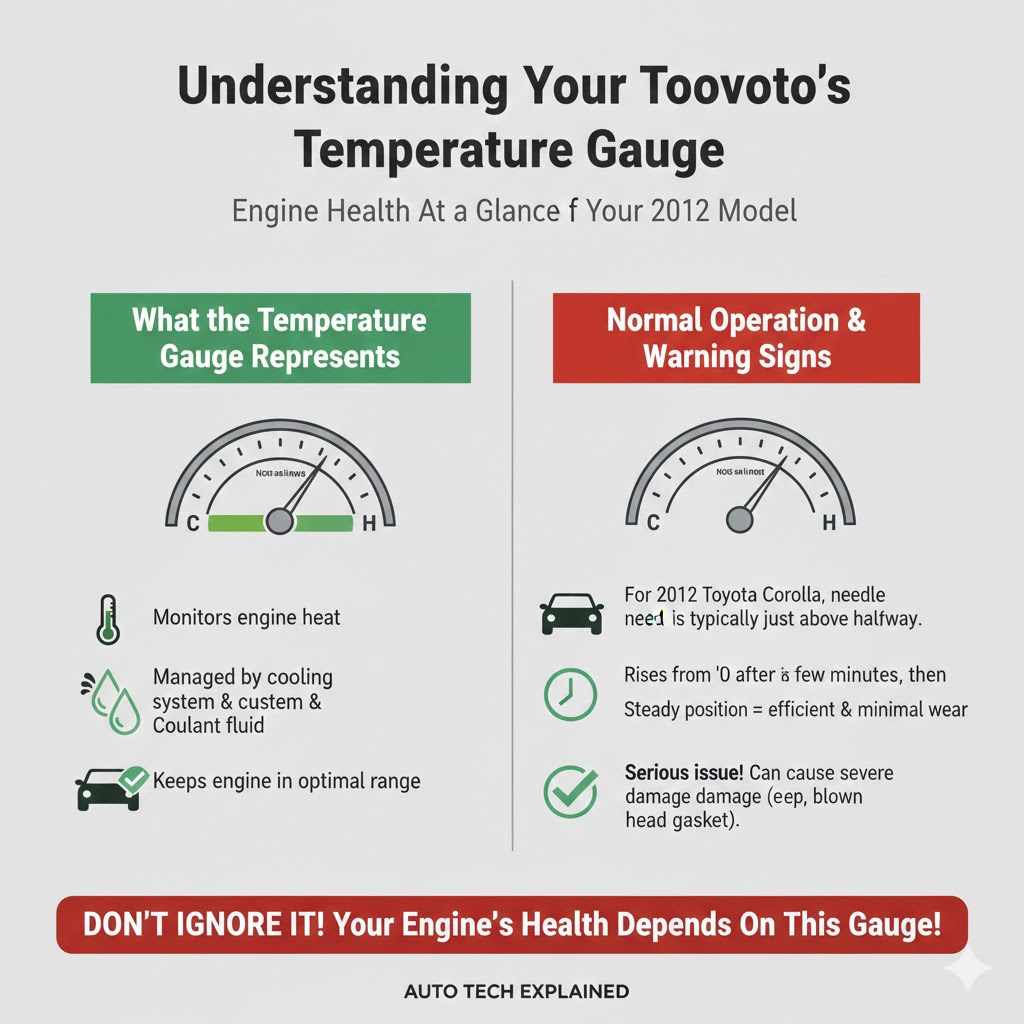
The temperature gauge on your dashboard is designed to show how hot your engine is. Engines generate a lot of heat when they run. This heat is managed by the cooling system, which uses a special fluid called coolant.
The gauge lets you see if the cooling system is doing its job correctly. If the engine gets too hot, it can cause serious problems.
This gauge typically has markings, often starting with ‘C’ for cold and ending with ‘H’ for hot. There’s also usually a middle point, often indicated by a line or a shaded area. This middle zone is where your engine should be when it’s running normally.
Keeping the needle within this normal operating range is important for your car’s longevity.
Normal Operating Range
For a 2012 Toyota Corolla, the temperature gauge should typically sit a little bit above the halfway mark. It should not be all the way at ‘H’ or even getting close to it. When you first start your car, the needle will be down near ‘C’.
As the engine warms up, it will rise and settle into its normal spot.
This normal range is designed to be consistent. Once your car has been running for a few minutes and is fully warmed up, the gauge should stay in that steady position. This steady position indicates that your engine is at its ideal temperature for efficient operation and minimal wear and tear.
Signs of Overheating or Underheating
If the temperature gauge starts climbing rapidly towards ‘H’, it means your engine is getting too hot, which is overheating. This is a serious issue that needs immediate attention. Driving with an overheating engine can cause severe and expensive damage, like a blown head gasket.
On the other hand, if the needle stays very low, near ‘C’, even after the engine has been running for a while, it could mean your engine is running too cool. While less common and usually less critical than overheating, an engine that’s too cool can also be inefficient and might signal a problem with the thermostat or the cooling system.
Where Should the Temp Gauge Be on a 2012 Toyota Corolla?
The central question for many drivers is quite specific: Where Should the Temp Gauge Be on a 2012 Toyota Corolla? The answer is consistent for this model. The gauge should rest in the middle of its range, or slightly above the middle, once the engine is fully warmed up.
This is the sweet spot where your engine is performing optimally. This section will give you precise details about the expected position of your temperature gauge under normal driving conditions.
The Ideal Needle Position
When your 2012 Toyota Corolla’s engine is running at its normal operating temperature, the needle on the temperature gauge should be pointing roughly to the middle of the gauge or just slightly above it. This is the most common and desirable position for the temperature gauge.
You might notice the needle can fluctuate slightly, which is normal. For example, it might creep up a tiny bit when you are stuck in traffic on a hot day, or drop a tiny bit when you are cruising at high speed on a cool morning. These small movements are usually not a cause for concern as long as the needle stays within the normal zone.
Understanding the Gauge Markings
Most temperature gauges have an ‘C’ for cold on one end and an ‘H’ for hot on the other. Between these are usually lines or a shaded area that indicates the normal operating range. For your 2012 Toyota Corolla, this normal range is typically centered around the halfway point.
The needle should settle comfortably within this central zone.
It’s important to know that the gauge is not always a precise thermometer. It’s more of an indicator. The ‘C’ and ‘H’ are the critical points.
Anything significantly below the middle could mean the engine is too cold, and anything significantly approaching ‘H’ means it’s too hot.
Factors Affecting Gauge Reading
Several external factors can influence where your temperature gauge appears to be. On a very cold day, it might take longer for the engine to reach its optimal temperature, so the needle might stay lower for a bit longer. Conversely, on a very hot day, especially if you are driving uphill or in heavy traffic, the engine might work harder, causing the needle to move slightly higher within the normal range.
However, if the needle moves beyond the normal range towards ‘H’, it’s a clear sign of a problem. This could be due to low coolant levels, a faulty thermostat, a malfunctioning cooling fan, or a blocked radiator. These issues prevent the engine from cooling down properly, leading to overheating.
Troubleshooting Common Temperature Gauge Issues
When your temperature gauge isn’t behaving as expected, it’s important to address it. Problems with the temperature gauge can stem from various parts of the cooling system or the gauge itself. This section will guide you through common issues and how to identify potential causes, helping you maintain your 2012 Toyota Corolla.
Engine Overheating Scenarios
If your temperature gauge is consistently reading high, often near the ‘H’ mark, your engine is overheating. This is a critical situation. The first step is to pull over safely and turn off the engine.
Never open the radiator cap when the engine is hot, as the pressurized hot coolant can cause severe burns. Let the engine cool down completely before checking coolant levels.
Common causes of overheating include a leak in the cooling system, a malfunctioning thermostat that isn’t opening to allow coolant to flow, or a faulty radiator fan that isn’t spinning to help cool the radiator. A clogged radiator can also restrict coolant flow.
Example Scenario: Sarah was driving her 2012 Toyota Corolla on a summer day when she noticed the temperature gauge climbing rapidly towards the red zone. She immediately pulled over to a safe spot. After the engine cooled, she checked the coolant reservoir and found it was very low.
She added coolant, and the gauge returned to normal. This indicated a leak, which she later had repaired.
Engine Running Too Cool Scenarios
If your temperature gauge needle stays very low, even after driving for a significant amount of time, your engine might be running too cool. This can happen if the thermostat is stuck open, meaning coolant is always circulating through the radiator, even when the engine is cold. While not as immediately dangerous as overheating, an engine that runs too cool is less efficient and can increase fuel consumption.
It can also lead to increased wear on engine components over time because the engine oil may not reach its optimal operating temperature, affecting lubrication. A faulty temperature sensor could also give a false reading, making it seem like the engine is cooler than it is.
Real-Life Observation: John noticed his 2012 Toyota Corolla’s temperature gauge never seemed to move much from the ‘C’ mark, even on long drives. He initially ignored it, but his mechanic later pointed out that the thermostat was stuck open. Replacing it improved his car’s fuel economy and engine performance.
Faulty Thermostat or Temperature Sensor
The thermostat is a valve that controls the flow of coolant. If it gets stuck closed, the engine will overheat. If it gets stuck open, the engine will run too cool.
This is one of the most frequent culprits behind temperature gauge issues.
The temperature sensor sends information from the engine to the temperature gauge. If this sensor is faulty, it might give inaccurate readings to the dashboard. This means your gauge might show a normal temperature when the engine is actually too hot, or vice-versa.
This can be misleading and dangerous.
Importance of a Functioning Cooling System
The cooling system in your 2012 Toyota Corolla is a critical component that works tirelessly to keep your engine at a stable temperature. Its proper function is directly linked to the accuracy and reliability of your temperature gauge. This section highlights why maintaining the cooling system is paramount for your car’s health and your peace of mind.
How the Cooling System Works
Your car’s cooling system has several key parts that work together. Coolant, a mixture of antifreeze and water, circulates through passages in the engine block, absorbing heat. A water pump pushes the coolant through the system.
When the coolant gets hot, it flows to the radiator. The radiator has fins that help dissipate heat into the air. A cooling fan, either electric or engine-driven, helps pull air through the radiator, especially when the car is stationary or moving slowly.
Once the coolant cools down in the radiator, it flows back into the engine to repeat the cycle.
Coolant and Its Role
Coolant, often called antifreeze, is a special fluid designed to prevent your engine from overheating and freezing. It has a much higher boiling point and a lower freezing point than water alone. The proper mixture of coolant and water is crucial for effective heat transfer and protection against corrosion within the engine’s metal parts.
The coolant level should be checked regularly. It’s usually visible in a translucent reservoir under the hood. If the coolant level is low, it means there might be a leak somewhere in the system, or coolant is being consumed.
Low coolant is a direct cause of engine overheating, as there isn’t enough fluid to absorb and carry away the engine’s heat.
Statistics on Cooling System Failures: Studies indicate that a significant percentage of engine failures are related to cooling system malfunctions. For instance, some reports suggest that up to 40% of roadside breakdowns are attributed to cooling system issues, with leaks and thermostat failures being common culprits.
When to Seek Professional Help
While basic checks like monitoring your temperature gauge and checking coolant levels can be done by any car owner, some issues require a mechanic’s expertise. If you see steam coming from under the hood, notice a constant sweet smell (indicating a coolant leak), or if your temperature gauge is consistently behaving erratically, it’s time to visit a professional.
A qualified mechanic has the tools and knowledge to diagnose complex cooling system problems. They can pressure-test the system for leaks, check the thermostat’s operation accurately, and diagnose issues with the cooling fan or radiator. Ignoring persistent temperature gauge problems can lead to much more expensive repairs down the line.
Case Study: Mark noticed his 2012 Toyota Corolla’s temperature gauge was fluctuating more than usual. He decided to have it checked. His mechanic found a small leak in a radiator hose and a slightly worn water pump.
By addressing these issues early, Mark avoided a potential engine overheat and a more costly repair.
Frequently Asked Questions
Question: What does it mean if my 2012 Toyota Corolla’s temp gauge is in the middle?
Answer: If your 2012 Toyota Corolla’s temperature gauge is in the middle, it means the engine is operating at its normal, optimal temperature. This is exactly where you want to see it.
Question: Should the temp gauge go all the way to H?
Answer: No, the temperature gauge should never go all the way to H. That indicates severe overheating, which can cause serious engine damage. If it gets close to H, pull over immediately.
Question: How often should I check my coolant level in my 2012 Toyota Corolla?
Answer: It’s a good idea to check your coolant level at least once a month, or before any long trips. Make sure the engine is cool when you check it.
Question: My temp gauge reads cold after starting my car. Is that normal?
Answer: Yes, when you first start your car, the temperature gauge will be low. It should gradually rise and settle in the middle as the engine warms up.
Question: Can a bad radiator cap cause overheating?
Answer: Yes, a faulty radiator cap can cause overheating because it may not be able to maintain the correct pressure in the cooling system, leading to coolant boiling over at a lower temperature.
Summary
Your 2012 Toyota Corolla’s temperature gauge should ideally sit in the middle, or slightly above, once the engine is warm. This position signifies healthy engine operation. Pay attention to any readings that creep too high or stay too low.
Regular checks of your coolant level and prompt attention to any gauge anomalies can prevent costly engine repairs.