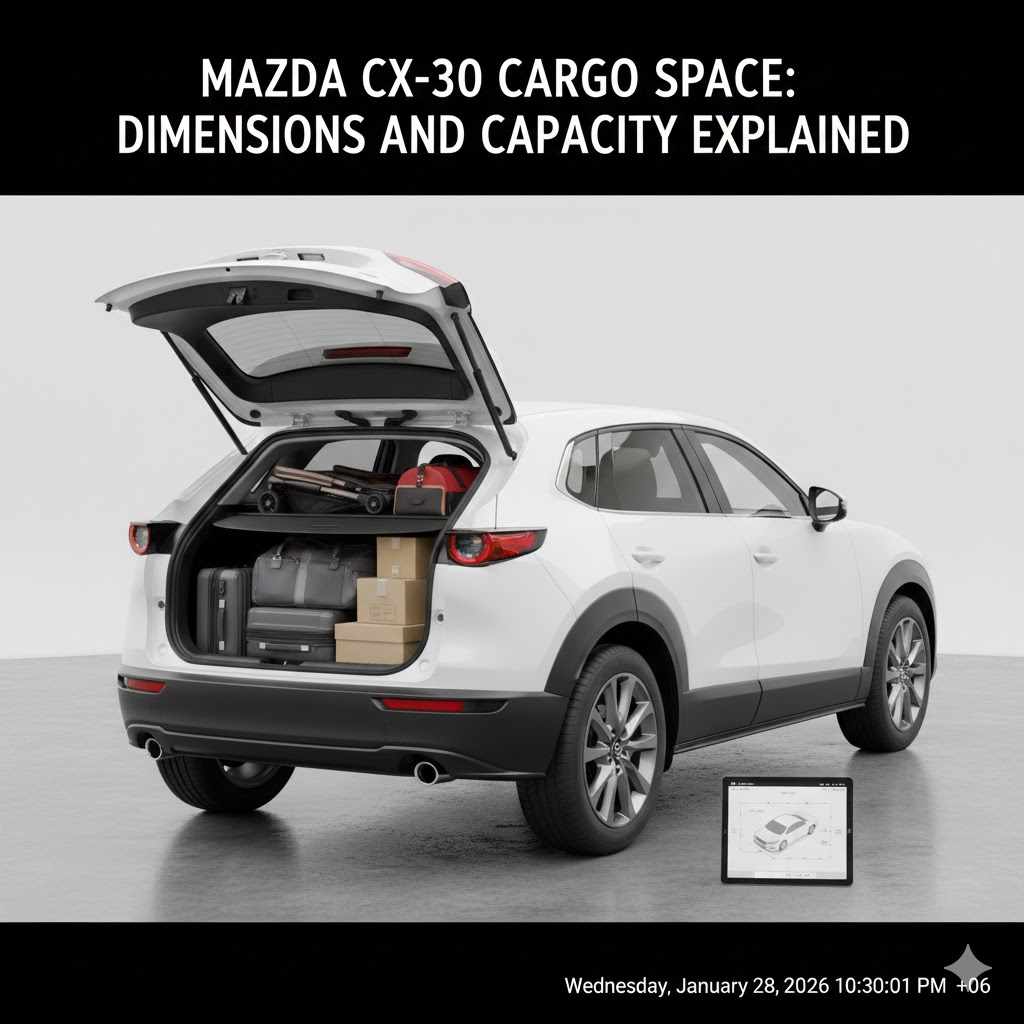
Mazda CX-30 Cargo Space: 20.2 to 45.2 Cubic Feet Explained
The Mazda CX-30 offers 20.2 cubic feet of cargo space behind the rear seats, expanding to 45.2 cubic feet when the 60/40 split-folding rear seats are folded flat. That’s on the smaller side for the compact SUV class — the Honda HR-V and Toyota Corolla Cross both offer more room in every configuration, though the CX-30 still edges out the Subaru Crosstrek for seats-up space. This guide breaks down the CX-30’s real cargo dimensions, shows exactly how it stacks up against its closest rivals, and covers how to get the most out of the space you have.
Quick Answer
The Mazda CX-30 has 20.2 cubic feet of cargo space behind the rear seats, and 45.2 cubic feet with the 60/40 split rear seats folded down. That’s less than the Honda HR-V (24.4 / 55.1 cu ft) and Toyota Corolla Cross (24.0 / 46.9 cu ft), but slightly more seats-up room than the Subaru Crosstrek (19.9 cu ft).
Getting to Know Your CX-30’s Storage
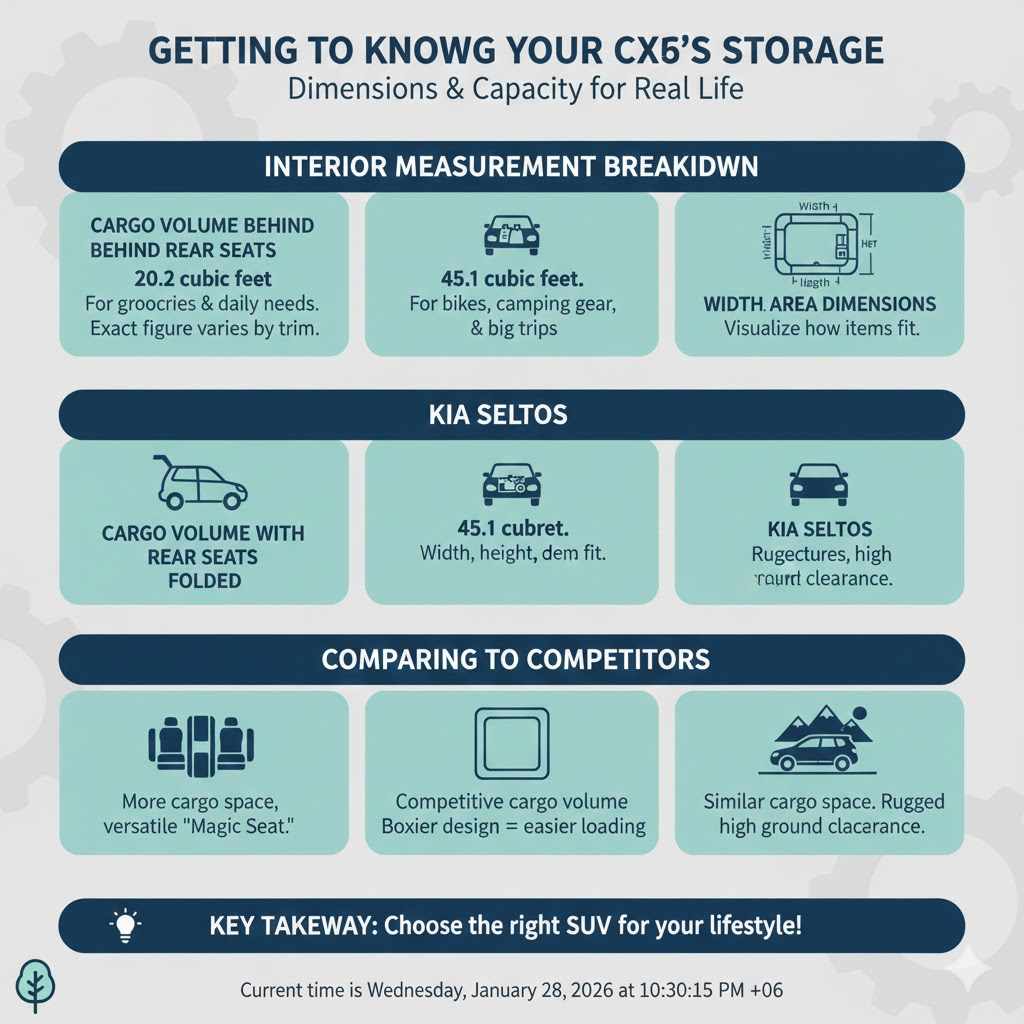
The Mazda CX-30 is known for its stylish design and comfortable ride. But how well does it handle the practical side of life, like carrying cargo? This section explores the basic dimensions and capacity numbers that define the Mazda CX-30 cargo space, helping you determine how much you can actually fit inside. We’ll look at the trunk’s size with the rear seats up and down, and how these dimensions compare to other cars in its class. Learning these specifications is the first step toward getting the most out of your vehicle.
Interior Measurement Breakdown
Understanding the numbers is important. The cargo volume behind the rear seats is a key measurement, given in cubic feet. This tells you how much space you have available without folding down the seats. When you fold the rear seats down, the cargo volume increases significantly, allowing for larger items. The measurement also reflects the height, width, and depth of the cargo area. It’s helpful to compare these measurements to other cars — if you frequently transport large luggage, cargo capacity will matter more to you than it would to someone who mostly hauls groceries.
- Cargo Volume Behind Rear Seats: This is a key figure. It indicates how much cargo you can carry when all seats are up. For the Mazda CX-30, this space is well-suited for everyday needs like groceries and backpacks. The cargo volume behind the rear seats of the Mazda CX-30 is officially rated at 20.2 cubic feet. This area is perfect for daily tasks and carrying smaller items like shopping bags or sports equipment. The exact figure is consistent across most CX-30 trim levels.
- Cargo Volume with Rear Seats Folded: Folding down the rear seats transforms the CX-30, increasing its cargo capacity to 45.2 cubic feet. This allows you to transport larger items like boxes or camping gear. This additional space makes the CX-30 more versatile, though it’s worth noting this figure is lower than several rivals in the same class — see the comparison table below.
- Cargo Area Dimensions: These measurements detail the physical space available, including width, height, and depth. Knowing these details helps you visualize how various items will fit in the cargo area. The cargo area dimensions provide a more detailed understanding of the space, offering a practical view of the usable footprint for different-sized objects. It’s worth measuring the specific items you carry most often against these numbers before buying gear that’s supposed to fit.
Mazda CX-30 vs. HR-V, Corolla Cross & Crosstrek: Cargo Space Compared
The Mazda CX-30 competes with several vehicles in the compact SUV class. Here’s how its official cargo figures stack up against its three closest rivals, based on current manufacturer specifications.
| Model | Behind Rear Seats | Rear Seats Folded |
|---|---|---|
| Mazda CX-30 | 20.2 cu ft | 45.2 cu ft |
| Honda HR-V | 24.4 cu ft | 55.1 cu ft |
| Toyota Corolla Cross | 24.0 cu ft | 46.9 cu ft |
| Subaru Crosstrek | 19.9 cu ft | 54.7 cu ft |
The takeaway: if maximum cargo volume with the seats folded is your top priority, the HR-V and Crosstrek both offer noticeably more room. But the CX-30’s smaller footprint also comes with tighter turning and a more premium-feeling cabin, which is part of why buyers cross-shop it against these rivals in the first place. If you’re comparing more than these four models, see our full SUV Cargo Space Comparison Chart covering 8 models ranked for 2026.
Maximizing Your CX-30 Cargo Area
Knowing the dimensions is one thing; making the most of the Mazda CX-30 cargo space is another. This section covers strategies and tools to maximize the use of your cargo area. Explore the best ways to pack, organize, and equip your CX-30 so it can handle anything from a quick grocery run to a longer trip.
Smart Packing Techniques
Effective packing can dramatically increase the amount of cargo you can carry. It involves more than just throwing items in the back. Learn strategies like using vertical space, organizing smaller items, and protecting fragile belongings. Consider weight distribution to maintain balance and driving safety. Think about the order you place items in — keeping frequently used items accessible can improve your experience on longer trips.
- Utilize Vertical Space: Use the height of the cargo area by stacking items strategically. Packing cubes or storage containers help you make use of every available inch, and keep cargo secure during travel.
- Organize with Containers and Cubes: Packing cubes and containers are excellent for organizing smaller items, such as books, shoes, or electronics. They help prevent items from shifting during transport and make it easier to find what you need quickly.
- Protect Fragile Items: Wrap delicate items, like electronics or glass, with bubble wrap or soft materials, and place them in a secure area away from heavier items. This minimizes the risk of damage in transit.
Accessories and Add-ons
Several accessories are available to enhance the usability of your CX-30’s cargo area, from cargo nets to roof racks. These tools are designed to provide extra space, secure items, and improve your overall driving experience.
- Cargo Nets and Organizers: Cargo nets and organizers are designed to keep items from shifting during travel, preventing them from rolling around and becoming damaged. They’re especially useful for groceries and smaller items you want to keep easily accessible.
- Roof Racks and Carriers: Roof racks and carriers provide extra storage space for luggage, sporting equipment, or larger items that don’t fit inside. They can effectively double your usable storage capacity for road trips.
- Cargo Liners and Mats: Cargo liners and mats protect your cargo area from spills, dirt, and wear. They’re easy to clean and often custom-fit to the CX-30, helping keep your vehicle looking new.
Our Top Pick
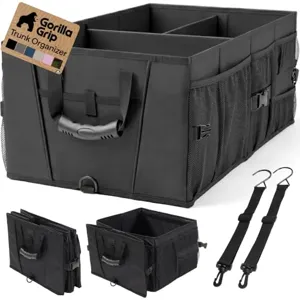
GORILLA GRIP Trunk Organizer for SUV and Cars
Best for: Making the most of the CX-30’s 20.2 cu ft behind-seat space with dedicated, collapsible compartments.
Why we picked it: Collapses flat when empty and has a wide, slip-resistant base that stays put on the CX-30’s cargo floor even when it isn’t perfectly flat with the seats folded.
Main drawback: Large capacity models take up a noticeable chunk of the CX-30’s smaller cargo footprint when fully expanded.
View Our Pick on Amazon
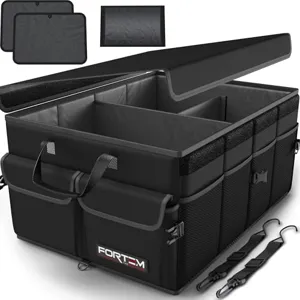 FORTEM Trunk Organizer Best for: Grocery runs and everyday errands. Why we picked it: 50L soft-sided design folds nearly flat and won’t scratch the cargo liner. Main drawback: Less rigid than hard-sided organizers, so it can tip if not loaded evenly. Check on Amazon |
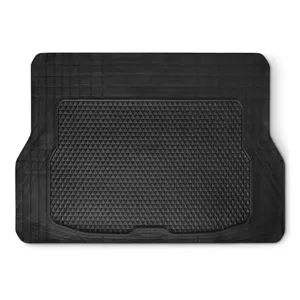 Amazon Basics Cargo Liner Mat Best for: Protecting the cargo floor from spills, mud, and pet hair. Why we picked it: Trimmable to fit the CX-30’s exact cargo floor shape, unlike rigid custom liners. Main drawback: Trimming yourself takes a bit more effort than a pre-cut custom liner. Check on Amazon |
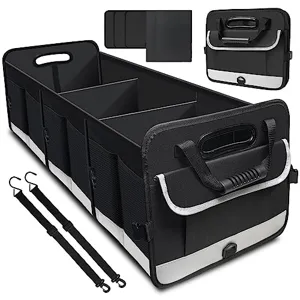 AOPHY 95L Cargo Organizer Best for: Maximizing the CX-30’s 45.2 cu ft seats-folded space on longer trips. Why we picked it: Retractable straps anchor it to the cargo floor so it doesn’t slide when the seats are folded flat. Main drawback: 95L capacity is overkill for daily errands — better suited to trips and moves. Check on Amazon |
Understanding Seat Configurations for Cargo Needs
The Mazda CX-30 cargo space is highly dependent on how you configure the seats. This section explains how to use the seats to change the available space, including folding down the rear seats and adjusting configurations for different cargo needs.
Folding Down Rear Seats
Folding the rear seats down is the simplest way to increase cargo space. Most CX-30 models have a 60/40 split-folding rear seat, which allows for flexibility in carrying both passengers and cargo at the same time.
- 60/40 Split-Folding Rear Seats: This design lets you fold down one or both sides of the rear seats, offering a balance between passenger comfort and cargo capacity. You can fold down only one side to carry long items while still accommodating a passenger.
- Seat Release Mechanisms: The release mechanisms are usually easily accessible, often located in the cargo area or near the rear passenger doors, making it fast to switch from passenger mode to cargo mode.
- Loading Considerations: When the seats are folded down, the cargo floor might not be completely flat. Take care when loading items, and consider using a cargo mat or securing straps to prevent shifting.
Passenger vs. Cargo Balance
Finding the right balance between passenger comfort and cargo space is crucial. When traveling with passengers, you might need to sacrifice some cargo capacity; for solo trips, you can use all of the available space. Balancing the two is mostly a matter of adjusting the seat configuration to match the trip you’re actually taking.
- Prioritizing Passengers: If you’re carrying passengers, keep the rear seats upright and consider a roof rack or cargo carrier for extra storage instead of folding seats down.
- Prioritizing Cargo: When you need maximum cargo space, fold down the rear seats and use a cargo mat to protect the floor and keep items from sliding.
- Trip-Based Planning: Tailor your seat configuration to each trip. For grocery runs or airport pickups, the seats can stay upright; for camping trips or hauling gear, fold them down completely.
Real-Life Examples of CX-30 Cargo Use
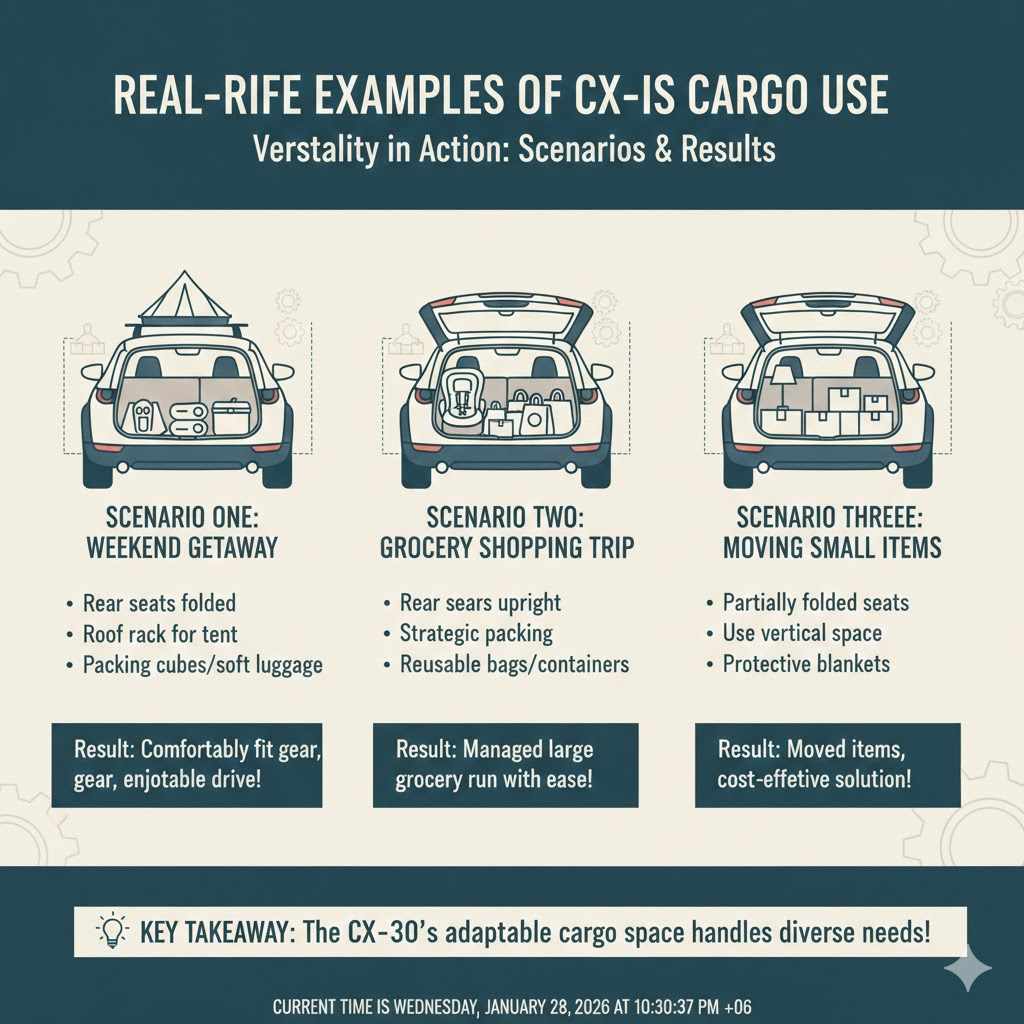
Seeing how the Mazda CX-30 cargo space works in practice helps put the numbers in context. Here are three common real-world scenarios showing how the CX-30’s cargo area handles everyday use.
Scenario One: Weekend Getaway
Imagine a couple planning a weekend camping trip. They load their CX-30 with a tent, sleeping bags, a cooler, and some luggage. With the rear seats folded down, they have enough room for all the gear, and the compact size of the CX-30 makes it easy to maneuver through winding roads.
- The rear seats were fully folded down to maximize the cargo area.
- They used a roof rack for extra storage space for the tent and bulky items.
- Packing cubes and soft luggage were used to fit everything.
Result: They comfortably fit everything, enjoyed the drive, and had a great weekend. The CX-30 proved to be a reliable and versatile travel partner.
Scenario Two: Grocery Shopping Trip
A busy parent needs to do a large grocery run — several bags, some boxes of supplies, and a few extra items. With the rear seats up, they still managed to fit everything, since the 20.2 cubic feet behind the seats is enough for a full weekly haul.
- The rear seats remained upright to accommodate a child seat in the back.
- The groceries were packed strategically to maximize space.
- Reusable shopping bags and containers were used to organize items.
Result: The parent easily managed the large grocery run. The combination of space and easy maneuverability made the shopping trip a success.
Scenario Three: Moving Small Items
A college student needed to move boxes and some furniture between apartments. The CX-30’s compact size and 45.2 cubic feet of folded cargo capacity made it a practical choice for a car this size, saving them from making several extra trips.
- The rear seats were partially folded down to fit larger items.
- Furniture was carefully positioned to use vertical space effectively.
- Protective blankets and packing materials were used to avoid scratches.
Result: The student successfully moved the items in one trip. This highlights the CX-30’s ability to handle a variety of transport needs despite its compact footprint.
Frequently Asked Questions
How many cubic feet of cargo space does the Mazda CX-30 have?
The Mazda CX-30 offers 20.2 cubic feet of cargo space behind the rear seats, and 45.2 cubic feet with the rear seats folded down.
Can I fit a stroller in the CX-30?
Yes, you can fit a stroller in the CX-30, especially with the rear seats folded down. The exact size and configuration of the stroller will affect how much cargo space remains.
How do I fold down the rear seats?
You can fold down the rear seats by pulling on the release levers located either in the cargo area or near the rear seats themselves. These levers release the seatback so it lies flat.
Are there any accessories that can help with cargo organization?
Yes, several accessories are available, including cargo nets, organizers, cargo liners, and mats. These help keep your cargo area organized and protect your vehicle’s floor from spills and wear.
Does the CX-30 have more cargo space than the Honda HR-V or Toyota Corolla Cross?
No. Both the Honda HR-V (24.4 / 55.1 cu ft) and Toyota Corolla Cross (24.0 / 46.9 cu ft) offer more cargo space than the CX-30 (20.2 / 45.2 cu ft) in both the seats-up and seats-folded configurations.
Is the Mazda CX-30’s cargo space bigger than the Subaru Crosstrek’s?
The CX-30 has slightly more room behind the rear seats (20.2 vs. 19.9 cu ft), but the Crosstrek pulls ahead with the seats folded, offering 54.7 cubic feet compared to the CX-30’s 45.2 cubic feet.
Final Thoughts
Understanding the Mazda CX-30’s cargo space helps you make the most of your vehicle. You’ve learned the key measurements, seen how the seats configure, and gotten tips for maximizing the space. With 20.2 cubic feet behind the rear seats and 45.2 cubic feet with them folded, the CX-30’s cargo capacity is on the smaller end for a compact SUV — but its 60/40 split-folding seats and flat load floor still make it flexible enough for daily errands, weekend trips, and the occasional small move.
To get the best out of your CX-30, think about what you usually carry, consider the trips you make most often, and use the accessories covered above to make every cubic foot count. If cargo space is your top priority when cross-shopping compact SUVs, check our full SUV Cargo Space Comparison Chart for how 8 models rank side by side.
Products related to this article
Sponsored / affiliate links. As an Amazon Associate I earn from qualifying purchases. I may earn additional commission from eligible campaigns.
 Solterra Cargo Liner - Trunk Mat for Subaru Solterra 2023-2026 & Toyota BZ4X 2023-2025, All Weather Cargo Mat for Solterra Accessories, Heavy Duty Car Mats, Car Accessories
 OEDRO Cargo Trunk Mat Fit for Honda HR-V 2023 2024 2025 2026 2027 (Hybrid & Gasoline), TPE All Weather Custom Fit Cargo Liner for HRV EX-L/LX/Sport Automotive Trunk Liner Accessories Waterproof, Black