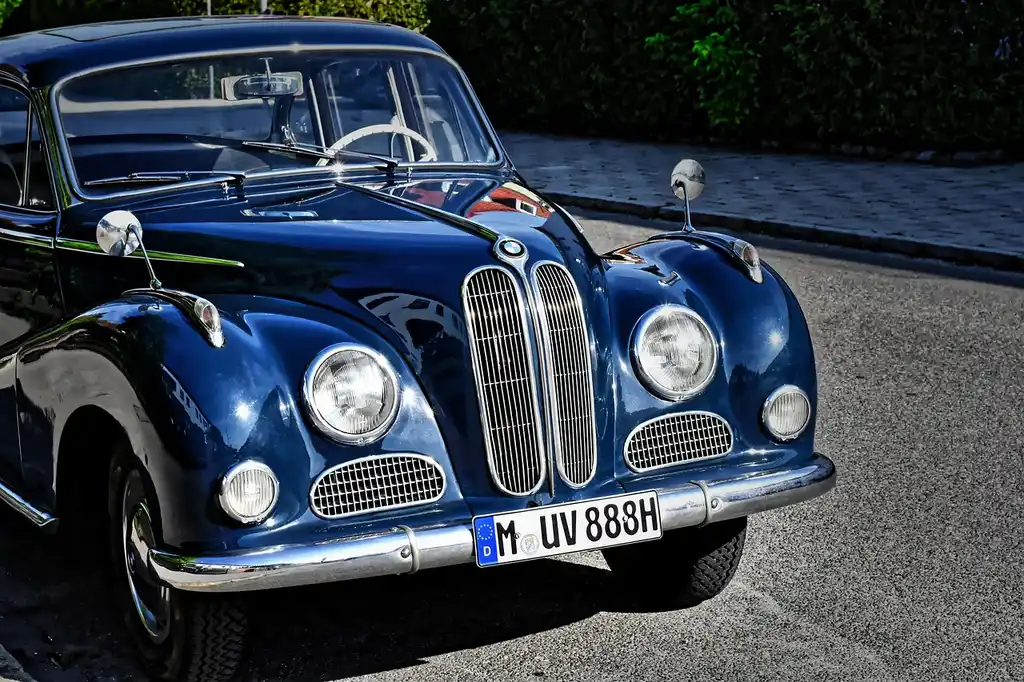
Why Does My BMW Shut Off When I Stop? Common Causes
On some BMWs, an engine that stops at a full halt can be normal start-stop behavior if it restarts when you lift the brake or press the accelerator. If it needs a key cycle or shows warning signs, treat it as a stall. Ignoring a real stall can leave you stranded and can turn a cheap battery or sensor fix into a larger diagnostic bill. This guide shows how to tell the two apart and which BMW checks to do first.
Why your BMW may shut off when you stop
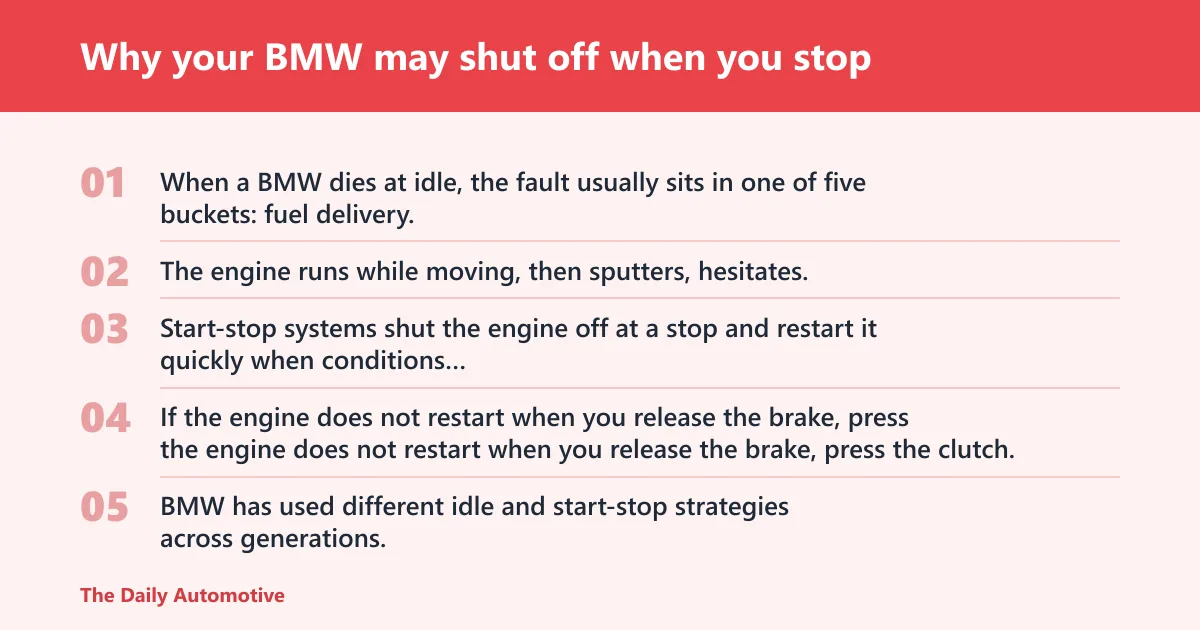


When a BMW dies at idle, the fault usually sits in one of five buckets: fuel delivery, airflow, electrical supply, sensor input, or idle control. The pattern is usually plain. The engine runs while moving, then sputters, hesitates, or shows fluctuating RPMs as it drops to idle, and then shuts off.
How to tell a real stall from BMW start-stop behavior
Start-stop systems shut the engine off at a stop and restart it quickly when conditions are met. A true stall is different. If the engine does not restart when you release the brake, press the clutch, or press the start button again, or if warning lights stay on, treat it as a fault.
Model and year matter. BMW has used different idle and start-stop strategies across generations, so a late-model car with start-stop, an older model without it, and a manual-transmission car may behave differently. The first job is to decide whether the shutdown is normal system operation or an abnormal engine cut-off.
Common symptoms: sputtering, hesitation, and fluctuating RPMs
Before a BMW stalls at a stop, it may stumble, shake, or dip in RPM. Those symptoms point toward air, fuel, or sensor trouble. A bad idle control valve can cause unstable idle, a blocked air intake can contribute to stalling, and a faulty fuel pump can lead to stalling when demand changes.
Say your 3 Series idles fine in Park, then drops to 500 rpm, sputters at the first red light, and starts again only after a key cycle. That pattern is not normal start-stop behavior. It points to a problem that shows up when the engine has to hold idle on its own.
Could this be BMW start-stop, not a failure?
Yes. If your BMW is equipped with automatic start-stop, the engine can shut off at a stop by design and restart almost immediately when you lift off the brake or press the clutch. That is normal. It becomes a fault when the engine will not restart normally, runs rough, or shows warning lights.
What normal engine shutoff looks like
Normal start-stop operation is usually smooth and repeatable. The engine shuts off only after the car is fully stopped, the battery state is acceptable, and other systems are ready. There should be no sputtering, no shaking, and no need to cycle the ignition. The cluster should not light up with engine fault warnings.
What should happen when you lift off the brake or press the clutch
On an automatic, lifting your foot from the brake should wake the engine almost immediately if start-stop is active. On a manual, pressing the clutch should trigger restart. If the car cranks but will not idle, or if it starts and then dies again, the issue is not normal start-stop behavior.
What should you check first when the engine dies at a stop?
Check the warning lights, confirm whether the engine restarts on its own, and note whether the symptom seems tied to the A/C being on. Then pull codes and freeze-frame data with a scan tool. That order separates a simple battery or airflow issue from a fuel, sensor, or control-module fault quickly.
First checks to make before replacing parts
- Look for the Check Engine Light or Oil Pressure Light.
- Note whether the engine restarts immediately or needs a key cycle.
- See whether the problem happens only with the A/C on.
- Scan for stored codes and freeze-frame data.
- Check live data for idle speed, battery voltage, and fuel trims.
Why scan data matters on BMWs
A code reader can sometimes reveal patterns that a visual check misses. Freeze-frame data shows what the engine was doing when the fault set. Live data can show idle instability, low charging voltage, airflow errors, or fuel-trim problems. That matters because BMW idle complaints can come from a bad idle control valve, a throttle valve issue, or a camshaft sensor fault.
What should you check first when my BMW dies at a stop? The first move is to verify whether it is a true stall, then read codes and freeze-frame data before replacing parts. That sequence saves time and avoids guessing at fuel, air, or electrical parts that may not be the root cause.
Fuel delivery problems that can stall a BMW at idle
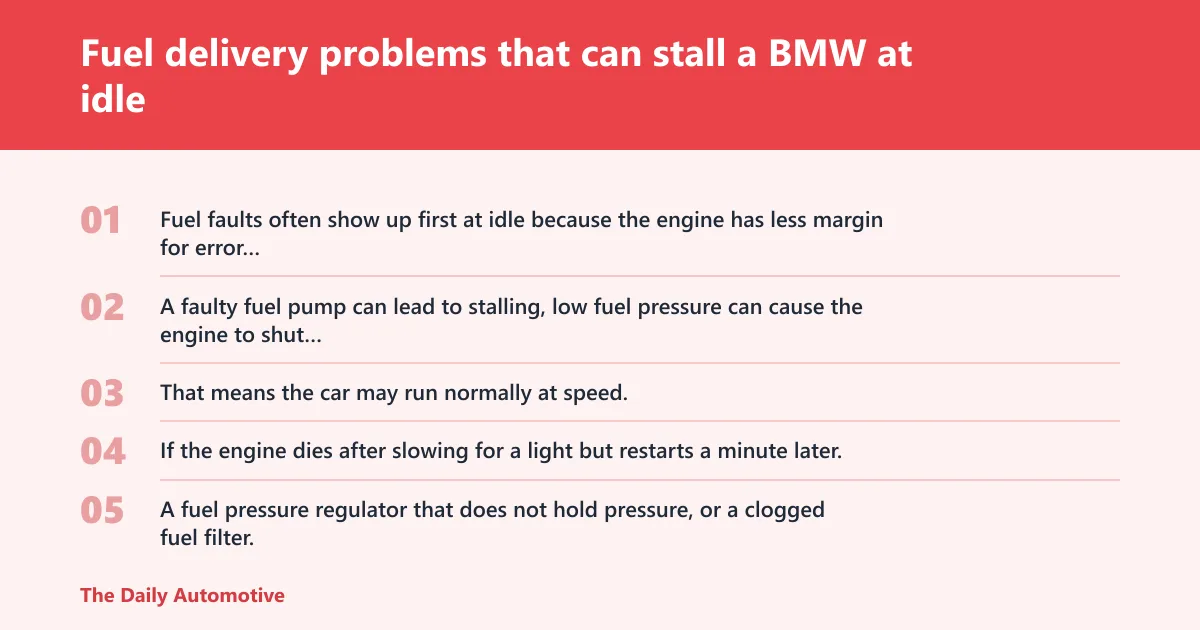
Fuel faults often show up first at idle because the engine has less margin for error when airflow and injection are low. A faulty fuel pump can lead to stalling, low fuel pressure can cause the engine to shut off, and a fuel pressure regulator or clogged fuel filter can be the source of that low pressure.
Fuel pump failure and intermittent low fuel supply
A fuel pump can fail intermittently. That means the car may run normally at speed, then lose supply when the engine drops to idle and fuel demand changes. If the engine dies after slowing for a light but restarts a minute later, weak fuel delivery belongs high on the list.
Low fuel pressure from the regulator or filter
Low fuel pressure can cause a stall at stop. A fuel pressure regulator that does not hold pressure, or a clogged fuel filter, can starve the engine just enough to make idle unstable. On BMWs, that often shows up as hesitation, a brief stumble, then shutdown.
Why weak fuel supply shows up when the engine drops to idle
At speed, the engine may tolerate a borderline fuel system. At idle, the margin gets smaller. That is why a weak pump, low pressure, or a restricted filter can seem fine on the road and fail at a traffic light. Fuel pressure testing is the next check once codes point in that direction.
Airflow and idle-control faults that cause shutdowns
Idle control depends on precise air management. If air cannot pass through the intake path correctly, the engine may stall when it is supposed to settle into idle. Common BMW causes include a bad idle control valve, a malfunctioning throttle valve, a dirty air filter, vacuum leaks, and MAF sensor faults.
Idle control valve problems and unstable idle
A bad idle control valve can cause shutdowns. It controls idle airflow, and a failing valve often causes unstable idle before the engine dies. When the car stops, the valve has to hold the engine at a steady speed. If it sticks, the RPM can drop too far and the engine can cut out.
Throttle body or throttle valve sticking
A malfunctioning throttle valve can cause cut-off when stopped. If the throttle body is dirty or the throttle plate sticks, the engine may not get the airflow it needs at idle. That problem can feel like a sudden cut, especially when the car comes to a complete stop and load changes.
Dirty air filter, vacuum leaks, and MAF sensor faults
A clogged or dirty air filter can impede airflow. A blocked air intake can contribute to stalling. Vacuum leaks and MAF sensor faults can also confuse the air-fuel mix and upset idle quality. BMWs are sensitive to unmetered air, so small intake leaks can matter more than many owners expect.
Picture a 5 Series that stalls only after a long freeway exit, then idles badly with the hood closed and the A/C on. That pattern can point to an intake restriction, a vacuum leak, or a throttle adaptation issue more than a dead fuel pump. The code data decides the next step.
Why throttle adaptation resets may matter
After throttle cleaning, battery replacement, or some repairs, BMWs may need a throttle adaptation reset. If the throttle valve and PCM no longer agree on idle position, the car can hunt for idle or shut off when coming to rest. That is one reason post-repair relearning should not be skipped.
Can electrical or sensor problems make a BMW die at a stop?
Yes. A weak battery or alternator charging fault can upset engine management, and sensor faults can cause the wrong ignition timing or idle command at the worst moment. On BMWs, a faulty camshaft sensor can disrupt ignition timing, and crankshaft sensor faults can cause similar slow-speed stalling.
Weak battery and alternator charging faults
The battery feeds the car’s electrical system, and the alternator keeps it charged. If charging voltage drops too low, the PCM and fuel system may not behave correctly at idle. That can create shutdowns, odd warning lights, or repeated no-start and stall complaints after short drives.
Camshaft sensor and crankshaft sensor issues
Could a camshaft sensor cause my BMW to shut off at stops? Yes. A faulty camshaft sensor can disrupt ignition timing, and that can cause shutdown at idle or a stumble as the car decelerates. Crankshaft sensor faults can also interrupt engine speed data and kill idle stability.
How PCM idle-control faults affect shutdown behavior
The powertrain control module maintains engine idle speed. If the PCM does not regulate idle correctly, the car may stall even when fuel and air hardware are intact. That branch usually needs scan-tool data, not guesswork, because the control problem can mimic a bad valve, sensor, or fuel issue.
BMW stop-stall decision tree and first diagnostic check
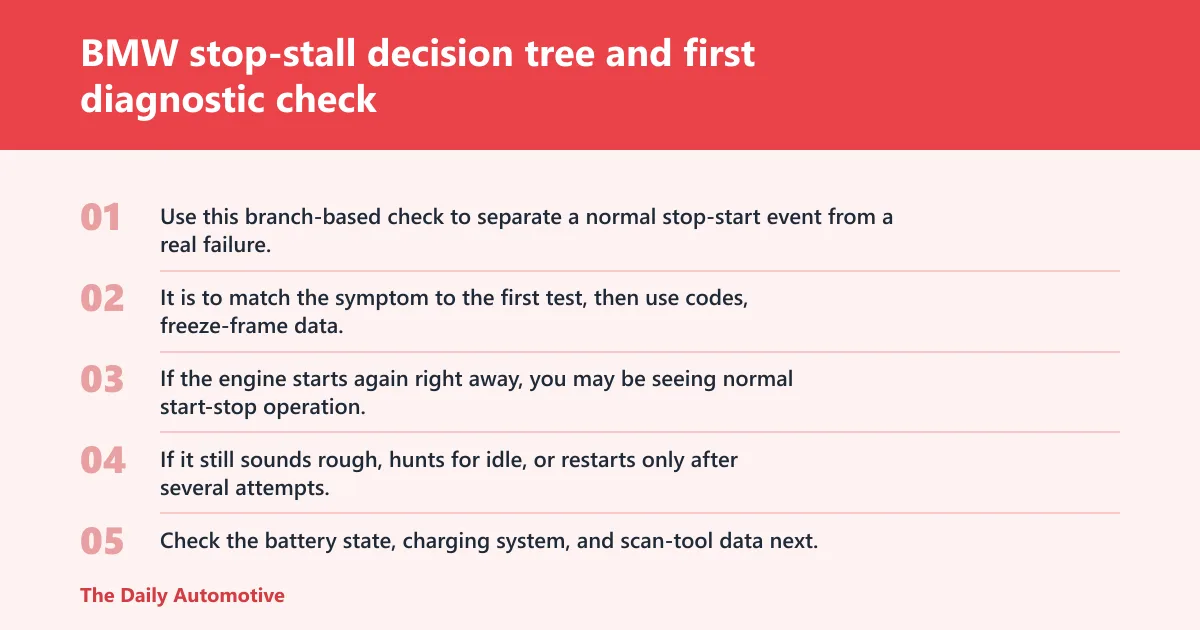
Use this branch-based check to separate a normal stop-start event from a real failure. The fastest path is not to replace parts. It is to match the symptom to the first test, then use codes, freeze-frame data, and live data to narrow the cause.
| Symptom | What it may mean | First diagnostic check |
|---|---|---|
| Engine restarts immediately | Likely start-stop behavior, not a stall | Check whether the car is equipped with BMW start-stop and whether the system conditions are met |
| Cranks but will not idle | Fuel, air, throttle, sensor, or PCM idle fault | Read stored codes and view live idle data |
| Warning lights are on | Fault likely stored in engine or charging system | Scan for codes, then inspect battery and charging voltage |
| Issue happens only with A/C on | Idle reserve may be too weak for added load | Check idle control, throttle adaptation, and charging output |
If it restarts immediately
If the engine starts again right away, you may be seeing normal start-stop operation. If it still sounds rough, hunts for idle, or restarts only after several attempts, the system is not behaving normally. Check the battery state, charging system, and scan-tool data next.
If it cranks but will not idle
That pattern points to a real stall or a no-idle condition. Focus on fuel pressure, fuel pump output, throttle valve operation, idle control valve performance, vacuum leaks, and camshaft or crankshaft sensor faults. A scan tool can show whether the PCM is asking for idle air or fuel that never arrives.
If warning lights are on
What warning lights appear when a BMW stalls at a stop? The Check Engine Light may appear, and the Oil Pressure Light may appear as well. Those lights matter. An oil-pressure warning is especially serious because it can indicate a lubrication problem, not just an idle complaint.
If the symptom appears only with the A/C on
If the engine dies only when the A/C compressor engages, the idle system may not have enough reserve. That branch puts more weight on the battery, alternator, PCM idle control, throttle adaptation, and idle control valve. It can also reveal a marginal fuel system that fails only under added load.
Should you drive it, or tow it?
Choose towing if the engine stalls repeatedly, the Oil Pressure Light is on, the car loses power steering or braking assist, or the engine will not stay running long enough to test safely. Short-distance driving may be reasonable only for diagnosis if the car restarts normally, runs cleanly between stops, and shows no serious warnings.
Do not treat repeated stalling as a minor annoyance. A BMW that dies at intersections can become unsafe fast. Prompt diagnosis by a qualified mechanic is the right move when codes, warning lights, or repeat shutdowns point beyond a simple battery check.
What warning lights appear when a BMW stalls at a stop?
The Check Engine Light is the most common warning tied to idle, fuel, sensor, or throttle faults. The Oil Pressure Light is more serious and should not be ignored. Any dashboard light that appears at the same time as a stall deserves immediate attention, especially if the engine then runs rough or will not restart.
Frequently asked questions
Why does my BMW shut off when I stop at a red light?
A BMW that shuts off at a red light may have normal start-stop operation, but a true stall usually points to fuel, air, electrical, sensor, or idle-control trouble. If it restarts only after a key cycle, or if it sputters first, scan the car for codes and check idle data.
Can a bad idle control valve cause my BMW to stall at stop?
Yes. A bad idle control valve can cause shutdowns, and unstable idle is a common clue. The valve controls idle airflow, so if it sticks or responds slowly, the engine can drop below a stable idle speed and stall when you come to a stop.
Can a failing fuel pump make a BMW die when idling?
Yes. A faulty fuel pump can lead to stalling, especially if delivery drops when the engine returns to idle. Low fuel pressure can also cause the engine to shut off, and the regulator or clogged fuel filter can be part of that pressure loss.
Could a camshaft sensor cause my BMW to shut off at stops?
Yes. A faulty camshaft sensor can disrupt ignition timing, and that can cause shutdown at idle or during slow-speed deceleration. If the stall happens mainly as the car slows to a stop, sensor data from a scan tool can help separate timing faults from fuel or air issues.
Does a dirty air filter make a BMW stall at idle?
Yes. Clogged or dirty air filters can impede airflow, and a blocked air intake can contribute to stalling. If the filter is overdue for service, it can worsen idle quality and make a borderline throttle or idle-control problem show up at stoplights.
Can the battery or alternator cause a BMW to shut off when stopping?
Yes. The battery feeds the car’s electrical system, and the alternator keeps it charged. If charging output is weak or the battery is low, engine management can become unstable at idle. That can lead to shutdowns, warning lights, and repeat restarts that seem random.
Products related to this article
Sponsored / affiliate links. As an Amazon Associate I earn from qualifying purchases. I may earn additional commission from eligible campaigns.