2026 BMW 540i for Sale: What to Check Before You Buy
A 2026 BMW 540i should be bought only after a pre-purchase inspection clears the engine, transmission, xDrive system, iDrive, and service history; one unresolved fault code or leak is often enough to walk away. Skip that check, and a premium sedan can quickly turn into a four-figure repair bill. This guide breaks the 540i check into mechanical, electronic, and ownership-document items you can verify before you sign.
BMW 540i buying checklist table


| Check item | Why it matters on a 2026 BMW 540i | Pass/fail evidence to request from the seller or inspector |
|---|---|---|
| VIN and trim verification | The 540i sits in the 5 Series trim line, and equipment varies between rear-wheel drive and xDrive cars. | VIN decode, window sticker, build sheet, and photos of drivetrain badging. |
| Fault-code scan | BMW electronics can store warnings before a dash light stays on, especially for engine, chassis, and driver-assist systems. | Full module scan showing no current faults or a repair invoice closing the issue. |
| iDrive screen and software status | Screen lag, missing updates, or odd menu behavior can signal software trouble that a walkaround will miss. | Photos of software version screens, update history, and proof of normal menu response. |
| Phone pairing and profile memory | Paired smartphone connectivity and driver-profile memory are common failure points after battery discharge or module resets. | Successful pairing demo, saved profile recall, and a scan without communication faults. |
| Tire set and tread wear | Matched tires matter for brake feel, traction, and xDrive function; uneven wear can point to alignment or suspension wear. | Tread-depth readings, matching brand and size, and photos of all four tires. |
| Wheel condition | Curb rash, bends, and cracks can cause vibration and hide impact damage on a luxury sedan with low-profile tires. | Close-up wheel photos and a road test with no shake at speed. |
| Suspension and steering | Clunks, vibration, or pulling can point to bushing wear, alignment issues, or adaptive damping problems. | Undercarriage inspection, road-test notes, and alignment printout if available. |
| Brake wear and service history | BMW brake parts are costly, and pad or rotor wear can add up fast on a heavy luxury sedan. | Pad thickness, rotor condition, pedal feel, and invoices showing recent brake work. |
| xDrive service history | xDrive improves traction but adds driveline parts and service complexity. | Evidence of correct tire matching, no binding on tight turns, and any transfer-case or driveline service records. |
| Warranty or CPO coverage | Remaining factory coverage or certified pre-owned terms can reduce risk if major electronics or driveline faults appear later. | In-service date, coverage end date, deductible amount, exclusions, and transferability proof. |
What should you inspect before the test drive?
Start with the body, tires, underhood area, and service paperwork before the wheels move. A clean-looking 2026 BMW 540i can still hide uneven tire wear, fluid seepage, or a rushed repair, so the first pass should focus on evidence, not shine. If the seller will not allow that, move on.
Bodywork and panel fit
Check hood, doors, trunk, and bumper gaps for even spacing. Look for overspray, broken clips, misaligned headlights, or fresh fasteners that suggest body repair. On a luxury sedan, a neat finish can still hide prior impact work, so ask whether paintwork or panel replacement appears on invoices.
Tires, wheels, and brakes
Confirm all four tires match in brand, size, and type. Measure tread depth, then look for feathering, inner-edge wear, and sidewall bubbles. Check wheels for curb rash or bends, then look through the spokes for rotor lips, uneven pad material, and cracked dust shields.
Leaks, odors, and underhood condition
Open the hood before a long road test and look for wet residue around valve covers, coolant joints, and oil-filter housing areas. A sweet smell can point to coolant seepage; a burnt smell can point to oil on hot parts. A clean engine bay helps, but receipts matter more than dressing.
Say your 540i wears one front tire at about 4/32 inch while the others sit near 8/32. That mismatch can hint at a prior alignment problem, a curb strike, or a suspension part that has already shifted out of spec.
How should the road test be handled?
The road test should show cold-start behavior, transmission quality, steering stability, brake feel, and whether warning messages appear after a few miles. In a 2026 BMW 540i, a short drive is not enough; use enough time for the engine, brakes, and chassis systems to warm up and reveal faults.
Cold-start behavior
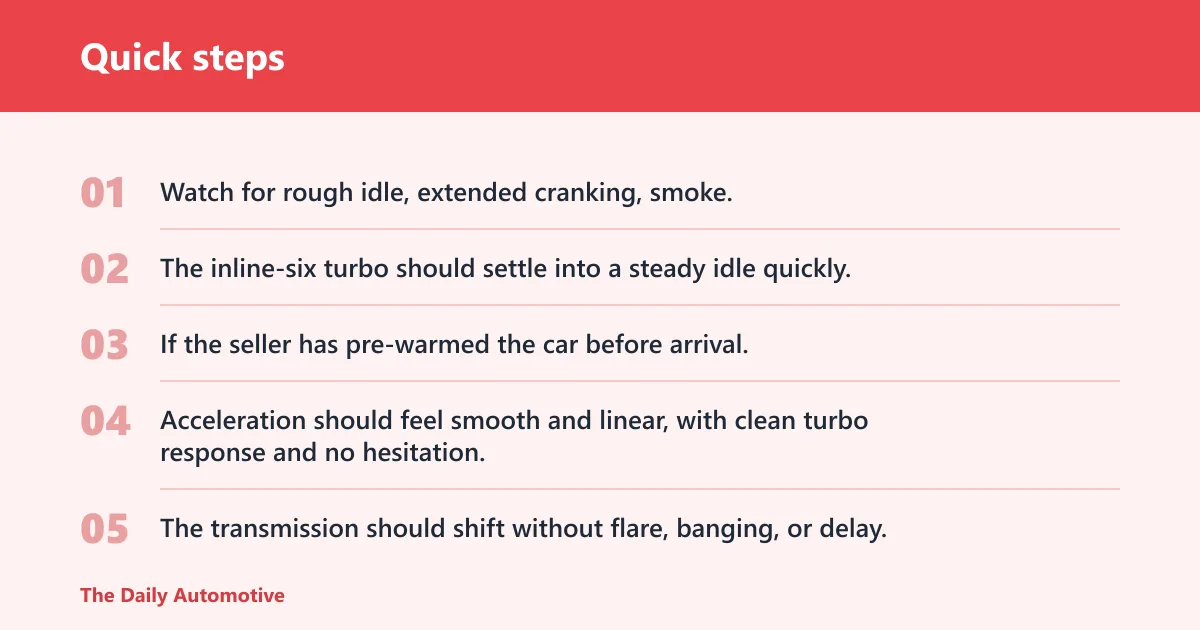
Watch for rough idle, extended cranking, smoke, or ticking that lasts longer than a brief start-up phase. The inline-six turbo should settle into a steady idle quickly. If the seller has pre-warmed the car before arrival, ask to inspect it cold another day or request cold-start video.
Acceleration, shifting, and turbo response
Acceleration should feel smooth and linear, with clean turbo response and no hesitation. The transmission should shift without flare, banging, or delay. Any shudder under light throttle or kickdown hesitation deserves a scan and a deeper drivetrain inspection, especially on an all-wheel-drive car.
Steering, ride, and brake feel
Hold a straight line at highway speed and on a rougher surface. Pulling, steering wheel shake, or a dull clunk over bumps can point to alignment, wheel damage, or worn bushings. Brakes should stop straight with a firm pedal, no pulsation, and no grinding or judder.
Warning lights and driver-assist behavior
Watch the cluster and center screen for warnings that appear after the car moves. Lane-assist faults, parking-assist errors, or collision-warning messages can mean a dirty sensor, a calibration problem, or a failing module. Those issues matter more than a simple stored cosmetic alert.
Suppose the brake pedal feels normal in town but starts pulsing at highway speeds. That often points to rotor thickness variation or pad deposit, and it is the sort of fault that can hide until the road test reaches speed.
How do you check iDrive and electronics?
BMW iDrive should respond quickly, remember profiles, connect to a paired smartphone, and store no unresolved warning history. Because the 2026 BMW 540i depends heavily on electronics, a static display check is not enough. You need menu speed, update status, and evidence that the software stack behaves normally.
Screen speed and menu response
Move through audio, navigation, climate, and vehicle menus several times. Screen lag, ghost touches, rebooting, or a frozen rotary controller can point to software or hardware trouble. A healthy system should react quickly and remember recent settings without random resets.
Phone pairing and profile memory
Pair a smartphone, then confirm calls, audio streaming, and contact access work. Save a driver profile, shut the car off, restart it, and verify the profile returns correctly. If paired phones disappear or seat settings fail to load, ask for module diagnostics and battery history.
Software version and update history
Ask for the current software version and proof of recent updates. BMW software can fix bugs in infotainment, driver-assist behavior, and connectivity. A seller who cannot show update history may still have a good car, but the missing record raises the inspection bar.
Camera, radar, and parking-assist function
Check backup camera image quality, parking sensor tone behavior, lane-assist prompts, and any available surround-view function. A blocked sensor is one thing. Repeated collision-warning faults or dead camera views are another, and they can mean a calibration or module issue after bodywork or windshield service.
What service records should a 2026 BMW 540i have?
A proper file should show oil changes on time, regular maintenance from a dealer or BMW specialist, software updates when applicable, and any warranty repairs. The more complete the paper trail, the easier it is to judge whether the car was maintained to luxury-sedan standards or merely kept running.
Oil changes and interval timing
Look for dated oil-change entries that make sense for mileage and use. Long gaps are a warning sign, especially on a turbocharged inline-six. Ask for receipts that show the mileage at service, not just a handwritten note or a vague “performed maintenance” line.
Dealer or specialist receipts
Receipts should list the exact work, parts, and fluid grades used. Dealer records are helpful, but a respected BMW specialist can be just as useful if the invoices are detailed. Missing labor lines, generic descriptions, or inconsistent dates make the history less persuasive.
Software and warranty repair records
Request proof of software updates, recall completion, and warranty work. On a modern 5 Series, electronic fixes matter as much as brake pads or filters. A car with repeated infotainment, sensor, or module repairs deserves a closer look than one with clean, one-time fixes.
A common first-timer mistake is accepting a neat folder of oil-change stamps and stopping there. The better question is whether the records also show brake work, tire replacements, alignment checks, software updates, and any factory warranty repairs that explain earlier faults.
Should you buy rear-wheel drive or xDrive?
Choose rear-wheel drive if you want the simpler layout and live where winter traction needs are modest. Choose xDrive if you need more traction in snow or rain and accept extra complexity, more tire sensitivity, and another system to maintain. Either version can be right if the condition and records are strong.
Climate and traction needs
xDrive suits buyers who regularly face snow, steep driveways, or wet-season commuting. Rear-wheel drive can be the better fit in mild climates, especially if you value lower complexity and easier service. Traction control and tire choice still matter on both versions.
Extra wear items on xDrive cars
Ask specifically about tire matching, front-to-rear wear, and any driveline service history. Mismatched tire sizes or major tread-depth differences can put extra stress on the system. On a used xDrive car, that matters more than a generic “all-wheel drive checked” note from a seller.
When rear-wheel drive makes more sense
Rear-wheel drive usually makes more sense if you want fewer moving parts, lower risk from mismatched tires, and simpler long-term upkeep. If your climate is mild and you do not need extra launch traction, the rear-drive car can be the cleaner ownership choice.
What does the checklist table tell you?
The checklist separates three kinds of risk. Mechanical pass/fail signs tell you whether the engine, brakes, tires, suspension, and driveline are healthy. Electronic pass/fail signs tell you whether iDrive, cameras, sensors, and warning histories are behaving. Document pass/fail signs tell you whether the car was cared for in a way that matches its price.
Mechanical pass/fail signs
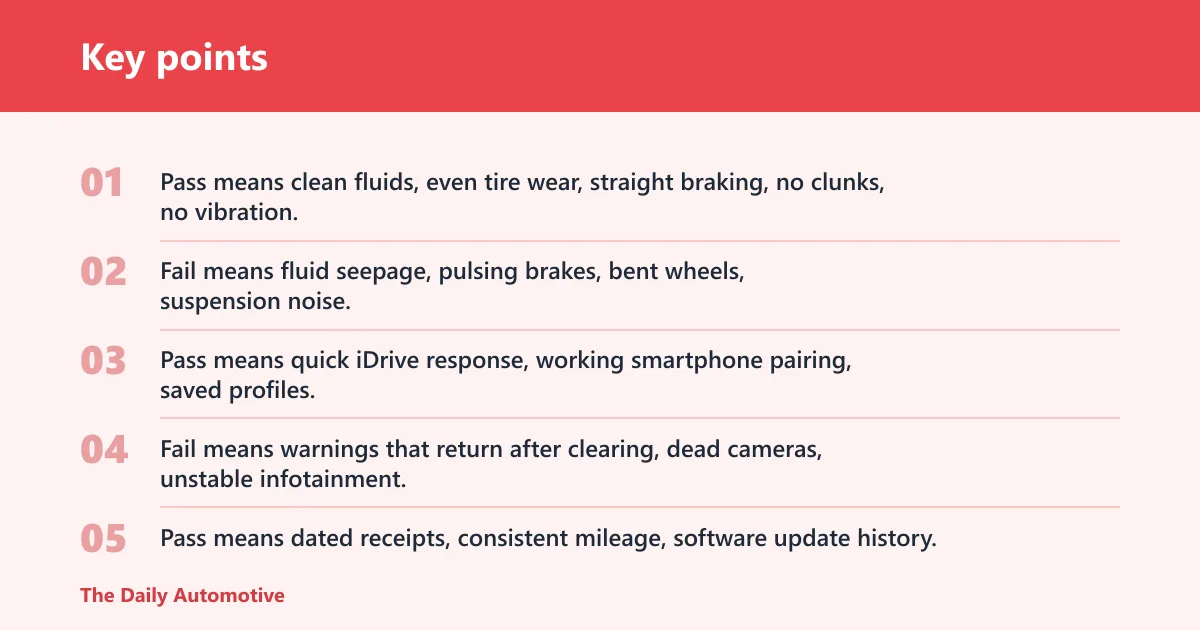
Pass means clean fluids, even tire wear, straight braking, no clunks, no vibration, and no leaks. Fail means fluid seepage, pulsing brakes, bent wheels, suspension noise, or xDrive behavior that feels tight or inconsistent on turns. Any of those deserves a hard pause.
Electronic pass/fail signs
Pass means quick iDrive response, working smartphone pairing, saved profiles, no current fault codes, and normal driver-assist operation. Fail means warnings that return after clearing, dead cameras, unstable infotainment, or messages tied to sensors, radar, or parking aids.
Document pass/fail signs
Pass means dated receipts, consistent mileage, software update history, and proof of warranty or CPO status. Fail means missing invoices, gaps in maintenance, unclear ownership, or a seller who cannot document repairs. That paper trail often decides whether the asking price makes sense.
Frequently asked questions
What should I check before buying a 2026 BMW 540i?
Check the engine, transmission, tires, brakes, suspension, iDrive, and all driver-assist systems, then confirm service records and warranty status. A scan for fault codes is essential. On a 2026 BMW 540i, a clean visual inspection is not enough without electronic and document evidence.
Is the 2026 BMW 540i reliable enough to buy used?
It can be, if the car has a clean inspection, complete records, and no unresolved software or driveline faults. Reliability on a used luxury sedan depends heavily on maintenance quality and repair history. A neglected example can become expensive quickly, especially with electronic or brake issues.
What problems should I look for on a BMW 540i inspection?
Watch for oil or coolant leaks, uneven tire wear, wheel damage, brake pulsation, steering clunks, and any warning messages tied to iDrive or driver-assist systems. Also ask about xDrive service history if equipped. Those are the problems most likely to turn into real costs.
How do I tell if a 2026 BMW 540i was cared for properly?
Look for dated receipts, consistent mileage, software update history, tire replacements, brake service, and warranty repair records that make sense together. A cared-for car usually has a paper trail that matches its condition. Missing records, mismatched tires, or repeated warning codes are warning signs.
Should I buy a 2026 BMW 540i xDrive or rear-wheel drive?
Buy xDrive if you need more traction in snow or frequent rain and accept higher complexity. Buy rear-wheel drive if you want simpler ownership and live in a milder climate. The better choice depends less on badge and more on where and how you drive.
How much should I budget for maintenance after buying a BMW 540i?
Budget for premium tires, brake wear, routine fluids, and occasional software or sensor work. Exact costs vary by condition and region, but a BMW 540i should not be treated like a basic sedan to maintain. A reserve for tires and brakes is wise from day one.
Products related to this article
Sponsored / affiliate links. As an Amazon Associate I earn from qualifying purchases. I may earn additional commission from eligible campaigns.