Does Safelite Use OEM Glass for BMW? Ask Before You Book
On some BMWs, glass choice can depend on the VIN, the sensor package, and the insurer’s rules, so OEM glass is not guaranteed. Ask before booking, because the exact part depends on your VIN, sensor package, and whether your insurer allows OEM. If you assume OEM and receive aftermarket glass, fitment issues, HUD distortion, camera calibration problems, or an unexpected bill can follow. This guide gives the exact questions to ask Safelite, plus how insurance and BMW options can change the answer.
Does Safelite use OEM glass for BMW?
Safelite offers OEM glass for BMW vehicles, but it is not always the default. Many customers report receiving aftermarket glass unless they ask for OEM clearly, so confirm the exact part type before you approve the job. For BMW windshields, the difference matters most when the car has HUD or windshield-mounted cameras.
What OEM glass means on a BMW windshield
OEM means Original Equipment Manufacturer, the part made to the vehicle maker’s specs. On a BMW, that usually means glass supplied by the same companies that build parts for BMW, and made to BMW’s dimensions and optical requirements. The practical benefit is a closer match to the original opening and the projection behavior BMW designed around.
That matters because a windshield is not only a pane of glass. It also affects sealing, body integrity, camera placement, and how projected images appear through the glass.
What Safelite can supply versus what you need to confirm
Safelite can offer several glass options for BMW vehicles, including OEM and aftermarket glass. What you need to confirm is whether OEM is available for your exact VIN, whether it will actually be installed, and whether your insurance will approve that choice. Do not assume the first quote includes OEM.
What is the difference between OEM and aftermarket glass for BMW?
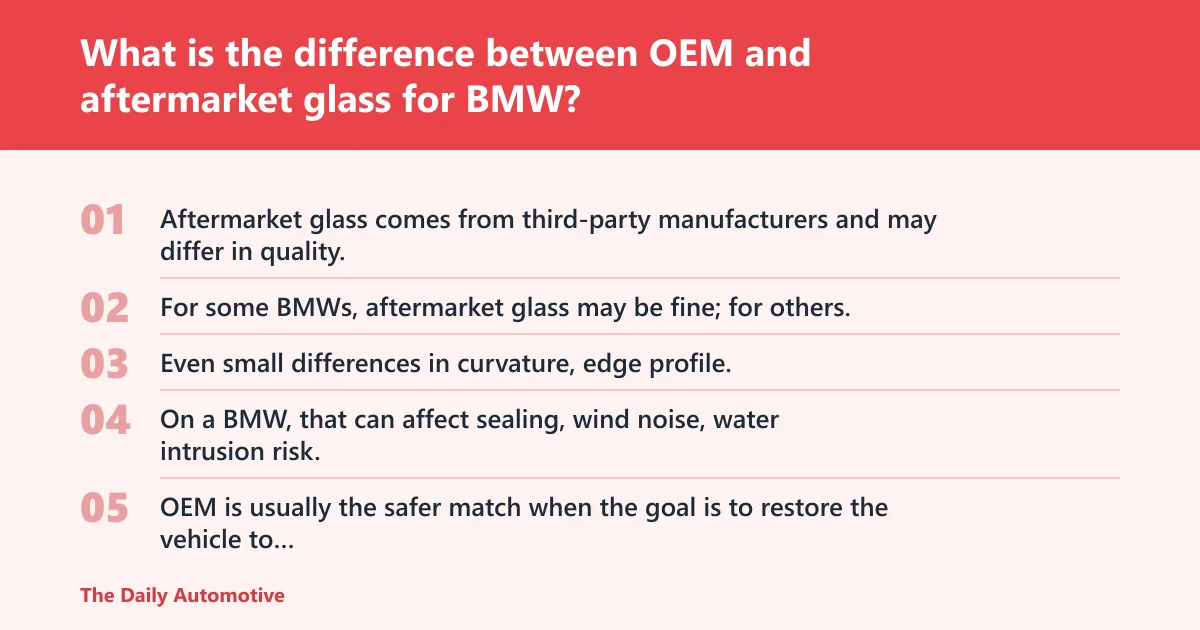
OEM glass is made to BMW specifications. Aftermarket glass comes from third-party manufacturers and may differ in quality, optical behavior, or dimensions. For some BMWs, aftermarket glass may be fine; for others, especially those with HUD or cameras, the details can affect how well the car systems work after replacement.
Fit and seal differences
Even small differences in curvature, edge profile, or thickness can change how a windshield fits. On a BMW, that can affect sealing, wind noise, water intrusion risk, and how the glass sits relative to trim and sensors. OEM is usually the safer match when the goal is to restore the vehicle to original-condition standards.
Optical and HUD-related differences
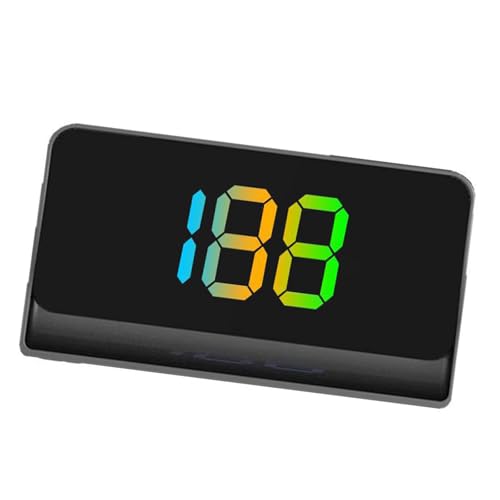
HUD-equipped BMWs are more sensitive because the windshield acts as the projection surface. OEM glass is made to match the HUD projector’s optical specification. Aftermarket glass may still work, but any change in optical clarity or angle can alter how sharp the display looks to the driver.
When aftermarket may be acceptable
Aftermarket glass can be a cost-effective option when the BMW does not have HUD, does not rely on complex windshield-mounted driver-assistance hardware, and the insurer will not approve OEM without a fight. If you choose aftermarket, confirm compatibility and make sure the installer will handle any needed calibration.
Picture a 5 Series with no HUD and only basic rain sensing. Aftermarket glass may be a reasonable choice if the part matches the opening correctly and the insurer covers it. Now picture the same car with HUD and forward-facing cameras. The decision becomes much more sensitive.
Why HUD and camera-equipped BMWs need extra care
BMWs with HUD or driver-assistance cameras need extra confirmation because the windshield does more than block wind. It must preserve the correct projection angle for HUD and give camera systems a stable reference. Confirming OEM glass helps keep those features working as intended.
Head-Up Display optical alignment
HUD depends on the windshield’s optical behavior. If the glass does not match BMW’s specification closely enough, the projected image can look blurry, shifted, or doubled. That is why OEM glass matters more on HUD-equipped BMWs than on a basic windshield replacement.
Driver-assistance camera mounting and calibration
Many BMWs mount driver-assistance cameras near or behind the windshield. After replacement, the camera may need calibration. Aftermarket glass may require extra sensor calibration work, and even OEM glass can still need camera alignment checks depending on the vehicle configuration.
A common first-timer mistake is approving the replacement before asking about calibration. The glass can look right and still leave the camera system out of spec until proper calibration is done.
Why small glass differences matter more here
A few millimeters of difference is not minor when a camera system or HUD is involved. The result can be warning lights, inconsistent lane-keeping behavior, or a display that does not read correctly. That is why HUD-equipped BMWs make OEM glass more important.
How to verify OEM availability before you book
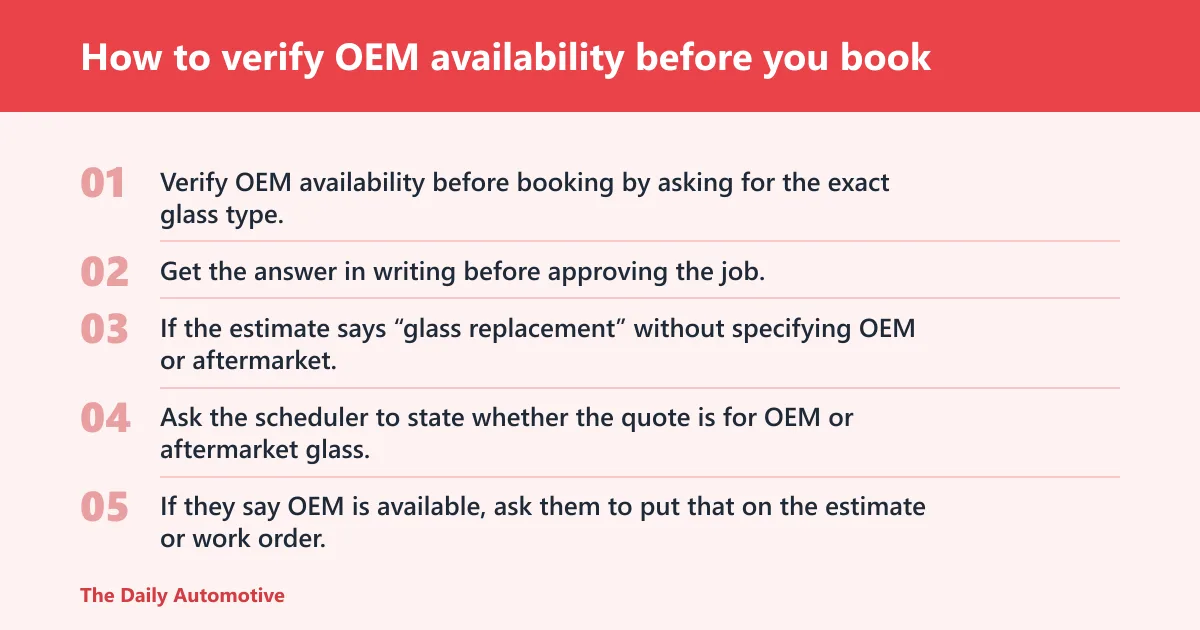
Verify OEM availability before booking by asking for the exact glass type, the manufacturer name, and the part number tied to your VIN. Get the answer in writing before approving the job. If the estimate says “glass replacement” without specifying OEM or aftermarket, it is not specific enough for a BMW.
Ask for the exact glass type on the estimate
Ask the scheduler to state whether the quote is for OEM or aftermarket glass. If they say OEM is available, ask them to put that on the estimate or work order. If they cannot document it, treat the answer as incomplete.
Confirm the manufacturer and part number
The part number matters because BMW windshield options can vary by model, trim, year, and equipment package. Ask which manufacturer will supply the windshield and whether that part matches the OEM specification for your VIN. That is the cleanest way to avoid a mismatch.
Get the answer in writing before approving the job
Use written confirmation in the estimate, text, email, or work order. The documentation should say OEM glass, or it should state the exact aftermarket brand if that is what you chose. If the paperwork is vague, you do not have enough information to approve the replacement.
Will insurance cover OEM glass on a BMW?
Insurance coverage for OEM glass should be confirmed before booking. Some policies may allow OEM coverage, some may pay only aftermarket pricing, and some may require a special endorsement or threshold. Your booking choice can change depending on whether you pay the difference or the insurer approves the full OEM part.
What to ask your insurer
Ask whether your policy covers OEM glass for a BMW windshield replacement, whether there is a deductible, and whether you must use a preferred glass provider to receive that coverage. If the insurer says OEM is covered only in certain cases, get those terms before scheduling.
When you may owe the difference
If your policy pays for aftermarket glass but you request OEM, you may owe the price difference. That difference can also appear if the insurer approves replacement but not the exact BMW-specific part. Confirming coverage before booking prevents a surprise invoice at pickup.
How coverage affects your booking choice
Coverage can decide whether OEM is the better choice. If OEM is approved with no extra cost, it is usually the cleaner answer for a BMW. If not, compare the value of OEM against your car’s equipment, especially HUD and camera-based features, before you consent to aftermarket.
What should I ask Safelite before booking a BMW windshield replacement?
Before you book, ask three things: whether OEM glass is available for your exact BMW, whether camera calibration is included or required, and whether the estimate documents the part type. Those questions reduce confusion, help you compare options, and force the booking to match what you want installed.
Availability and stock question
Ask: “Is OEM glass available for my BMW by VIN, and is that what this estimate includes?” This puts the burden on the scheduler to verify availability rather than guessing. If the answer is “probably” or “usually,” keep asking until the part type is confirmed.
Calibration and sensor question
Ask: “Will this replacement require driver-assistance camera calibration, and is that included?” BMWs with cameras or windshield-mounted sensors may need calibration after installation. If the answer is unclear, you need a more precise explanation before booking.
Work-order documentation question
Ask: “Can you note OEM glass, the part number, and any calibration work on the work order?” This is how you prevent a verbal promise from turning into a different part at installation time. The paperwork should match the car, the coverage, and the replacement plan.
Pre-booking checklist: the answers you want to hear
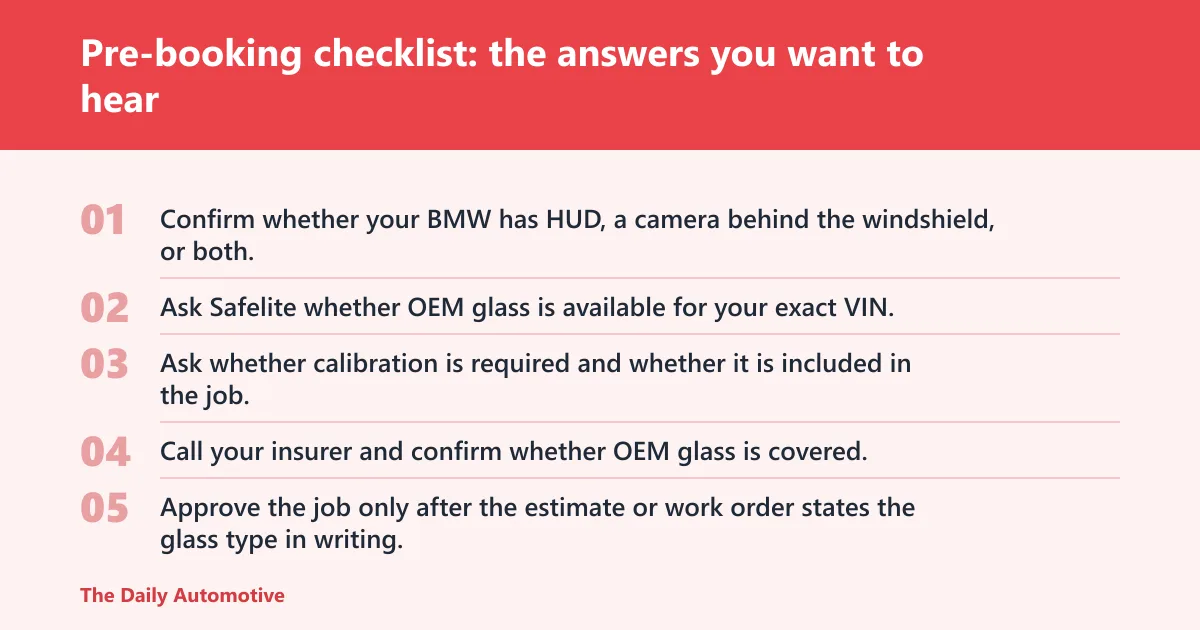
Use this checklist before approving a BMW windshield replacement. The best answers are specific, written, and tied to your VIN. If the response is vague, you do not have enough detail to proceed confidently, especially on HUD-equipped BMWs or cars with forward-facing cameras.
| Question | Expected answer | Red flag response | Matters more for HUD/camera-equipped BMWs? |
|---|---|---|---|
| Is OEM glass available for my VIN? | Yes, and the estimate lists OEM glass | “We usually use OEM” or “it should fit” | Yes |
| What manufacturer and part number will be installed? | A named manufacturer and part number tied to the VIN | No part number, no manufacturer, or “generic BMW glass” | Yes |
| Does this windshield support HUD? | Yes, if your BMW has HUD | No clear answer on optical spec | Yes |
| Will the camera system need calibration? | Yes or no, with the calibration plan stated | “We’ll see after installation” | Yes |
| Does my insurance approve OEM glass? | Yes, or a clear explanation of any price difference | “The claim department will figure it out later” | Sometimes |
| Will the work order say OEM glass? | Yes, in writing | No written documentation | Yes |
- Confirm whether your BMW has HUD, a camera behind the windshield, or both.
- Ask Safelite whether OEM glass is available for your exact VIN.
- Ask whether calibration is required and whether it is included in the job.
- Call your insurer and confirm whether OEM glass is covered.
- Approve the job only after the estimate or work order states the glass type in writing.
How do I confirm the glass type before Safelite installs it?
Confirm the glass type by getting the estimate, work order, or claim notes to name OEM or aftermarket explicitly. Ask for the manufacturer and part number, then compare that against your VIN-based requirements. If the installer cannot document the glass type before arrival, do not treat it as confirmed.
Use the estimate as your paper trail
The estimate should say more than “windshield replacement.” It should identify the glass type, list the part number, and note any calibration. If those details are missing, ask for a revised estimate before the appointment is set.
Check the work order before the tech starts
When the technician arrives, review the work order and confirm it still matches the approved estimate. If the paperwork changed from OEM to aftermarket, stop the job and ask why. The wrong part is easier to prevent than to unwind after installation.
Document the answer in plain language
Keep a record that says: OEM glass approved, manufacturer listed, calibration noted, insurance coverage verified. That simple paper trail helps if the claim is disputed later or if the installed part does not match what was promised.
Frequently asked questions
Can I request OEM glass from Safelite for my BMW windshield?
Yes, you can request OEM glass. The key is to make the request before booking and get the estimate to state OEM clearly. If the quote does not specify the part type, ask for the manufacturer and part number so you know what will be installed.
Is aftermarket glass okay for BMWs with HUD?
It can be, but it needs extra scrutiny. HUD-equipped BMWs are more sensitive because the windshield affects the projection’s alignment and clarity. If you choose aftermarket, confirm that it is compatible with HUD and that any needed calibration or optical issue is addressed first.
Does Safelite calibrate cameras after windshield replacement on BMWs?
Camera calibration may be needed after windshield replacement on BMWs, especially when the camera is mounted to or near the windshield. Ask whether the job includes calibration or whether it is a separate step. Do not assume the replacement alone completes the repair.
DOES Definition & Meaning | Dictionary.com — DOES definition: a plural of doe. See examples of does used in a sentence.
That dictionary result is unrelated to BMW windshield replacement. If you are comparing Safelite glass for a BMW, focus on OEM versus aftermarket, insurance approval, HUD compatibility, and camera calibration instead of unrelated dictionary entries that do not affect the repair.
Products related to this article
Sponsored / affiliate links. As an Amazon Associate I earn from qualifying purchases. I may earn additional commission from eligible campaigns.