2026 Honda CR-V Oil Capacity: Complete Specs and DIY Guide
You’re staring at the owner’s manual, oil draining into a pan, and you still can’t find the exact capacity for your 2026 CR-V. Maybe you grabbed the wrong bottle of oil at the store. Maybe you’re worried about overfilling. Either way, guessing with engine oil is a mistake that can cost you thousands.
This guide gives you the exact 2026 Honda CR-V oil capacity for both engines, the correct viscosity, torque specs for the drain plug and filter, and a full DIY walkthrough that includes the step most guides skip: resetting the Maintenance Minder. You’ll also learn why over-tightening causes leaks and how to tell if your engine is burning oil before it becomes a problem.

Bosch
BOSCH 3323 Premium Engine Oil Filter With…
- Exclusive FILTECH media technology screens out and holds on to up to 14 grams of dirt and particles, preventing it from circulatin…
- OE fit ensured through strong steel base plates and housings that prevent warpage, leaks, and poor fit
- Silicone anti-drain back valve ensures engine receives a supply of clean oil when the vehicle is started
Before we get into the specs, a quick word on filters. The factory filter works fine, but the BOSCH 3323 Premium Oil Filter is a solid upgrade. Its FILTECH media holds up to 14 grams of dirt, and the silicone anti-drain back valve keeps oil in the filter so the engine gets pressurized oil immediately at startup. That matters on cold mornings. We’ll talk more about filter choices later.
2026 Honda CR-V Oil Capacity by Engine (1.5L Turbo vs. 2.0L Hybrid)
Honda built two very different powertrains for the 2026 CR-V. The base engine is a 1.5L turbocharged four-cylinder (code L15BE), and the hybrid uses a 2.0L Atkinson-cycle four-cylinder (code LFB2) paired with electric motors. They have different oil needs.
Here are the exact numbers:
- 1.5L Turbo (L15BE): 4.4 quarts (4.2 liters) with filter change. Without filter change, it’s 4.2 quarts.
- 2.0L Hybrid (LFB2): 3.8 quarts (3.6 liters) with filter change. Without filter change, 3.6 quarts.
Those figures assume you’re draining the oil completely and replacing the filter. If you only drain and skip the filter (not recommended), you’ll be slightly underfilled. Always change the filter. It’s cheap insurance.
The hybrid’s lower capacity isn’t a mistake. The LFB2 engine is smaller in displacement and doesn’t work as hard because the electric motors handle much of the acceleration load. That means less oil circulating through the system.
One more thing: the hybrid’s oil pan is shaped differently from the turbo’s. You can’t swap pans between them, and you shouldn’t try. Buy the right filter and oil for your specific engine.
Recommended Oil Type and Viscosity (0W-20 Explained)
Both engines require 0W-20 viscosity oil. Honda specifies this for a reason, and it’s not just about fuel economy.
The “0W” part means the oil flows like a thin 0-weight oil at cold temperatures. That’s critical for the 1.5L turbo, which has tight bearing clearances and needs oil to reach the turbocharger quickly on startup. The “20” part means it thickens to a 20-weight oil at operating temperature, providing enough film strength for normal driving.
Honda recommends oil that meets API SN or ILSAC GF-5 standards. Most modern synthetic blends and full synthetics meet this. You’ll see “synthetic blend” on many bottles of 0W-20 — that’s fine. Full synthetic is better for extreme conditions, but not required.
What about cold weather vs. hot weather? Some owners in Arizona or Texas wonder if they should run 5W-30 in summer. Don’t. The 2026 CR-V’s engine management system is calibrated for 0W-20. Thicker oil will reduce fuel economy, slow oil flow to the turbo, and can trigger the oil pressure light in extreme cold. Stick with 0W-20 year-round.
If you drive in severe cold (below -20°F), 0W-20 is actually the best choice because it stays fluid. In extreme heat, 0W-20 still protects fine as long as you change it on schedule. The oil’s additive package matters more than the base viscosity.
Honda Genuine Oil is a safe bet, but any reputable brand that meets API SN and ILSAC GF-5 works. Mobil 1, Pennzoil, Castrol — they’re all fine. Just check the label for those certifications.
OEM vs. Aftermarket Oil Filters: Which to Choose?
The OEM Honda filter (part number 15400-PLM-A02) is good. It’s made by a reputable supplier and meets Honda’s specifications. But it’s not the only option.
Aftermarket filters vary wildly in quality. The cheapest ones use paper media that collapses under pressure and bypass valves that stick. I’ve seen a $3 filter cause a $4,000 engine failure. Not worth it.
The BOSCH 3323 is a strong alternative to OEM. Its FILTECH media screens out particles down to a microscopic level and holds up to 14 grams of dirt before clogging. The steel base plate prevents warpage, and the silicone anti-drain back valve is a real upgrade over the rubber valves in cheap filters. That silicone valve doesn’t harden in cold weather, so the filter stays full of oil between starts.
Here’s a quick comparison table for the three most common choices:
| Filter | Media Type | Anti-Drain Back Valve | Best For |
|---|---|---|---|
| Honda OEM | Paper blend | Rubber | Factory spec, peace of mind |
| Bosch 3323 | FILTECH synthetic | Silicone | Extended intervals, cold climates |
| Budget store brand | Paper | Rubber (often poor) | Emergency only — avoid |
The Bosch filter costs a few dollars more than a budget filter but less than most dealership parts counters. It’s a good middle ground. Check the fitment guide before buying, since engine type affects compatibility.
Step-by-Step Oil Change Procedure (With Torque Specs)
Doing your own oil change on a 2026 CR-V is straightforward. You’ll need a few tools and about 45 minutes. Here’s the complete process.
Tools and Supplies Needed
- 4.5 quarts of 0W-20 oil (for the 1.5L turbo) or 4 quarts (for the hybrid)
- New oil filter (OEM or Bosch 3323)
- New crush washer for the drain plug (14mm)
- 17mm socket for the drain plug
- Oil filter wrench (cap style works best)
- Drain pan with at least 6-quart capacity
- Funnel
- Jack and jack stands (or ramps)
- Shop rags or paper towels
Warm up the engine for 2-3 minutes before draining. Warm oil flows faster and carries more suspended particles out of the pan. Don’t drive it hard — just let it idle.
Draining the Oil and Replacing the Filter
- Park on level ground, set the parking brake, and chock the rear wheels.
- Jack up the front and secure it on jack stands. Never work under a car supported only by a jack.
- Slide under the front of the car. The drain plug is on the driver’s side of the oil pan, pointing downward.
- Place the drain pan under the plug. Loosen the plug with the 17mm socket, then remove it by hand. Expect oil to flow immediately — keep your hand clear.
- Let the oil drain for at least 10 minutes. The longer it drains, the more old oil comes out.
- While draining, locate the oil filter. On the 1.5L turbo, it’s on the front of the engine, accessible from below. On the hybrid, it’s on the side, slightly harder to reach.
- Use the filter wrench to loosen it. It will still contain oil, so have the drain pan ready. Turn it counterclockwise and let it drain into the pan.
- Clean the filter mounting surface with a rag. Make sure the old gasket comes off with the old filter — a stuck gasket causes a massive leak.
- Lightly coat the new filter’s gasket with fresh oil. Screw it on by hand until the gasket touches, then tighten another 3/4 turn. Do NOT use a wrench to tighten a hand-tight filter.
- Replace the crush washer on the drain plug. Torque the plug to 29 lb-ft (39 Nm). Over-tightening strips the aluminum pan threads. Under-tightening causes drips.
Torque specs matter more than people think. The drain plug on the 2026 CR-V is easy to strip if you crank it down with a breaker bar. The aluminum oil pan threads are softer than the steel plug. Use a torque wrench — it costs $20 and saves you from a $500 pan replacement.
Refilling and Checking the Dipstick
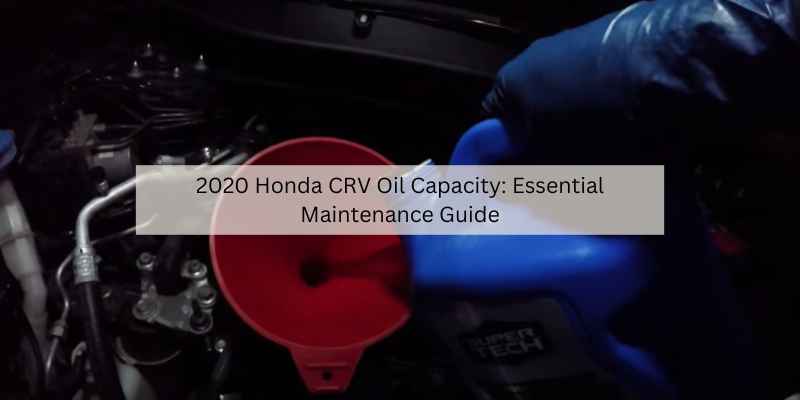
- Lower the car and remove the oil fill cap from the valve cover.
- Insert the funnel and pour in about 80% of the required capacity. For the 1.5L turbo, that’s about 3.5 quarts. For the hybrid, about 3 quarts.
- Wait 2 minutes for the oil to settle into the pan.
- Check the dipstick. Wipe it clean, reinsert fully, pull it out, and read the level. It should be between the lower and upper marks.
- Add more oil in small increments (1/4 cup at a time) until the level is near the upper mark.
- Replace the fill cap, start the engine, and let it idle for 30 seconds. Check for leaks under the car.
- Turn off the engine, wait 2 minutes, and recheck the dipstick. Top off if needed.
Overfilling is a real problem. If you dump the entire 4.4 quarts in without checking, you’ll likely be over the full mark. Excess oil gets whipped into foam by the crankshaft, which causes poor lubrication and can damage the catalytic converter. When in doubt, add less and top off.
How to Reset the Maintenance Minder Light
After an oil change, the Maintenance Minder system still shows oil life at some low percentage. You have to reset it manually. Here’s how.
- Turn the ignition to ON (do not start the engine).
- Press the MENU button on the left side of the steering wheel until you reach the oil life screen.
- Press and hold the ENTER button for about 10 seconds.
- The display will show “Oil Life 100%” and then “Maintenance Reset” with an option to confirm.
- Select “Reset” and confirm. The display should show 100%.
- Turn the ignition off, then start the engine to verify the reset worked.
If the light doesn’t reset on the first try, repeat the process. Some owners report needing to hold the button longer than 10 seconds. Don’t skip this step — driving with the maintenance light on makes it easy to lose track of your next service interval.
For older CR-V models, the reset process is slightly different. If you’re working on a different year, check our guide on resetting oil life for that specific generation.
Oil Change Interval: Mileage, Time, and Driving Conditions
Honda’s Maintenance Minder system calculates oil life based on driving conditions, not just miles. The system tracks engine temperature, RPM, cold starts, and trip length to estimate oil degradation. That’s why the interval varies between 5,000 and 10,000 miles.
Here’s what the system doesn’t tell you: severe conditions accelerate oil breakdown. If you drive short trips (under 10 miles), live in extreme heat or cold, tow, or sit in heavy traffic, your oil degrades faster than the algorithm predicts. The Maintenance Minder might say 15% oil life, but the oil could already be sheared down.
My rule of thumb: trust the Maintenance Minder for normal driving, but change oil at 5,000 miles or 6 months if you fall into any severe condition category. The cost of an oil change is trivial compared to engine repair.
The 1.5L turbo is more sensitive to oil quality than the hybrid. The turbocharger spins at up to 150,000 RPM and relies on oil for both lubrication and cooling. Old, degraded oil leads to carbon buildup on the turbo shaft and premature bearing failure. If you own the turbo, don’t stretch intervals past 7,500 miles.
The hybrid’s LFB2 engine runs less often and at lower loads, so it can go closer to the full 10,000-mile interval. But the oil still gets contaminated with fuel and condensation. 8,000 miles is a reasonable ceiling.
Common Oil-Related Problems and FAQs (Burning, Leaks, Overfill)
Owners report a few recurring issues with the 2026 CR-V’s oil system. Here’s what to watch for and how to handle it.
Is the 1.5L turbo known for burning oil?
Some 1.5L turbos consume oil between changes, especially with hard driving. Normal consumption is about 1 quart per 3,000 miles. If you’re adding a quart every 1,000 miles, that’s excessive and worth a dealership visit. Causes include stuck piston rings, turbo seal wear, or a PCV valve blockage.
What does the “oil life” percentage actually mean?
It’s a calculated estimate of remaining oil life, not a direct measurement. The system considers engine RPM, temperature, and trip patterns. When it hits 15%, the maintenance light comes on. At 0%, you’re overdue.
Can I use 5W-30 instead of 0W-20?
Not recommended. The engine is designed for 0W-20. Using 5W-30 increases friction, reduces fuel economy, and can cause the variable valve timing system to respond slower. In freezing temperatures, 5W-30 flows too slowly and can cause startup wear.
Why is there oil on the drain plug after an oil change?
Almost always a bad crush washer or over-tightening. The crush washer deforms to seal the gap. If you reuse it, it won’t seal properly. If you over-tighten, you deform the washer too much and it leaks. Always use a new washer and torque to 29 lb-ft.
What happens if I overfill the oil?
The crankshaft whips the excess oil into foam. Foam doesn’t lubricate well, and the oil pressure drops. You might hear a knocking sound or see the oil pressure light flicker. Drain some oil immediately. Overfilling by more than a quart can cause oil to be forced past the piston rings into the combustion chamber, leading to catalytic converter damage.
Final Notes on Keeping Your CR-V’s Oil System Healthy
- Use 0W-20 oil that meets API SN or ILSAC GF-5 — no exceptions for weather.
- Capacity is 4.4 quarts for the 1.5L turbo, 3.8 quarts for the hybrid, both with filter.
- Torque the drain plug to 29 lb-ft and the filter to 3/4 turn after hand-tightening.
- Change the filter every time you change the oil. A good filter like the Bosch 3323 is worth the extra few dollars.
- Reset the Maintenance Minder after every oil change to keep your service records accurate.
- Check the dipstick monthly. Catching a low level early prevents engine damage.
- If you see oil spots on your driveway, investigate immediately. Small drips become big leaks fast.
For more details on oil types for other CR-V generations, check our guide on the 2026 CR-V oil type or the 2026 CR-V oil capacity. The specs differ, so don’t assume they’re the same.
Products related to this article
Sponsored / affiliate links. As an Amazon Associate I earn from qualifying purchases. I may earn additional commission from eligible campaigns.