Honda Ridgeline Wheels: Bolt Pattern & Fitment Guide
Honda Ridgeline wheels are commonly listed with a 5×120 bolt pattern, and a cautious replacement fitment usually stays near the factory 18–20 inch diameters with the correct offset and a load rating at least equal to OEM. Wrong specs can cause rubbing, vibration, ABS issues, or a wheel failure you can’t afford. This guide breaks down bolt pattern, center bore, offset, diameter, and load rating so you can buy the right wheels the first time.
What Honda Ridgeline wheel fitment means
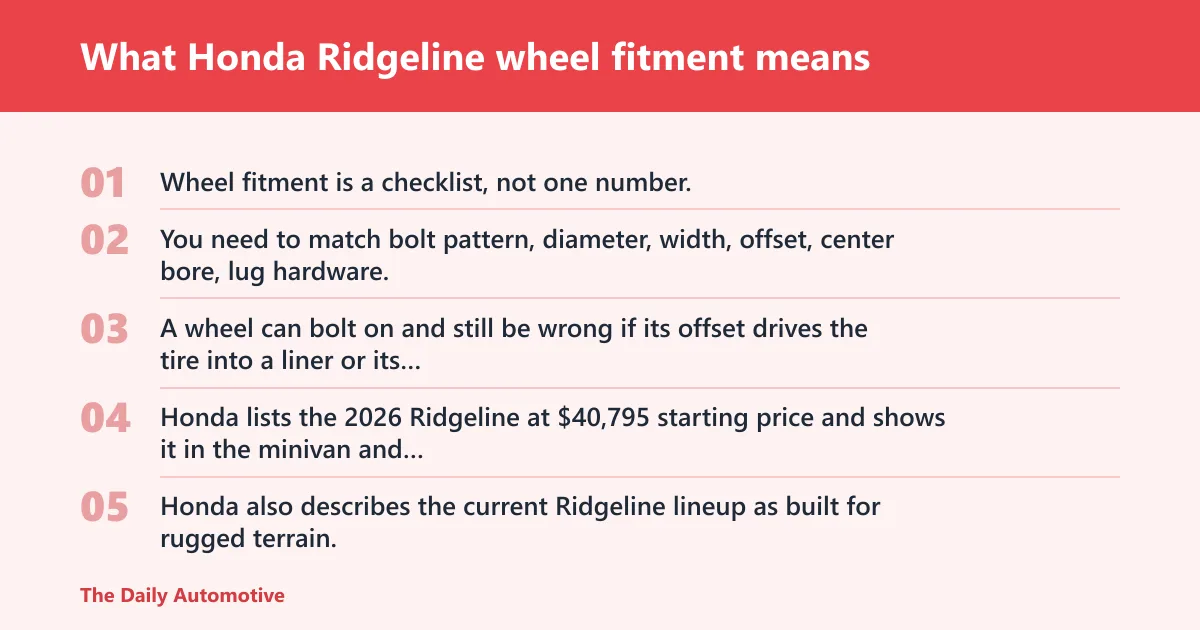


Wheel fitment is a checklist, not one number. You need to match bolt pattern, diameter, width, offset, center bore, lug hardware, TPMS compatibility, and load rating. A wheel can bolt on and still be wrong if its offset drives the tire into a liner or its center bore does not center on the hub.
Honda lists the 2026 Ridgeline at $40,795 starting price and shows it in the minivan and truck category, with an 18/24 city/hwy MPG rating on its models page. Honda also describes the current Ridgeline lineup as built for rugged terrain. That is a reminder that wheel choice has to respect both road use and load capacity.
For Ridgeline buyers, the choice is usually direct: stay with an OEM replacement wheel if you want factory behavior and look, or move to an aftermarket wheel only after confirming every fitment number. A wheel skin is a cosmetic cover. It is not a replacement wheel.
📊 The competitor guide says the OEM-style wheel is designed to replicate the factory look for 2024-2026 Ridgeline models. Source: Honda Ridgeline Wheels: Bolt Pattern & Fitment Guide.
What is the Honda Ridgeline bolt pattern?
The current fitment guides referenced here list the Ridgeline bolt pattern as 5x120mm. That means five lug holes arranged on a 120 mm bolt circle. Bolt pattern is the first compatibility check because the wheel has to physically bolt to the hub before any other measurement matters.
That said, buyers should verify the exact pattern by model year and generation before ordering. Wheel listings, trim differences, and source quality vary. A mismatch can leave you with a wheel that looks close on paper but will not seat correctly on the hub.
How to read lug count and circle diameter
“5×120” means five lugs and a 120 mm pitch circle diameter. The lug count must match, and the circle diameter must match. If either one is wrong, the wheel will not fit correctly. Aftermarket compatibility depends on that exact match, not on visual similarity.
Will 5×120 wheels fit a Honda Ridgeline?
Current Ridgeline fitment guides list 5x120mm, so 5×120 wheels are the number to start with, not the number to assume without checking. The safe answer is yes only when the wheel also matches the correct offset, center bore, load rating, and brake clearance for the specific Ridgeline generation.
Picture a wheel that matches 5×120 but uses the wrong center bore. It may bolt up and still sit off-center, which can create vibration. Or suppose the offset is too aggressive. The tire may rub at full lock or under compression even though the bolt pattern is correct.
What wheel size fits a Honda Ridgeline?
Ridgeline fitment discussions usually center on 17-inch and 18-inch wheels, with some factory-style and aftermarket options built around 18×8 sizing. Diameter changes ride quality, sidewall height, steering response, and the tire choices available to you. Bigger is not automatically better.
17-inch wheels: comfort, tire sidewall, and common use cases
Can I run 17-inch wheels on a Ridgeline? Yes, if the wheel clears the brakes, matches bolt pattern and offset, and carries the proper load rating. A 17-inch wheel usually leaves more sidewall, which can improve ride comfort and reduce pothole harshness. It may also open up more winter-tire choices.
That extra sidewall can help on rough pavement, but the final answer still depends on the exact wheel width and offset. Tire diameter has to stay close enough to factory calibration that speedometer error and rubbing stay under control.
18-inch wheels: appearance, steering feel, and tradeoffs
What wheel size fits a Honda Ridgeline? For many owners, 18-inch wheels are the most straightforward answer because they are common in OEM-style and aftermarket listings, including 18×8 examples. An 18-inch wheel generally reduces sidewall height versus a 17-inch setup, which can sharpen steering feel and change the truck’s stance.
The tradeoff is comfort. Less sidewall usually means less cushion over broken pavement. It also narrows the tire-selection window if you are trying to keep the overall diameter near stock.
How wheel diameter changes tire options
Diameter controls what tire sizes you can run without upsetting fitment. A larger wheel usually needs a lower-profile tire to keep overall diameter near the factory target. That can affect ride comfort, pothole resistance, and curb protection. A smaller wheel can do the opposite.
How width and offset change fitment
Width and offset are the two numbers that usually decide whether a wheel rubs or clears. Width sets how much tire you can fit. Offset sets how far the wheel sits inboard or outboard from the hub face. Both affect brake clearance, suspension clearance, and fender clearance.
What an 8-inch wheel width means for tire pairing
A common Ridgeline wheel listing uses 18×8 sizing. An 8-inch width is broad enough for many street-oriented truck tire sizes, but the tire has to be chosen for the wheel’s width range. A tire that is too narrow can look pinched. A tire that is too wide can rub or wear poorly.
Width also changes how the sidewall sits. That affects steering response and how exposed the wheel edge is to curb damage. Buyers comparing OEM replacement wheels with aftermarket wheels should look at wheel width and tire spec together, not separately.
What a +42 mm offset does to clearance and stance
The competitor wheel example uses a +42 mm offset. Positive offset moves the wheel mounting pad outward relative to the wheel centerline, which generally tucks the wheel farther under the truck body. That can help with fender clearance, but it can also reduce inner suspension clearance if the wheel is too wide.
Offset changes stance too. A lower positive offset can push the wheel outward for a wider look, but that may increase the risk of rubbing on liners or fenders. Offset is one of the most important numbers to verify before ordering.
Common rubbing points to check before you buy
- Front strut and upper control arm clearance
- Brake caliper and spoke clearance
- Fender liner contact at full steering lock
- Rear liner contact under suspension compression
- Valve stem or TPMS sensor clearance inside the wheel barrel
OEM replacement wheels vs aftermarket wheels
OEM replacement wheels are the simplest path if you want the factory look and factory-style behavior. The competitor guide says its OEM-style wheel is designed to replicate the factory look for 2024-2026 Ridgeline models. That is the right starting point for owners who want appearance matching with fewer fitment variables.
Factory-style replacement wheels and model-year matching
What OEM-style wheels fit 2024 to 2026 Ridgeline models? Wheels advertised for that model-year span should still be checked for bolt pattern, offset, center bore, and load rating. Matching the appearance is not enough. Model-year matching matters because brake clearance and trim-specific fitment can change.
OEM replacement wheels usually cut risk because they are built to a known factory style and load target. Reconditioned OEM wheels can also be a sensible choice if they are inspected for bend, crack, and corrosion damage.
Aftermarket wheel materials, construction, and verification steps
Aftermarket wheels come in many designs, and the tradeoff is usually style versus verification work. Cast wheels are common and usually less expensive. Flow-formed and forged wheels often weigh less and can cost more, but the buyer still has to confirm fitment, load rating, and brake clearance.
A competitor listing identifies an 18×8 wheel with 5×4.5/5×120 fitment and a +42 mm offset. That illustrates the main point: a wheel can look right on paper and still need a careful check of center bore, lug type, and TPMS compatibility before purchase.
How to compare appearance, weight, and budget
A lighter wheel can reduce unsprung mass, but the correct fit still comes first. A heavier wheel may be cheaper, but if it carries the proper load rating and clears the brakes, it can still be a valid choice for a daily-driven Ridgeline. Style should come after fitment, not before it.
Wheel skins are the budget cosmetic option. The competitor guide references a 17-inch chrome ABS wheel skin set. That is a cover, not a wheel, and it changes appearance only.
Ridgeline wheel fitment checklist by generation and model year
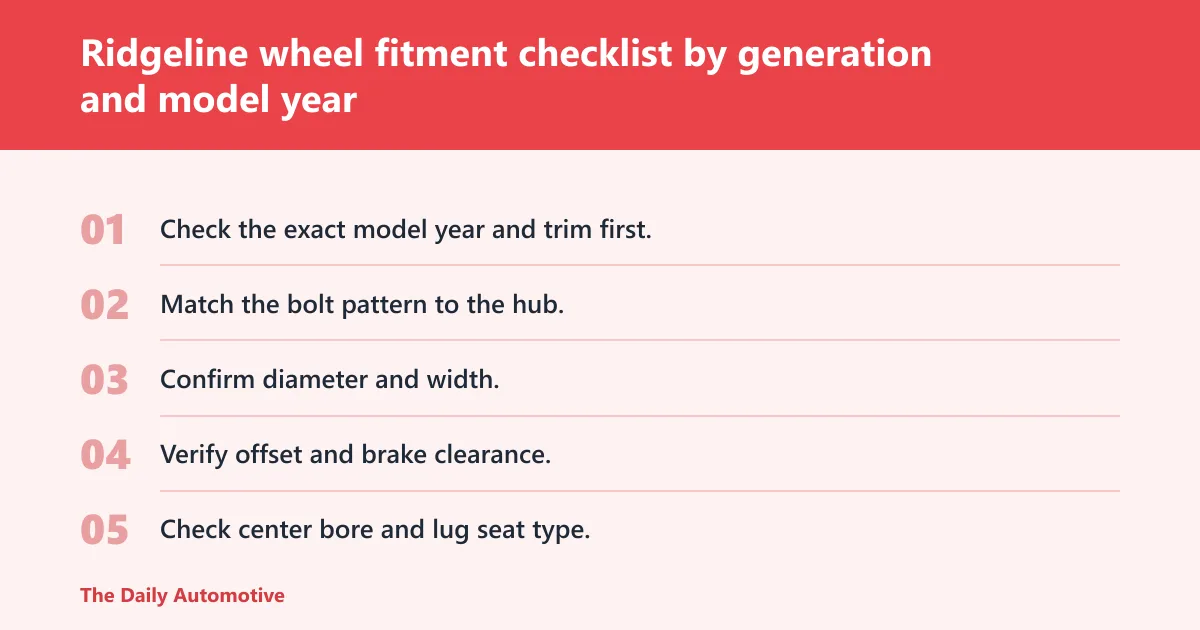
Use this table before ordering any wheel. It separates what is known from what still needs verification, because the failure points are usually in the details: center bore, offset, load rating, and hardware. Verify all of them against the exact wheel and your exact Ridgeline.
| Generation / model year | What to verify before ordering | Bolt pattern | Wheel diameter | Width | Offset | Center bore | Lug type | Common fitment risks |
|---|---|---|---|---|---|---|---|---|
| Current Ridgeline, 2024-2026 | Confirm wheel is listed for the exact model year and trim; verify brake clearance, TPMS compatibility, and load rating | 5x120mm per current fitment guides | 17-inch or 18-inch common; 18×8 appears in competitor listings | 8-inch example is common in aftermarket listings | Example shown: +42 mm | Verify against wheel and hub; must center correctly | Verify lug nut seat type and thread spec | Rubbing, vibration, incorrect TPMS fit, insufficient load rating |
| Current Ridgeline, OEM-style replacement | Match factory look, but still verify size, offset, and rating against the exact wheel | 5x120mm per current fitment guides | Factory-style replacement options often mirror stock diameter | Match the OEM wheel width or approved equivalent | Use the factory-equivalent offset or a confirmed equivalent | Verify hub fit, especially on replica or reconditioned wheels | Use correct OEM-equivalent lug hardware | Replica mismatch, finish differences, hidden curb damage on used wheels |
| Any Ridgeline wheel skin setup | Confirm you are buying a cover, not a wheel | Not a wheel fitment item | Matches cover size, not wheel replacement size | Matches original wheel underneath | Not applicable | Not applicable | Not applicable | Confusing cosmetic covers with actual replacement wheels |
- Check the exact model year and trim first.
- Match the bolt pattern to the hub.
- Confirm diameter and width.
- Verify offset and brake clearance.
- Check center bore and lug seat type.
- Confirm load rating and TPMS compatibility.
- Only then compare finish, price, and design.
Frequently asked questions
What is the Honda Ridgeline bolt pattern?
Current fitment guides list the Honda Ridgeline bolt pattern as 5x120mm. That means five lug holes on a 120 mm circle. Even so, buyers should verify the exact model year and wheel listing, because bolt pattern alone does not guarantee correct offset, center bore, or load rating.
What wheel size fits a Honda Ridgeline?
Both 17-inch and 18-inch wheels are common discussion points for the Ridgeline, and 18×8 shows up in competitor listings. The right choice depends on brake clearance, tire selection, ride comfort, and stance. Diameter should be matched with offset and width, not treated as a standalone number.
Will 5×120 wheels fit a Honda Ridgeline?
They can, if the wheel is built for the Ridgeline’s fitment and the rest of the specs line up. The current guide data referenced here lists 5x120mm, but you still need the correct center bore, offset, load rating, and lug hardware. A close match is not enough.
What offset do Honda Ridgeline wheels use?
Offset varies by wheel design and application, so it should be verified for the exact wheel you plan to buy. A competitor example uses +42 mm. That number is useful as a reference point, but the real goal is proper brake, suspension, and fender clearance for your specific setup.
Can I run 17-inch wheels on a Ridgeline?
Yes, provided the wheel clears the brakes and matches the vehicle’s bolt pattern, offset, center bore, and load rating. A 17-inch wheel can improve comfort by allowing more sidewall, and it is often a practical choice for owners who want a more forgiving ride and winter tire options.
What OEM-style wheels fit 2024 to 2026 Ridgeline models?
OEM-style wheels for 2024 to 2026 Ridgeline models are the ones designed to replicate the factory look and stay close to factory dimensions. That means checking the exact wheel year range, bolt pattern, width, offset, center bore, and load rating. Match appearance last, not first.
Do aftermarket wheels affect Ridgeline handling and ride quality?
Yes. Wheel diameter, width, weight, and offset all influence steering feel, ride comfort, and noise. A larger or heavier wheel can change the truck’s behavior, and a poorly chosen offset can create rubbing. Aftermarket wheels can work well, but only if the fitment numbers are right.
How do I choose wheels that match the factory look?
Start with OEM replacement wheels or OEM-style replicas made for the correct Ridgeline model years. Then confirm the dimensions, finish, center bore, and lug hardware. If you want the factory look with the fewest surprises, factory-style replacement wheels are the cleanest path.
Products related to this article
Sponsored / affiliate links. As an Amazon Associate I earn from qualifying purchases. I may earn additional commission from eligible campaigns.