Chevy Tahoe Z71 vs RST: Price, Specs, and Differences
Pick the Tahoe Z71 if you want standard 4WD, skid plates, and off-road tuning. Pick the RST if you want a lower-priced, street-focused Tahoe and you are fine adding 4WD or bigger wheels as options. Choosing wrong can mean paying for hardware you will not use. This guide compares price, specs, comfort, and value.
| Factor | Chevy Tahoe Z71 | RST: Price, Specs, and Differences | Winner |
|---|---|---|---|
| Price | Usually asks more when you value the standard off-road hardware; Chevrolet lists the Tahoe starting at $60,700. | Can be cheaper on the sticker, but options can bring it up to or above Z71 pricing. | RST: Price, Specs, and Differences |
| Drivetrain and off-road hardware | Standard 4WD on the trim’s core formula, plus an automatic locking rear differential, modified lower bumper, aluminum skid plate, and skid plate for the two-speed transfer case. | Mostly appearance-led equipment; off-road hardware depends on added options. | Chevy Tahoe Z71 |
| Ride and street manners | Still a family SUV, but tuned with off-road priorities in mind. | Cleaner street feel and better match for commuting, highway use, and daily driving. | RST: Price, Specs, and Differences |
| Best-fit use | Stronger pick for snow, gravel, light trails, unplowed roads, muddy jobsite access, and a dirt road to a cabin. | Better if most driving is school runs, highway miles, parking lots, and other paved-road use. | Tie |
| Value at the same option level | Better if you will use the differential, skid plates, and traction hardware. | Better if you want the look and can skip off-road equipment; a stripped build may undercut Z71. | Tie |
| Suspension and ground clearance | Optional Air Ride adaptive suspension can raise the SUV by 2 inches and adds 4 inches of adjustable ride height; cited as up to 6 inches of additional ground clearance. | Suspension tuning is aimed more at street manners than extra clearance. | Chevy Tahoe Z71 |
| Wheel and tire setup | Off-road-leaning package choices support rougher surfaces better and prioritize traction and sidewall protection. | Wheel choices lean toward appearance and pavement use. | Chevy Tahoe Z71 |
| Protection and limitations | Has skid plates and a transfer-case skidplate, but the rear differential gets no additional protection, the rear bumper is standard, and the fuel tank is unprotected. | Less underbody protection and fewer standard off-road parts. | Chevy Tahoe Z71 |
| Overall character | Off-road-oriented trim with hardware for loose surfaces and winter use. | Sport-styled, road-focused trim built around appearance and daily driving. | Tie |
Chevy Tahoe Z71 vs. RST: the real trade-off



The Tahoe is a full-size SUV with multiple trims, and Chevrolet lists it starting at $60,700. The Z71 is generally the off-road-focused version, while the RST is typically the sportier, appearance-focused trim. On paper, both are family SUVs; in practice, they split into capability first versus style first.
What you buy with Z71 is hardware. What you buy with RST is a cleaner street setup and a trim that can be cheaper if you keep the build simple. The catch is that options move the price in both directions, so the winner often depends on how much equipment you add.
Say your Tahoe will spend most of its life on school runs, highway miles, and parking lots, with only the occasional snowy driveway. RST usually makes more sense there. If you regularly face unplowed roads, muddy jobsite access, or a dirt road to a cabin, Z71 starts to earn its keep.
📊 Chevrolet lists the Tahoe starting at $60,700. Source: Chevrolet Cars, Trucks, SUVs, Crossovers and Vans.
How much does the Tahoe Z71 cost versus the RST?
Chevrolet starts the Tahoe lineup at $60,700, but that base number does not settle the Z71-versus-RST question because both trims move with drivetrain and option choices. The RST can cost less or more than the Z71 depending on what you add. Compare similarly equipped builds, not trim names alone.
A buyer-first comparison means matching four things before judging value: drivetrain, suspension, wheel and tire setup, and the comfort or clearance package underneath the body. A stripped RST with simpler wheels may undercut a Z71. A loaded RST with larger wheels, 4WD, and other extras can close the gap quickly.
How to compare similarly equipped builds
- Match 2WD or 4WD first.
- Match wheel size and tire type next.
- Check whether air suspension is included or optional.
- Then compare the off-road hardware that remains standard versus optional.
Side-by-side value table: Z71 vs. RST at the same option level
| Factor | Chevy Tahoe Z71 | RST | Winner |
|---|---|---|---|
| Price position | Usually asks more when you value the standard off-road hardware | Can be cheaper, but options can bring it up to or above Z71 pricing | RST for lower entry cost |
| Drivetrain | Built around off-road use with standard 4WD on the trim’s core formula | Often chosen for road use; 4WD is not the point of the trim | Z71 |
| Suspension and ride height | Optional Air Ride adaptive suspension can raise the SUV by 2 inches and adds 4 inches of adjustable ride height | Suspension tuning is aimed more at street manners than extra clearance | Z71 |
| Wheel and tire setup | Off-road-leaning package choices support rougher surfaces better | Wheel choices lean toward appearance and pavement use | Z71 |
| Clearance-related hardware | Modified lower bumper, aluminum skid plate, skid plate for the two-speed transfer case, automatic locking rear differential | Less underbody protection and fewer standard off-road parts | Z71 |
| Best for snow | Better starting point | Works if equipped right, but lacks the same built-in hardware | Z71 |
| Best for towing | Strong when traction matters on ramps, campsites, and slippery launch areas | Fine for road-focused towing, especially if the route stays paved | Depends on route |
| Best for commuting | Capable, but the hardware is more than some commuters need | Better fit for daily street use | RST |
| Best for light trails | More prepared out of the box | Needs more equipment to reach the same comfort on rough surfaces | Z71 |
Price and drivetrain
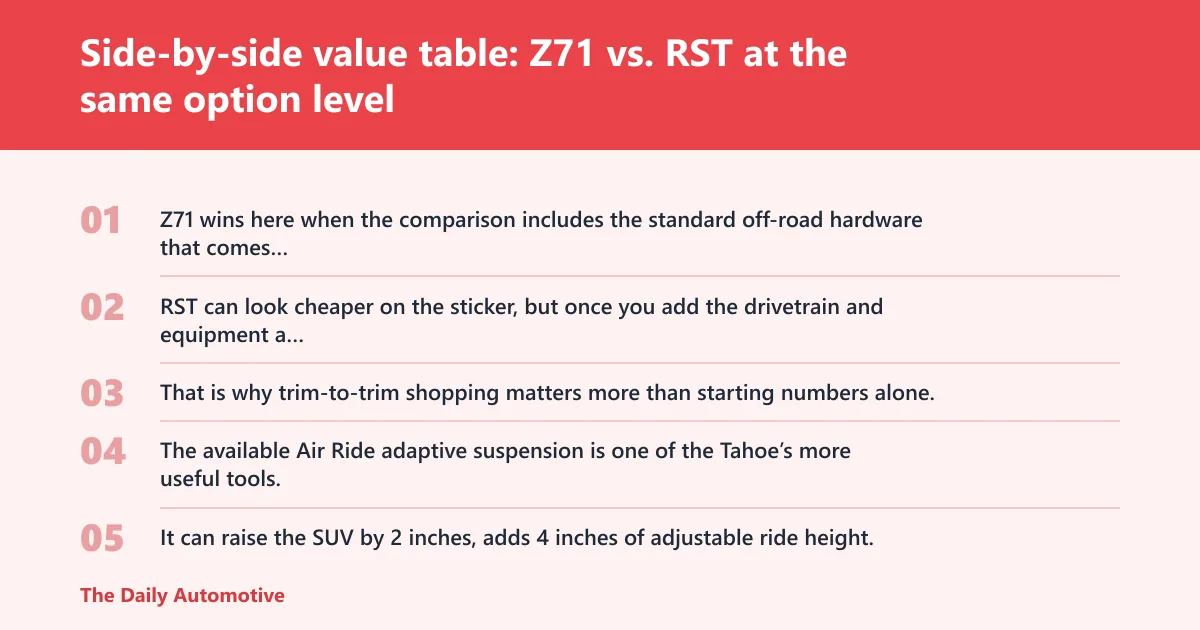
Z71 wins here when the comparison includes the standard off-road hardware that comes with the trim. RST can look cheaper on the sticker, but once you add the drivetrain and equipment a buyer actually wants, the gap can shrink or flip. That is why trim-to-trim shopping matters more than starting numbers alone.
Suspension and ride height
The available Air Ride adaptive suspension is one of the Tahoe’s more useful tools. It can raise the SUV by 2 inches, adds 4 inches of adjustable ride height, and MotorBiscuit cites up to 6 inches of additional ground clearance. That matters on ruts, snowpack, and steep approaches, but it is not the same as giving the Tahoe a dedicated trail chassis.
Wheel and tire setup
RST’s wheel-and-tire story is mostly about appearance, which helps on the street and in the showroom. Z71’s setup is aimed at keeping traction and sidewall protection in mind. For buyers who expect potholes, slush, or dirt roads, the more functional setup usually pays off.
Clearance-related hardware
The Z71’s modified lower bumper and aluminum skid plate are the kinds of details that matter once pavement ends. The two-speed transfer case also gets its own skidplate, which helps protect the hardware that supports low-speed off-road driving. That said, the source notes the rear differential gets no additional protection, the rear bumper is the same as the standard Tahoe’s, and the fuel tank is unprotected.
What makes the Tahoe Z71 different?
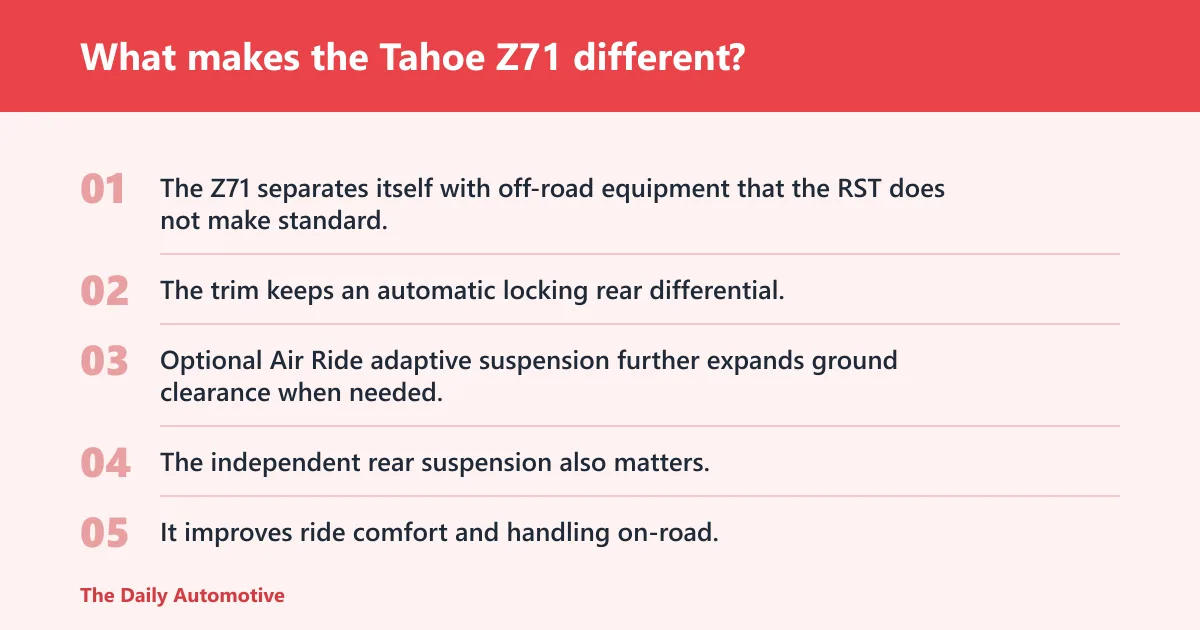
The Z71 separates itself with off-road equipment that the RST does not make standard. The trim keeps an automatic locking rear differential, adds a modified lower bumper and aluminum skid plate, and protects the two-speed transfer case with its own skidplate. Optional Air Ride adaptive suspension further expands ground clearance when needed.
The independent rear suspension also matters. It improves ride comfort and handling on-road, which is part of why the Tahoe drives like a modern full-size SUV instead of a truck with an enclosed box. The tradeoff is articulation: independent rear suspension does not move over rough terrain the way some solid-axle off-road layouts do.
Why the transfer case and rear differential matter
A two-speed transfer case helps keep control at low speeds when traction drops, which is exactly where snow, mud, and steep gravel roads get messy. The automatic locking rear differential helps send power where it can still be used. The concern is protection, not just traction, because the brief notes the rear differential gets no additional protection.
What makes the Tahoe RST different?
The RST is the road-first, style-first Tahoe. It leans on a sport appearance package, cleaner street manners, and a trim strategy that can keep the truck’s price in check if you avoid adding off-road hardware. It is the better fit for drivers who care more about curb appeal and commuting than trail tools.
That does not make it a weak choice. It makes it a different one. If you want a Tahoe that looks sharper on pavement and you do not need skid plates or the locking rear differential, the RST is often the smarter buy.
Where RST can be the better value
RST becomes attractive when you want the Tahoe cabin and size without paying for off-road parts you will never use. It also gives shoppers more flexibility if they want to build around street style instead of trail protection. Once you start adding 4WD, bigger wheels, and appearance packages, though, the value edge can narrow quickly.
Which Chevy Tahoe trim is better for off-road use, Z71 or RST?
The Z71 is the better off-road trim, full stop. It brings the automatic locking rear differential, skid plates, and a modified lower bumper, while the RST is built around appearance and street use. For dirt, snow, and uneven surfaces, the Z71 starts with the right equipment.
That does not mean the Z71 is a rock crawler. Chevrolet’s spokesperson said the Z71 is not intended as a hardcore rock crawler, and that limitation shows in the unprotected areas called out in the brief. It is a capable soft-road and winter-use Tahoe, not a specialized trail rig.
Limitations that matter
Ground clearance is helpful, but departure angle and underbody protection still set the ceiling. The rear bumper remains standard, the rear differential gets no additional protection, and the fuel tank is unprotected. Those are the kinds of details that separate an honest winter-and-gravel SUV from a dedicated off-road machine.
Is the Tahoe Z71 better for snow, gravel, and light trails?
Yes. Chevrolet said the Z71 would be awesome for getting through deep snow, and the trim’s hardware backs that up. The locking rear differential, skid plates, and available raised ride height are exactly the features that help when surfaces are loose, uneven, or packed with snow.
It is still a full-size family SUV, so the use case matters. Gravel roads, snowy commutes, campsite access, and forest roads fit the Z71 well. Technical rock sections, deep ruts, and repeated bumper strikes do not.
Why it is not a rock-crawling SUV
Ground clearance helps only if the body, rear bumper, and fuel tank are also protected. The brief says they are not. That means a Z71 driver can go farther off pavement than an RST driver, but the Tahoe’s design still places limits on departure angle and vulnerable components.
Does the Tahoe RST have the same engine options as the Z71?
No. The brief says the 3.0-liter Duramax turbodiesel hardware won’t fit the Z71, which means the Z71 does not get the same engine menu as the RST. That matters for buyers who want diesel torque and range more than off-road hardware.
If diesel is part of your must-have list, the RST may be the easier path. If off-road traction features matter more, Z71 is the trim to start with. This is one of the clearest ways the two versions split on value.
Can you get the Tahoe Z71 with a diesel engine?
Not according to the cited source. The article says the 3.0-liter Duramax turbodiesel hardware won’t fit the Z71, so shoppers should not plan on pairing that engine with the off-road trim. That is an important limiter for buyers who wanted towing and highway efficiency together.
That leaves a simple choice. If your priority is diesel availability, the Z71 is the wrong starting point. If your priority is snow, dirt, and low-speed control, the Z71 still makes sense without it.
What are the main styling differences between Tahoe Z71 and RST?
Z71 styling follows function. RST styling follows the street. The Z71’s modified lower bumper and more rugged cues are there because the trim needs clearance-related equipment, while the RST’s look is built around sport appearance and a cleaner road presence.
That difference matters less to a shopper who only wants a Tahoe that looks good on 22-inch wheels and more to a shopper who expects mud, snow, and curbs to be part of the vehicle’s life. In other words, the visual gap reflects the hardware gap.
Choose Chevy Tahoe Z71 if… / Choose Tahoe RST if…
Choose the Tahoe Z71 if you want the more capable starting point for winter roads, gravel, and light trails. Choose it if an automatic locking rear differential, skid plates, and a modified front end are worth paying for. Choose it if you may use Air Ride adaptive suspension to gain extra clearance.
Choose the Tahoe RST if you want the Tahoe’s size and cabin with a street-first setup. Choose it if commuting, highway miles, and appearance matter more than underbody protection. Choose it if you want to avoid paying for off-road equipment you will not use.
For towing, the decision depends on where the trailer goes. If launches, campsites, or work sites are slippery, Z71’s traction hardware helps. If the route stays paved, RST can be the better value. For most family buyers, the right answer is the trim that matches the roads you actually drive.
Frequently asked questions
What is the price difference between the Chevy Tahoe Z71 and RST?
There is no single fixed gap because the Tahoe lineup starts at $60,700 and both trims move with options. The RST can cost less or more than the Z71 depending on drivetrain, wheels, and added equipment. The safest comparison is similarly equipped builds, not base trim names.
Which Chevy Tahoe trim is better for off-road use, Z71 or RST?
The Z71 is better for off-road use because it includes the hardware that actually helps off pavement: an automatic locking rear differential, skid plates, and a modified lower bumper. RST is built for street style, so it starts at a disadvantage once traction and protection matter.
What standard features does the Tahoe Z71 have that the RST does not?
The Z71 has an automatic locking rear differential, a modified lower bumper, an aluminum skid plate, and a skidplate for the two-speed transfer case. Those parts are there for a reason. They help the Tahoe handle snow, gravel, and light trail duty better than the RST.
Does the Tahoe RST have the same engine options as the Z71?
No. The brief says the 3.0-liter Duramax turbodiesel hardware won’t fit the Z71, which means the trims do not share the same engine availability. Buyers who want diesel torque need to verify the exact trim and powertrain pairing before ordering.
How much ground clearance does the Tahoe Z71 get with air suspension?
Optional Air Ride adaptive suspension can raise the SUV by 2 inches and adds 4 inches of adjustable ride height. MotorBiscuit cites up to 6 inches of additional ground clearance. That helps on snow, ruts, and steep driveways, but it does not turn the Tahoe into a dedicated crawler.
Can you get the Tahoe Z71 with a diesel engine?
No, not according to the source cited in the brief. The 3.0-liter Duramax turbodiesel hardware won’t fit the Z71, so diesel shoppers should look closely at other Tahoe trims instead. That is one of the biggest differences in real-world buying.
Products related to this article
Sponsored / affiliate links. As an Amazon Associate I earn from qualifying purchases. I may earn additional commission from eligible campaigns.