Are Motorcycles Safer Than Cars? Proven Safety
Are motorcycles safer than cars? In terms of sheer protection in a crash, cars generally offer more. However, rider skill, protective gear, and responsible riding significantly impact motorcycle safety, making it a comparable choice for many.
Are Motorcycles Safer Than Cars? Understanding the Proven Safety
It’s a question many curious minds ponder when seeing a motorcycle glide by: are motorcycles safer than cars? It’s easy to look at a car’s metal shell and airbags and immediately think “safer.” But the reality is far more nuanced. Many factors contribute to the safety of any vehicle, and motorcycles have their own unique set of advantages and disadvantages. We’re here to break down the facts, helping you understand the true picture of motorcycle safety with clear, simple explanations.
You might be surprised to learn that when you factor in choices and proactive measures, the answer isn’t always a simple yes or no. We’ll explore the data, look at the protective gear that makes a huge difference, and discuss how rider awareness plays a vital role. Get ready to get a clear picture of motorcycle safety, presented in a way that’s easy to grasp, even if you’ve never sat on a bike before.
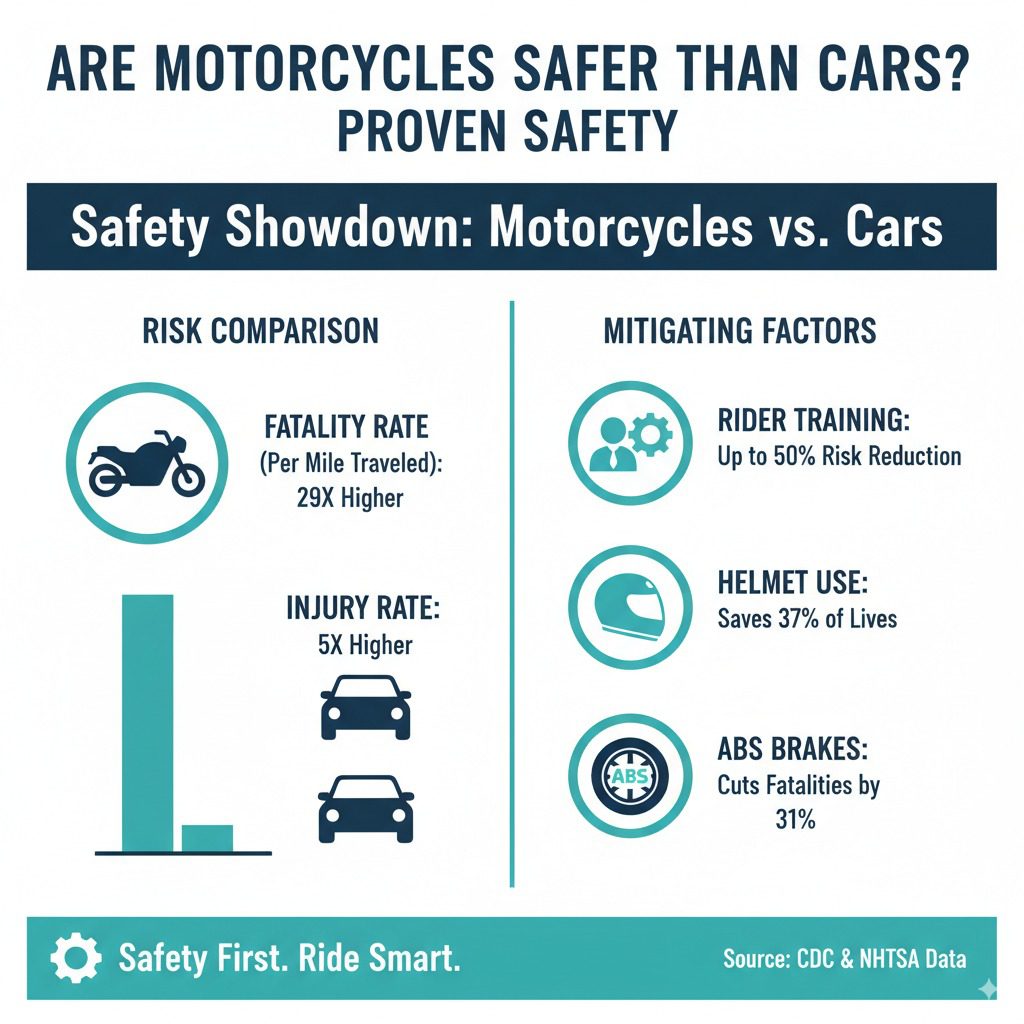
The Big Picture: How Do Motorcycles and Cars Compare?
When we talk about vehicle safety, we often look at statistics. These numbers can be a bit stark at first glance, but as we’ll see, they tell a complex story. It’s important to remember that statistics are averages, and individual experiences can vary greatly.
Crash Statistics: A Closer Look
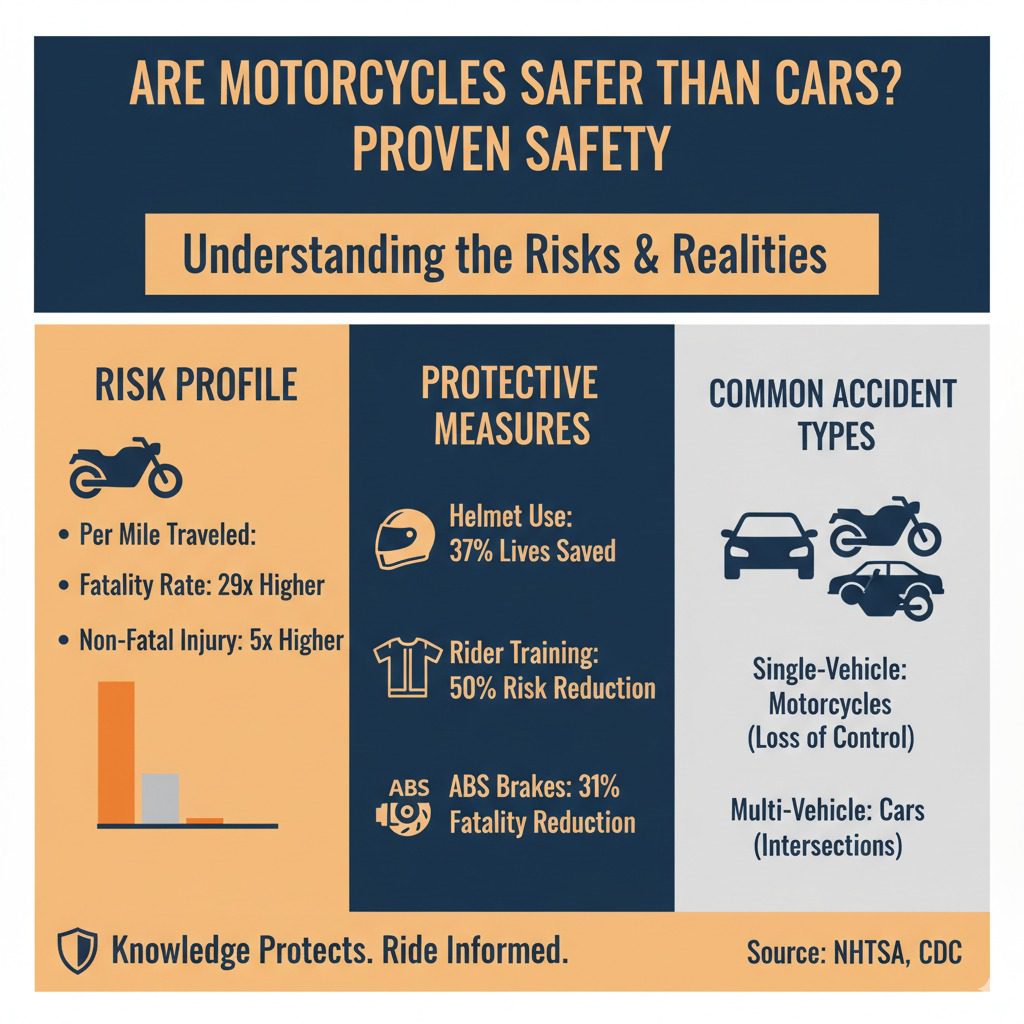
Data from organizations like the National Highway Traffic Safety Administration (NHTSA) consistently shows that motorcyclists are more vulnerable in a crash than car occupants. This is primarily because a motorcycle offers no external protection. There’s no metal cage, no seatbelts, and no airbags to absorb the impact or keep the rider secure.
For instance, you’ll often see figures stating that motorcyclists are X times more likely to be killed or severely injured per mile traveled than occupants of cars. While this sounds alarming, it’s crucial to understand what this means. It highlights the physics of a crash involving a motorcycle versus a car. Without the protective structure of a car, riders are exposed to direct impact forces.
What the Numbers Really Tell Us
These statistics don’t necessarily mean that riding a motorcycle is inherently a bad idea. Instead, they underscore the importance of:
- Protective Gear: Wearing the right gear can drastically reduce the severity of injuries.
- Rider Skill and Training: Experienced and well-trained riders are often better at avoiding accidents in the first place.
- Vehicle Design and Maintenance: Both motorcycles and cars need to be in good working order.
- Environmental Factors: Road conditions, weather, and the behavior of other drivers are huge influences.
It’s like comparing an open-air sports car to a minivan. On a perfect, sunny day, driving at moderate speeds, both can be enjoyable. But in a sudden storm or a high-speed collision, the minivan’s enclosed structure offers a different level of protection. Motorcycles, by their very nature, require a different approach to safety.
The Role of Protective Gear: Your First Line of Defense
This is where motorcycles can often bridge the safety gap with cars, or at least significantly reduce risks. While a car has built-in safety features, a motorcycle rider’s safety depends heavily on what they wear. Think of riding gear not as an accessory, but as your personal safety system.
Essential Motorcycle Safety Gear Explained
Every piece of gear is designed to protect specific parts of your body from abrasion, impact, and the elements. Here’s a breakdown of what’s crucial:
| Gear Item | Why It’s Important | What to Look For |
|---|---|---|
| Helmet | Protects your head from impact, which can prevent traumatic brain injuries. The single most critical piece of safety equipment. | DOT or ECE certified. Full-face helmets offer the most protection. Ensure a snug fit. |
| Jacket | Protects your upper body (arms, shoulders, back) from abrasions if you slide on the road and from impact. | Made of leather or abrasion-resistant textile (like Cordura). Should have built-in armor for shoulders and elbows. |
| Gloves | Protects your hands from abrasions and impact. Your hands are often the first thing you reach out with to break a fall. | Made of leather or tough synthetic materials. Should cover the wrist. |
| Pants | Protects your legs and hips from abrasions and impacts. | Made of leather or abrasion-resistant textile with knee and hip armor. |
| Boots | Protects your feet and ankles from impact, crushing injuries, and abrasion. Crucial for shifting and braking control. | Over-the-ankle boots made of sturdy material, preferably with ankle protection. |
Wearing all of this gear might seem cumbersome, but studies consistently show that riders wearing helmets are significantly less likely to die in a crash. For example, the Insurance Institute for Highway Safety (IIHS) has extensive research highlighting the lifesaving benefits of helmets.
The “Leather is Safer” Myth (and Reality)
You’ll often hear that “leather is safer.” This has a lot of truth to it. Leather is incredibly resistant to abrasion, which means it’s much less likely to tear or wear through in a slide on pavement. However, modern advanced textiles also offer fantastic protection. The key is to ensure the gear is specifically designed for motorcycling and includes impact protection (armor) in the right places.
Think of your gear as a wearable airbag and shield. In a car, the car’s structure is the primary shield. On a motorcycle, you are your own shield, and your gear is what builds that shield.
Rider Training and Skill: The Human Factor
Beyond the vehicle and the gear, the rider themselves is perhaps the most critical element of safety. This is where motorcycles can offer a different kind of safety advantage: the emphasis placed on rider competence.
Formal Training vs. Intuition
Most car drivers learn through informal practice, often with a family member. While this is common, it doesn’t always instill a deep understanding of vehicle dynamics or emergency maneuvers. Motorcycle riding, on the other hand, almost universally begins with formal training.
Courses like those offered by the Motorcycle Safety Foundation (MSF) teach fundamental skills, hazard perception, and avoidance techniques. These programs are designed to build confidence and competence, which directly translates to safer riding.
Defensive Riding Techniques
A core component of motorcycle safety is defensive riding. This means actively anticipating potential hazards on the road and being prepared to react. Key defensive riding principles include:
- Scanning the road: Constantly looking ahead for potential dangers.
- Maintaining space: Keeping a safe distance from other vehicles.
- Being visible: Making sure other drivers see you (using headlights, reflective gear).
- Predicting actions: Thinking about what other drivers or pedestrians might do.
- Having an escape route: Always knowing where you can go if a situation becomes dangerous.
The skills learned in motorcycle training are proactive. They aim to help riders avoid accidents before they happen. While a car’s safety systems are reactive (deploying in a crash), a skilled motorcyclist’s safety is primarily about prevention.
Visibility: Being Seen on the Road
One of the biggest challenges in motorcycle safety is simply being seen. Because of their smaller profile, motorcycles can be harder for other road users to spot, especially in traffic or at night.
How to Maximize Your Visibility
Fortunately, there are several effective ways for motorcyclists to increase their visibility:
- Headlight Use: Always ride with your headlight on, even during the day. Many modern bikes have automatic headlights.
- High-Visibility Gear: Wear brightly colored or reflective clothing. A bright helmet and jacket can make a significant difference.
- Lane Positioning: Position yourself in your lane where you are most likely to be seen by drivers in other vehicles. This might mean riding closer to the center of the lane on straights and to the inside of the lane approaching intersections.
- Avoiding Blind Spots: Be aware of the blind spots of cars and trucks and try not to linger in them.
- Signaling Intentions: Use your turn signals clearly and early.
While cars have large bodies and multiple lights that make them generally easy to spot, motorcyclists need to be more diligent. Think of it as adding your own personal signaling system through your gear and riding position.
Vehicle Dynamics and Handling: A Different Experience
The way motorcycles and cars handle is fundamentally different, and this impacts safety in various ways.
Motorcycle Agility vs. Car Stability
Motorcycles are incredibly agile. They can accelerate, brake, and maneuver much faster than cars. This agility can be a major safety advantage, allowing riders to make quick evasive maneuvers that might be impossible in a car.
However, this agility also means that surprises on the road can be more dangerous. Hitting a patch of gravel, a pothole, or oil can cause a motorcycle to lose traction and potentially crash much more easily than a car would. Cars, with their four-wheel contact patch and wider base, are generally more stable on varied surfaces.
Braking Power and Control
Modern motorcycles often have excellent braking systems, including Anti-lock Braking Systems (ABS), which work much like those in cars to prevent wheel lock-up during hard braking. ABS is a crucial safety feature that can help riders maintain control during emergency stops.
The challenge with motorcycles is that braking is a more complex skill. It involves modulating both front and rear brakes effectively, often simultaneously. Mishandling the brakes, especially the front brake on a slippery surface, can lead to a loss of control.
When Are Motorcycles More “Safe” Than Cars?
While statistics often paint a picture of increased risk for motorcyclists due to the lack of structural protection, there are scenarios and factors related to motorcycle use that can be considered safer or lead to fewer overall incidents:
- Evasive Maneuvers: The agility of a motorcycle can allow a rider to avoid a collision entirely in situations where a car might not have the same option. Think of a sudden obstacle appearing on the road.
- Fuel Efficiency & Environmental Impact: While not direct “crash safety,” the lower fuel consumption and reduced environmental footprint of most motorcycles can be seen as a contribution to overall well-being and planetary health, which is a form of safety.
- Reduced Congestion Impact: Motorcycles take up less space on the road, potentially contributing to smoother traffic flow and reducing the likelihood of certain types of multi-vehicle accidents caused by congestion.
- Rider Awareness and Skill: As mentioned, the necessity of advanced training and constant vigilance in motorcycling means many riders are highly skilled and constantly assessing risk. This proactive approach can, in some cases, lead to fewer actual crashes than less attentive drivers in cars.
It’s about recognizing that “safety” isn’t just about surviving a crash; it’s also about the ability to avoid one. Motorcycles, in the hands of skilled, well-equipped riders, excel at avoidance.
Comparing Safety Features Side-by-Side
Let’s put it into a table to make the differences clear. This isn’t to say one is definitively “better,” but to highlight their distinct safety approaches.
| Safety Aspect | Car | Motorcycle |
|---|---|---|
| Occupant Protection (in a crash) | High – Metal frame, airbags, seatbelts, crumple zones. Offers significant protection from impact and ejection. | Low – No external protection. Rider is exposed. Relies entirely on rider and gear. |
| Active Safety (avoiding a crash) | Moderate – Features like ABS, stability control, and advanced driver-assistance systems (ADAS) exist. Driver skill is crucial. | High potential – Extreme agility for evasive maneuvers. Rider skill and awareness are paramount. ABS available. |
| Visibility to Others | High – Large profile, multiple lights. | Low – Small profile, single rider. Requires proactive effort (bright gear, positioning). |
| Environmental Tolerance (road surface) | Higher – More stable on uneven surfaces, gravel, or wet roads. | Lower – More susceptible to losing traction on slippery or uneven surfaces. |
| Protective Systems | Built-in (passive safety systems). | Rider-provided (gear, training – active safety). |
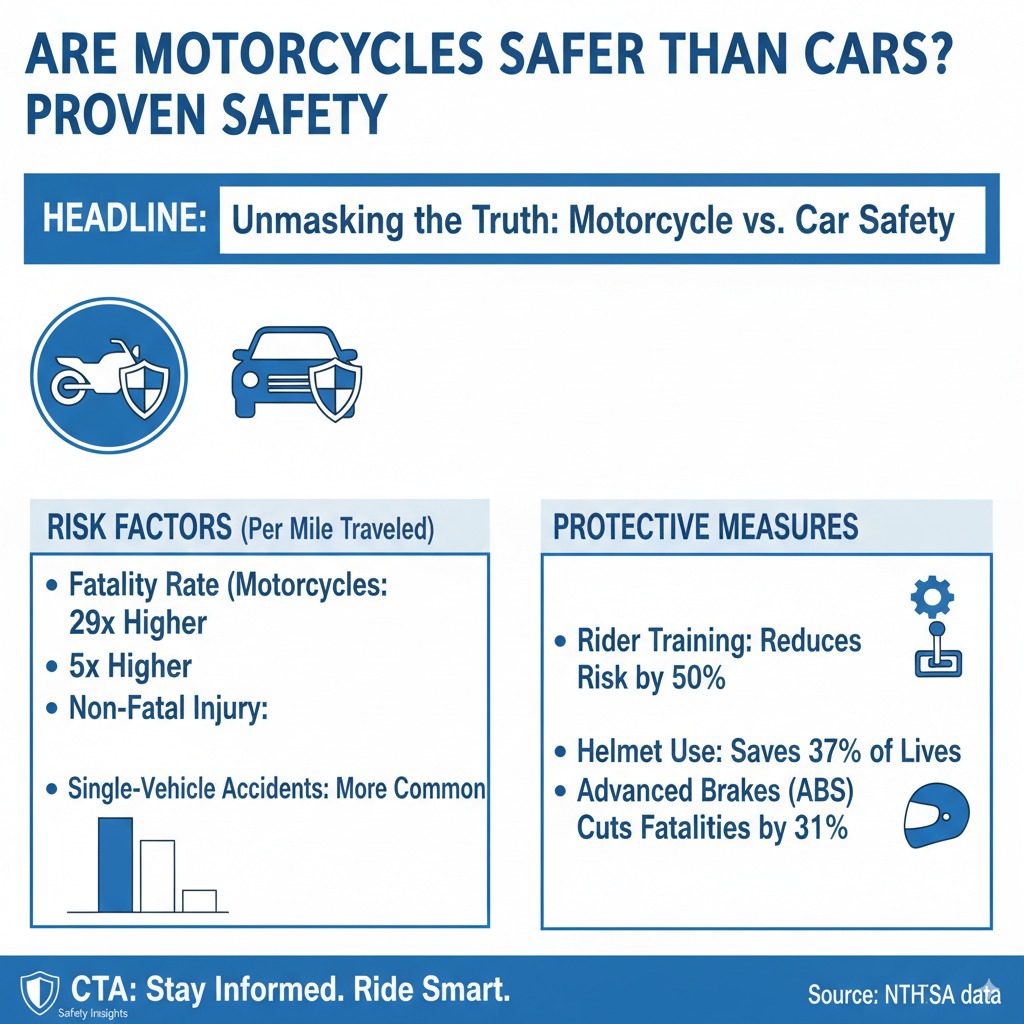
FAQ: Your Motorcycle Safety Questions Answered
Q1: Are motorcycles inherently dangerous?
Motorcycles require more skill and awareness to operate safely than cars. While the risk of serious injury in a crash is higher due to lack of protection, practiced, well-trained riders using proper gear can significantly mitigate risks. So, inherently, they present different, not necessarily insurmountable, challenges.
Q2: Does riding a motorcycle without a helmet make it unsafe?
Yes, significantly. Helmets are the most critical piece of protective gear. Riding without one dramatically increases the risk of severe head injury or death in the event of a crash. Many places also have laws requiring helmet use.
Q3: Are automatic motorcycles safer than manual ones?
Automatic (or “twist-and-go”) motorcycles can simplify the riding experience by removing the need to operate a clutch and shift gears. This can allow new riders to focus more on road hazards and balance, potentially making them safer for beginners. However, the fundamental safety principles and risks remain the same.
Q4: Is it true that most motorcycle accidents involve other vehicles?
Yes, a large percentage of motorcycle accidents do involve collisions with other vehicles. Often, these incidents occur when other drivers fail to see the motorcycle, pull out in front of it, or don’t yield the right of way. This highlights the importance of visibility and defensive riding.
Q5: What’s the single most important thing a new rider can do for their safety?
Get formal training from a certified instructor, such as through the MSF. This provides essential skills in bike control, hazard avoidance, and responsible riding, which are fundamental to safety.
Q6: Can I make my motorcycle as safe as a car?
While you can’t replicate a car’s metal structure on a motorcycle, you can achieve a high level of safety through: formal training, wearing full protective gear, riding defensively, being highly visible, and maintaining your motorcycle diligently. It’s about adopting a proactive safety mindset.
Conclusion: Making the Choice for Safety
So, are motorcycles safer than cars? The direct answer, looking only at protection offered in a crash, leans towards cars providing more inherent safety. However, this overlooks the crucial role of the rider, their training, and the gear they choose to wear.
Motorcycling is an active participation in safety. It demands constant vigilance, skill, and preparation. When riders embrace these responsibilities – by investing in quality protective gear, committing to ongoing training, and practicing defensive riding techniques – they significantly narrow the safety gap. Motorcycle fatalities are tragic, but by understanding the risks and taking proactive steps, riders can enjoy the freedom and exhilaration of motorcycling with confidence and a strong sense of personal safety.