Automobile Technology Seminar Topics: Ideas by Level
For 2026, pick automobile technology seminar topics that hit at least 2 of 3: fresh evidence, strong demo value, and enough technical depth for your audience level. A weak topic wastes time, hurts marks, and leaves your argument easy to challenge. This guide ranks topic ideas by originality, presentation value, and technical depth, then matches them to diploma, degree, and research seminars.
How should you choose an automobile seminar topic in 2026?

Start with audience level, then check evidence depth and presentation time. Diploma topics should explain one system clearly. Degree topics can compare architectures or tradeoffs. Research seminars need current constraints, open questions, and enough literature to defend a claim.
Pick by audience level
A strong diploma topic should stay visual and concrete: ADAS features, EV charging basics, or connected-car services. Degree seminars can handle battery chemistry, autonomous sensing, or cybersecurity threats. Research-level topics should include an unresolved tension, such as OTA governance, solid-state validation, or V2V latency limits.
Check evidence availability before you commit
The strongest seminar ideas have enough public material for diagrams, standards, and recent review papers. That matters in 2026 because a broad topic list often hides weak evidence. A seminar on EVs is easy to support; a narrow claim about a future battery breakthrough may not be.
Cars have over 1.6 billion units in use worldwide as of 2025, so many topics still matter because the vehicle fleet is huge. The modern practical automobile is credited to 1886, with Carl Benz identified as the inventor, while the Ford Model T was produced from 1908 to 1927 and described as mass-affordable. (en.wikipedia.org)
Match topic depth to the time you have
If you only have 5 to 7 minutes, avoid topics that need regulation history and layered architecture. If you have around 10 minutes or so, a structured comparison works well. With a full seminar, you can cover failure cases, standards, and future limits.
- Choose one system boundary: battery, autonomy, connectivity, safety, or powertrain.
- Ask whether you can explain it with one diagram.
- Check whether at least two recent constraints exist.
- Decide whether a demo is possible with a block diagram, app flow, or scenario.
- Score the topic against the matrix below.
📊 The modern practical automobile is credited to 1886. Source: Car.
Which automobile technology topics are strongest for 2026?
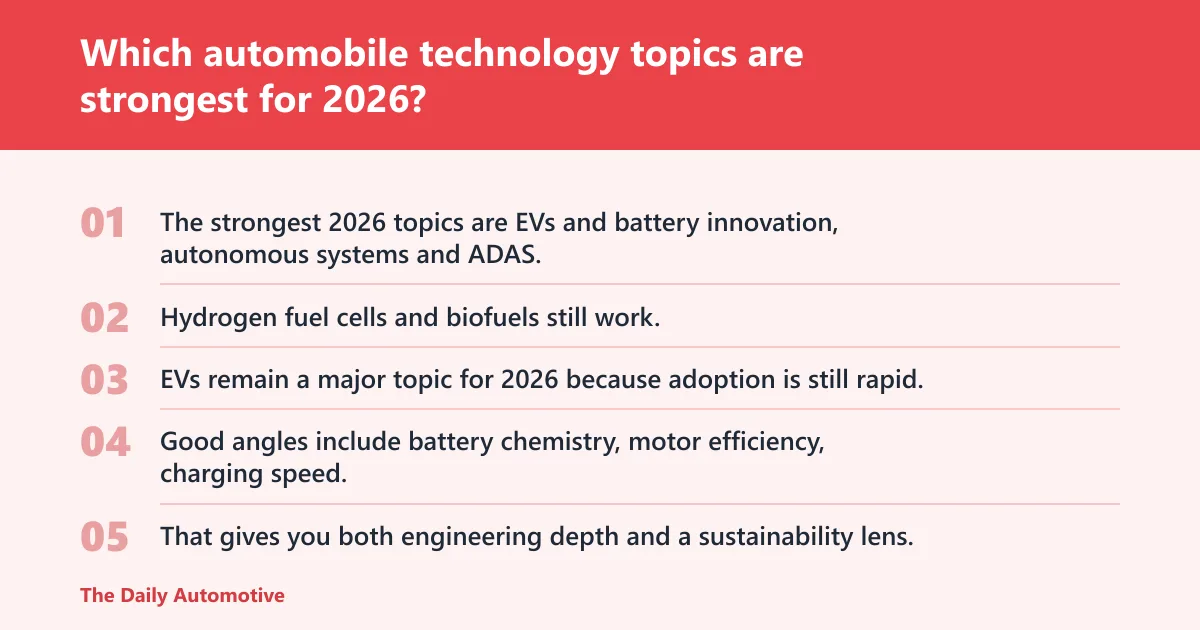
The strongest 2026 topics are EVs and battery innovation, autonomous systems and ADAS, connected cars with cybersecurity, and software-defined vehicle architecture. Hydrogen fuel cells and biofuels still work, but they fit best when you want an alternative-powertrain comparison rather than a trend-first seminar.
Electric vehicles and battery innovation
EVs remain a major topic for 2026 because adoption is still rapid, and the technical story keeps changing. Good angles include battery chemistry, motor efficiency, charging speed, range improvement, thermal safety, recycling, and second-life economics. That gives you both engineering depth and a sustainability lens.
Autonomous vehicles and driver assistance
Autonomous vehicles are still seminar-ready because they combine sensors, algorithms, safety, and legislation. The best angle is usually levels of autonomy rather than “self-driving cars” as a slogan. That keeps the talk grounded in what can be verified and explained.
Connected cars, V2V, and cybersecurity
Connected cars are a strong 2026 topic because IoT integration, vehicle-to-vehicle communication, remote diagnostics, and software updates are now part of the automotive stack. Add cybersecurity, and the topic gets sharper: encryption, secure communication, intrusion detection, and OTA update risk are all current concerns.
A seminar-topic list page explicitly highlights EVs, autonomous driving, connected cars, and cybersecurity. The same page calls software-defined vehicle architecture and battery chemistry major attention areas, which is a good clue for topic selection in 2026.
Hydrogen fuel cells, biofuels, and software-defined vehicles
Hydrogen fuel cells still matter because they produce zero tailpipe emissions and water vapor at the exhaust, but infrastructure limits and efficiency tradeoffs are hard to ignore. Biofuels are useful when you want feedstocks, carbon reduction claims, sustainability constraints, and blending potential in one talk. Software-defined vehicles are especially current because centralized computing and OTA updates are changing how vehicles are built and maintained.
How do EV and battery topics compare for seminar value?
EV topics are the safest high-score choice for 2026 because they are current, easy to structure, and supported by clear technical subtopics. Battery chemistry can be even stronger for degree or research seminars if you want more depth, but it can become too narrow for a short presentation.
Solid-state batteries and fast charging
Solid-state batteries are popular because they connect directly to energy density, safety, and range improvement. Fast charging is equally useful, but it needs careful framing around heat, degradation, and charging infrastructure. Avoid claiming a single chemistry solves everything; that is exactly where a seminar gets challenged.
Range, energy density, and thermal safety
These topics work because the logic is easy to follow: more usable energy and better thermal control should improve driving range and reduce risk. The catch is that higher energy density can bring safety concerns, especially during abuse conditions or damaged-cell scenarios.
Charging infrastructure, recycling, and second-life economics
This is one of the best 2026 angles because it moves beyond generic EV praise. Charging access, battery recycling, and second-life economics let you discuss sustainability with real constraints. It also helps avoid the common “EVs are the answer” trap.
What autonomous and ADAS topics are easiest to present clearly?
The easiest autonomous and ADAS topics are those that separate function from hype. Present levels of autonomy, sensor suites, collision avoidance, and adaptive cruise control before moving into safety validation or law. That order makes the seminar easier to explain and harder to oversell.
Levels of autonomy and sensor suites
This is the cleanest starting point because it gives you a framework. Cameras, radar, lidar, and ultrasonic sensors can be introduced one by one, then tied to perception and control. The topic stays understandable even for a mixed audience.
Collision avoidance and adaptive cruise control
These are among the easiest ADAS topics for a seminar because the use cases are intuitive. A front-collision warning or cruise control system can be described with a simple flow: detect, decide, act. That makes the topic ideal for diploma-level presentations.
Safety limits, validation, and regulation
Good seminars also explain what the system cannot do. Weather, sensor occlusion, edge cases, and legal responsibility matter. If you include regulation, make sure the discussion is current and cautious, because autonomy law changes by region and remains uneven.
Say your class has 8 minutes and a projector. A seminar on adaptive cruise control with a sensor diagram, one safety limitation, and one comparison table will land better than a broad “future of self-driving cars” talk with no structure.
How do connected cars, V2V, and cybersecurity fit together?
They fit together because connected cars depend on data exchange, and that creates a security problem. The best seminar framing is: connectivity enables services, V2V improves awareness, and cybersecurity protects the data path. That gives the talk a clear technical chain.
IoT integration and remote diagnostics
Connected cars rely on real-time data exchange for features such as diagnostics, fleet monitoring, and service alerts. IoT makes the architecture easier to explain because it links vehicle systems to cloud services and mobile apps. It also opens the door to privacy and reliability questions.
Vehicle-to-vehicle communication and latency
V2V belongs inside the larger V2X context. The main value is safety: warnings about sudden braking, traffic coordination, and hazard sharing. The main technical problem is latency and reliability, because a message that arrives late may be useless.
Encryption, intrusion detection, and OTA update risk
Automotive cybersecurity is a current concern because software now reaches deep into vehicle function. Encryption and secure communication reduce exposure, intrusion detection helps spot abnormal behavior, and OTA updates create both convenience and attack surface. That balance makes the topic current and discussable.
What alternative powertrain topics still work in 2026?
Hydrogen fuel cells and biofuels still work in 2026, but they are strongest when presented as constrained alternatives rather than universal answers. They are useful if your faculty wants comparison, policy context, or sustainability tradeoffs rather than a pure EV seminar.
Hydrogen fuel cells and infrastructure limits
Hydrogen fuel cells are a valid seminar choice because they offer zero tailpipe emissions and water vapor at the exhaust. The weak point is infrastructure, followed by efficiency tradeoffs. That makes them a better topic for comparison than for advocacy.
Biofuels, feedstocks, and blending potential
Biofuels are strongest when you discuss feedstock choices, carbon reduction claims, and sustainability constraints. They can fit well in seminars focused on transition fuels, especially if you want to compare them against electrification rather than treat them as a stand-alone future.
Where these topics fit better than EV-only presentations
Choose hydrogen or biofuels when your audience wants policy, infrastructure, or regional adoption issues. Choose EVs when you want broader evidence, clearer demos, and easier technical explanation. That simple split saves a lot of wasted effort.
Topic selection matrix: 12 ideas ranked for 2026

The matrix below scores each topic on originality, research depth, demo potential, recency, and ease of explanation using a simple low-to-high scale. Higher totals point to stronger seminar value. The “best for” column helps you match topic difficulty to diploma, degree, or research level.
| Topic | Originality | Research depth | Demo potential | Recency | Ease of explanation | Total | Best for |
|---|---|---|---|---|---|---|---|
| EV battery chemistry and solid-state batteries | 4 | 5 | 3 | 5 | 3 | 20 | Degree |
| EV charging, range, and thermal safety | 3 | 4 | 4 | 5 | 4 | 20 | Diploma |
| Autonomous vehicle sensor suites and levels of autonomy | 3 | 4 | 4 | 4 | 4 | 19 | Degree |
| ADAS collision avoidance and adaptive cruise control | 2 | 3 | 5 | 4 | 5 | 19 | Diploma |
| Connected cars, IoT integration, and remote diagnostics | 4 | 4 | 4 | 5 | 4 | 21 | Degree |
| Automotive cybersecurity and OTA update risk | 5 | 5 | 3 | 5 | 3 | 21 | Research |
| Vehicle-to-vehicle communication and V2X latency | 4 | 4 | 3 | 5 | 3 | 19 | Degree |
| Software-defined vehicle architecture | 5 | 5 | 3 | 5 | 3 | 21 | Research |
| Hydrogen fuel cells and infrastructure limits | 3 | 4 | 2 | 4 | 4 | 17 | Degree |
| Biofuels, feedstocks, and blending potential | 3 | 3 | 2 | 3 | 4 | 15 | Diploma |
| Battery recycling and second-life economics | 4 | 4 | 3 | 5 | 4 | 20 | Degree |
| Autonomous safety, validation, and legislation | 4 | 5 | 2 | 4 | 3 | 18 | Research |
Best-topic picks by level
Best for diploma: ADAS collision avoidance and adaptive cruise control, EV charging and range, and biofuels. These are easier to explain, easier to diagram, and less likely to sprawl.
Best for degree: EV battery chemistry, connected cars and remote diagnostics, V2V communication, battery recycling and second-life economics, and hydrogen fuel cells. These topics have enough depth without becoming too abstract.
Best for research: automotive cybersecurity, software-defined vehicle architecture, and autonomous safety and legislation. They are current, layered, and tied to open technical and regulatory questions.
Which topics to avoid if your seminar time is short
Avoid broad “future of transportation” talks. Also avoid topics that demand heavy policy comparison unless your outline is already tight. If you only have a short slot, steer away from autonomy law, cybersecurity architectures, and multi-chemistry battery comparisons.
Frequently asked questions
What are the best automobile technology seminar topics for 2026?
The best seminar topics for 2026 are EV battery innovation, software-defined vehicles, automotive cybersecurity, connected cars, and autonomous safety. These topics have strong evidence, current relevance, and enough technical material to support clear slides without becoming vague trend talk.
Which EV seminar topics are most relevant in 2026?
The most relevant EV topics are battery chemistry, fast charging, range improvement, thermal safety, recycling, and second-life economics. These subtopics are stronger than a general “EV introduction” because they address current engineering limits and sustainability questions that audiences can actually evaluate.
What automobile seminar topics are related to autonomous vehicles?
Good autonomous-vehicle seminar topics include levels of autonomy, sensor suites, collision avoidance, perception algorithms, safety validation, and legislation. If you want a clearer presentation, start with driver-assistance functions and then move toward higher automation and regulatory limits.
What are good seminar topics on connected cars and cybersecurity?
Strong options include IoT integration, remote diagnostics, V2V communication, encryption, intrusion detection, and OTA update risk. This cluster works well because it shows both the benefit of connectivity and the security problems that arrive with it.
Which battery technology topics are worth presenting in 2026?
Solid-state batteries, energy density, fast charging, safety, recycling, and second-life economics are the best battery topics for 2026. They are current, easy to tie to EV adoption, and strong enough for both degree-level and research-level seminars.
What are the latest trends in software-defined vehicles?
The latest trends are centralized computing, OTA updates, software stack integration, and feature-based vehicle functions. This topic is especially useful for research seminars because it connects hardware design, software management, and update governance in one current discussion.
Products related to this article
Sponsored / affiliate links. As an Amazon Associate I earn from qualifying purchases. I may earn additional commission from eligible campaigns.