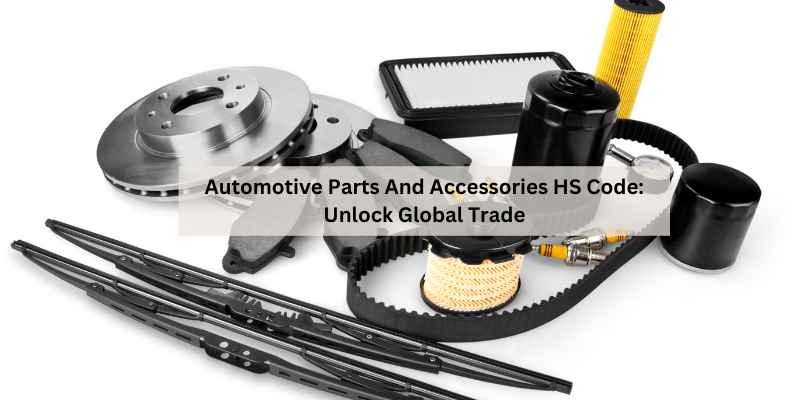
Auto Parts HS Code (8708): Full List for Car Parts & Accessories
The HS code for automotive parts and accessories is 8708. It is crucial for international trade.
Harmonized Tariff System codes are used for classifying these products. When importing or exporting auto parts, having the correct HS code ensures smooth customs clearance. The code 8708 specifically covers parts and accessories for motor vehicles. Understanding and utilizing these codes correctly is essential for the automotive industry to comply with international trade regulations and facilitate efficient global trade practices.
By accurately identifying the HS code for automotive parts and accessories, businesses can streamline their import-export processes and avoid potential delays or penalties related to incorrect classification.
Quick Answer
The general HS code for car parts and accessories is 8708 (parts and accessories of motor vehicles of headings 8701-8705). It breaks into 15 subheadings covering bumpers (8708.10), brakes (8708.30), road wheels (8708.70), suspension (8708.80), and a broad “other parts” catch-all (8708.99) that covers most accessories not separately listed. Tires (4011), engines (8407/8408), and lights (8512) use different chapters entirely.
Hs Code Essentials For Automotive Trade
The essential HS codes for automotive trade cover a range of parts and accessories for motor vehicles. These codes are crucial for importers and exporters to ensure proper classification and smooth international trade operations. With HS codes such as 8708 for road wheels and parts, businesses can navigate the global automotive market efficiently.
The Role Of Hs Codes In Global Automotive Trade
HS Codes, or Harmonized System Codes, are a globally recognized system of numbers and names that classify traded products. In the automotive industry, HS Codes are essential for trade as they ensure that products are classified correctly and that the correct duties and taxes are applied to them. HS Codes also help in tracking the movement of goods across borders, making it easier to identify and monitor the origin, destination, and quantity of automotive parts and accessories.
Navigating The Hs Code System For Automotive Components
Navigating the HS Code System for Automotive Components can be a daunting task, but it is a necessary one for anyone involved in the automotive trade. The HS Code system is divided into chapters, with each chapter relating to a specific category of product. For example, Chapter 87 relates to vehicles, while Chapter 84 relates to machinery. Within each chapter, there are further subdivisions that provide more detailed descriptions of the products.
To find the correct HS Code for automotive parts and accessories, it is essential to identify the product’s characteristics, such as its material composition, function, and design. Once you have identified the product’s characteristics, you can search for the appropriate HS Code using online databases such as the Harmonized Tariff Schedule or consult with a customs broker or trade specialist.
Hs Codes For Automotive Parts And Accessories
Full List of HS Code 8708 Subheadings (Motor Vehicle Parts)
HS code 8708 covers “parts and accessories of the motor vehicles of headings 87.01 to 87.05” and breaks down into 15 subheadings. Here is the complete breakdown:
| Subheading | Covers |
|---|---|
| 8708.10 | Bumpers and parts thereof |
| 8708.21 | Safety seat belts |
| 8708.22 | Toughened/laminated glass for windscreens, windows, mirrors |
| 8708.29 | Other body parts and accessories (doors, fenders, panels) |
| 8708.30 | Brakes and servo-brakes; parts thereof |
| 8708.40 | Gear boxes and transmissions |
| 8708.50 | Drive axles with differential (with or without other transmission components) |
| 8708.70 | Road wheels and parts and accessories thereof |
| 8708.80 | Suspension systems and shock absorbers |
| 8708.91 | Radiators and parts thereof |
| 8708.92 | Silencers (mufflers) and exhaust pipes; parts thereof |
| 8708.93 | Clutches and parts thereof |
| 8708.94 | Steering wheels, steering columns, and steering boxes |
| 8708.95 | Safety airbags with inflater system; parts thereof |
| 8708.99 | Other parts and accessories not separately specified (the largest catch-all subheading by trade volume — this is where code 87089997/8708.99.97 falls in the 10-digit U.S. HTS) |
Related HS Codes Outside Chapter 8708
Not every auto part falls under 8708. Several common parts and accessories are classified in entirely different chapters:
| Part | HS Code | Chapter |
|---|---|---|
| Tires (new pneumatic) | 4011 | 40 – Rubber |
| Engines (spark-ignition) | 8407 | 84 – Machinery |
| Engines (diesel/compression-ignition) | 8408 | 84 – Machinery |
| Engine parts (pistons, valves, etc.) | 8409 | 84 – Machinery |
| Headlights/lighting equipment | 8512 | 85 – Electrical |
| Wiring harnesses/insulated cable | 8544 | 85 – Electrical |
| Batteries (lead-acid, car) | 8507 | 85 – Electrical |
| Spark plugs | 8511 | 85 – Electrical |
This distinction matters because misclassifying a tire or engine under 8708 instead of its correct chapter is one of the most common customs errors importers make — and it can trigger different duty rates entirely.
Decoding The 8708 Hs Code
Decoding the 8708 HS Code is crucial for understanding the classification of Automotive Parts and Accessories. Let’s delve into the specifics of the 8708 Automotive Tariff Category.
Understanding The 8708 Automotive Tariff Category
The HS Code 8708 encompasses a wide range of components related to motor vehicles. It serves as a key identifier for customs purposes, facilitating the smooth flow of international trade.
Components Covered Under Hs Code 8708
Under HS Code 8708, various parts and accessories essential for motor vehicles are included. These components play a vital role in the functioning and maintenance of automobiles. Here are some of the key items covered:
- Car body parts
- Car engine parts
- Car accessories
- Used auto parts
The detailed classification provided by the HS Code ensures that each component is accurately identified and categorized for trade purposes.
Harmonized Tariff System And Auto Parts
When it comes to importing or exporting auto parts, understanding the Harmonized Tariff System (HTS) codes is crucial. These codes, also known as tariff codes, are used to classify and define different types of auto parts for international trade. By using the HTS codes, businesses can ensure compliance with customs regulations and accurately determine the duties and taxes applicable to specific auto parts and accessories.
Correlation Between Hts Codes And Auto Parts
HTS codes provide a standardized way of categorizing auto parts, making it easier to identify and differentiate various components. Each auto part is assigned a specific HTS code based on factors such as material composition, function, and design. This correlation streamlines the import and export process, allowing businesses to accurately classify and declare their auto parts for customs clearance.
Schedule B And Naics Codes In Auto Parts Classification
In addition to HTS codes, auto parts are also classified using Schedule B and North American Industry Classification System (NAICS) codes. Schedule B codes are used for exporting goods from the United States, while NAICS codes are employed for statistical analysis and reporting purposes. Understanding the relationship between these codes is essential for accurately identifying and classifying auto parts in the global market.
Impact On International Trade
When it comes to international trade, the classification of automotive parts and accessories under the Harmonized System (HS) code has a significant impact. Understanding how HS codes affect automotive exports and imports, as well as the influence of trade agreements on HS coding, is crucial for businesses engaged in the global automotive trade.
How Hs Codes Affect Automotive Exports And Imports
HS codes play a pivotal role in regulating the import and export of automotive parts and accessories. These codes provide a standardized classification system that helps in identifying products and determining applicable duties and tariffs. For example, the HS code for motor parts and accessories is 8708, and this code is universally recognized, simplifying the customs clearance process for international shipments of automotive components.
Trade Agreements And Their Influence On Hs Coding
Trade agreements between countries often impact the assignment of HS codes to automotive products. These agreements can lead to the creation of specific tariff classifications or exemptions for certain goods. As a result, businesses involved in the automotive industry need to stay abreast of these trade agreements and their implications on HS coding to ensure compliance and optimize international trade operations.
Hs Code Lookup Tools
When it comes to importing or exporting automotive parts and accessories, understanding the Harmonized System (HS) codes is crucial for ensuring smooth customs clearance and compliance. Utilizing online resources for HS code verification and accessing comprehensive HS code databases tailored for automotive parts and accessories can greatly simplify the process and help avoid potential issues.
Utilizing Online Resources For Hs Code Verification
Online tools and databases are invaluable for verifying HS codes for automotive parts and accessories. These resources provide up-to-date and accurate information, enabling businesses to confidently classify their products and determine the applicable duties and taxes. By utilizing these tools, importers and exporters can ensure compliance with international trade regulations and streamline their operations.
Hs Code Databases For Automotive Parts And Accessories
There are several dedicated HS code databases specifically designed for automotive parts and accessories. These databases offer detailed information on a wide range of products, including road wheels, motor vehicle parts, car accessories, and more. By accessing these databases, businesses can quickly find the corresponding HS codes for their specific products, saving time and minimizing the risk of misclassification.
Case Studies: Hs Code Application
When it comes to the accurate classification of automotive parts and accessories, real-world examples of HS code application can shed light on the challenges and solutions encountered in the process. Let’s delve into some case studies that illustrate the complexities and resolutions in HS coding for automotive components.
Real-world Examples Of Automotive Hs Code Classification
Classifying automotive parts and accessories under the Harmonized System (HS) code can present intricate scenarios that require careful analysis. Let’s explore some real-world instances that highlight the application of HS codes in the automotive industry.
Challenges And Solutions In Hs Coding For Automotive Parts
Identifying the correct HS code for automotive parts and accessories can pose significant challenges, leading to potential discrepancies in international trade. However, through strategic approaches and meticulous evaluation, solutions can be found to streamline the HS coding process for automotive components.
Customs And Compliance
When it comes to the import and export of automotive parts and accessories, understanding and adhering to HS codes is crucial for customs and compliance. Let’s delve into the role of U.S. Customs in HS code enforcement and ensuring compliance with HS code regulations.
The Role Of U.s. Customs In Hs Code Enforcement
U.S. Customs plays a vital role in enforcing HS codes for automotive parts and accessories. They ensure that the correct HS codes are used for accurate classification and tariff determination.
- Verification of HS codes on import/export documentation
- Inspection of shipments for HS code compliance
- Imposing penalties for incorrect HS code usage
Ensuring Compliance With Hs Code Regulations
Compliance with HS code regulations is essential to avoid delays, fines, or other penalties. Businesses must take necessary steps to ensure accurate HS code classification and reporting.
- Regular review and update of HS codes
- Training staff on HS code requirements
- Engaging customs brokers for expert guidance
2026 Update: Section 232 Auto Parts Tariffs
As of 2026, Section 232 auto parts tariffs apply to a Commerce Department list of “covered auto parts,” which primarily draws from HTS chapters 8407, 8408, 8409, 8706, 8707, 8708, plus selected items in 4011 (tires) and 8511 (ignition equipment). If you import or export under HS 8708, check whether your specific subheading appears on the current covered-parts list, since the applicable duty rate can differ significantly from the standard HS 8708 rate. The covered-parts list is updated periodically, so verify against the latest Federal Register notice or your customs broker before filing.
Future Of Hs Coding In Automotive Sector
The future of HS coding in the automotive sector is pivotal for tracking and categorizing automotive parts and accessories. Accurate HS codes streamline international trade and ensure compliance with regulations, benefiting the automotive industry’s supply chain efficiency and global market reach.
Technological Advancements In Hs Code Assignment
The automotive industry has been rapidly evolving with the integration of advanced technologies. In line with this, the HS code assignment process has also witnessed significant advancements. With the use of advanced algorithms and machine learning, the HS code assignment process has become more streamlined and efficient. The use of technology has ensured that the HS code assignment process is more accurate, reducing errors and discrepancies.
Predicting Changes In Global Trade And Hs Coding
Global trade is constantly evolving, and the automotive sector is no exception. As global trade patterns change, the HS codes assigned to automotive parts and accessories are also likely to change. The ability to predict these changes in advance is crucial for businesses to stay ahead of the curve. Predictive analytics and data modeling have made it possible to anticipate changes in global trade and HS coding. This enables businesses to prepare and adapt to the changes in advance, reducing the impact of any potential disruptions.
The future of HS coding in the automotive sector is highly dependent on the integration of advanced technologies and the changes in global trade patterns. The use of technology will continue to streamline the HS code assignment process, making it more efficient and accurate. Additionally, predictive analytics and data modeling will enable businesses to anticipate changes in global trade and HS coding, allowing them to adapt and prepare accordingly. As the automotive industry continues to evolve, the importance of HS coding in facilitating international trade will only increase.
Frequently Asked Questions
What Is The Hs Code For Motor Parts And Accessories?
The HS code for motor parts and accessories is 8708, as per the Harmonized Tariff System.
What Is The Hs Code 8708.70 99?
The HS Code 8708. 70. 99 refers to parts and accessories for motor vehicles, specifically road wheels.
What Is The Hs Code For 87089900?
The HS code for 87089900 is for “Other parts and accessories of motor vehicles, not elsewhere specified. “
What Is The Hs Code 87089997?
The HS code 87089997 is for “Parts and accessories for motor vehicles. “
What Is the HS Code for Auto Spare Parts?
Auto spare parts generally fall under HS code 8708, with the specific subheading depending on the part — for example, 8708.30 for brake components, 8708.70 for wheels, or 8708.99 for parts that don’t fit a more specific subheading. Engines, tires, and electrical parts use separate chapters (8407/8408, 4011, and 8511/8544 respectively).
What Is the HS Code for Car Accessories?
Car accessories that are structural or functional parts of the vehicle (floor mats designed for a specific model, seat covers, body trim) are typically classified under 8708.29 or 8708.99. Generic aftermarket accessories not designed to fit a specific vehicle may fall under a different chapter based on their material — a customs broker can confirm borderline cases.
Are Auto Parts Tariff Codes the Same in Every Country?
The first 6 digits of the HS code (8708.99, for example) are standardized internationally under the World Customs Organization system. Countries then add their own additional digits — the U.S. uses a 10-digit HTS code (like 8708.99.97), while the EU and other regions use their own extended formats. Always confirm the full code for your specific destination country.
Conclusion
To sum up, understanding the HS codes for automotive parts is crucial for import and export processes. Proper classification ensures smooth transactions and compliance with regulations. Utilizing the right HS code streamlines the entire logistics chain for automotive businesses. Stay informed and leverage HS codes effectively.
Products related to this article
Sponsored / affiliate links. As an Amazon Associate I earn from qualifying purchases. I may earn additional commission from eligible campaigns.